

The Bradbury Group: Barbara Edmonds, Hone Harawira and Qiulae Wong

The Bradbury Group goes pre-Budget with Labour finance spokesperson Barbara Edmonds, Hone Harawira on Māori politics and Election 2026, plus Matthew Hooton, Verity Johnson and Qiulae Wong on Luxon, the economy and the Government’s latest culture-war distractions.
A Marxist, a finance spokesperson a Māori political legend, a leader of a political party and two newspaper columnists all walk into a bar.
The barman looks up and says, ‘What do you think this is? The Bradbury Group?”
1-on-1 in 10 with Labour Party Spokesperson Barbara Edmonds
The Labour Party Finance Spokesperson Barbara Edmonds on the pre-budget and how economic vandalism for free market ideology is hurting communities, not building them up.
Extra 1-on-1 in 10 with Hone Harawira
He’s not running for TTT but he has insights and a message for Māori Politics this election.
Political Panel Discussion
-
Matthew Hooton – NZ Herald Columnist
-
Verity Johnston – Stuff Columnist
-
Quilae Wong – Leader of TOP
Tonight’s Political Agenda
-
Issue 1 – The Big Polluter scandal and Luxon threatening John Campbell
- Issue 2 – OCR vs Budget vs Economy – who is winning?
- Issue 3 – English before Māori, defining a woman and arresting the homeless they’ve created – how does any of that grow the economy?
Live from Waatea, The Bradbury Group brings together politicians, journalists and commentators for Aotearoa’s most fearless weekly political debate.
For election year, we’re proud to announce the weekly inclusion of political commentator, academic and newspaper columnist Matthew Hooton.
“Every Muppet Show needs its Statler and Waldorf – and legendary political commentator Dr Matthew Hooton has agreed to fulfil that role for this election, beamed in weekly from a secure, undisclosed location.”
The show will be available on Waatea Facebook, Waatea Radio, Sky TV, YouTube, ROVA, Spotify, The Daily Blog and Apple Podcasts.
The Bradbury Group – Live at 8pm every Tuesday night.

It’s time to start the music. It’s time to light the lights. It’s time to start the revolution on the Muppet Show Tonight.


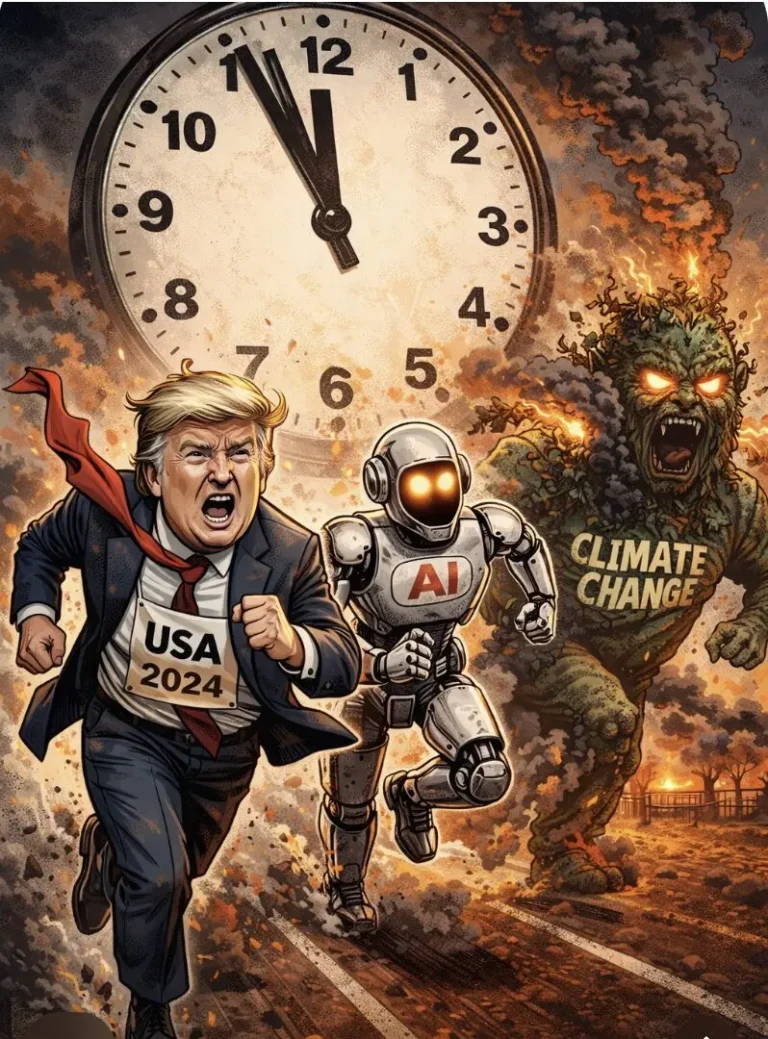



The current Government is placing much trust on the future of AI computing. The Pope has warnings about it but I asked some questions.
Asking AI questions about the validity of economics.
I first asked about research results for Supply/Demand data.
“There is no single definitive paper that conclusively “proves” that supply and demand graphs in economics are correct.” The most basic of economic ideas has no evidence. The thing to do then is to ask if economics has any errors. The answers I got referred to “Flawed foundations” and said economics while widely used and influential, has several significant errors, mistakes, and problems. Ten items of this were listed. There was “Incorrect assumptions”. My university economics textbook contained 437 variations of the word assuming as an example. More than one for every two pages.
The economic theory of firm behaviour “does not accurately describe how firms actually operate”. I knew this in my computing service to business.
The AI wrote there were problems with equilibrium theory, over-reliance on mathematical models, neglect of historical context, and macro-economic vs micro-economic inconsistencies. If that was not enough errors to think about, included were Cognitive biases, normative assumptions (that word again), a gradual nature of economic errors, and difficulty in empirical testing. That last item suggests the scientific credential of economics must be questioned.
I had an AI question about energy because now that the overheating of our planet the importance of energy in both labour and industry must be important. The AI program came up the statement “Economists generally do not include energy as a separate factor of production”. It then went on to explain how economists dodge handling energy properly in a multitude of ways. Ecological economics may include energy as a distinct factor, recognizing its crucial role in all production processes.
When it comes to the question of the consequences of global heating the AI specifies a half dozens aspects where there will be economic damage. The transportation system, power grid, telecommunications connection, water system, and buildings will suffer. Agriculture of course is an obvious victim of overheating. Only the billions of damage losses in the US get an estimate.
I asked if economics was more of a religion than science? It answered the question “… hinges on several key points that highlight its similarities to religious belief systems rather than empirical scientific disciplines”. The AI system provided six items that confirm that economics is a religious endeavour. Many words; belief, prescribe, visions, narratives, dogmatism, assumptions, doctrines, and faith were offered.
Maybe AI will help us understand economics better.