

GUEST BLOG: Ian Powell – Could the Opportunity Party upend New Zealand’s general election

The phrase ‘for whom the bell tolls’ has a long history signifying the interconnectedness of humanity and the inevitability of death.

Dramatic poet John Donne (1572-1631) originally formulated the phrase to emphasise that no person is an island by highlighting the importance of community and human connection
The ringing of a bell, traditionally used to announce a death, served as a reminder that death is a shared experience and that we are all affected by the loss of others.
Perhaps the biggest popularisation of the phase, certainly for over a century, was American novelist Ernest Hemmingway who used it as the title of his famous 1940 novel.

‘For Whom the Bell Tolls’ tells the story of an American fighting with Spanish Republican guerrillas during the Spanish Civil War, exploring love, duty, and the human cost of war
Since John Donne’s formulation the phrase has taken on different meanings and applied in different contexts. In 1993 it was used by the Bee Gees as the tile for their then chart-topping song in the United Kingdom.
One of the meanings is to indicate that something is important or significant by conveying the gravity and impact of a situation or event, often suggesting that it affects a larger group or community rather than just one person.
A poll that suggests to whom the bell might toll for
The phrase in this latter above context is what came to my self-diagnosed eclectic mind when reading the piece by Radio New Zealand Political Editor Jo Moir (17 July): Voters open to changing party preferences.
More than half of those surveyed in the latest RNZ-Reid Research poll could be persuaded to vote for a different party. Opportunity was identified as the party which might benefit most.
The article was a follow-up to the latest RNZ-Reid Research poll released on 14 July. It reported the narrowest of possible majority in a 120-seat Parliament for the three governing rightwing coalition parties: National hits new low; Opportunity rises.
The coalition government would be made up of National, despite slumping to 28.7%, and both NZ First and ACT slightly increasing to 11.5% and 7.8%. In opposition was Labour on 34%, Greens on 10.3% and Te Pāti Māori on 2.3%. Opportunity was a tantalising record high of 4.7%.
Drilling down further

Jo Moir drills down further
But what was more interesting to me was Jo Moir drilling down into further first-time data revealing:
…how easily a party’s share of the vote could change as scrutiny of policies intensifies in the lead-up to the election.
…respondents not only which party they would vote for today, but which other parties they might seriously consider voting for in the upcoming election.
When respondents were asked their party vote if an election was held today, they were also asked if that was the only party they would consider voting for. Over 54% indicated they would seriously consider voting for more than one party.
Among the revelations were that by combining an identified possible shift in party support and locked-in preferences the following potential outcome emerged:
- Labour drops from 34% to 28.7%;
- National drops from 28.7% to 24.3%;
- NZ First increases from 11.5% to 13.8%;
- Greens increases from 10.3% to 13.1%;
- ACT increases from 7.8% to 10.5%;
- Opportunity increases from 4.7% to 6%; and
- Te Pāti Māori increases from 2.3% to 3.6%.
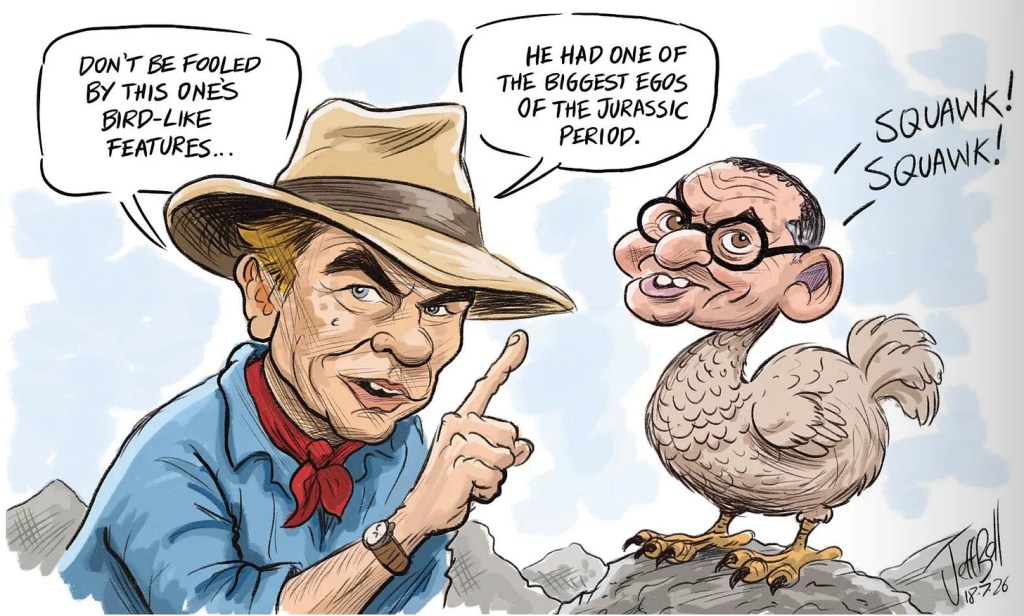
ACT hopes that Paul Henry will provide an electoral enhancement opportunity; Sam Neill seems to think otherwise
In other words, improved opportunities for all parties excluding Labour and National. But, as Moir observes:
Most strikingly it bumped Opportunity over the five percent threshold and put it in a true kingmaker position as the party capable of deciding the next government.
The same day Radio New Zealand’s Midday Report also featured an interesting Guyon Espinar interview with journalist Russell Palmer on these additional poll results: Opportunity’s coalition stance.
Is the Bell tolling for Opportunity as power-broker
Jo Moir’s piece was published 10 days after a column from Richard Shaw, Professor of Politics at Massey University, was published in The Conversation (7 July); Opportunity to be power-broker?
Consequently Shaw was writing prior to the release of the RNZ-Reid Research poll results.

Professor Richard Shaw: Opportunity Party “generating more buzz”
Nevertheless the 0.4% needed for the Opportunity Party to reach the 5% threshold identified in a recent 1 News- Verian poll gave him sufficient justification to conclude that it was the party contesting the next election that seemed “…to be generating more buzz than almost any other.”
His argument is that the Opportunity Party was reflecting dissatisfaction with fractious politics, generational change, eroding support for the two main parties creating more political space, and NZ First moving too far to the right to credibly maintain its claim to be a ‘centrist party’.
Shaw correctly identifies that its policies are more likely to sit comfortably with Labour and the Greens but not with the parties comprising the current government. But he also makes the valid point that its internal decision-making procedures are much more centralised than Labour and the Greens.
This includes the absence of local or regional membership branches which made it more comparable with ACT.
His article is thought-provoking as he canvasses various ‘ifs and but’ over Opportunity’s prospects of achieving the 5% threshold and becoming a genuine power-broker. Might it take some votes away from Labour and the Greens for example.
My substantive point of departure with Shaw’s argument is his description of Opportunity as ‘centrist’ (as well as NZ First previously being ‘centrist’). I find this term simplistic in its use and usefulness.
Be careful about what tolling bell you wish for
Former NZ Herald journalist Simon Wilson now has his own Substack publication Hopetown. As one would expect from him his writing is thoughtful and insightful.

Simon Wilson: be careful Opportunity Party
On 12 July, two days before the release of the RNZ-Reid Research poll, he published a timely post on the Opportunity Party: Be careful what you wish for.
Wilson opens by saying this about Qiulae Wong as the:
…leader of the newly reinvented Opportunity Party (TOP), has pulled off a remarkable trick. She has successfully presented her party as the answer to every question. Whatever distresses you about politics today, the answer is: TOP.
He delves into a number of relevant issues such as:
- arguable precedents;
- practicalities of potential government coalition options;
- where Opportunity’s votes came from in previous elections;
- who its identified voters want to be in coalition with (half with Greens and a third with Labour; few with National); and
- whether the party would succeed in its implied objective of in drawing voting support away from NZ First; somewhere between highly unlikely and non-existent he suggests (and he’s right).
In respect of the above final bullet point, Simon Wilson does note that the “…sad fact is that votes for TOP won’t hurt him [Winston Peters].”
He may have cause to review this conclusion in light of the subsequent additional information published by Jo Moir (discussed above) and the analysis by Henry Cooke below.
The Opportunity Party may not hurt NZ First’s votes. But it might hurt NZ First by preventing the return of a rightwing coalition government.
Upending the election?
The other media piece that caught my attention was by The Post political editor Henry Cooke (18 July; paywalled): Opportunity could upend election.
Unlike Richard Shaw and Simon Wilson, he was able to draw upon Jo Moir’s reporting of the RNZ-Reid Research poll.

Henry Cooke discusses Opportunity’s re-emergence
Cooke’s article is a wide-ranging coverage of the most recent polls and the implications for the next general election. His main focus is not on the Opportunity Party but he does give its recent re-emergence special consideration.
Noting that it has scored just under the 5% threshold in the two recent “reputable polls” he argues that the possibility of this “upends the election.”
Consequently, if Opportunity met the threshold, it would become “extremely difficult” for National to lead a rightwing coalition government.
Cooke concludes:
Opportunity is clearly not for everyone. But it seems there are a large number of voters who are displeased with simply being offered a left bloc and a right bloc, with either the current Government in a slightly new configuration or Labour supported by the Greens and Te Pāti Māori. It would take very few of them to actually lend Opportunity their votes for the election to be changed completely.

My past thoughts on Opportunity Party
I have published two previous posts in Political Bytes on the Opportunity Party. It interested me as a political dynamic but not enough to consider a third.
At least not until the two recent polls discussed above and, particularly, the above-mentioned Jo Moir piece!
My first post (14 April) sought to make sense of increasing signs of interest in the revamped party and pondered whether the small ripples it was making might evolve into political waves: Ripples or waves.

Qiulae Wong provides charismatic leadership but charisma isn’t enough
The second post (20 June) took its resurrection further posing whether opportunity might in fact be knocking for it: Opportunity knocks for Opportunity Party?
Is the Bell tolling for the Opportunity Party
In the first post I concluded that:
Its policy priorities suggest that rather than leftwing or rightwing (or sitting above both), it is a genuine social liberal party.
It resonates with my recollection of the Values Party which generated much excitement in the 1972 general election (many consider the Values Party to be the precursor of the Greens).
Its main difference with Labour appears to be uncertainty where it sits on the collective-individual responsibility continuum and lack of political experience and history (it is a young party and its candidates are young – not a criticism).
As a resident of the Kapiti Coast for over 40 years I’m familiar with ripples. Often ripples evolve into bigger waves.
The question is whether the enthusiasm generated by this political ripple (the Opportunity Party) becomes a political 5%+ wave in November. If it does there will be an intriguing new parliamentary dynamic.
In my second post I concluded that:
It is promoting a simplistic construct that it would be a more reliable government partner for National than NZ First. This makes little political sense.
This position also confuses potential voters because of its fundamental policy differences with both National and ACT
Hypothetically if it were to find itself in this position after the next election, it most likely would be part of a hard rightwing government driven by National and ACT.
Un-hypothetically it would be self-inflicted political suicide. It would end up supporting a government whose core policies were oppositional to its own. It would not be swallowing dead rats; it would become a dead rat.
Political parties don’t go into coalition governments with either identical or predominantly oppositional policies.
Rather they do so when they assess there is sufficient policy alignment (and relationship compatibility) to allow them to progress some of their objectives.
While there is some social liberal presence within the existing government (with or without NZ First) it can’t be characterised as social liberal; quite the opposite in fact.
As it presently stands, both the Opportunity Party and Labour can be characterised as social liberal technocratic (which has a shared risk of elitism) while the Greens and Te Pati Maori are social liberal plus.
If electorally successful in November it should be policy alignment that determines who the Opportunity Party might go into government with (or whether it sits in the crossbenches).
The Party does not press my political voting button. But I do respect its enthusiasm and gumption; nor do I dismiss it as another rightwing party.
However, the Opportunity Party requires more than infectious enthusiasm; it requires political grit. As the song goes, ‘when opportunity knocks’ they are “golden chances dressed in grit”.
Making sense of the Opportunity Party – again!
Despite claims to the contrary the Opportunity Party is neither leftwing nor rightwing except if the definitions are reduced to one is what the other isn’t. I have discussed what leftwing is in a previous Political Bytes post (30 April 2023: What being leftwing really means.
Opportunity Party: social liberal rather than leftwing, rightwing or centrist
However, it is similarly simplistic and misleading to call it ‘centrist’. It could only be one of these descriptors if they have no substantive meaning. Instead it is a genuinely values based social liberal party characterised by enthusiasm and vibrancy.
Its rhetoric of going for either the right or left is naive. This is not the choice; in fact, far from it.
Instead it is a choice between a hard and far rightwing coalition government or a largely social liberal coalition government with a stronger emphasis on collective responsibility and some leftwing impulse. Policy alignment should shape its choice.
The Party needs to be less elitist in its message and acknowledge that as laudable as it values and many policies are, there are also big gaps. Employment relations and workers right immediately come to mind.
Be careful what you ask for because you might get it
At the moment the electoral bell is tolling for the Opportunity Party. Potentially it could determine the composition of the next government; one that includes social liberal values or one dominated by hard and far right values.
Think of the wise adapted words of Simon Wilson – be careful what you wish (ask for) because you might get it.
Ian Powell was Executive Director of the Association of Salaried Medical Specialists, the professional union representing senior doctors and dentists in New Zealand, for over 30 years, until December 2019. He is now a health systems, labour market, and political commentator living in the small river estuary community of Otaihanga (the place by the tide). First published at Political Bytes


