

The economic myth of NZ Dairy and Agriculture

One of the arguments espoused by the Right in NZ is the economic myth of NZ Dairy and Agriculture.
We are told we have to accept higher food prices, legal monopolies, the vast amount of pollution and water use all because the Farmers create so much economic worth.
That is a myth.
New Zealand’s economic backbone not so strong
The farming sector is enjoying a boom time at the moment. Beef prices are experiencing a 60 year high, the farm gate milk price is almost $10/kgMS, wool prices have achieved a 10 year high, lamb is getting $2/kg more than last year and fruit prices are also strong. If the sector is the ‘backbone of the economy’, as is often claimed, then why is it that we are struggling to stand upright economically at the moment. Unemployment is sitting at 5.3% (over 11% for Māori and Pasifika) and households are generally struggling to make ends meet.
The problem with agriculture is that most New Zealanders get little value from the sector. While it earns around 85% (dairy is 30%) of our export income it only adds only 5% to our total GDP. It employs just 5% of the workforce and contributes a measly 1-3% of total tax income. The income generated mainly goes to the likes of Fonterra (15 staff earn over $1 million pa), various corporates (many overseas owned) and increasing equity for farm owners who pay minimal tax. Total farm debt was almost $65 billion at the end of 2025 that helped feed the $7.5 billion net profit for our Australian owned banks.
New Zealand exports are mainly raw and semi-processed goods sold in commodity markets and those buying them make even more money from adding further value. Our low level of productivity is partly because we do little manufacturing ourselves. We are rely on quantity over quality.
More and more of our agricultural production is now owned by overseas corporates that funnel profits off shore: 50% of our forestry cutting rights, 40% of wine production and 25% of our food and beverage manufacturing.
We need a completely different strategy moving forward.
Food security in New Zealand is worsening…
Foodbank demand surging across New Zealand
City Mission Whanganui faces closure as food aid demand surges another 30%
A key support agency in Whanganui is struggling to keep its doors open as food assistance requests soar.
Demand at City Mission Whanganui for food services rose more than 30% in January and February – on top of a 100% increase in 2025 from 2024.
City Mission is struggling to meet the rising demand.
NZME
The scale of food insecurity in New Zealand
600,000 Kiwis rely on Foodbanks every month and almost 180,000 children are in material hardship.
All of this in a land of plenty!
Hunger Monitor 2025: Food insecurity surges as cost of living bites – Editorial
- The 2025 Hunger Monitor report shows one in three households struggled with food access last year.
- Nearly 70% experiencing food insecurity faced it for the first time, with severe cases in one in five households.
- Waikato reported higher food insecurity at 40%, with foodbanks struggling to meet rising demand.
NZME
I am sick to death of having to compete with the 40 million middle class Chinese who can compete for prices to food that is grown in NZ!
New Zealand produces enough food for 40 million
By the numbers: Who is eating all of our food if we make enough to feed 40 million people?
Experts are calling for a national food plan to tackle problems of food insecurity – despite the country producing enough food to feed 40 million people a year.
New Zealand ranks 14th in the world for food self-sufficiency – but you wouldn’t always know it by our supermarket shelves.
So how much food are we actually producing, and who is eating it all?
40 million
As a nation of five million people, New Zealand feeds more than 40 million global consumers each year, according to New Zealand Trade and Enterprise.
Should New Zealand prioritise feeding its own people?
..why should we be competing against international prices for food grown here?
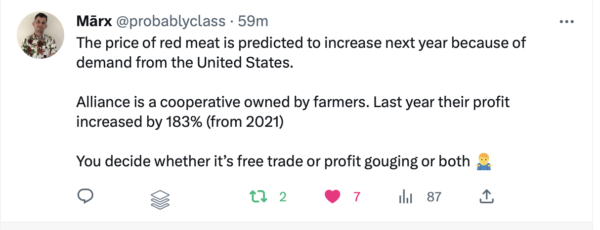
We need a Kiwi subsidy on all local produce to recognise that producers have already used water and generated local emissions contributing to climate change to create their product and as such consumers have already paid a price just to get the product to their table.
We should feed the 5 million here first before boasting about feeding 40 million worldwide!
Calls to ‘feed the 5 million first’ before exporting NZ food
People are going hungry even though New Zealand produces enough food to feed 40 million – and it’s spurring calls for the country to “feed the five million first”.
Almost 40% of New Zealand households experience food insecurity, while 19% of children live in households that experience food insecurity.
Poverty researcher Dr Rebekah Graham said while working on her thesis on food insecurity, she interviewed a woman who walked for 90 minutes each day to get a free community meal.
…it is outrageous that children born in this nation cannot taste the harvest of New Zealand, because it is being sold to the wealthy overseas!
The Left must force a bargain with Farmers and Growers for strategically essential reasons.
They are going to feed us when the famine comes.
A recent report on food security found NZ had incredibly low food security because it was so open market driven and refused to subsidise farmers.
Which is where we on the Left must drive the debate.
A case for subsidising local food production
We should absolutely consider subsidising food grown by NZ farmers and horticulturalists and our seafood and meat and dairy that generates a 15% price reduction for all NZ produce consumed here.
For growers we need to protect our most productive growing land for food by giving those producers tax breaks to ensure they can continue to feed New Zealanders first.
Rebuilding a direct link between the harvest grown here, the people who grow it and a grateful local market who enjoy the product WITH a 15% price reduction.
Climate change and the future of food security
Climate change will kill global free market supply chains, we are locked into hyper-regionalism. We need to build new economic structures, subsidising NZ kai for the domestic market would lock in certainty for producers while strengthening food security for the population.
We have to find new ways of working together to ensure we can survive what’s coming.
The old greeds, the old hates and the old exploitations will no longer hold the system together if that system is melting in real time
If we continue to treat food purely as an export commodity rather than a human necessity, the consequences won’t just be economic — they will be social, political, and deeply destabilising.




fuck kiwis, you lot hate and demonise us who farm so why in the hell would we cut you a deal or give a shit about feeding you?
pay export prices or starve, i dont care. eat imported tofu or something, meat and dairy isnt a right or need anyways, its a nice to have. plus if you lived by your green climate virtues you shouldnt be using those products anyways.
Well fucking done and about fucking time !
we’re continually demonised and blamed, yeah nah i aint giving jack shit to scum kiwis nor would i give lower prices to kiwis cuz feelz.
pay full price fuckers, until you respect farmers you dont deserve what we produce… go starve, at least those 40mil chinese are appreciative.
” pay full price fuckers, until you respect farmers you dont deserve what we produce… ”
Fantastic stuff. Finally!
If the average Kiwi is to survive there will need to be a huge shift in how we charge them for locally produced food as opposed to how we charge export customers. Why Kiwis have been ‘made’ to pay the same is outrageous and I don’t believe it is how it is done in most other countries. We keep claiming we can feed 40 million, and of course we can, but at the expense of our local people who should be paying 15-20% less than export prices. What we do now is akin to theft. Our local families are starving while they subsidise the exporters – this is ridiculous and should never happen. All Kiwis want is fairness – is that so hard to comprehend? The GREED out there is sickening!
So GDP is 400 million .A quick google tells you that ag is 15% of the economy .It also says that ag is 60% of the exports .So there in lies the problem .85% of the economy is not exported so ag is small change in the big picture .So surly we should be looking at that 85% to see how we can turn that into more exports .The green power industry is booming so we could improve the ballance of payments if we invested the corporate welfare into that industry and cut imports of fossil fuels .Clearly we need to invest in the 85% to lift the whole country out of the current malaise .We need to invest in new areas not just milking cows and selling low value logs .Currently high prices are due to the deals done by Damien Oconnor in the last govt .The increased quoters resulted in higher demand as sales were moved from China to UK and EU and farmers are unable to meet that demand .