Why does the United States have it in for Cuba so badly, and for so long?

Why has the United States maintained decades of hostility towards Cuba since the 1959 revolution? This guest blog by Ian Powell explores the historical, political and economic reasons behind one of the longest-running geopolitical conflicts in modern history.
Origins of the Cuban Revolution
The 1959 Cuban revolution was in direct response to the coup in 1952 launched by Fulgencio Batista which overthrew an emerging Cuban democracy and replaced it with his dictatorship.
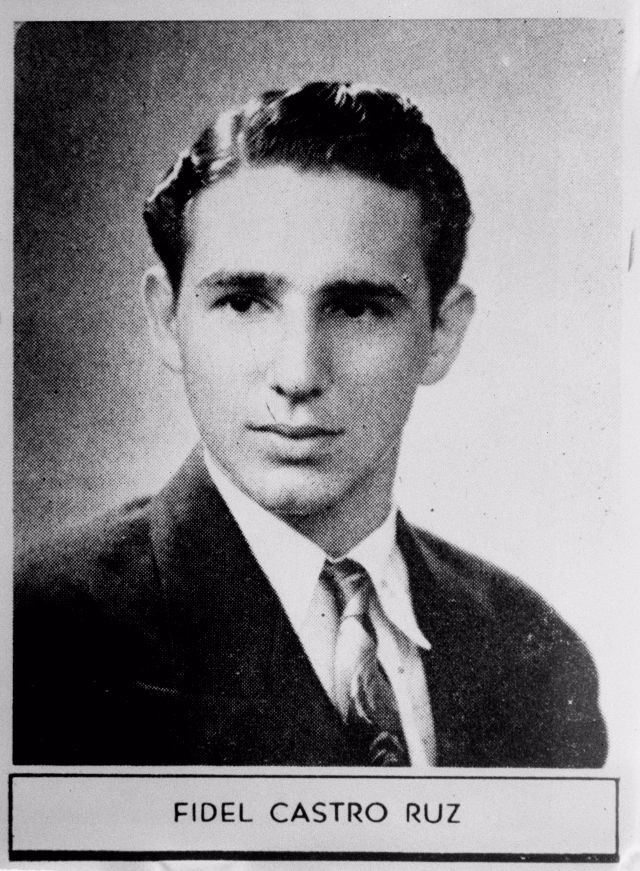
Young Fidel Castro first tried to oppose military coup by legal means.
Among those who opposed the coup was a young lawyer called Fidel Castro who initially tried to challenge Batista’s regime by legal means in the Cuban courts.
This failure led him and his comrades to launch the 26 July Movement which through political and military means eventually, with Cuban public support overthrew the dictatorship in January 1959.
US influence in pre-revolution Cuba
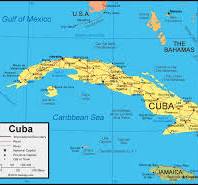
Cuba became American playground.
The United States was a strong backer of Batista’s dictatorship. Cuba also became a ‘playground’ for America including its gangsters in the lucrative casino industry, particularly in Havana.
However, this was not the cause of this entrenched hostility to the Cuban Revolution. It is necessary to dig deeper to identify causation.
The Bay of Pigs and US intervention
Initially the US tried to militarily overthrow the Revolution in the one-day fiasco known as the Bay of Pigs on 17 April 1961.
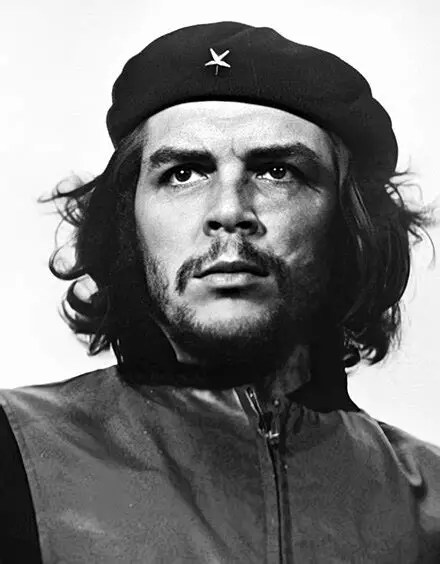
Che Guevara led the Cuban defeat of US supported Bay of Pigs invasion.
Following this embarrassing defeat the United States quickly declared economic war on Cuba (known as the blockade). This involved endeavouring to use deprivation to defeat Cuba which has continued ever since.
There was a brief rapprochement in the last years of Barack Obama’s presidency although the blockade continued.
In his first presidential term Donald Trump ended this short glimmer of hope and intensified the economic warfare even more. This was continued by President Joe Biden.
Modern escalation of US economic warfare
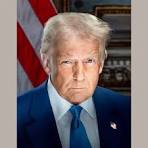
Donald Trump cruelly further escalated economic warfare against Cuba in his second term.
Trump’s second term has led to a cruel escalation of this warfare including, through blocking oil supplies, using what might be called ‘economic genocide’.
The objective is to starve the population into submission. It also involves preventing Cuban hospitals from functioning, including for emergencies and acute admissions.
Why the US opposes Cuba
But why this murderous aggression against Cuba? If Cuba is a dictatorship as the US claims (it isn’t in my view but that is another discussion), then what is the problem?
After all, dictatorships are among the US’s closest allies. Take Saudi Arabia as perhaps the most obvious example. Further, the US supports Israel’s genocide against Palestinians in Gaza.
Concern for humanity and human life plays no part in the United States’ decision-making processes.
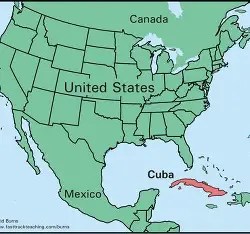
Tiny Cuba’s heartbeat challenges the might of US imperialism
Instead the answer is the heartbeat of the Cuban Revolution which still continues to beat today; a heartbeat that immediately puts it in opposition to the heartbeat of the world’s biggest imperialist power, the United States.
The ideology behind the Cuban system
The Cuban Revolution heartbeat is captured in its constitution which was revised in 2019 following a comprehensive engagement process. It is the legal foundation for what Cuba stood for in 1959 and still stands for today.
Cuban Constitution an extraordinarily revolutionary and anti-capitalist document
Its preamble is extraordinary beginning with:
We the people of Cuba, inspired by the heroism and patriotism of those that fought for a free, independent, sovereign, and democratic homeland of social justice and human solidarity, forged through the sacrifice of our ancestor;
by the indigenous peoples who resisted submission;
by the slaves that rebelled against their masters;
by those that awoke the national conscience and Cuban desire for our liberty and homeland;
by the patriots that started and participated in our struggles for independence against Spanish colonization beginning in 1868 as well as those whose final efforts of 1895 were denied victory with the beginning of the military intervention and occupation of Yankee imperialism in 1898;
by those that fought for over fifty years against imperialist domination, political corruption, the lack of rights and liberties, unemployment, the exploitation imposed by capitalists, landowners, and other social evils;
by those who promoted, participated in, and developed the first organizations of laborers, farm workers, and students; disseminated socialist ideas; and founded the first revolutionary, Marxist, and Leninist movements;
by the members of the vanguard of the generation of the 100th anniversary of Martí’s birth, who, nourished by his teaching, led us to the victorious popular revolution in January of 1959;
by those that, in sacrificing their lives, defended the Revolution and contributed to its definitive consolidation;
by those that completed heroic international missions together;
by the epic resistance and unity of our people….
This is an extraordinary constitutional preamble. It focuses on the character of the revolutionary movements from its indigenous populations and slaves right up to those that participated in the 1959 revolution.
It is about revolutionary spirit, independence and opposition to both colonisation and imperialism.
Political Foundations
Article 2 of the Constitution outlines Cuba’s political foundations, including that:
Cuba is a democratic, independent and sovereign, organised by all and for the good of all….founded by the labor, dignity, humanism and ethic of its citizens for the enjoyment of liberty, equity, justice, and equality, solidarity, and individual and collective well-being and prosperity.
This is a strong statement stressing that democracy, independence and sovereignty is required to be “…organised by all and for the good of all…”
Economic Foundations
The Constitution’s economic foundations begin in Article 18:
…Cuba is governed by a socialist economic system based on ownership by all people of the fundamental means of production as the primary form of property as well as the planned direction of the economy, which considers, regulates and monitors the economy according to the interests of the society.
These foundations continue in Articles 19-21. In particular:
- The state directs, regulates and monitors economy activity reconciling interests;
- workers participate in the processes of economic planning, regulation and monitoring; and
- the state promotes advance of science, technology and innovation.
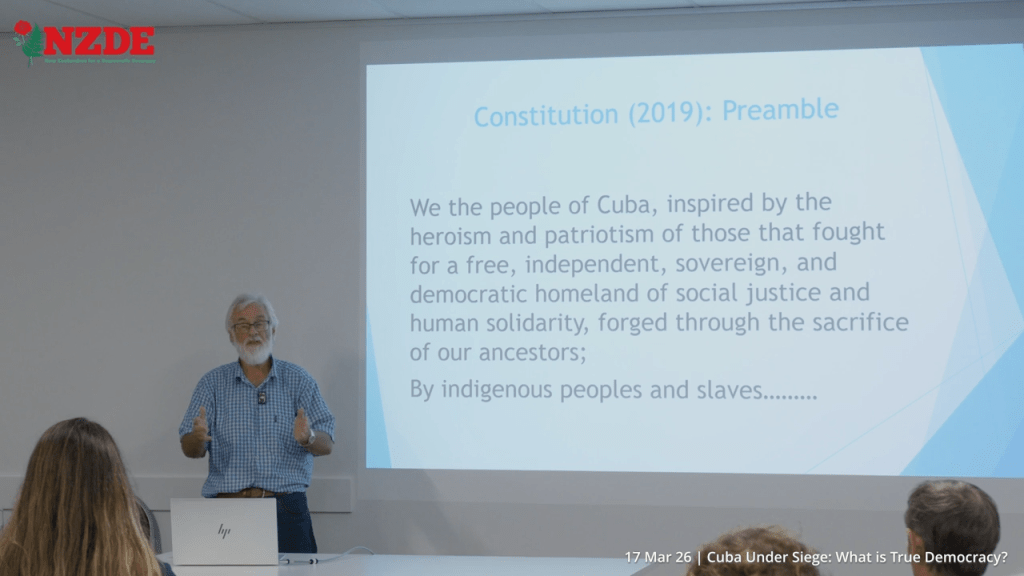
On 17 March, I spoke on Cuba to a well-attended meeting in Christchurch organised by New Zealanders for a Democratic Economy
Arising out of these foundations the Cuban economy:
- Emphasises social welfare programmes, providing subsidised education, healthcare, and food to its citizens
- its largest contributor to Gross Domestic Product is its services sector (nearly 74%), which includes healthcare and tourism
- Its industrial sector focuses on areas such as agrifood, cement production, textiles, tobacco (unfortunately), and agricultural machinery (comprising 24% of GDP); and
- Serves the people rather than the other way round
Imperialism and the threat of alternative systems
The Constitution as the foundation for Cuba goes to the heart of why the United States as the planet’s strongest imperialist power has, for over 60 years, engaged in economic warfare against a tiny island a mere 460 kilometres away.
Imperialism is when a powerful country extends its economic power, exploitation of, and influence over other countries. Historically this has been through colonisation, invariably by the use of military force.
Imperialism is the highest and most dangerous form of capitalism. If alternatives to this economic system emerge then they not only challenge capitalism where these alternatives occur; they also challenge imperialism itself.
Cuba’s economy includes commerce and trade. However, on their own they don’t define capitalism. Both existed under feudalism before capitalism emerged and no doubt will continue in post-capitalist economies.

Wealth accumulation drives capitalism (and imperialism)
What defines capitalism is that its prime driver is the maximisation of wealth accumulation from both the appropriation of surplus value from workers and degradation of the environment.
It is when the role of the many is to serve the economy so that the few can consequentially materially and otherwise benefit.
The more a country, no matter how small, migrates towards an economy that serves the people, the more it is a threat to capitalism.
When the economy serving the people is enshrined in a country’s constitution then imperialism is also threatened.
This goes to the core of why the United States is so determined to defeat the Cuban Revolution. It also goes to the core of why we all should oppose this evil determination.
Ultimately, the United States’ hostility towards Cuba is not about geography or even governance — it is about ideology. A small nation attempting to organise its economy around social welfare and collective benefit challenges the very foundations of global capitalism. That, more than anything else, explains why the pressure has never stopped.
Ian Powell was Executive Director of the Association of Salaried Medical Specialists, the professional union representing senior doctors and dentists in New Zealand, for over 30 years, until December 2019. He is now a health systems, labour market, and political commentator living in the small river estuary community of Otaihanga (the place by the tide). First published at Political Bytes