
This is not us
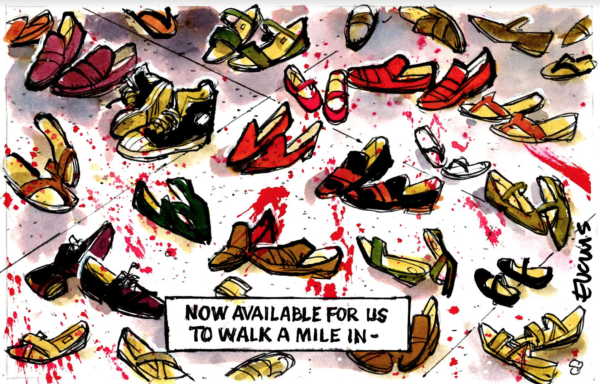
Sitting at church yesterday, I felt an overwhelming sense of pain and despair at the animal-like murder, of people who had gathered to pray. Seated in the middle pew of our church, clutching the hand of my wife on one side and my daughter on the other, I began to think of the how blessed we were to be at church, in a posture of trust, honesty, calm and vulnerability. Our Pastor struggled to find the words following the introit, in gathering our thoughts in the call to worship. We found comfort in one another as prayed for those who had lost their lives, their families and friends, devastated communities and a soul-searching nation.
Over the past few days I’ve been fascinated by the number of times I’ve seen the phrase ‘this is not us’ posted on social media and the many people I’ve spoken with. There seems to be a level of surprise by many interviewed on the news and posts online that something as terrible as this, could happen in NZ. Media outlets have been quick to point out that the perpetrator was born in Australia, as if that subtle attempt to place blame away or outside of a certain group, will help us grieve.
The Prime Minister’s leadership during these dark days has been outstanding. She has reached out to the nation with words and actions to exhibit the very compassion needed at this time. She has also made bold statements to advise that attitudes and practices in this small nation, must change. And while the pain is still raw and deep, we must continue to find the appropriate words, actions and even silence to comfort those who mourn.
One political leader said that he felt despair on the day these sinister events took place. But looking out at a gathered crowd, he felt a sense of hope. I wish I could share that hope. I wish I could feel that same level of optimism. But I don’t.
Stories of Muslim women being yelled at to go back to their countries continue to emerge. Posts online of people yelling at ‘dark-skinned’ individuals cheering at this despicable act of last week surface. And this is just the outward manifestation of the racism in NZ. It has been insidious for years. The term unconscious bias is the nice, polite way to describe the way in which the brain reacts to difference. And in the main, difference is the colour of your skin and gender. That difference is picked up by the eye immediately and it feeds that information directly to the brain. Then judgements are made about who is in, and who is out.
I don’t share that same sense of hope because people from minority backgrounds continue to exist from the periphery. It may well be the desire of the dominant culture to feel a sense of hope, because it may well be a way to manage internalized feelings of guilt. I don’t know. What I do know is that the most vulnerable voices in our community have little voice around key decision-making tables. The Children’s Commissioners office identified the racism kids feel at school and if it’s ingrained at that age, the structures won’t change in a hurry. I don’t share that same notion of hope because of how my own family was treated at my inauguration.
Our first action to bring about real hope, is to listen. For those who have always had access to decision-making tables and resource. Listen. Be quiet and listen. Don’t judge. Don’t categorise. Don’t question. Don’t speak. Just listen. And then think about doing something even more daring. Give up your seat. Make way. Invite another person different to you, to take your seat. Get out of the way. All weekend we’ve heard the stats about being a country of more than 200 ethnicities and 160 languages, but access to power remains limited; extremely limited. Fluffy political speeches have had their day. It’s time for real action based on humility and generosity.
We visited the beautiful Al-Mustafa Jamia Masjid mosque in Otahuhu yesterday. An armed police officer stood at the front gate as sad but necessary reminder of the awful attack only a couple of days earlier. The leaders of the mosque came to the gate to hug, greet and thank us for coming. As we slowly and somberly walked to the entrance of the mosque, we all reflected on recent events. Inside, we were warmly welcomed and thanked. And immediately, they gave us the chance to speak. To share. To give. We were on their land, inside their mosque, their place of prayer. And they gave us the chance to speak first. And they listened intently to our shared sadness and brokenness. Then they comforted us.
That’s what hope looks like to me. This, could be us.


Well F%&k Me senseless I never knew about this Natzi Initiative ?
This is us
http://www.scoop.co.nz/stories/HL1810/S00113/new-zealand-military-covered-up-killing-of-afghan-children.htm
This is us
https://www.stuff.co.nz/national/education/93425398/education-minister-to-shut-down-guns-in-schools-after-army-gave-rifles-to-children
Well F%&k Me senseless I never knew about this Natzi Initiative ?
Photo these people to shame them if that is possible.
NZ has always been a Racist country and no doubt will continue to be so after this. Let’s get real, it is who we are. But at least the outwardly racist folks are easier to deal with. And you know who they are. The ones I find more troubling are the insidious, covert racists, the institutional racists. The ‘nice’ people who may not speak up but their ignorance and actions speak louder than their words. People of colour can all provide stories and examples of being shafted because of the colour of our skin or the different sounding name we have. NZers may feel good about ourselves because we have come together for this short time and pat ourselves on the back because ordinary New Zealanders are so kind. But then we get burnt out by all that grief and go back to being who we were.
(Sorry about using ‘we’ for everything. I am Māori. So it’s a bit confusing being part of a whole group and part of a minority).
NZ has always been a Racist country and no doubt will continue to be so after this. Let’s get real, it is who we are. But at least the outwardly racist folks are easier to deal with. And you know who they are. The ones I find more troubling are the insidious, covert racists, the institutional racists. The ‘nice’ people who may not speak up but their ignorance and actions speak louder than their words. People of colour can all provide stories and examples of being shafted because of the colour of our skin or the different sounding name we have. We may feel good about ourselves because we have come together for this short time and pat ourselves on the back because ordinary New Zealanders are so kind. But then we get burnt out by all that grief and go back to being who we were.
I tell a relatively trivial story to show there is always a tiny minority who, instead of displaying a healthy curiosity towards diversity, fear anything different sufficiently to spur them to violence using whatever level of brute force they have at their disposal. In 1961 I was 5 years old and my (caucasian) family had just arrived to live at Northcote from the States. We still had strong, cowboy-like midwestern accents and I only had blue jeans to wear to school — forbidden by the rules in those days but my (Auckland-born) mother had permission for me. Word had obviously got around that we were unrepentant foreigners, and one day out of the blue I was “sorted out” by a gang of four brothers in the schoolyard. My sister jumped in to fend off the heaviest blows and got a tooth knocked out for her trouble. Then she was told off for swearing when she mentioned her bloody nose at sickbay. She says that one or two teachers stood watching the whole thing — and it wasn’t done then to go “telling tales” to other teachers who might have cared. Maybe she got it too for wearing her pretty “Tahiti” dress my mother had bought for her on the trip over. Who knows? Anti-American feeling in those days was so strong a parent might have directed them to get revenge for the GIs here during the war. Of course, my jeans became cool after a while, and our accents were eventually diluted but not enough for some people in authority who continued to exert a malign influence over our lives when an opportunity presented. We had no cultural peers to lend moral support, just open-minded Kiwi friends who loved us for who we were. I’m so glad to see now the Muslim community of NZ being supported by our people as a whole.
The violence in video games centre around shooting and destroying the players way though many “enemies’ to achieve some goal of point scoring. The more fire power the better and higher powered weapons can be “earned’ by higher scores.
The points scored rewards the player for on screen killing or blowing up screen images of people or substitutes, leaving a feeling of power over others and legitimises the experience.
Training for gaming based on us against them where the them do not matter and can be “killed’ without conscience or guilt.
Very common place
Very addictive to many and often displaces youth effort toward education and study
Very dangerous stuff at many levels.
We know about this yet do nothing to remove this scourge.
Nothing will really change.
What is happening now is that the people this Blog sometimes disparagingly refer to as ‘muddle nu zealand’ or ‘sleepy hobbits’ are standing up to show our migrant communities, to show our ethnic minorities that ,in fact, this is not us. We are showing it with our prayers, with our vigils and with our charity. We muddle along with our lives, we have no power to share, we have no seat to give up, we have no internalized guilt to wrestle with. We are, I think, trying to show that we are good people, no where near perfect people, living in a country that is good, nowhere near perfect.
But nothing or no one will really change because out on the dark edges the far right, the white supremacists, the islamaphobes, the racists are just keeping their heads down. Nothing that has happened has made them think ‘maybe my views are wrong’ ‘maybe I will change as a person’
All we can hope for is that our leaders fix some mistakes they have made, focus on what they should have already focused on and act
Māori under colonisation kicked along at 1%-3% growth of the GDP sines the signing of the treaty. When accrual accounting was brought in under neoliberalism by the wonderful sage affectionally know by baby boomers (or muddle nu zilind) as Rogernomics nothing changed. The argument for the economics of colonisation never changed. The economy is still kicking along at 1%-3% and the economics of colonisation is a terrible argument. Hope I don’t have to explain to you why the economics colonisation is terrible.
So, Māori are not inherently greedy, we don’t wish to conquer and subjugate the land, we may squabble with our neighbour but as a people we do not desire to travel to forign lands, show up, and say this is our capital now and you all are our subjects. What Māori desire and all indications are that Māori desire more kapas (kapa haka) where ever you’d like to look whether it be polls, media, online, surveys Māori desire more kapa haka and wake-ama, more polyfeast, and more intermingling and trading of food, ideas and culture.
So it is because the english langauge has brought science and commerce to the pacific, Māori, and opening up the world of trade to them, Māori must in turn trade certain dialects say that a homogenous language can be tuaght in schools across the country as the mother tongue. To be able to move around New Zealand, feed, cloth and house each other it is incumbent on any traveler to have the most basic grasp of geography and history. Being able to pronounce Māori and pakeha place names with sufficient accuracy by cultivating between 200-400 Māori words so that people leaving the education system can move about comfortable in there mother tongue, is what Māori desire to trade with pakeha for, while retaining the eglish language as the working language and maintaining Aotearoa-New Zealands multi-cultural heritage against all who may subvert her.
When multi-lingual children speak to there friends about what may be on the radio or TV or on a magazine and make fun of others from another place, they will know what we mean when we say to them, don’t be quick to judge others, be respectful of others, be kind to them, and live and let live.
That is my real concern.
‘Nothing will really change’
This is us.
Yeterday in Palmerston North, a penis in a shirt with a large swaztika on it, was moved on from in front of a mosque.
https://www.stuff.co.nz/national/christchurch-shooting/111382007/swastikaclad-man-seen-hanging-around-palmerston-north-mosque
also, in palmy yesterday, a muslim women was abused and punched in the face.
these fuckwits are emboldened.
They’re a bit emboldened – if they do it when no one is watching that’s not good but if they do it front of other people that’s worse – and if they do it in front of other people and no one does or says anything then they really will be emboldened.
And some folk wonder why my tolerance for far right toxic ideology is next to zero.
What about toxic left ideology? How is your tolerance for that?
why do we need to answer that! This is not about Communists killing 50 people – yes I am sure you can give me examples but I don’t care. Am sick of the “whatabout” group. Women speak out about domestic violence we get caught by men saying what about men being hit. It is a way to shut down the discussion about the wrong being done! I don’t care about toxic lefties they are not the issue. i have zero tolerance for right wing people who allow and embolden people to kill 50 people and eg them on and share the horrific results and clap quietly in the background then say what about toxic left wing people.
Hey Win. Friday 15 March. Remember? Don’t be such a dick with your “whataboutism”. It’s not appropriate. It also demonstrates you have nothing else to give us.
Hey, what about those effing Napoleonic Wars, huh, Win?? Bloody French. I blame them.
oh sorry I shouldn’t have brought up that the far left has toxic ideology too. And I definitely don’t mean Communists. WE need to be careful about the labels we use. One ‘far’ whatever is as bad as the other. And we need to be aware that the left is not immune from toxicity.
What we are talking about is a disgusting human being who allegedly shot 50 people dead and injured a whole lot of others. Interesting thing though is that he went to Pakistan and thought it was a great country.
Quite right – there may be some home-grown berserkers who may feel emboldened – but hopefully cowed by the huge outpouring of goodwill and compassion. I have not a little concern about all this – even before the Christchurch attack. My Jewish wife and “half-Jewish” daughter, who has recently begun to identify with the faith, have become increasingly worried and sceptical about the atmosphere in NZ. Ironic and sad considering that the family on that side started their journey (both sets of grandparents) back at the turn of the 20th century (ca. 1900), escaping pogroms and violent antisemitism in Germany and the Baltic states to go to England (yes, that nasty racist country). Both my wife’s late parents were communists in the 1930s-40s but remained lifelong secular socialists and humanists. I think they would be horrified to know that even in far-off NZ the poison of anti-semitic and anti-islamic has its presence.
Beautifully stated Efeso. Everyone needs to call out racism, and in particular if its our family, friends or neighbours. That is the hardest, most personal and most uncomfortable but it is the calling out that is most likely to encourage people to change.