
SPECIAL INVESTIGATION: A possible solution to Party campaign funding rorts
.

.
1. Party donations
As the law currently stands with regards to party donations, there are set limits to election spending. According to the Electoral Commission;
Expenditure limit
A registered party’s election expenses during the regulated period for the 2017 general election (23 June to 22 September) must not exceed $1,115,000 (including GST) plus $26,200 (including GST) per electorate contested by the party.
If a registered party does not contest the party vote, its total election expenses cannot exceed $26,200 (including GST) for each electorate candidate nominated by the party.
The candidate election expenses regime does not apply to people who are list candidates only. Any spending by those candidates promoting the party is an election expense of the party and must be authorised by the party secretary.
Party limits are separate from the expense limits applying to electorate candidates.
The issue of donations is more complicated;
Party donations and contributions to donations of more than $15,000 (including GST) are required to be declared in the party’s annual return of donations. A series of donations, or contributions of more than $1,500 to donations, made by one person that adds up to more than $15,000 must also be declared.
Fundraising activities are also covered;
Raffles, stalls and other fundraisers
A supporter providing a party with free cakes or other goods or services to use for fundraising is not making a donation for the purposes of the Electoral Act if the value of the items given is worth $1,500 or less. Purchasers of raffle tickets and cakes from a cake stall are not ‘donors’ as they are not making a donation to anyone. The total proceeds of a raffle or a cake stall for a party’s campaign are treated as a donation. The person who runs the raffle or cake stall will normally be the donor.
If the total funds from the raffle or cake stall are over $15,000, then the party’s donation return must include the name and address of the person who ran the fundraiser and subsequently donated the proceeds, along with the total amount given and the date that the donation was received by the party secretary.
It would be a fairly profitable “chook raffle” or “cake stall” to raise $15,000. That’s a very expensive chook. And a truck-load lot of cupcakes.
2. Dodgy dealings
Fundraisers such as National’s $5,000/plate dinner event at ‘Antoine’s’ restaurant in Parnell, Auckland in 2014 raised eyebrows, forcing then-PM John Key to defend his Party’s activities;
.

.
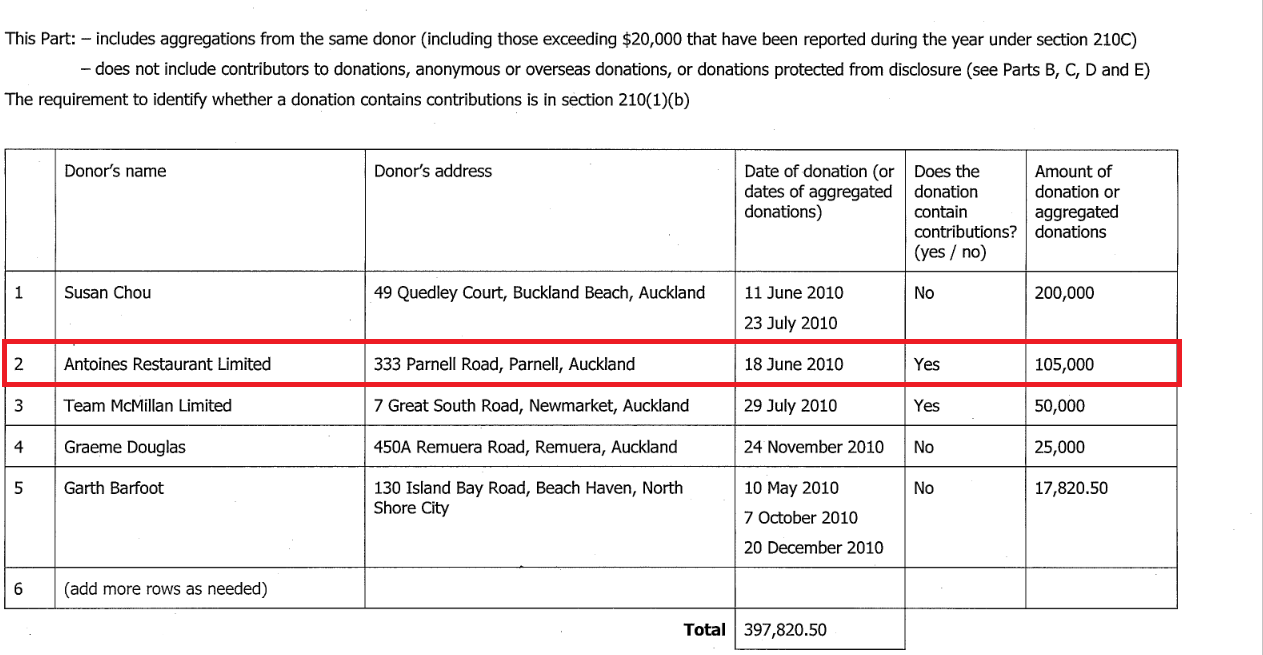
Fundraising events using fronts such as ‘Antoine’s‘ restaurant are nominally legitimate – if dubious – methods to avoid identifying donors to political parties. Donation returns for National in 2010 and 2011 showed tens of thousands of dollars being funnelled through the restaurant;
.
.

.
There is currently little protection from circumventing disclosure requirements by using ‘fronts’ such as Trusts and private companies.
Only direct donations are monitored.
Only where non-disclosure or false information is provided is the law is unequivocal regarding a donation;
If the party secretary knows, or has reasonable grounds to believe, that the donor has failed to supply information about contributions, the whole donation must be returned to the donor.
And,
Parties are not allowed to retain anonymous donations exceeding $1,500. An anonymous donation is a donation made in such a way that the party secretary who receives the donation does not know the identity of the donor and could not, in the circumstances, reasonably be expected to know the identity of the donor. [See section 207 of the Electoral Act]
If you receive an anonymous donation greater than $1,500 you may retain $1,500 of that donation. The balance of the donation must, within 20 working days of receipt, be paid to the Electoral Commission for payment into a Crown bank account.
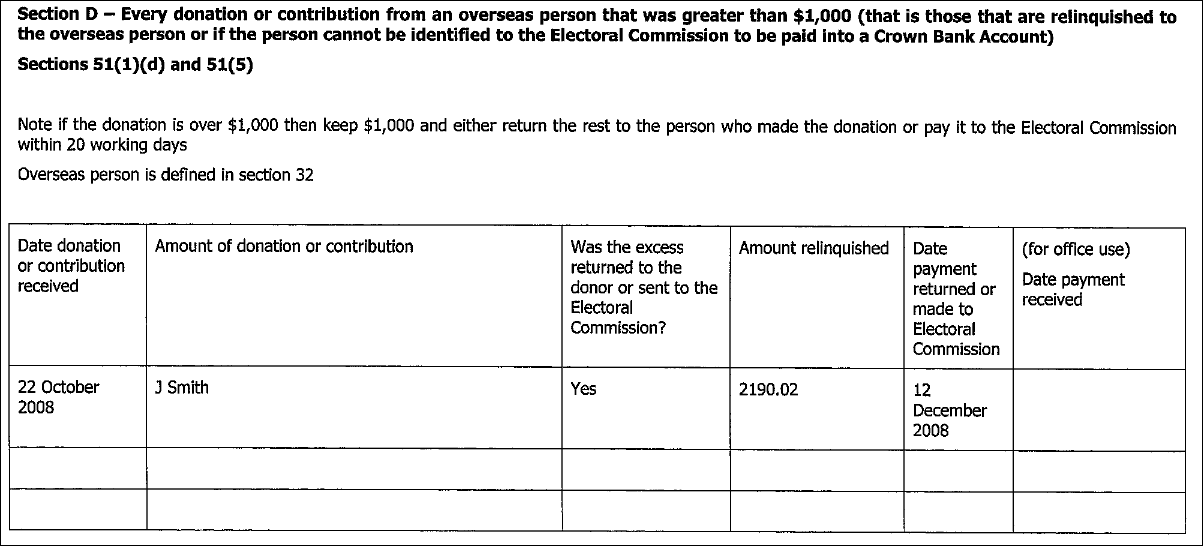
NZ First was forced to return a portion of one such donation in 2008 when it received a donation of $3,690.02 from an unknown donor who was obviously providing bogus details;
.
.
The possibility of a deliberate set-up by a political opponent should make all Party Secretaries highly cautious when dealing with donations where the donor’s details are dubious. The Donghua Liu Affair showed vividly what can happen when a Party is accused (falsely in this case) of rorting the Electoral Act.
But where a donor providing larger donation is known to Party leaders it becomes easier to circumvent legal requirements for disclosure. Recent allegations from Jami Lee Ross that businessman Zhang Yikun donated $100,000 to National, via the Botany Electorate of that Party, and was broken up at some point into smaller portions below the $15,000 threshold for mandatory declaration, are being investigated by the Police.
The apparent ease by which the Electoral Act’s requirements for disclosure can be flouted is disturbing. It opens up dangerous vulnerabilities for corruption; undue influence by big business and the wealthy, and candidates-for-money.
The US shows us where Big Money buying influence leads us – and it is not a good place.
Problems surrounding rorting the party donation system need to be urgently addressed. It is harder to cut out rot once it has set in; corruption is hard to dislodge once it has taken hold.
3. Solutions
Suggestions for tightening up legislation has ranged from lowering the limit for mandatory disclosure to $1,000 to full public funding of political parties by taxpayers.
As Green Party co-leader, Marama Davidson warned;
“The fact of the matter is, as long as political parties are accepting donations from powerful vested interests, there is a constant risk of corruption.
It is clear that those vested interests have a tangible influence on the decision making of political parties. This is a threat to democracy and should change.
Political parties are an important component of our democracy and if increasing state money for electioneering removes the influence of powerful vested interests, then it should be considered.”
Writing for Interest.co.nz, David Hargreaves has gone further, calling for a total end of private donations to political parties;
But there’s no question also that these ‘donations’ can be used by those making the donation to seek influence. If a donation ‘buys’ the people giving the money access to the political party concerned (such as dinner at someone’s house) then the opportunity is there to carry influence.
So, you get the situation in which the person making the donation wants to be able to influence proceedings – without the public at large knowing that – while the party receiving the donations doesn’t want the public at large to know that they are getting money from places that might suggest they are being subjected to particular influence.
There has to be obvious concern if particular vested interests are pumping money into political parties in order to seek influence. Now that could be say religious groups. It could be people from other countries – and what if other countries are seeking to assert their so-called ‘soft power’?
This all has to be taken very seriously.
[…]
It’s the lack of transparency about the current system that’s the real problem.
[…]
I increasingly think ‘donations’ should be banned. I think it should be illegal for anybody to contribute money to a political party.
Activist group, Action Stations has called for three significant reforms for Party donations:
- All donations over $1500 should be declared and the donors named.
- Loopholes that allow fundraising through trusts, dinners, and charity auctions to remain anonymous should be closed.
- Donations should be publicly disclosed in real time, to allow greater and immediate scrutiny.
4. There is a further option to tighten up controls on donation.
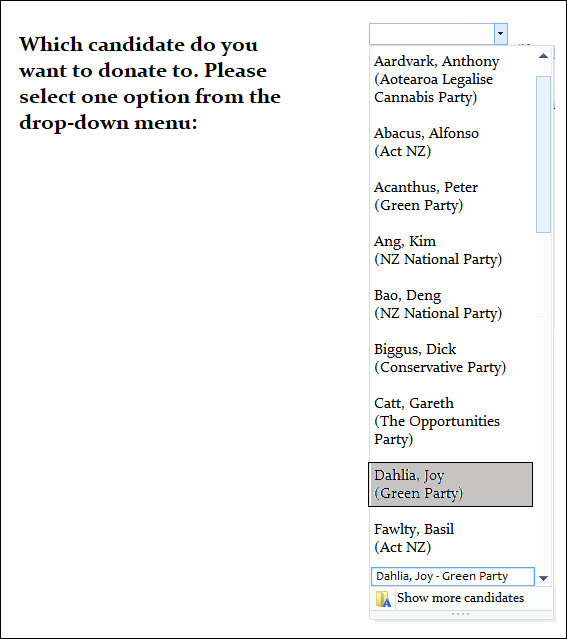
This blogger proposes that all donations above a certain amount (whether $1,000 or $1,500) be made directly to the Electoral Commission, using internet banking. For those not au fait with internet banking, donations could be available by other means – NZPost, etc – but still made directly to the Electoral Commission.
Each donation would be made to a nominated Party or Electorate Candidate using drop-down menus on the Commission’s website.
.

.
.

.
Donor’s details can be matched with their bank account details. Once verified, the donated amount is lodged in a holding-account and the donor’s name made public in real-time.
Donations through dinners, auctions, etc, can be lodged directly during the event, into the Commission’s account, disclosing the details of the donor at the dinner or auction. (Again, if the donor’s details do not match their bank account details, the donation is automatically rejected.)
As per Action Station’s demand, donations through Trusts would be banned. Any method that does not provide transparency would not be permitted through the Commission.
Parties would be banned from handling funds greater than $1,000 or $1,500.
This still allows for low-level fund-raising such as sausage sizzles, cake stalls, and chook raffles. (Cake stalls raising $15,000 would be scrutinised to see what the hell those ‘cakes’ were made from.)
Once verified, funds would be disbursed to relevent Parties to meet campaign expenses.
Any funds over the Party and Electorate cap (see above) would be held in escrow for the following election.
Interest gained from holding these funds in the Electoral Commission’s account would self-fund the system.
The obvious primary benefit would be that it makes it harder – though not impossible* – for political Parties to rort the system.
(* A wealthy donor could still, theoretically give smaller amounts to friends and family, who then make said donations to a Party or Electorate Candidate via the Commission’s account. A bank would have to implement protocols to detect suspicious payments. Any police investigation; subsequent prosecution and conviction, would have to have financial penalties so severe that anyone contemplating such a scheme would think very carefully before proceeding.)
The above proposal does not cover every aspect of donations (such as goods and services) to political parties – but it’s a start.
If Jami Lee Ross has achieved anything, it is casting the full glare of public scrutiny over Party donations. His methods may have been unorthodox – but he’s got our attention. We can no longer feign lack of awareness of this dark shadow over our democracy.
The rest is up to us, as a nation, what we do now.
Otherwise, we end up with more-of-the-same;
.

.
For sale: one parliament.
.
.
.
References
Electoral Commission: Part 3 – Election expenses, donations and loans
Mediaworks: Key not talking about fundraising dinner
Electoral Commission: National_Party_donations_2010.pdf
Electoral Commission: New Zealand National Party donations 2011.pdf
Electoral Commission: NZ First Party Donations Returns 2008
Fairfax media: Show us the money: Donors bankrolling Greens lead way in fronting up to public
Interest.co.nz: We should urgently consider changes to the way our political parties are funded
Action Stations: Fix Political Donations
Scoop media: Stop powerful vested interests and preserve democracy
NZ Herald: Bryce Edwards – Should taxpayers fund political parties?
Fairfax media: Secret donors – Buck stops here
Additional
The Good Society: Max Rashbrooke – Donations to political parties 2011-16
Electoral Commission: Party Donations by Year
Fairfax media: Over half of major political cash comes from donations of over $15,000
NBR: Key under fire for Antoine’s donations
Other blogs
The Standard: Ross saga quiescent, but donations scandal needs addressing
Previous related blogposts
National’s fund-raising at Antoine’s – was GST paid?
Some troubling questions about the Ross Affair
.
.
.

With acknowledgement to Sharon Murdoch
.
.
= fs =


Donations ought to be banned entirely, it is undemocratic. Publicly fund campaigns, let the parties live and die on the merit of their policies, not on the wealth of their propaganda machines.
Best case scenario, donations to a commission still results in parties with skewed funding depending on the wealth of their voter base. That would not be considered a fair system in any other realm.
Worst case scenario and almost inevitable, the system will still be scammed. If there is the potential for corruption, there will be corruption, this is the simple truth of human nature, punitive deterrents won’t work.
Let’s get rid of political parties.
Find a better way to be governed than parties and party faithful and over-paid entitled place holders. So nineteenth century, and look at the mess it made of the twentieth.
If you scanned the current crop, ignored the party labels – who would you want to stay in place to tackle the issues we have that need consultation, consideration, co-operation followed by regulation and legislation to confirm the decisions reached?
From that few – who have the vision and foresight to take us out of the current comfy mire and into better versions of our societies? Make unity in diversity…
Then fund that – more than you fund the players. (We’re great for rewarding the totem poles and starving the systems.)
Donations from private individuals cannot but buy influence and corruption to our democratic system and undermines our society (Corporate governance)
All donations should be distributed evenly between Political parties or not at all
Politicians should fund there own Political parties and campaigns (they get paid to much anyway)
Donations or perks given to individual politicians need to be scrutinized and audited and made public knowledge
Private donations to individual parties must bring influence and corruption and is an attempt to buy our democratic system If these donators are wanting to help the Political system maybe the donations should be distributed evenly amongst all parties
Maybe this will expose the true motives of these well heeled individuals
Or just get rid of private donations altogether and let politicians pay for there own campaigns (they certainly get paid enough)
I like this proposal of all donations to political parties to made through the Electoral Commission, and all that implies as you outline.
And reading ‘Newsroom’ comment from Victoria University of Wellington’s Jack Vowles … “Individual contributions directly to political parties should be limited to a maximum of, say, $1000 a year and treated for tax purposes as a charitable donation, and perhaps matched by a taxpayer top-up.”
Although I am not sure about the donation limit of $1000, necessarily , nor the charitable tax purposes element … but the matching taxpayer top-up is a way of funding political parties that seems worthy of consideration. This could be a 1:1 ratio or even higher if there were lower limits set to donations. The lower the donation limit the higher the ratio from taxpayer funding.
Thankyou Frank for another really interesting article.
Thanks, Joanna. My proposal is a basic outline. The best thing about publishing my blogpost above is that it can be ‘refined’ and improved by “crowd sourcing” for better ideas to improve on what I’ve suggested.
I’ll be sending a proposal to all political parties for their response.
Donations are fine, but, as highlighted recently, by questionable funds given to the National PRC Party, there needs to be more transparency and recording of such matters
Yes Frank;
China will buy more votes here if we don’t tighten up the donation system.
good article Frank 100% support.
Thanks, Cleangreen. Possibly the worst possible option is that we do nothing, and our political parties come under undue influence. The “dinners” hosted at Antoine’s and the recent Zhang Yikun Affair have “lifted the bedcovers” on how the donation-disclosure system can – and is – being rorted.
One hopes that perhaps this is something NZ First and the Green Party can work together to sort out.
Otherwise we let this state of affairs continue at our peril.
It is an excellent idea, but Mjolnir may also be right in saying only state funding may – theoretically – address threats to the democratic process.
There is also the other issue exposed by “Dirty Politics” of big bucks buying advantage in candidate selection by using the services of people like Lusk and co whose methods can be filthy and dishonest.
If foreign donors just want Queen’s Honours, knighthoods etc, good luck to them, they’re all a bit of a joke now and have become increasingly debased.
However, if as likely, rich interests seek to buy political influence at the expense of the rest of us and of NZ’s sovereignty, this has to be addressed right now, and if the Coalition Govt doesn’t realise this, they should.
No-one wants to see anti-Chinese or anti-Asian prejudice whipped up in NZ, but nor do we want to see unknown monies buying candidacy for unknown or obscure purposes. If the Greens can spearhead getting transparency here, good, because some-one has to.
Agree! Its much more outrageous than has been reported or commented on that this is going on. How is it possible that money can buy a seat in parliament, as revealed by Bridges and JLR’s recorded conversation about 100K and what the donor wanted for it. Where is the inquiry?
So why do we not make the donations public ie parties are not allowed to collect donations on their own – all donations must go through the Electoral Office and these are handed to party with public disclosure on web site! All amounts are publicly displayed and party accounts with ALL bank accounts are also publicly listed. Light tends to make people honest. Yes I know people will try and cheat but then they are doing something illegal.
A financial donation from a business is one of two things:
1. Illegal, because it is an attempt to buy influence that benefits the company. Corruption.
2. Illegal, because it does not buy influence that benefits the company and is thus a dereliction in the fiduciary duty of the directors toward the company and its share holders.
Either way it is a crime.
Until state funding for parties is enacted, this may be a reasonably effective stop-gap measure to reduce rorting. I like how it could be made self-funding using interest from donations held by the Commission.
It still doesn’t prevent undue influence, but that’s why only state funding will address that vulnerability to our democratic process.
You’re right, Mjolnir, it wouldn’t “prevent undue influence”. But at least we’d see who was paying what for that influence. Voters can then decide if they want to ‘support’ that influence with their vote…
Thats a good practical simple plan to arrange donations Frank. Parties should jump at it as it would eliminate suspicion .
D J S
One would hope so, David. Anything that brings integrity back into the system should be welcomed.
Even if it were done on a voluntary basis (at first), the public would be looking hard at parties that don’t participate by asking the obvious question: “what have you got to hide?”.