
Ihumātao – What Pākehā should *NOT* do
.

.
With some historical and present context, it should become readily apparent to Pakeha that the occupation at Ihumātao is not a free-for-all conflict for any and everyone to become involved in.
First, some important dates:
.
1840
.
The year in which the Treaty of Waitingi was signed. Article Two of the Treaty was especially important for Maori;
Article Two
Māori version: confirmed and guaranteed the chiefs ‘te tino rangatiratanga’ – the exercise of chieftainship – over their lands, villages and ‘taonga katoa’ – all treasured things. Māori agreed to give the Crown a right to deal with them over land transactions.
English version: confirmed and guaranteed to the chiefs ‘exclusive and undisturbed possession of their lands and estates, forests, fisheries, and other properties’. The Crown sought an exclusive right to deal with Māori over land transactions.
.
1863
.
Twenty three years after the last signature to the Treaty document had dried, land at Ihumātao was seized ‘by proclamation’ under the New Zealand Settlements Act. Four hundred hectares of land at Ihumātao was taken by the Colonial Government and transferred to settler families in the area;
“There was an accusation that was levelled against Waikato that there was an imminent plot to attack the settlers of Auckland. It was a fabrication, part of [Governor George] Grey’s dodgy dossier,” says O’Malley. “The accusation was window-dressing for the British Colonial Office, to give the appearance that Grey had no choice but to take troops into the Waikato.”
More than 400 hectares of land at Ihumātao was confiscated by the Crown, as punishment for the community’s allegiance to the King movement, and given to a handful of settler families.
Article two of the Treaty had been well and truly breached. “Exclusive possession of the land” had been “disturbed” as thoroughly as it could be.
.
2008
.
The Crown recognised Te Kawerau Iwi Tribal Authority with which to undertake settlement negotiations for breach-of-Treaty claims.
.
2014
.
A Deed of Settlement was signed at Makaurau Marae in Māngere, between the Crown and Te Kawerau ā Maki Iwi Authority.
.
2016
.
A group of tangata whenua calling themselves SOUL (Save Our Unique Landscape) establish a presence at Ihumātao Quarry Road.
.
Present
.
The presence of SOUL and supporters at Ihumātao had swelled to several thousand people, from all over the country. The congenial attitude of Police, interacting peacefully with protectors/protestors, could be seen as the ‘New Zealand Way’ of doing things. (Subsequently, that good-will took a severe battering when some twit within the Police hierarchy thought it would be a ‘clever idea’ to publicly carry a firearm in the vicinity of the occupation.)
Politically, there have been many voices demanding many forms of ‘action’ or ‘intervention’.
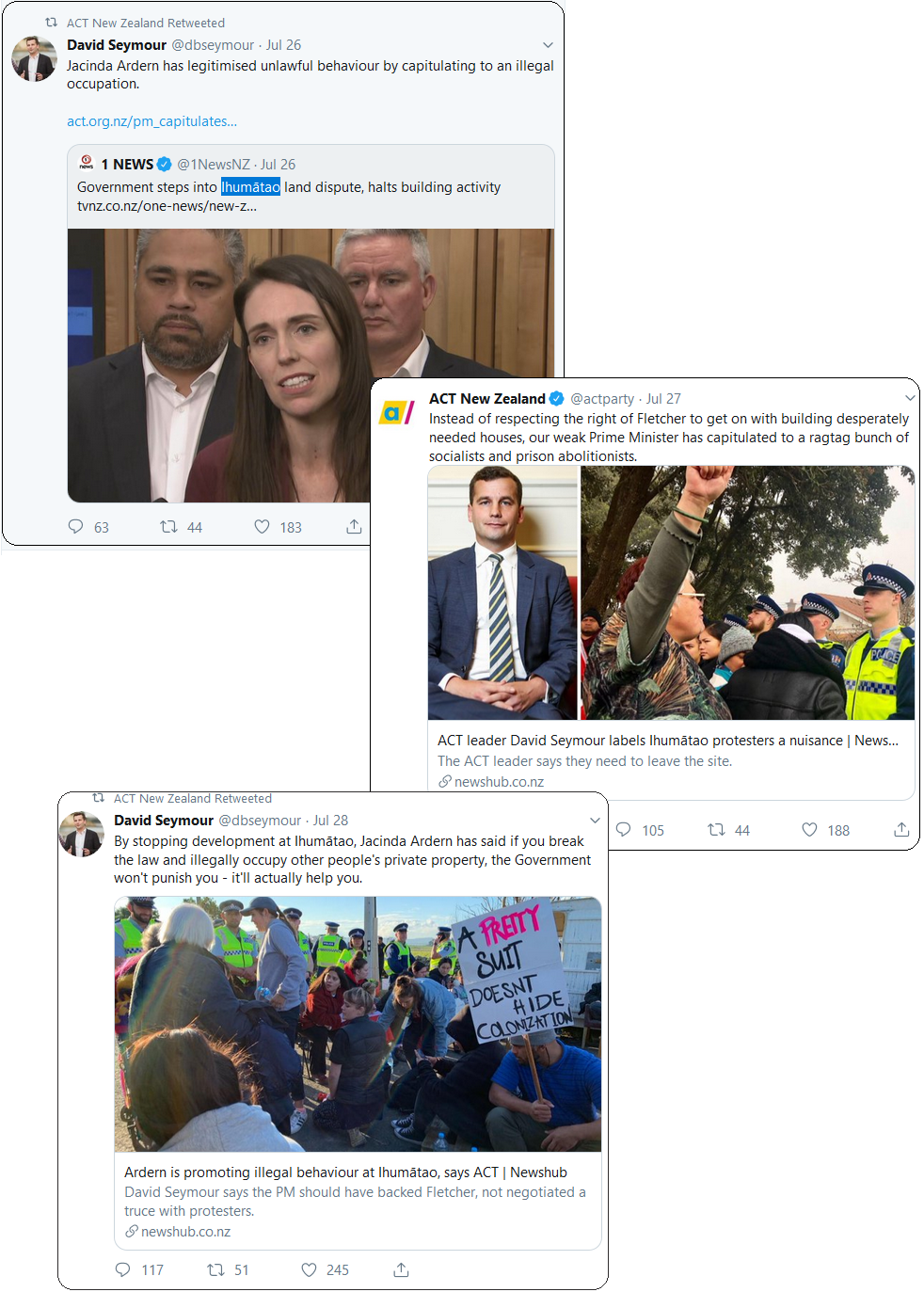
From ACT’s shallow knowledge of history and feeding red-meat to it’s reactionary base;
.
.
Mr Seymour’s references to the occupiers “break[ing] the law and illegally occupy[ing] other people’s private property“; “legitimis[ing] unlawful behaviour by capitulating to an illegal occupation“, and “capitulat[ing] to a ragtag bunch of socialists and prison abolitionists” can only be described as a toxic, noisome, brew of crass ignorance and racism.
There is black irony and unashamed hypocrisy is describing the occupation as “break[ing] the law and illegally occupy[ing] other people’s private property” and “legitimis[ing] unlawful behaviour by capitulating to an illegal occupation” when the land was originally unlawfully seized, illegally occupied, and on-sold to colonial settlers in the first place.
His description of the occupiers as “a ragtag bunch of socialists and prison abolitionists” – without once mentioning that they were tangata whenua, was wilfully insulting, with more racism piled on. David Seymour is without self-awareness or shame with his appalling comments.
Then we heard Simon Bridges criticising Prime Minister Jacinda Ardern making a state visit to Tokelau on Radio NZ;
“She’s put herself in it and where is she? She’s taken herself off for days to Tokelau – 1500 people – well every MP has a street she hasn’t visited that has many more people than that and look, whether it’s the stalling economy, whether it’s Ihumātao, whether it’s a bunch of other issues – the prime minister and government are showing themselves to be a part-time prime minister and government.”
But when asked by Radio NZ’s Corin Dann if she should have attended Ihumātao, his equivocation was cringeworthy and embarrassing;
“No. Because I don’t believe a leader necessarily needs to insert themselves in this. I think that’s – [interuption]
[…] She shouldn’t have got involved.
[…] She got involved. She set a bad precedent.
[…] I would not be intervening in this particular instance, the way the Prime Minister is.”
On Twitter, Russell Brown from the Public Address blog, put it perfectly when he summed up Simon Bridge’s insanely contradictory statements;
.

.
Hone Harawira said it most clearly;
“It would be nice to see the Māori ministers leading here rather than being told what to do by Jacinda. I don’t think she knows what’s going on here. Stay overseas. Leave it to Peeni and the whānau here. Let’s get it done.”
This is especially vital considering that the dispute over Ihumātao appears to be a schism with local Māori. As RNZ’s , Shannon Haunui-Thompson, explained;
This isn’t a Māori versus Fletcher issue – on both sides are members of the same iwi, hapū and whānau.
When the eviction notices were served yesterday, well-respected kaumātua of Te Kawerau a Maki and Te Akitai accompanied police and asked for the occupation to end and for them to leave Ihumātao peacefully. They even performed a karakia.
Ms Haunui-Thompson also rejected that the dispute was “generational”;
“…to say it’s a rangitahi [younger generation] issue is incorrect. There’s definitely a divide though amongst the iwi, amongst the hapu and whanau.”
To make it clear, it was not for the Prime Minister to intervene. Calls for her to visit Ihumātao were misguided. Her presence, at best, would be symbolic. At worst, misconstrued as more pakeha paternalism.
What was appropriate was for Māori MPs to visit; to listen; to facilitate where possible; to carry back to the Government what they had seen and heard. Māori working with Māori.
.
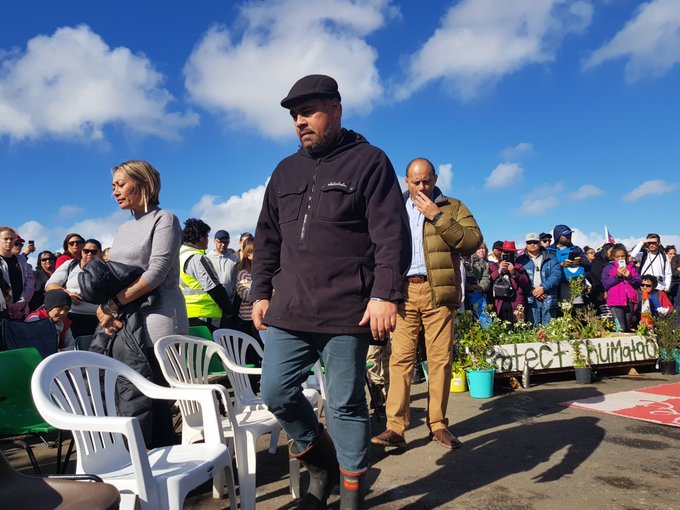
“It’s a tense feeling here at Ihumātao as ministers arrive at the whenua.” – Te Aniwa Hurihanganui, Radio NZ, @teaniwahuri
.
Simon Bridges then played the “law and order” and “private land rights”, cards. On 30 July, interviewed on TVNZ’s “Q+A”, Jack Tame asked the current National Party Leader if he “would support police removing the people who are occupying the land at the moment“. Mr Bridges dodged the question;
“Well, it’s pretty simple when it comes to protests. You have an absolute right in this country to legitimate, fair, vociferous protest; you don’t have a right to break the law and get in the way of other people’s lawful activity.”
When asked again, Mr Bridges played the “Dumb Card”;
“Well, I don’t know the ins and outs…”
It was a simple question. It had only two possible answers;
-
- Yes, I would support the police removing protestors.
- No, I wouldn’t support police removing protestors.
There is no third option.
Any mature person watching that exchange and listening to Mr Bridges’ response could reasonably infer that (a) Simon Bridges had no idea whatsoever of the issues surrounding Ihumātao or (b) understood the issues perfectly well, but did not have the guts to offer a definitive answer.
Neither option is an edifying position for The Man Who Would Be Prime Minister. If he doesn’t “know the ins and out” perhaps he should do what all new MPs do in Parliament: breathe through his nose.
Barely two weeks later, Simon Bridges was once again pontificating by press release, On 11 August, he demanded that Prime Minister Ardern tell “protestors to go home and let the landowners build houses for Aucklanders“.
So there we have it: Simon Bridges is of the opinion that Jacinda Ardern has the Stalinist power to command “protestors to go home“. Who would have thought she wielded such Imperial Roman authority over her subjects. Mr Bridges had best tread cautiously; the Prime Minister could send him packing as well.
The reality is that Mr Bridges can comfortably pontificate what should or should not be done. Or both. His comments can (and have been) as contradictory as he fancies. He can cause harm; sow discord; rattle nerves. From the relative safety and responsibility-free-zone of the Opposition, he can say whatever he likes, regardless of consequences.
What is telling is that none of his utterances have been in any way constructive. His chest-thumping machismo no substitute for calmer, cooler heads. We are fortunate that he is nowhere near the “levers of power”.
Contrast Simon Bridges’ incoherence and impotence with that of the solemn mana of the Māori King, Kiingi Tūheitia Potatau Te Wherowhero VII, who on 3 August was welcomed onto Ihumātao with a formal pōwhiri;
.

.
Kiingi Tūheitia offered to mediate between protectors/protestors and the Iwi authority to find a way forward. Kiingitanga spokeswoman, Rukumoana Schaafhausen, said;
“We have to hear all the mana whenua and find a way forward that works for all of them.”
The meeting would not include Fletchers, or the Government, Schaafhausen said.
And that is the point that has eluded most people: this issue is for mana whenua to discuss and to arrive at a solution. It is not for the pakeha Coalition government to intervene. It is not for the police to force protestors out. And it is most certainly not for self-serving politicians from the Right to exploit this issue for a perverted “law and order” beat-up to win a few votes from ill-informed redneck voters.
This is for Māori to resolve.
As the Māori version of Article Two of te Tiriti states;
“…confirmed and guaranteed the chiefs ‘te tino rangatiratanga’ – the exercise of chieftainship”
At a time when Māori are determined to take firmer control of their own affairs – such as up-lifting and placement of Māori children by Oranga Tamariki – resolving disputes such as Ihumātao can only achieved by those directly involved.
The Crown – represented by the government – can assist. It can mediate. And in the end it can listen.
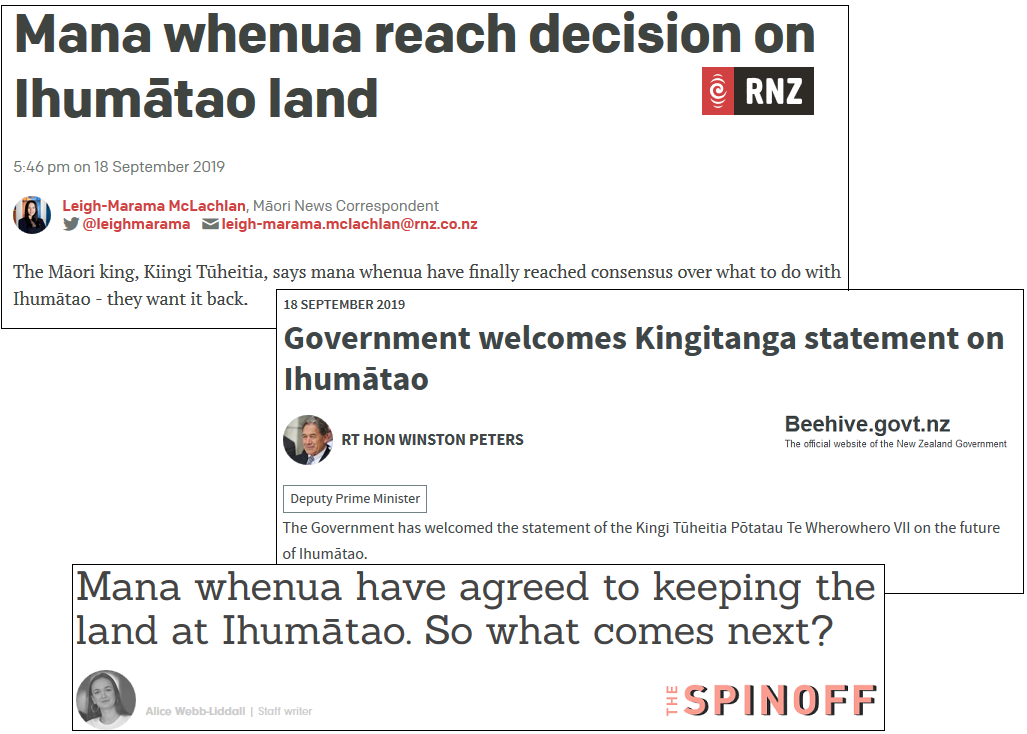
On 18 September, mana whenua announced that they had negotiated and reached a decision;
.
.
Māori had arrived at a resolution. By Māori, for Māori.
Kiingi Tūheitia explained the position that had been arrived at:
“Mana whenua agree they want their land returned, so they can make decisions about its future.”
Kiingi Tūheitia further expressed mana whenua’s desired outcome:
“Kiingitanga has conveyed the views of mana whenua to the government and urged it to negotiate with Fletchers for the return of Ihumātao to its rightful owners.”
Now is the rightful moment for the Crown, through the Coalition Government, to sit at the table and play it’s rightful part as one of the two Treaty partners.
.
.
.
References
Encyclopedia of New Zealand – Te Ara: Treaty of Waitangi – Interpretations of the Treaty of Waitangi
Radio NZ: Ihumātao land battle – a timeline
New Zealand Geographic: When worlds collide
NZ Government: Te Kawerau ā Maki – Summary
NZ Government: Te Kawerau ā Maki
NZ Herald: Battle for Ihumātao – How farmland became a flashpoint
Fairfax/Stuff: Police officer sings with protesters at Ihumātao
Fairfax/Stuff: Ihumātao – Police deny carrying firearms at protest after Facebook video outcry
Twitter: David Seymour – Ihumātao – 10:25 PM – July 26, 2019
Twitter: David Seymour – Ihumātao – 11:01 AM – July 27, 2019
Twitter: David Seymour – Ihumātao – 08:12 AM – July 28, 2019
Radio NZ: Ihumātao – Simon Bridges slams PM for timing of Tokelau trip
Radio NZ: Bridges defends ‘part-time PM’ criticism of Ardern
Twitter: Russell Brown – Ihumatao – Simon Bridges – 7:34 AM – July 31, 2019
Radio NZ: Ihumātao – Government ministers welcomed to protest site with powerful powhiri
Radio NZ: Explainer – Why Ihumātao is being occupied by ‘protectors’
Twitter: Te Aniwa Hurihanganui – Ministers arrive at Ihumātao – 12:11 PM, July 27 2019
TVNZ: Q+A – Simon Bridges interviewed by Jack Tame
Victoria University: Research Archive – Breathing Through their Noses – Candidate Selection and Role Adaptation amongst First-Term MPs in the New Zealand Parliament
National: Tell them to go home, Prime Minister (alt.link)
NZ Herald: Kīngitanga flag raised at Ihumātao, to stay until resolution reached
Fairfax/Stuff media: Ihumātao – Māori King invites mana whenua to meet to find a solution
TVNZ: ‘By Māori, for Māori’ – Oranga Tamariki hui reveals Māori want to look after their own
Radio NZ: Mana whenua reach decision on Ihumātao land
Beehive: Government welcomes Kingitanga statement on Ihumātao
The Spinoff: Mana whenua have agreed to keeping the land at Ihumātao. So what comes next?
.
.
.
.
.
= fs =


Frank Macskasy: “…..”break[ing] the law and illegally occupy[ing] other people’s private property“; “legitimis[ing] unlawful behaviour by capitulating to an illegal occupation“”
This is correct. Were it other parties involved, this would be glaringly obvious.
Bastion Point this ain’t: I well remember that time. I was among many pakeha who completely supported Ngati Whatua claims to have the land returned to them by the government; it was the right thing to do.
As you’re well aware, Ihumatao – unlike Bastion Point – is in private ownership. However inconvenient that is for many people, and regardless of the fact that it was confiscated in 1863, that’s the situation.
I’ve long taken an interest in our history. This particular aspect of it – the invasion of the Waikato and the confiscation of the land at Ihumatao – was an awful episode in a litany of awful episodes, with regard to land theft in the 19th century.
But: nobody now alive is responsible for any of it. That includes the previous owners of Ihumatao, who were acting lawfully in selling the land to Fletcher, which is now the lawful owner. No matter how egregious the behaviour of the settler government, the fault rests with it; it does not pass down to the current generation.
“His description of the occupiers as “a ragtag bunch of socialists and prison abolitionists”…”
On the other hand, Seymour’s completely wrong about that.
“….the dispute over Ihumātao appears to be a schism with local Māori……..Ms Haunui-Thompson also rejected that the dispute was “generational””
Indeed. It’s a class dispute. Here’s what Alex Birchall said about it:
““The Ihumātao situation is – or should be – a watershed moment for Māori politics. It demonstrates the potentially explosive nature of the looming conflict between a growing self-interested class of moneyed iwi leaders, and those Māori who are working-class or poor and utterly destitute who have not benefited in any way whatsoever from treaty settlements.””
http://tolerantleftist.blogspot.com/2019/07/ihumatao-class-conflict-in-maori.html
In my view, he’s right; the growing class divide in Maori society has been obvious for quite some time. It goes a considerable way to explaining the lack of Maori success in education so often complained about, along with poorer health statistics. And, of course, the disproportionate impact of drugs and the resulting mental health issues, violence and crime on Maori society. Many of us have noticed the fact that the benefits of Treaty settlements haven’t percolated down to the poorest Maori. (I’ve made this comment elsewhere)
“To make it clear, it was not for the Prime Minister to intervene. Calls for her to visit Ihumātao were misguided.”
I agree with you; though not for the same reasons. She’s already stuck her nose in further than she should have. The land is privately-owned; the government has no role – cannot have any role – in the dispute, and the ethnicity of the owner is irrelevant. The law applies here: if Maori want the land back, they must pay Fletcher an agreed price for it. If they’re unwilling to do that, the land stays with Fletcher, who must be allowed to get on with the planned development. There’s no other solution to this situation.
“Any mature person watching that exchange and listening to Mr Bridges’ response could reasonably infer that (a) Simon Bridges had no idea whatsoever of the issues surrounding Ihumātao or (b) understood the issues perfectly well, but did not have the guts to offer a definitive answer.”
I’d go with (b) here; Bridges is just flailing about. If he had the courage that the leader of an opposition party ought to have, he’d say unequivocally what I’ve said above. But he’s obviously trying to have a political bob each way; it isn’t working, as I’m sure that he’s aware.
“….Simon Bridges is of the opinion that Jacinda Ardern has the Stalinist power to command “protestors to go home“.”
Hmm…. “Stalinist” is a curious term for you to use in this context. What she does have is the weight of the law behind her: she could order the protesters to be removed. A fortiori,she may have to do that if Maori won’t buy the land from Fletcher. Or Fletcher as rightful owner can ask police to remove the protesters.
“Kiingi Tūheitia further expressed mana whenua’s desired outcome:
“Kiingitanga has conveyed the views of mana whenua to the government and urged it to negotiate with Fletchers for the return of Ihumātao to its rightful owners.””
It looks as if Tuheitia doesn’t have a handle on the situation, either. For the reasons already adduced, the government cannot do this.
“Now is the rightful moment for the Crown, through the Coalition Government, to sit at the table and play it’s rightful part as one of the two Treaty partners.”
No. The government has to stay out altogether. Because the land is in private ownership, this cannot be a Treaty issue.
The rest of us have the right to expect the law to protect our property rights. All of us: not just pakeha. It isn’t our fault that the 1863 government acted in bad faith; do not expect us to pay the price for wrongs that we didn’t commit. If this country were to go down that road, the future would look very bleak indeed.
Yes, there were massive injustices in the past; but they cannot be remedied by creating further, contemporary injustices.
“As you’re well aware, Ihumatao – unlike Bastion Point – is in private ownership.”
“The rest of us have the right to expect the law to protect our property rights.”
Calling on “private ownership” and “property rights” to be respected is 156 years too late. It’s risable that pākehā demand “private ownership” and “property rights” be respected after those same rights were grossly violated by – pākehā. Like Saddam Hussein, Idi Amin, Pol Pot, Pinochet, Papa Doc Duvalier, et al, pontificating on protecting human rights.
Indigenous property rights were violated by the Crown – not by Pakeha.
As you may be aware, land owned by Pakeha who had collaborated with the Kingitanga was also confiscated in the raupatu.
There is a regrettable tendency among some to blame Pakeha for the sins of the British Crown – thus stirring up racial antagonism and at the same time effectively letting the Crown (and with it the entire colonial system) escape responsibility for its crimes.
Anyone who blames Pakeha as a race for the misdeeds of the Crown is doing all of our people a gross mis-service.
Geoff Fischer: “Indigenous property rights were violated by the Crown – not by Pakeha.”
The crown was represented by the settler government, which was irredeemably pakeha at the time. So: representatives of pakeha violated indigenous property rights. Fancy semantic footwork won’t change that.
It makes no difference to the current state of affairs: taking privately-owned land as remedy for past confiscation simply creates a new injustice.
“There is a regrettable tendency among some to blame Pakeha for the sins of the British Crown – thus stirring up racial antagonism and at the same time effectively letting the Crown (and with it the entire colonial system) escape responsibility for its crimes.”
Whether you wish to acknowledge it or not, that’s exactly what you and other commenters here have been doing. And here you are, yet again going on about the crown and the colonial system as if it were extant. It isn’t. And attempting to abstract it away from pakeha, as if there were no pakeha in government here in the 19th century. That makes no sense at all, you know.
Again: NZ is now a modern representative democracy. It’s a former colony, with a dark past in respect of land confiscations and wars fought on false pretences. But: the injustices of the past cannot be remedied in the present by taking back privately-owned land, because that simply creates a fresh injustice. Iwi can buy back land, if owners are willing to sell; if not, then they cannot have the land returned. That’s the way things are now.
Frank. of course Maori property rights were grossly violated in the 19th century. I do know that, you know. It’s an awful history.
But it wasn’t any of us who did it. We weren’t born then. It’s a gross injustice to punish us for the wrongs committed by the government of the time. That’s the point I’ve been making.
And that’s also why I’ve said that those injustices cannot be remedied by the creation of fresh injustices. It’s the way the world is. I’d add that many of us pakeha are here in NZ precisely because injustices of a similar sort were visited upon sundry ancestors, mostly by the British government. I have in the past pointed out that particular paradox.
But we all have the law to protect our rights. And it’s all that we have. Surely you would not take that away?
“Like Saddam Hussein, Idi Amin, Pol Pot, Pinochet, Papa Doc Duvalier, et al, pontificating on protecting human rights.”
I’m not sure what useful contribution reference to these people makes. When it comes to land seizure – which appears to be what you and others are implying should happen here – Robert Mugabe would be your man. And that turned out well for Zimbabwe, didn’t it! Though Idi Amin did a comprehensive line in ejecting citizens of Uganda who weren’t African. If I remember rightly, Amin kept their assets, charming fellow that he was. I’ve got the impression from some Maori commenters here that this is what they’d like to have happen to “immigrants”. Whatever that means….
Kia ora ano Frank
There are many false claims and disingenuous arguments emanating from one source in particular on this thread (including the extraordinary assertion that the Crown is no longer “extant” in New Zealand, which will come as a welcome surprise to some of us and a massive shock to others).
The essence of these arguments are that the right to private property should be absolute.
I waged a 15 year campaign to protect our whanau land from a politically motivated and aggressive incursion by the Crown. We were ultimately successful, thanks in good measure to the residual integrity of the New Zealand judicial system. Because the Crown had acted in bad faith throughout the dispute we received a considerable sum in compensation courtesy of the New Zealand Treasury. So I know about the value attached to “private property”, I have respect for certain aspects of the New Zealand system of governance (the Courts themselves being an agency of the Crown) and I also have a degree of sympathy for the “long-suffering taxpayer” whose governments have served them badly.
But should the “rights of private property” constitute the fundamental value of any society or individual?
They do not with me. Social responsibility, fairness, equity and the pursuit of the common good should take precedence over property rights. So long as property owners use their powers voluntarily to serve the good of all, the system of private property will not be threatened. When that is no longer the case, then those who seek to expropriate property or to restrict the rights of property must act openly, honestly and in good faith to produce an equitable outcome. That is always possible, and the present case of Ihumaatao is no exception.
Which brings us to the second false argument, which is that the present socio-political system (however one chooses to describe it) should be preserved and defended at all costs.
The system has not served New Zealand well and its popular support is steadily eroding. It is only a matter of time until it goes.
In the interim, what dangers do we face?
One of them is racism.
Not just D’Esterre’s crude disparaging of Maoritanga and rangatiratanga, but also his false identification of “Pakeha” with “the Crown”, a dangerous misconception which also infects many who do not share his reactionary racial opinions.
Many Pakeha understand that they have little in common with the corrupt political establishment which administers the Realm of New Zealand, or with the grasping capitalist class which is its sole beneficiary. But supposedly well-informed people will still argue that “Pakeha did this to Maori”, and suggest that the interests of Maori are fundamentally opposed to those of Pakeha. That has the effect of making our struggle just a little bit harder than it needs to be.
Good analysis
Those who think the govt should be involved should bear in mind Simon Bridges demands that the police be brought in and the protestors forcibly removed
Thats what pakeha interference could amount to forcible eviction
The best course is to let Maori resolve this between themselves and only then negotiate with the Crown . No other course will work. Pakeha have interfered in the past, and the results have led to the current occupation
How would shame jones know he is Ngapuhi and he should poke his nose in the nimbyism happening in Whangarei if he is really concerned about homes for our Maori people he needs to sort out this shit in his own area shame on you shane.
This is not a Maori versus Pakeha issue.
There are Maori on both sides (on the Crown’s side Simon Bridges, Winston Peters, Maori police officers and formerly Te Kawerau a Maki) and Pakeha on the side of the kaitiaki (on the front line at Ihumaatao, providing logistical support, in SOUL, journalists who tautoko the cause). Just as there were Maori and Pakeha on both sides in 1863.
That is just the way it is, and it is not a bad thing, except for the fact that Pakeha are a minority on the ground among the kaitiaki of Ihumaatao, when they should be present in far greater numbers if the nation of Aotearoa is to progress more expeditiously on its journey to rangatiratanga and liberation from colonial rule.
So yes, the Crown can move to resolve the dispute by designating Ihumaatao as a national reserve and memorial to the heroes of 1863.
But if it does not, we will continue to defend the whenua even more vigorously than we have in the past.
That will oblige every New Zealander, Maori, Pakeha or tauiwi to ask themselves the question: “Who do I support? The Crown or the people? British sovereignty or rangatiratanga?”. The answer given to that question will count for everything. In the end, it is our spiritual whakapapa that matters.
Geoff Fischer: “This is not a Maori versus Pakeha issue.”
Indeed it isn’t. This is a situation in which a group of people want to take a piece of land from its lawful owner, and they don’t want to pay for it. Shorn of all the political and ethnic stuff, that’s what lies at its heart.
“…journalists who tautoko the cause)…”
Ha! I’ve yet to hear media commentary that indicates the individual in question actually understands at all what this is about. Sympathy and support is all very well, but it’s critical for such commenters to have a grip on what the fundamental issues actually are. Journalists: as far as I recall, Michael Field was the last journalist working here. We now have reporters; some of them do a good job on local issues, but there’s nobody that I’ve heard who has any grasp of constitutional affairs, such that they can proffer any analysis of what’s happening. Still less do they have enough knowledge of NZ history to be able to deal in any depth with the issues underpinning Ihumatao.
“…on its journey to rangatiratanga and liberation from colonial rule.”
Again: what are you talking about? Colonial rule? Nonsense. This is a modern representative democracy: not in any way colonial.
Rangatiratanga? What had you in mind: clan based quasi-feudalism, as was, broadly speaking, the case in NZ at first contact with westerners? You know, surely, that it’s the oldest and worst form of government. Which is why most countries have in modern times dispensed with it. There’s nothing to learn from societies still mired in it: that’s not a road down which we here in NZ ought to go.
“….the Crown can move to resolve the dispute by designating Ihumaatao as a national reserve….”
No. It cannot. The land at Ihumatao is privately owned. The government cannot buy that land without creating a precedent. All previous Treaty settlements will be reopened. We’ve already had affirmation as to this. That’s a potential nightmare for all of us, you included.
“…Who do I support? The Crown or the people? British sovereignty or rangatiratanga?”.”
What? Are you still living in the mid-19th century? This is incoherent, as I’m sure that you know. We have neither British sovereignty, nor rangatiratanga.
This is a modern, representative democracy. All citizens must live under the rule of law, and in turn are entitled to protection under that rule of law.
You use the term “tauiwi”: there is no constitutional place in NZ for such terminology. People may be born overseas, but once they’re citizens, they’re citizens, with all the rights and responsibilities of citizenship.
Your narrative edges disturbingly close to fascism. We don’t need that sort of ideology here.
Given that you’ve evidently got a bee in your bonnet about Old Blighty, I remind you: everything in this country which allows us to live as comfortably as we do exists in the first place because of British law, British science and British industry. We’ve made all of it our own here in NZ but its origins are indisputably British, whether you like it or not.
I remind you further: were it not for Captain Cook on his second visit giving 18th century Maori pigs, goats and chickens, and if early western explorers hadn’t given Maori the cabbage, carrot and potatoes, there’d have likely been a large scale population crash due to starvation.
“Indeed it isn’t. This is a situation in which a group of people want to take a piece of land from its lawful owner, and they don’t want to pay for it. Shorn of all the political and ethnic stuff, that’s what lies at its heart.”
That statement should apply to Ihumātao’s original owners. Under British law, it is difficult to apply legal ownership when those who benefited did so from an illegal act (land confiscation).
“I remind you further: were it not for Captain Cook on his second visit giving 18th century Maori pigs, goats and chickens, and if early western explorers hadn’t given Maori the cabbage, carrot and potatoes, there’d have likely been a large scale population crash due to starvation.”
So, going by that “logic”, theft is justified if I give you some grocery items? It is unclear where that resides in British or New Zealand law.
Kia ora Frank
I don’t know that the person who goes by the pseudonym (false name) of “D’Esterre” deserves a reply.
His modus operandi is to slander (he has accused me of being a fascist and racist, knowing full well that I am neither) and dissimulate.
He tries to deny what the colonial regime itself insists is the case, that the Realm of New Zealand is a monarchy under the sovereign authority of the British Queen.
His absolute ignorance of rangatiratanga does not stop him from arrogantly describing it as “the oldest and worst form of government”.
His only contribution to this discussion is to demonstrate through his own disingenuous nature the ugliness of colonial rule.
Frank: “That statement should apply to Ihumātao’s original owners. Under British law, it is difficult to apply legal ownership when those who benefited did so from an illegal act (land confiscation).”
But the original owners died in the 19th century. Do you not see? The owners who sold to Fletcher were the – as I understand things – descendants (likely second generation) of the original owners. Not the original owners. The people who sold to Fletcher were entitled to do so. And Fletcher bought the land lawfully. That’s why I say that the injustice of the original confiscation cannot be remedied in the way that many people are wanting to do it.
“So, going by that “logic”, theft is justified if I give you some grocery items? It is unclear where that resides in British or New Zealand law.”
It’s best not to take sections of a comment out of context. My comment was directed at Geoff Fischer, who is doing a sterling job of sounding as if he’s got a bee in his bonnet about anything British. It’s indisputable that Cook and the early European explorers saved 18th century Maori from likely starvation: another of the benefits of European contact, but one that contemporary Maori seem to forget. I’d add that Cook didn’t steal anything; certainly no land.
However: I’m guessing that, if Cook on his first visit could have foreseen the trouble that lay ahead in this country, he’d simply have mapped the coastline, then sailed away, never to return.
One of you best pieces yet Frank. A clear concise explanation why pakeha should keep their noses out. Also a good explanation why Jacinda Ardern was right to stay away. And why Simon Bridges is such a total tool.
Great piece Frank you have hit the nail on the head but what is a matter with some of our Pakeha whanau no matter how much proof or evidence we put up they still think the same bullshit.
Theres also the other issue of fighting over who has the better upper class. That’s why it’s important to have economic sovereignty before anything else.
Well most of my pakeha ancestors were Irish, Scottish, English and poor French peasants they weren’t high echelons of society peoples hence why they came here for a better life and to get some land as they couldn’t get it in their own countries. So upper class some may be but they weren’t upper class when they came here but they might be now thanks to our governing colonial system that privileged Pakeha.
But my father was full blooded Maori we don’t have class we call them Rangatiri.
Well as I’m sure you are well aware, Michelle. Only a fraction of Māori live in and around the marae. The vast majority of Māori live in towns and cities. At an average Wage of approximately thirty thousand dollars per year they grow up in relatively comfortable lives compared to there tangata whenua ancestors who earnt one hundred dollars per year, one hundred and sixty years ago. Urban Māori will not tolerate people who look back at the numbers and yearn for a system from one hundred years ago. Thanks to those ancestors we now have a treaty to uphold and a future to make better.
I note no mention has been made of the attitude of the main coalition partner NZFIRST. Shane Jones said it was a rubbish claim for a wheat field. As with so many plans that Labour wants to put forward the stumbling block is Winstons mob and along with Jacindas week approach will not end well for the country
Excellent.. thank you Frank.