
Dr Liz Gordon – Free to choose? Not even close!
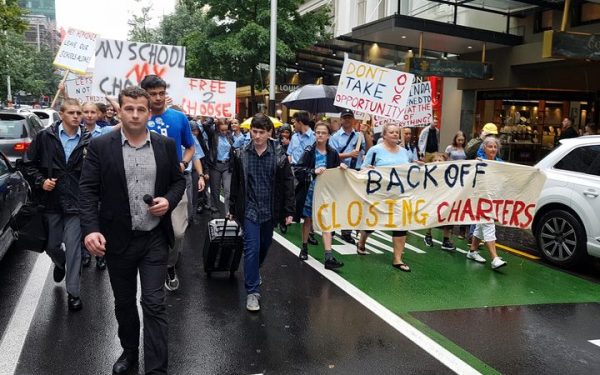
Well the big announcement has been made and charter schools are to close (sort of). The latest of National’s ideological experiments is to be consigned to the dustbin of history, where it belongs. In a previous blog I went through the performance shortcomings of the New Zealand experiment. For some, though, the performance issues do not matter. It is the ‘freedom to choose’ that is important.
Over the years I have written a lot about the drivers of school choice. I have observed that one can have the most ‘free to choose’ system in the world, but still the choice exponents will want more. And here we have it. New Zealand has the most open system in the world – in principle any child can go to any public school the parent chooses (although in practice popular schools become full very quickly, then it is down to a lottery). But there is more clamour for more choice, better choice, different choice. This is despite the fact that taxpayers show little appetite to pay for such choices.
So, my question to you, dear reader, is in two parts. When, after 30 years of choice-based schooling, New Zealand‘s international performance in literacy has fallen from first to fifteenthish in the world, and all other choice-based systems have also fallen, why should we have faith in ‘choice’ as a policy mandate? Choice reduces overall educational performance.
And, second, why should the New Zealand government pay for schools that can use unregistered teachers, strange curricula and cowboy providers to produce, let’s face it, less than spectacular results?
In short, the New Zealand public should be clamouring for an end to the charter school experiment, and a return to a system where high-quality teaching and learning, within a national framework, is available to all. We should concentrate all our resources on improving the system that we have, which is not bad internationally, and perhaps work to become first in the world again.
If there is extra to spend, we must use it to support the hundreds and thousands of children who live in poverty, because they experience huge barriers to learning. There are supports in place but there are also still big holes in the support systems.
Alvin Poole, who runs two middle schools along with his wife and a board of Christian evangelicals (I am not against such people, but their drivers tend to be about God, not policy), has vowed to oppose the removal of the schools. He will learn that governments do have the right to change policies and change the law.
I like some of Alvin’s ideas. I am interested in the community service element that he has brought into his schools. I think schools overall need to be more outward looking. They should be extrovert organisations in their own communities, hubs of activity and places of learning for all (bring back community education!).
It makes the most sense to put all that innovation money into the existing system of schools, rather that starting new ones. I completely reject the idea that the private sector does education better than the public. New Zealand’s private schools are foundering financially and only state grants hold them up.
The charter school experiment is based on a myth that private schools are better than public. Yet in reality state schools in this country produce outcomes as good as the best private schools with about half the funding (or less), and without a moneyed community behind them.
The argument that charter schools should stay because they perform better than private schools founders on their extremely poor retention and completion results. Certainly, review them one by one. Save the effective Rise Pacific school and perhaps the one or two best Maori schools. For goodness sake close the religious and military schools, Minister. We don’t need them and they detract from the goal of a good state schooling for all.
There are vested interests in this field, even within the government. Those who have interests need to recuse themselves from all say and all involvement in the decision. Let the decisions be dispassionate and analytical. We deserve nothing less.
Dr Liz Gordon began her working life as a university lecturer at Massey and the Canterbury universities. She spent six years as an Alliance MP, before starting her own research company, Pukeko Research. Her work is in the fields of justice, law, education and sociology (poverty and inequality). She is the president of Pillars, a charity that works for the children of prisoners, a prison volunteer, and is on the board of several other organisations. Her mission is to see New Zealand freed from the shackles of neo-liberalism before she dies (hopefully well before!).


OK.
There’s a core set of skills we’d like to think every citizen with the capacity to learn could have mastered before they skip away from primary school into the holding pen of secondary school.
And, too often, we’re failing.
We had the Labour thing about ‘qualifications’ – every kid should have one. Every kid who didn’t? Well, ‘we know’ about them, eh?
Tough if you wanted one of the core skills to be swimming. Schools closed the pools. ‘Safety’. Too bad if you wanted your kids to know about shopping, cooking, budgetting and basic life skills. ‘Frills! Learn at home’
The curriculim is a portable feast. A hot pot of the moment and the trends. Readily put on a diet or starved to death. Subject to whim and ideology.
It’s a crock.
Dispute? Who is putting together a lot of online material? Unless there’s been a change – good old USA, as part of the great propaganda drive.
All schools are charter schools under the skin. Each is the creation of the teachers, kids and community. There’s very little commonality at all.
PS in the Olden Days – lots of teachers, damn’ good ones, came in from trades and similar to teach. ‘Unqualified’ – and kids learned well enough to cope with leaving early. Qualifications have not led to teacher retention or increased learning skills in many students.
BTW – where are the second chance schools for men? Lots of young fellows crave to leave school early. Get a job. Buy the toys. And would love to return later, when they’ve reached a learning frame of mind.
Make it easy and very affordable to learn in a formal environment, any time. Always. Unconditionally. Throughout life.
Now, when do night classes start again?
I think you’re mistaking cause and effect. It was National education policy that told schools they should be putting all their focus on STEM subjects, and defunded schools pools, and manual and art classes. Has this actually improved students’ performance in the STEM subjects? Well no, and teachers told them it wouldn’t, because decades of international research show that supporting learning in non-STEM areas like art supports learning in STEM areas.
“The curriculim is a portable feast. A hot pot of the moment and the trends. Readily put on a diet or starved to death. Subject to whim and ideology.”
Have you ever actually looked at the curriculum? A friend who was homeschooling his daughter showed me his copies. He explained that the curriculum lays out all the things the education authorities expect a child to learn during their schooling, and leaves it up to educators (including parents like my friend) to decide the best way of teaching that material for the students they teach. There’s nothing arbitrary or ideological about it, and your description couldn’t be further from the truth.
“Online material”? I’m guessing you’re referring to the “COOL” program, another National policy, which was basically another kind of Charter School in techno-utopian drag. I support distance learning (extramural/ correspondence), and the internet seems like a sensible way to deliver it in the 21st century, but online courses need to be subject to the same curriculum and teaching standards that apply to traditional postal correspondence courses.
“in the Olden Days – lots of teachers, damn’ good ones, came in from trades and similar to teach.”
Yes, and in the Olden Days, physical abuse of students by these untrained teachers was much higher, because they had neither the patience nor the training to carry out effective, non-violent classroom management. Sexual abuse was also higher, as their motives for going into teaching weren’t always noble. Mandating proper training and registration can’t completely eliminate pedophiles from the teaching profession, but it forces them to go to much greater effort to get access to classrooms full of children, and makes it much easier to keep their out of schools once they are identified.
Absolutely agree about the second-chance schools. High schools have pushed academic learning over practical learning since my time there, whether that’s appropriate for a given student or not. In my parents’ day, students who were more suited to trades and other hands-on work could go to technical colleges instead of academic-orientated high schools; basically go straight to polytech but without the student loan. Fortunately, the NCEA system now allows high schools to offer more practical subjects. For example, see the students being trained in panelbeating at a high school in Nigel Latta’s documentary series from 2014:
https://www.tvnz.co.nz/shows/nigel-latta/episodes/s1-e2
The ACT Party is really desperate, that is what I read into this.
The debate about Charter Schools has been incredibly frustrating. The right have presented those of us opposed to Charter Schools as advocates of a conformist, one-size-fits-all school system, which prevents educators from experimenting with new approaches for specific groups of learners. The sensible response would have been to consistently debunk this caricature, by pointing out that the public education system already supports a diverse range of special character schools, kura kaupapa, and so on. Instead, too many on the left leaped into the hole the PR trolls of the right dug for them, by attacking the idea of different kinds of schools existing within a unified system, instead of criticizing the things that were actually wrong with Charter Schools (unregisted teachers, not bound to the same curriculum, with greater funding , and so on) *facepalm*.
I see no reason to discourage private schools so long as they perform to a standard set by society. But I see no reason for them to be funded by the state at all. How bazar that the extreme neoliberal, user pays, politicians seem to think they should be state funded.
D J S
Bang on David, by all means have your private school but the moment it is funded by the Government then you play by their rules.
Yes National have used us an a social experiment with their crazy ideologies just like Hitler did during the war.
So we are welcoming the scrapping of these draconian privatizations of our essential services.
Send the National Party also to the scrap heap too please.
it is now out of date and unfit for purpose any more.
We need a ‘National Socialist Party’ that cares and builds the future for us all not just the few.
The rationale for funding private schools, as I once had it explained to me by a Ministry of Education policy analyst, is primarily down to a recognition that private schools remove students from the public education system. So the Ministry provides an amount but it is nowhere what a publicly funded school receives in funding entitlements.
But I don’t agree with it. It’s either private or public and private should be able to stand on its own without public assistance. And the likes of Wanganui Collegiate getting a $3.8m bailout in 2012 (even though they became integrated as a result) still irks me, especially as the school at the time held an asset portfolio of around $6m.
The Wanganui Collegiate School bailout should have been a massive scandal. Given the power of the teflon Government of the time it wasn’t.
All the crap about charter schools and their difference to state schools, all the rhetoric about accountability, all the bunkum about private models being best.
They were failing, they should not have been bailed out. You know , you don’t make a go of it you close, that’s what’s good about the charter model. There was enough school space in the district to absorb the locals who attended.
The MInistry advice was ignored, the Minister was out-voted and Chester Borrows will probably get a knighthood for getting the Cabinet to support him.
The scum on Kiwiblog who proudly flaunt the “NZ is least corrupt country’ sort of angle when international surveys come out (well did when their cobbers were in government) see the Wanganui Collegiate episode as good business. I call it corruption. Wanganui Collegiate = WC
http://www.stuff.co.nz/national/politics/8345722/Parata-overruled-on-Collegiate-integration
The simple fact is the right are using the ignorance and sense of entitlement of the masses to get them to fight for their profit-making causes – as is always the case. Charters are a money-making scam, but members of the public don’t see that – they just see “my school”, “my uniform”, “my community” – the “choice” argument from the right is just the hook; pure pretense. As a result, the public end up ironically fighting for ideologically leftian causes but which have been co-opted by the right. This is why a basic political/historical education is necessary.