

Dairy sell out and how Fonterra have trashed their social licence
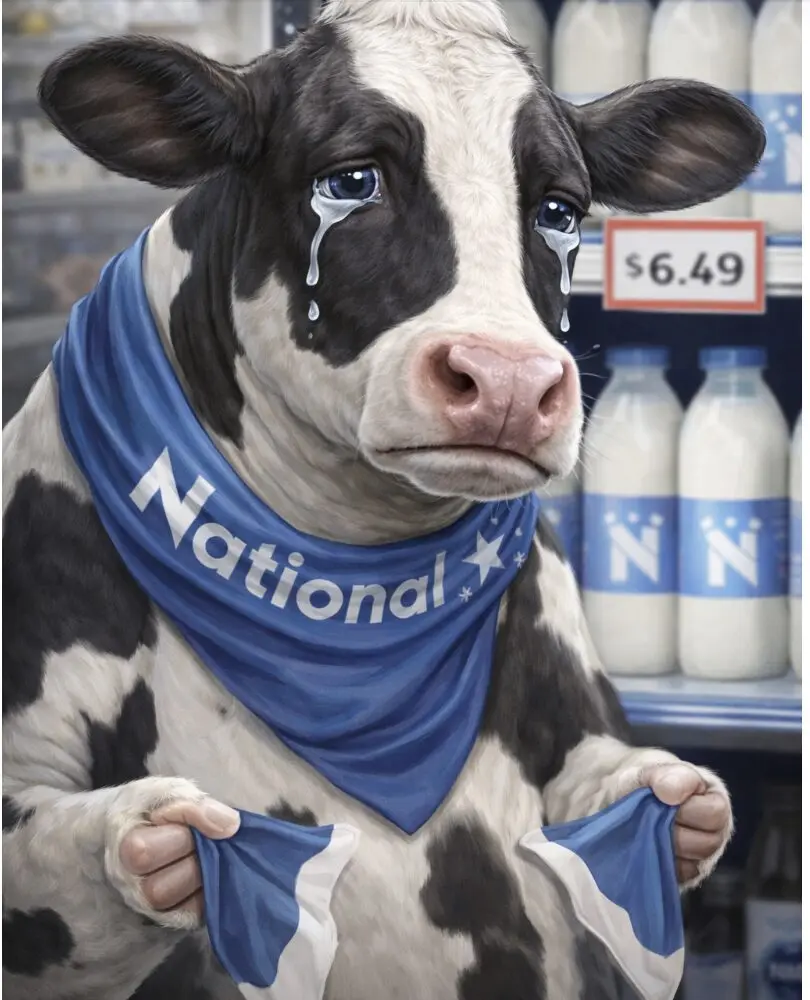
Fonterra’s social licence in New Zealand has always rested on a simple deal: we give you scale, you give us value back. But the dairy sell-out to Lactalis suggests that deal is dead — and Kiwis are the last to be told.
Fonterra’s billion-dollar payout not a lottery win, say farmers
Dairy farmers woke up significantly wealthier on Tuesday, but few are calling it a windfall.
Fonterra’s $3.2 billion sale of its Kiwi consumer brands to French dairy giant Lactalis has triggered one of the biggest single-day cash injections rural New Zealand has seen, delivering an average of about $400,000 per farm.
Economists say the boost is large enough to lift national GDP by around 1% at a time the economy could use it.
The sale included some of New Zealand’s most familiar dairy brands, including Kāpiti ice cream, Mainland cheese and Anchor butter.
Stuff

Fonterra milks its monopoly position to screw us the domestic consumer from eating the harvest from our own land.
Fonterra have trashed their social licence in NZ
They have destroyed all the value added brand to just produce milk powder as a ingredient filler for the mass produced ultra-processed food industry…
Selling the future for a one-off payout
Fonterra’s farmers vote in favour of $4.2b Mainland sale to Lactalis
Fonterra’s farmers have voted strongly in favour of the sale of its Mainland consumer and related businesses to France’s Lactalis for $4.22 billion.
The co-op said 88.47% of the total farmer votes were in support of the sales.
Voting, which started on October 7, closed today at a special meeting.
The co-op is targeting a tax-free capital return to farmers of $2 per share from the transaction.
Analysts estimate the deal is worth about $400,000 in total for an average farmer.
A $400,000 tax-free payout given to selfish Dairy Farmers who used their monopoly position to build these brands only to flog them off in favour of milk powder production for the heavily manufactured food industry!
Fonterra doesn’t care about New Zealand. That’s Greenpeace Aotearoa’s message following the confirmation of sale of Fonterra’s consumer brands this morning.
Greenpeace spokesperson Sinéad Deighton-O’Flynn says, “Fonterra’s CEO Miles Hurrell has shown that he views New Zealand as nothing more than a milk powder factory, creating low-value products to ship overseas for use in Mars Bars.”
“People can’t afford to buy butter, their water is contaminated with nitrate and E. coli, and the worsening impacts of the climate crisis are being felt across the country. Meanwhile, New Zealand’s worst climate polluter has made a killing selling off its consumer brands to French dairy giant Lactalis. Fonterra is milking us dry and selling us all out.”
“While Fonterra makes $4.2 billion from the brand sale, New Zealand’s integrity as a fair and socially responsible country is being whittled away by the impacts of intensive dairying.”
Two thirds of rivers and lakes are too degraded to swim in or collect kai from, and many rural communities can’t drink the water coming out of their kitchen tap because of nitrate contamination from intensive dairying.
Fonterra is also New Zealand’s worst climate polluter, producing massive amounts of superheating methane gas.
“Fonterra is driving catastrophic climate change.” says Deighton-O’Flynn. “Already this year we’ve seen multiple extreme weather events hitting rural communities hard, and unless Fonterra supports farmers to move away from its intensive farming practices, these events will get worse.”
Over the long weekend, New Zealanders were hit by yet another extreme weather event in the South Island, made more likely due to climate change.
“We all want a stable climate to grow food, access to safe drinking water, and a secure future for our kids. But Fonterra clearly doesn’t care about New Zealanders. Instead of throwing a lifeline, and helping dairy farmers to transition away from destructive intensive dairying, Fonterra is prioritising lining the pockets of its executives.
“Any claims that this sale is good for New Zealanders are built on the fallacy of trickle down economics. The proceeds from the brand sale aren’t going to help New Zealanders struggling to pay for butter at the supermarket or recovering from storm damage, the only thing trickling down in this economy is nitrate and E.coli.”
Why Kiwis can’t afford their own milk
We created a monopoly in the form of Fonterra to maximise price negotiations on the global market, but the flipside of that is that me as a consumer in NZ, for a product made in NZ, I’m competing with 500 million middle class Chinese who want this product.
NZ only has a population of 5 million, we can never compete for price against 500 million middle class Chinese.
Why should we be forced to pay the same price as the Chinese Middle Class can afford?
The Chinese Middle Class is forecast to grow to 787 million!
On top of that, this butter is created by a cow which takes water, pollutes water and generates climate warming emissions.
So this product, that I’ve already paid an environmental price in the manufacturing of, also costs me an arm and a leg price wise, because I’m competing with 500 million middle class Chinese?
Why are we paying a price that is imposed upon us by a middle class market that is many times larger than our total population?
Also consider the impact of synthetic milk production that would cripple our economy overnight!
How close is research to synthetic milk powder?
Current progress
Precision fermentation: Companies like Perfect Day (US), Imagindairy (Israel), and Remilk (Israel) are already producing dairy proteins (casein, whey) using genetically engineered microbes. These proteins are identical to those in cow’s milk.
Pilot products: Ice cream, cheese, and yoghurts using synthetic milk proteins are already on the market in limited quantities.
Milk powder challenge:
-
Fresh liquid milk analogues are progressing faster because they need fewer processing steps.
-
Milk powder requires scale and drying infrastructure — you need not just proteins but fats, sugars (lactose alternatives), and minerals in the right balance, then spray-dry them without losing functionality.
-
As of 2025, no company has achieved full commercial-scale milk powder equivalents suitable for use in all the same applications (e.g., infant formula, bakery, confectionery).
Timeframe estimates
Industry analysts predict proof-of-concept synthetic milk powders within 3–5 years, but mass-scale, cost-competitive production is probably 10+ years away.
Bottlenecks: scaling fermentation vats, energy cost of spray drying, regulatory approvals, and consumer acceptance.
Dairy is a sunset industry and our decision to destroy the brands and sell them off means we are simply basic bitch milk powder producers and we lose all our edge the moment synthetic dairy can replace organic milk powder.
Our milk powder is used as an ingredient filler for the heavily manufactured food industry, a food industry that produces fat, sugar and salt laden crap food.
Do you all honestly believe hand on heart that that food industry will draw a line in the sand for our organic milk powder?
How stupid is that?
Why have we allowed the corporates to take the kai from our nation and make us compete against far larger markets who will pay more than the domestic population in NZ can afford?
I’m sick of Fonterra’s excuses.
We created a Monopoly for them and they have trashed their social contract with Kiwis!
Watch as these French owners use New Zealand’s brand and then replaces our product for theirs while trading on our brand!
The huge pay off from selling our brands will be reinvested into the right wing astroturf influencers as Dark Ag money to manipulate the sleepy hobbits into entrenching their interests.
Get off your knees Kiwi, the Dairy Farmer ain’t your mate!
The real risk isn’t just that Fonterra has lost its social licence — it’s that by abandoning value-added production and doubling down on commodity exports, it may have also gambled away the long-term future of New Zealand’s most important industry.
Because once you sell the brands, you don’t just lose margin — you lose identity. And when synthetic dairy finally scales, no one is going to pay a premium for anonymous milk powder. That’s the real gamble here. Not just that Fonterra has trashed its social licence, but that it’s traded New Zealand’s long-term economic leverage for a short-term cheque.




On TV last night a couple of farmers were interviewed all saying essentially the same thing. Retiring debt, there were issues with the brands, maybe a family holiday? A response issued by Fonterra corporate affairs perhaps ?
However, when the French eventually bail, as they will, Peaches and Frozen Veggies anyone?
“Few are calling their $400k payout a windfall!” Poor farmers, my heart bleeds for them. What a kick in the teeth for those for whom it would have been like winning a lotto prize. That “paltry” amount would pay a number of debts for our poorer paid. What an insult; what a self-entitled reaction! Once these brands were sold there are no further earnings from them. If our farmers wish to be respected, time to stop polluting our waterways, stop producing excessive methane gas, and start using sustainable, organic fertilizers, already being produced in NZ. Thx to all caring farmers. The greedy, uncaring – hang your heads in shame!
Farmers are hard working individuals who try and make a success of their lives by hard work.It is no wonder the Left do not like them .
Trevor have you no compassion – even the cow is crying? ‘Hard work’ is doing two full-time jobs just to make ends meet! You are becoming BTF.v2 with your 2 sentence responses. Read the article again and try really hard to come back with your very “own” innovative comments.
Middle and low income workers work just as hard Trevor, no wonder the right hate them until a pandemic happens and the right need toilet paper, then they become the biggest hypocrites on the planet. Farmers rely on customers to buy their products, so in fact the co sumer should stop buying local and watch the price of goods drop then. Then perhaps the Right who hate workers and workers rights will fall on their swords.
The Right and Trump have similar traits.