
1984, Year Zero: The Juggernaut story of the fourth Labour government and Unwinding neoliberalism in Aotearoa New Zealand
Contemporary experience is a misleading guide to tumultuous events. The old order may well be dying, but the new is yet to emerge. Ruptures of history only become identifiable in retrospect, when the noise and dust has cleared. After 40 years of neoliberalism in Aotearoa-New Zealand, the events of July 1984 signify a rupture of capitalism, politics, economic language and collective memory.
Back in June ‘84, Prime Minister Robert Muldoon laid his final bet. In a less than sober state, he wagered that a snap election would surprise the Labour Party and increase National’s two-seat parliamentary majority. But, during a disastrous election campaign, Muldoon was humiliated by Labour’s David Lange in a television debate and Bob Jones’ economic-right New Zealand Party attracted National voters in marginal seats. As Labour and the New Zealand Party gained momentum, many sensed that Muldoon was done for, and that David Lange would be the new prime minister. I experienced this result at an election might party in a small Mt Eden villa not far from Eden Park. Labour voters all, we celebrated wildly as Muldoon’s citadel was swept away. David Lange, prime minister elect, commanded the televisual stage. After almost nine years of divisive rule, progressive national purpose had prevailed. Next morning, worse for wear, on the Auckland launch to Waiheke Island, I read the Sunday paper acclamations. On Monday, though, euphoria disappeared as news of a currency crisis set in. Over subsequent days, weeks and months, uneasiness grew—election night ’84 would prove to be a mirage.
Economic policy coup
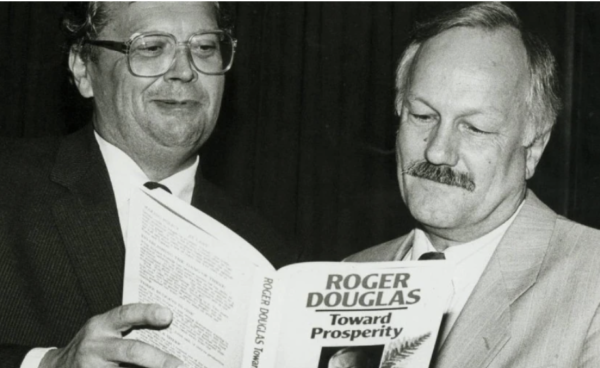
Over February-March 1983, David Lange usurped Bill Rowling as Labour leader and appointed Roger Douglas as shadow finance minister. During the year his broadly Keynesian approach to economic management shifted to the economic right, under the influence of Doug Andrew, Treasury liaison for the Labour Party. Alongside Treasury colleagues and Reserve Bank officials, he had become a monetarist, free-market convert. Douglas, Andrew and supporting researchers produced a policy package for Labour’s caucus Economic Committee which favoured devaluation of the New Zealand dollar. That never became Labour Party policy, but by the June 1984 snap election , business leaders and financial investors well knew Douglas’ preference. They converted New Zealand dollar funds and credit into other currencies with the intention of converting back once devaluation occurred. During the campaign, a foreign exchange crisis developed as the Reserve Bank ran out of overseas reserves. Officials favoured a 20 percent devaluation and the abolition of interest rate controls. Upon election, Finance Minister Roger Douglas duly delivered, and the currency speculators made a killing. Outgoing Prime Minister Muldoon tried to avert these events without support or success. David Lange performed as the authoritative prime minister elect, but this was illusory. As Bruce Jesson recalled in Fragments of Labour (1989), “it was at that precise moment that he lost any chance of controlling his government’.
Currency devaluation and interest rate deregulation, effected before the new government was sworn in, had not been signalled in Labour’s Policy Document. Uncompleted in detail because of the snap election, it prioritised full employment, economic growth, a prices and incomes policy and New Zealanders’ control over their economy. After the devaluation, government economic policy answered to a more influential document—Treasury’s Economic Management. This was a set of post-election briefing papers which opposed, on principle, Keynesian policy prescriptions and recommended thorough-going reduction in the government’s economic role. Accordingly, banking was deregulated and the New Zealand dollar floated (in March 1985). Roger Douglas with Treasury backing decided to corporatise government departments. From April 1987, nine new state-owned enterprises covered banking, postal services, land management, telecommunications, forestry and mining. Their private sector-based management systems, incentive structures and financial control mechanisms prefigured a privatisation programme after Labour’s re-election in 1987.
From 1987 to 1990, major asset sales included New Zealand steel, state forestry reserves, Petrocorp, Telecom and Postbank. They were never signalled during Labour’s re-election campaign. The entire process was coordinated by Treasury. From July 1984, it became the conduit between corporate interests such as the Business Round Table and the most influential cabinet ministers. Treasury’s neoliberal rationale was bolstered by a new strata of think tanks, lobbyists and public relations mediators. Organisations such as the Centre for Independent Studies, Consultus, Strategos and Communicor formed lines of communication among financiers, stockbrokers, corporate heads, SOE managers, Treasury, the Reserve Bank and key ministers aligned with Roger Douglas. This network reduced the government policy influence of traditional pressure groups (i.e., farmers, producer boards, manufacturers) and parliamentary watchdogs such as the Ombudsman and Auditor General. Also under Labour, the neoliberal economic agenda was constitutionally cemented by the 1989 Reserve Bank Act. Corporatist income policy arrangements involving government, major employers and unions thereby ended. All macroeconomic goals became subordinated to the maintenance of low inflation. Long-term structural unemployment was the inevitable result.
The snap election currency crisis had enabled Roger Douglas and his cabinet supporters (Richard Prebble, David Caygill), Treasury and the Reserve Bank to capture the macroeconomic agenda and reject Labour’s Policy document. When National conformed to, and extended the prevailing ideology from 1990, the policy coup was completed. ‘Free market’ dogma had become the lexicon of New Zealand’s political class. Ideological dissensus and party fragmentation did result. However, the emergence of New Labour (1989), Mana Motuhake (1990), the Greens (1990), the Alliance (1991) and New Zealand First (1993) did not overthrow the new orthodoxy.
Global capitalism versus economic sovereignty
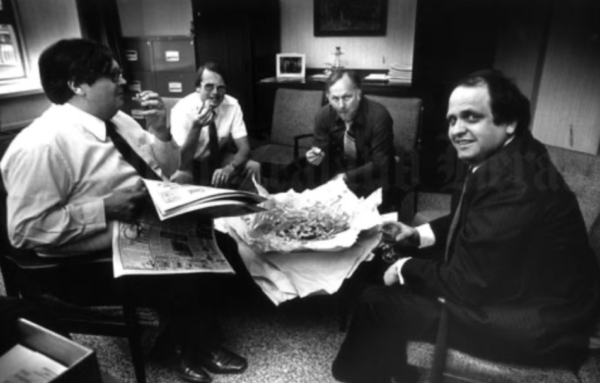
Once Roger Douglas announced a 20 percent currency devaluation, revoked interest rate controls and deregulated banking, the finance sector expanded rapidly. Media depictions of financial moguls such as Michael Fay, David Richwhite, Bruce Judge, Colin Reynolds, Alan Hawkins and Craig Heatley exuded dynamism, prosperity and progress. Their combined capital contributed to commercial building booms and property bubbles in Wellington and Auckland. Meanwhile, directorial elites, institutional investors and company shareholders were caught in a wave of mergers and acquisitions. After Labour’s removal of foreign exchange controls in March 1985, corporate predators used local and international markets to activate passive shareholders against target companies through ‘buy-outs’ and offers of higher dividend returns. By late 1986, euphoria and greed had gripped the country. Almost 900,000 New Zealanders owned shares. Joining a share club or attending an investment seminar became as common as buying a lottery ticket or attending a race meeting. Most brokers offered one simple message—buy! To this end, smaller investors sold land, mortgaged houses, withdrew life savings or sought loans at rates exceeding 25 percent.
Crucially, economic sovereignty was being eroded. This became apparent after the share market collapse on Tuesday 19 October 1987. The commercial building boom ended, property companies collapsed, and the financial services industry contracted. Over exposed banks demanded their money back and triggered further bankruptcy. Many New Zealand companies were sold cheaply to surviving local corporates (such as Fletcher Challenge or Brierleys) or to overseas transnationals. Consequently, New Zealand was no longer a nationally constituted economy. By 1996 six of the seven major banks and nine of the top 10 insurance companies were overseas owned. Under the 1989 Reserve Bank Act, strict monetary policies allowed foreign investors and currency speculators to exploit high domestic interest rates and drive up the value of the New Zealand dollar. Financial volatility had unpredictable impacts on local bank lending margins, import prices, export competitiveness and the current account deficit. Domestic business activity thereby became incorporated within the flows and networks of global capitalism.
‘Free’ market language prevails
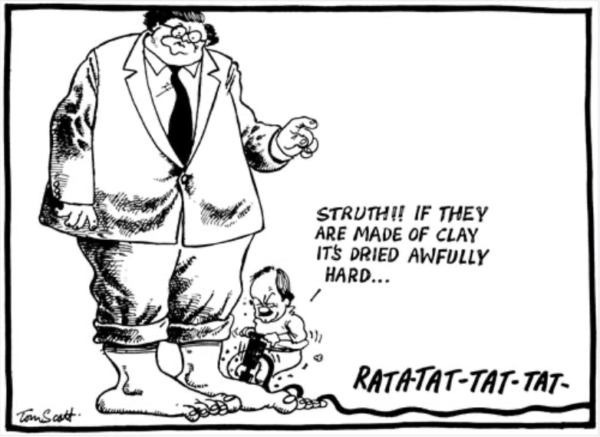
The growth of a financially driven corporate culture and the disintegration of economic sovereignty was obscured by the changing patterns of language and imagery associated with `the economy’. This transition was abetted by negative media depictions of the previous government. Robert Muldoon and his strategies of economic management (‘think big’ energy projects, the wage-price freeze) became synonymous with ‘inefficiency’, ‘regulation’ and ‘intervention’. These were signifiers of ‘Muldoonism’, an epithet for economic irrationality and anachronism, which implied that the policy initiatives of the Lange-Douglas government were absolutely necessary. I well remember the times. Muldoon seemed culpable for everything—rising oil prices, world recession, inclement weather, sun sports, continental drift. Stereotypes of the ‘old’ economy per se were inherent to the overlapping images of manufacturing, blue-collar work and associated union activity. Television and print pictures of factory yards, railway workshops, worksite meetings and Federation of Labour President Jim Knox appeared as relics within the new mediated world of financial entrepreneurship.
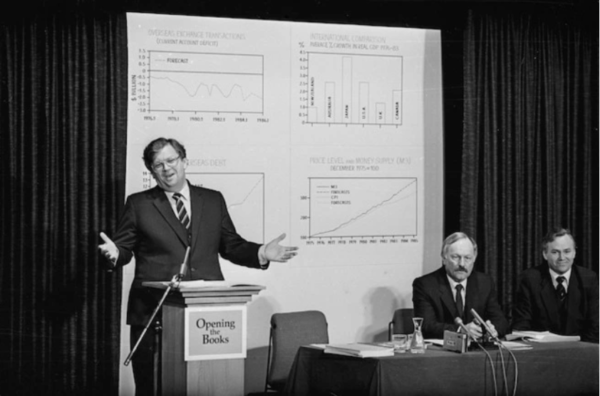
Language associated with ‘the economy’ began to shift once the new government released Treasury and Reserve Bank documents purporting to outline New Zealand’s worsening economic plight. From this point onwards, their diagnoses and prescriptions dominated economic news reportage. It was, and thereafter remained, difficult to criticise the emerging macroeconomic agenda without appearing irrational or anachronistic. The mainstream media wasn’t suddenly converted to the Treasury/Reserve Bank line; the process at work was subtler. Editorial writers, sub-editors, newsreaders and interviewers assessed the so-called ‘opened books’ through language that the books themselves authorised. Consequently, the stances contained within official documents became absorbed into mainstream news coverage as natural descriptions of economic change. Open policy debate did not entirely disappear. Rather, it centred around a rearranged conception of ‘the economy’ as a self-operating dynamic instead of an entity that could be managed by governments on public behalf.
How, then, did this transition of language occur? Here, we must revisit the September 1984 Economic Summit—a staged, televised façade of politicians, employers, business sector organisations, unions and unemployment rights groups. Prior news coverage had registered two separate languages. One portrayed an economy which was planned and protected, the other an economy which was free and open. The former was associated with manufacturers and unions, while the later expressed the views of Treasury, the Reserve Bank, corporate elites and the Minister of finance. Summit news coverage shows that debate between these rival perspectives was more apparent than real. Only one economy could become ‘the’ economy, and it was the free-market version which prevailed. Such is evident in the following Television New Zealand news bulletin of 24 September 1984.
Philp Sherry (Anchor): In the news, the Economic Summit conference begins but already consensus has given way to conflict. Good evening – on the opening day of the Government’s Economic Summit, conference unions and employers have clashed over who is to control and benefit from the economy. The Federation of Labour and the Combined State Unions published an alternative economic strategy which called for controls on investments, profits and dividends. Union speakers at the conference argued that they must have a greater say in running the economy; however, business leaders stressed the need to open up the economy (;6.30 News, TV1, 12 September 1984)
In Philip Sherry’s introduction, ‘the economy’ as such is subject to rival conceptions. These are ‘running’ the economy and ‘opening up’ the economy. From the union perspective, the ‘economy’ appears as a means of controlling ‘investments, profits and dividends’. However, for business leaders, ‘the economy’ is an end in itself; it must on principle be opened rather than controlled for ulterior purposes. Crucially, the union view is said to represent an ‘alternative’ economic strategy to the one which is officially on offer. Thus, the bulletin is in effect an historic snapshot of how market-oriented representations of ‘the economy’ were being formulated against union wishes. We are told that union speakers want a greater say in ‘running’ the economy. But the parameters of language are set at another level; the real and one-sided debate is whether ‘the economy’ should be run at all. After the Economic Summit, the ‘free market’ or ‘open’ economy simply became ‘the economy’. Accordingly, the ‘alternative’ economic strategy that had been proposed was consigned to the discredited economic past.
Reconstructing and reinventing the economic past
Jim Bolger’s National government of October 1990 had promised voters a ‘decent society’. However, under Treasury’s tutelage, National further advanced the neoliberal agenda. The welfare state as such was seen as an impediment to fiscal constraint and economic growth. Thus, Finance Minister Ruth Richardson reduced a range of benefits in December 1990 and announced a further round of cuts in the 1991 budget. The Employment Contracts Act of May 1991 vetoed union bargaining agency and reduced union membership. That budget also sold most of the remaining state forests and some Crown mineral interests. In late 1992, the government sold its majority stake in the Bank of New Zealand to National Australia Bank, and in July 1993 New Zealand Rail was privatised.
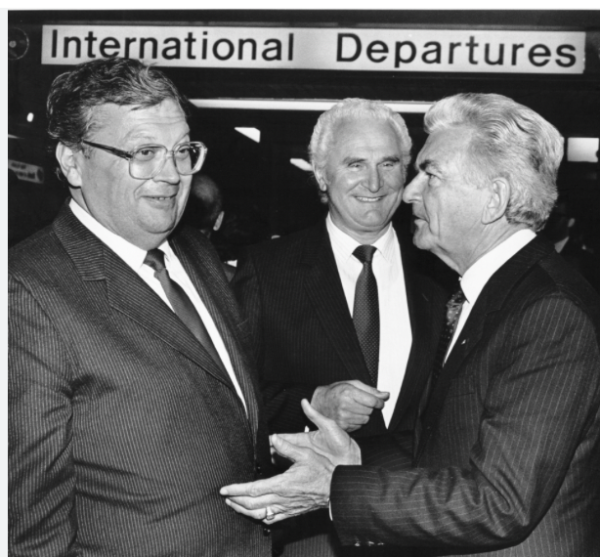
The very extremism of National’s policy initiatives obscured their Labour origins. After the demise of David Lange, Roger Douglas, Richard Prebble and David Caygill plus Jim Anderton’s departure to the New Labour Party, a false narrative emerged—the Fourth Labour Government had to make tough, unpopular economic decisions but the Bolger-Richardson National government went too far. This reinvention of the economic past informed the post-Rogernomics Labour Party and Helen Clark’s prime ministership from December 1999. Documentary evidence suggested otherwise. Back in April 1990, TVNZ’s Frontline special For the Public Good had explored the relationship between major corporates and the Fourth Labour Government. Its 1987 re-election campaign was, allegedly, partially funded by donors intending to benefit from favourable policy initiatives. Thus, Alan Hawkins of Equiticorp gave $250,000. Post-election, one day before the sharemarket crash, Roger Douglas announced that Equiticorp would purchase New Zealand Steel. Whether Hawkins or other donors directly brought policies such as asset sales was virulently debated. Beyond dispute, though, was the fact that generous corporate donors actively supported Roger Douglas and Treasury’s policy agenda. Subsequently, Alistair Barry’s 1996 documentary Someone Else’s Country reconstructed the July 1984 policy coup and detailed its impact upon national economic sovereignty. Testimonies from workers, families, communities, public service officials and gulled Labour Party members recalled the political deceit involved—New Zealand’s electoral mandate had been abandoned.
Meanwhile, official ideological reinventions of July 1984 events were advanced in a 1996, TVNZ document series—Revolution: New Zealand from Fortress to Free Market. The opening voiceover in the first episode contained the following pronouncement.
Around the world, gurus of market-driven economic theory watched in envy as a tiny nation in the South Pacific did an about-turn and marched in a different direction. It’s the story of a revolution: and it was our revolution.
The double assumption here is that free-market policies grew out of popular revolt and that New Zealanders experienced this process together. The other, unstated, view was that this was an elite, top-down counter-revolution which generated major social division. Of those interviewed during the series, most were architects or advocates of the neoliberal policy agenda from the corporate sector, Treasury, the Reserve Bank and the Fourth Labour Government itself. Non-neoliberal voices were occasionally heard from David Lange, Bryan Gould, Ken Douglas and Margaret Wilson. However, those commentators who might have contributed to an oppositional narrative—Brian Easton, Simon Collins, Jane Kelsey, Bruce Jesson, Susan St John, Sandra Coney and Geoff Bertram—were conspicuous by their absence. The very title of the documentary asserted that New Zealand was, in fact, a ‘fortress’ before 1984. This reinvention of the economic past complemented the oft repeated claim that the national economy had been a stagnant, highly regulated ‘Polish shipyard. The phrase was initially used by Labour MP Jim Sutton in 1986 at a Labour caucus meeting and, on occasion, by Prime Minister David Lange between 1984 and 1989. Subsequently, he and Associate Finance Minister Richard Prebble used the term repeatedly as did New Zealand businessmen Alan Gibbs, Don Trotter, Roger Kerr along with Labour Prime Minister Helen Clark (from 1999). The implication of this phrase and of TVNZ’s Revolution documentary was that New Zealand represented a Soviet command economy rather than a developed Western economy. Yet, Keynesian capitalism from 1935 was not over-regulated by the standards of the time. The Polish shipyard image and fortress economy rhetoric were employed to discredit consideration of new social democratic alternatives.
Against my critical analysis one can evaluate contemporary reconstructions of our political-economic past. The most comprehensive has been Toby Manhire’s six-part podcast Juggernaut: The Story of the Fourth Labour Government. From 20+ interviews, 40+ books, government papers, television and radio documentaries and complementary news-current affairs footage, a fascinating archive emerges. However, there is no surrounding picture of how the entire structure of governance was being repurposed and repositioned within a globalizing economy. Also missing is a critical reconstruction of the ideological formations involved. Allow me to explain. Podcasts two: The Nation is at Risk, three Uranium on Your Breath, and five: Nine Day Wonder, together provide compelling reminiscences of New Zealand’s 1984 anti-nuclear stance, the Rainbow Warrior bombing, the 1985-86 homosexual law reform campaign and original Treaty of Waitangi jurisprudence. From my experiences these laudable developments also served an ideological purpose. They associated the Fourth Labour Government with reform and progress, rather than unmandated economic extremism. That combination of social liberalism and neoliberalism shaped Labour Party thought thereafter. A more interpretative podcast account could have highlighted the origins of this process.
Podcast six, entitled Breakup recalls the 1987-88 clash between David Lange and Roger Douglas/Richard Prebble over tax scales. These ministers were directly attacking the social democratic principles of progressive taxation. On David Lange’s subsequent testimony, he had come to recognise that a ‘new right’ agenda was dismissing his Labour beliefs and threatening his prime ministerial authority. Podcast footage on this matter is poignant but misleading. Intra-cabinet clashes over taxation cannot be understood without reference to Government Management, Treasury’s two-volume brief for the 1987 Labour Government. Here, neoliberal precepts were applied to state assets, government departments and social policy, including health and education. One simple formula infused the whole document—private equals efficiency, prosperity; public equals inefficiency, waste. Such was the crude rationale for subsequent privatisations, the 1988 State Sector Act, commercially driven health administration and ‘Tomorrow’s Schools’. Although Government Management did make allowances for extremely disadvantaged individuals, social entitlement principles were eschewed. My point is that the drama of the Fourth Labour Government cabinet breakup, admirably captured in Manhire’s podcast episode, was symptomatic of a deeper unacknowledged power-play—Treasury’s ideological onslaught against the remnants of Keynesian social democracy.
Most recently, the Aotearoa Wellbeing Economic Alliance released a 96-second video entitled Neoliberalism: Leave it in the 1980s. I was initially sceptical about this, but the title was promising. 1980s neoliberalism is certainly an anachronism, like Muldoonism before it. Eventual impressions were positive—the introductory voiceover framed matters nicely.
A new government imported a radical economic vision, one where the state took a step back and rules for corporations were weakened. We call this neoliberalism.
I would replace the word ‘vision’ with ‘doctrine’; neoliberalism in practice is formulaic and myopic rather than future oriented. And a few sharp images of corporate logos and corporate leaders—Ron Trotter, Douglas Myers, Roger Deane et al. would have reinforced the message. Quibbles aside, this is an impressively succinct video which historically informs today’s social justice struggles.
Concluding thoughts
This has been a long read, so my final comments will be brief. Neoliberalism would have found us eventually. From the 1980s, the International Monetary Fund (IMF) and World Bank imposed structural adjustment programmes on the global south. Reaganomics and Thatcherism in the US and UK respectively, presaged Rogernomics. Smaller, national economies everywhere were especially vulnerable to transnational corporations. Yet, our story is unique, internationally. An anti-Keynesian, ‘new right’ economic agenda was installed by a supposedly social democratic government. Further, some policy decisions were idiotically extreme.
I will never forget the 1990 sale of Telecom under Labour. All national phone lines and associated infrastructure was sold to Bell Atlantic and Ameritech for NZ$4.25 billion. Over the next decade, huge nine-figure profits were repatriated annually, consumers were stung by monopoly charges, thousands of skilled workers lost jobs, and a generation of human capital was destroyed.
In 2024, our present government repeats the neoliberal cliches and prejudices of the Ruth Richardson era. Government overspending causes inflation, work-shy beneficiaries must be disciplined. Labour meanwhile has no avowed recollection of its economic culpability and no conception of a non-neoliberal future. Like Leonard Shelby in Christopher Nolan’s film Memento (2000), they inhabit a doom-loop of amnesia and mistake repetition. Unlike Leonard, however, Labour seems oblivious to its condition. Fortunately, this is not a national plight. As younger activists are now realising, 1984 stands alongside 1935 and 1840 as a year of collective remembrance.


what happened in the neoliberal coup was that the big boys invaded the little kids’ playground and stole their lunches. They have never been made to give them back so keep right on doing it. That is what has happened.
Such a great analogy Wendy.
The real damage wasnt done until Ruth’s 1991 austerity budget.
There was nothing really wrong with SOE’s, as these organisations needed some form of autonomy, but the issues were them being flogged off to the highest bidder, mainly to oligarchs and and multinationals. A lot of workers laid off as a result of that formed their own businesses (that contracted back to the new companies) with their generous redundancy pay, effectively forming a new layer of middle class business owners.
Did the author go to Nicaragua in the late 80s?
An interesting article by Wayne Hope, but one that needs a deeper historical context.
The “neoliberal” policies of the 1980s in New Zealand and internationally came in the wake of the economic crises of the 1970s. The long decades of prosperity following World War Two bred a hubris among economists and capitalist politicians. We’ve learnt the lessons of the Great Depression of the 1930s they said. If the economy threatens to slow down all we need to do “prime the pump” through a mixture of government budget deficits and easy monetary policies, an approach associated with the name of John Maynard Keynes. “We all Keynesians now” US President Richard Nixon famously said at the time, and Muldoon agreed with him.
When the good times inevitably came to an end in the early 1970s, the Keynesians got their chance. The result was what came to be called stagflation, a deep recession combined unprecedented levels of inflation that threatened to turn into uncontrollable hyper-inflation. It’s easy to forget how scary the situation was. The policies the rulers adopted in the 1980s, here and elsewhere, were in part a reaction to that — they had to take drastic action or see their system collapse.
I recall the first stirrings of the economic debate in the 1970s inside the Labour Party between traditional “left” social democrats and an emerging right wing that came to be led by Roger Douglas. There was a professor named Holt (I forget his first name) at Auckland University who spoke for the right in the Party. One representative issue was the rent controls adopted by the Kirk Labour Government. Won’t work argued Holt. Investors will just withdraw from the housing market and you will end up making things worse for tenants. In a sense, he called the left’s bluff. If you accept the existence of the market economy and the capitalist system he told them — which they did — you have to let it work in the most efficient way, unrestricted by your regulations. And if you stay inside the framework of capitalism, Holt had a point. That’s why the right generally won the economic debate at the time.
Of course the “neoliberals” have largely had the field to themselves since the 1980s, allowing us to see in turn the results of an untrammeled capitalism in action, an economic and social disaster for working people as Hope and others have documented. The conclusion from all of this seems blindingly obviously to me: Keynesian reformism doesn’t work; neoliberalism doesn’t work — perhaps the problem is the capitalist system itself.
Perhaps we would get better results from economics if planned rollouts of methods were halted at the time of discussion, every hour. And the question then asked – What effect will this have on ordinary people? Is this effect, useful to us and the economy, and not deep and depressing of opportunities for improvement and return of basic wellbeing. Then alternatives be looked out such as are known by the clever ones such as talking something down, expressing concern in the media, etc.
When a whole economy can be ruled by an idea posited centuries ago, it can lead to mixed results, some being improvement and some being negative. The blanket effect may result in one canceling out the other, so inertia, or the fresh rise being stopped in its tracks while the negative outcomes increase. So one system cannot be regarded a panacea. We should think back into the centuries by all means including about Sisyphus; that heavy stone seems to roll over us all regularly, until we are all equal, only some are more equal than others!
Centuries ago Sir Thomas Browne wrote that ‘Death is the cure for all diseases’.
He did a lot of thinking in the 1600s and this about such in Wikipedia.
https://en.wikipedia.org/wiki/Thomas_Browne
In 1646 Browne published his encyclopaedia, Pseudodoxia Epidemica, or, Enquiries into Very many Received Tenents, and commonly Presumed Truths, the title of which refers to the prevalence of false beliefs and “vulgar errors”. A sceptical work that debunks in a methodical and witty manner several legends circulating at the time, it displays the Baconian side of Browne—the side that was unafraid of what at the time was still called the “New Learning”. The book is significant in the history of science because it promoted an awareness of scientific journalism.
We aren’t dead yet, but not in a healthy state! So what an active mind was thinking in the 1600s, like questioning and checking long-held practices, should well be noted and followed in the 2000s – in the important discipline of Economics and reviewed FTTT; examining those previously dismissed as unsuitable such as Keynesian approaches – instead using that with some mix of differing approaches suited for present dominating forces; not carrying on stolidly with failing methods still regarded as absolute truth and TINA.
The thing about rent control is that its opponents have nothing to say about what happens if landlords can just put their rents up willy nilly.
And no, ‘building more houses’ is not the answer.
I’ve been to Australia a couple of times in the last year or so, if anyone needs to see first hand what NZ might have been like without Lange/Douglas then visit brisbane or perth. Even allowing for differences in scale and culture there is just so much more going on economically and culturally over there and you can have a sensible political discussion without descending to insults or worse blank incomprehension.
Let’s not forget the neoliberal, stupid reforms to NZSuperannuation in 1991 budget. For a time on paper before the repeal of the legislation we were the most extreme country in the OECD–welfare benefit only and no tax concessions for retirement saving. 2024 NZ Super has not been touched (yet)
1991 budget said
“A revised National Superannuation scheme will replace Guaranteed
Retirement Income, as of April 1, 1992.
• At the same time, the GR! earners’ surcharge will be repealed and replaced
with a new abatement scheme.
• Under the abatement scheme, only 50 percent of a pension paid by a registered
superannuation scheme and annuities paid by a life insurance company
will be counted as private income.
• Couples or individuals with private incomes of less than $80 a week will
receive 100 percent of their National Superannuation when they reach the
age of eligibility.
• Couples or individuals with private incomes above $80 a week will have
their gross National Superannuation payments reduced at a rate of 90 cents
for every additional dollar of gross income earned after the first $80 of
private income earned each week. This is generally equivalent to a net
phase-out rate of 65 cents for every dollar of gross income.
• At the age of 70 and over, couples or individuals with private incomes of
more than $80 a week will receive 50 percent of the National Superannuation
paid to a married person, regardless of the level of their other income.
• The age of eligibility for National Superannuation will rise from 60 to 61
on April 1, 1992, and, after that, it will rise from 61 to 65 years at the rate
of three months in age every six months in time.
• As of April 1, 1993, the purchasing power of National Superannuation
will be protected, and the after-tax rates will be adjusted on that date in
line with the cost ofliving over the preceding year, and annually thereafter.
“It’s unavoidable that we’ll experience some short -erm pain for the longer term gain.”
The Artful Rodger Douglas, failed pig farmer.
Thank you Mr Hope.
I remember it all like yesterday. I have to admit that as with many, my repugnance at Muldoon’s tenure had me cheering on the early years of reform, but in my case the penny dropped when the newly created SOEs, which I had initially supported, started going up for sale without the mandate of voters. That, and the obvious double dealing and self-enrichment of the ex-treasury brokers such as Fay etc. The way certain trade union leaders rolled over, took the money, took up cushy corporate board placements and sold out also disgusted me.
I’ve been living in a shared neoliberal nightmare ever since, calling it out to whoever might be receptive to seeing the reality. We are now owned by foreign interests that suck the wealth out of our nation. In plain language, we’re fucked.
Just as we might wonder at how those at the bottom of the feudal heap never changed their world, future generations might wonder why we continue to allow it to continue.
The author has produced a wonderful financial analysis.
But I remember social change as being equally massive too. (My next article)
By 1984 economic changes were way over due.
Economically the country was run on a 1950’s model.
So what to do?
The incoming Labour Government knew massive and unpopular change was needed.
but did not signal their intentions at the 1984 election. They lied/with held the truth.
40 years later they will say it was all for the common good ..
But was it?
The new economic mantra was modernisation/technology and efficiency.
But what efficiency actually meant was putting 200,000 out of work.
The pain was not spread evenly The great majority of the 200,000 colateral damage were manual workers .
So what to do with all these 200000 unemployed?
1. Blame the poor unemployed for not finding work where there was none.
2.Blame the said unemployed for now being on a benefit.
3. Turning a blind eye to the problem.
4. Let the next Government deal with the problem of no plan B
David Lange like many incoming Prime Ministers left the sinking ship late on thus avoiding blame at the inevitable land slide defeat all parties eventually suffer.
To me the new economic master plan was no more than a case of slash and burn.
Every man and woman for themselves and to hell with any one else.
But David Caygill and Roger Douglas were financial geniuses and speak in economic techno jargon.
The 1990 Bolger Government followed and promised to halve unemployment but doubled unemplyment in 3 years not helped at all by the 1991 global recession.
Beneficiary bashing reached obscene levels for the entire 1990’s
Winston Peters epitmises the entire process as he ran away from the problem forming his own party where he could forever avoid responsibility by changing allegiances according to the latest opinion polls.
The unemployment figures today are really closer to 500,000 when you factor in the 250,000 more superanuents, thousands of unemployed moved on to sickness and ACC benefits, thousands in endless education programms and thousands fleeing to Australia.
So did the 1984 Labour Government actually change things for the better or did they just just move
the pieces around and create a permanent beneficiary blaming culture?
I am open to persuasion but very suspicious of deception.
So having lived through the era I believe improved technology has been great but the failure
to find alternative unemployment for half a million adults and using beneficiary bashing as an excuse for this failure remains a horrible blight on successive Governments.
Thankfully we now have a wonderful new caring kind understanding Government eager to heal the wounds with fair and equitable policies especially looking after the beneficiaries so we can all
finally live happily ever after…
There’s a book by Prof Jane Kelsey detailing how neoliberal thinking came to dominate Treasury just before the 84 election. It reads like a documentary about a cult where the participants have completely lost their faculty for critical thinking. Might have been called The New Zealand Experiment
A very good book.
Worth the long read, Mr Hope. No better time spent at first light. And a reminder of how language is used to express and hide intent – and equally, without critical scrutiny, how understandings of events reported through language (and often their associated images) can through the passage of time pass into the realm of myth. The article adds to the alternative voice and no better than 40 years on. My only hope is that the article is more widely disseminated, no disrespect to TDB. It deserves that.
And that’s why there is no longer a Left in New Zealand.
Grre piece, timely and knowledgeable encapsulation.
*great (damn acer keyboard)
Wow, a real trip down memory lane there Wayne. They were in retrospect quite heady times and remember them well. I quite often wonder what would’ve happened if the fourth labour government didn’t react in the way that they did, in regards to the economy and where would we ( AO/NZ) be today?
Great piece, made it all feel like yesterday. The start of globalism leading to the end of economic, therefore national, sovereignty, brought to us all, and still manged for us all, by both main NZ political parties!
The 1984 Labour government should have been good for four terms. But the sheer political ineptitude and incompetence of its caucus stuffed it into the bin in four years flat.
VG — Wrt the Gen X politicians who can’t think outside the neoliberal box, the expression “young fogeys” comes to mind. Leave them in the 1980s, alright.