
Your fellow citizens need YOU!
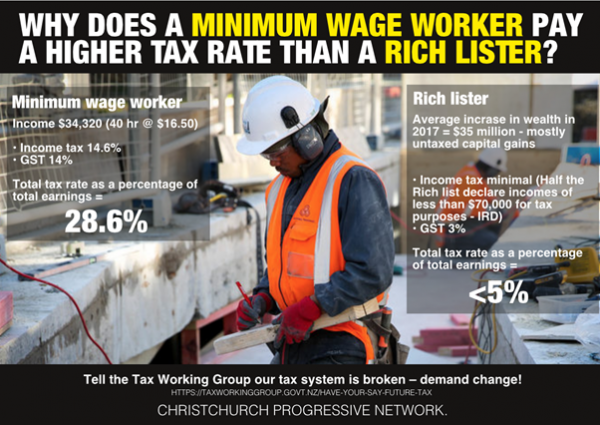
Yes – I know most readers of the Daily Blog are very cynical about the Tax Working Group. I share the cynicism. The TWG is stacked 8 to 2 with people who have spent most of their lives earning huge money to advise corporate New Zealand how to avoid tax. I blogged about it here.
But we have to build an alternative tax framework and you can help get your thoughts together on this through preparing a brief submission THIS WEEKEND.
Submission close this Monday 30 April.
The Tax Working Group have emphasised they want peoples’ input without necessarily including detailed arguments. I made some suggestions here.
Submissions can be made on-line under five headings as follows: (Just click on the links to give your input in less than 1000 characters!)
What does the future of tax look like to you?
Are we taxing the right things?
Can tax make housing more affordable?
What tax issues matter most to you?
And ask to be heard in person – the more voices the better!


What is missing from the neoliberal narrative is that:
1. Those at the top of the social-financial pyramid are not necessarily any more intelligent or hardworking than those at the bottom. Indeed, the reverse is often the case; people at the top are in privileged positions that provide high income because of inherited wealth (originally stolen from the indigenous population) or because of personal connection with the sociopaths that run the system. They do deals that raid the commons. They orchestrate projects (via the corrupt bureaucracy) that benefit themselves and their mates at the expense of the general populace.
2. The most basic existence in NZ requires payment of:
a. hundreds of dollars a week in rent -money effectively lost by the tenant and gained by the landlord
or b.
the payment of thousands of dollars in rates to local council and regional councils (these days in the range ($2,000 to $4,000 per annum)
c. the payment of insurance (again measured in hundreds or thousands of dollars per annum
d. the payment of energy bills (again measured in thousands per annum)
e. the purchase of food (again many thousands of dollars per annum
f. the purchase of clothing (hundreds of thousands of dollars per annum)
g. medical and dental treatment (again hundreds or thousands of dollars per annum)
So the important factor is the amount of money left over after the absolute basics are covered. And for many people towards the bottom of the heap there is nothing left over, whereas the ‘haves’ are able to afford all the latest gadgets and several overseas holidays every year.
$15,000 minus expenses of $15,000 = nothing
$150,000 minus expenses of $30,000 = $120,000
It was suggested to minister Grant Robertson that his tax review panel should include some members of the general public, selected by lot, or alternatively that he should run a citizens’ assembly in parallel. No response received. Submissions are what I call black hole consultation, they go in but nothing comes out. The issue here, as with so many difficult topics, is the need for long-form democratic discussion. The poor old internet is simply useless as a tool for discussion. Too many rants, too little willingness listen, or read, differing viewpoints and ask why and how and try to arrive at actions we can all live with.
That horrible disparity is why I suggested that tax be calculated at point of spending not earning !