
The Liberal Agenda: PolyFest 2024 and the reverberations of Don Brash’s 2018 comments
I have zero Māori blood in me or my family, but I always believed that my daughter had a birthright as a Kiwi to access the cultural treasure that is the Māori language, so since 5 she has been in Māori immersion education.
Each year at the start of school, the kids in my daughters class all line up and tell the class what tribe they are connected to and my daughter always says none, and there is the usual shock from the teachers as to why she is there if she isn’t a member of a tribe and she tells them each year that her Dad thought it was important that as a Kiwi she had access to the Māori language, and each year the Teachers praise her in surprise that a pakeha family would even consider this as an option.
Personally I’m always disappointed that more Pakeha parents don’t take up the option for Māori immersed education more.
When my daughter does a Karakia in fluent Māori at my table before we eat, it brings tears to my eyes and makes me feel like more of a New Zealander than any other single thing.
For me the Māori culture is a beautiful gift that can give you a deeper resonance of being a New Zealander, and it should be seen as the gift that it is, rather than an existential threat to Cracker.
Last year despite training for the first 8 weeks, my Daughter didn’t get into the Kapa Haka team at Polyfest which was tough for her, but she stayed with it and alongside her other class mates were doing Kapa Haka practise until 10pm 3 nights a week this year, and after all that hard work, she got selected for Polyfest competition and like any proud Dad, I turned up to watch her perform.
Polyfest was held at the Manukau Sports Bowl which is a large burning dish of heat with zero shade or seating. Directly under the flight path of Auckland Airport, large planes suspended midair like silver crucifixes drop menacingly from the sky every few minutes to remind everyone that those under that flight path are disposable to the interests of the wealthier suburbs of Tāmaki Makaurau.
None of this matters to the performers.
Their pride, their youth, their power is everywhere all at once under the predictable heat of capitalist dispossession.
There are so many infants to young mums fiercely spelling out their independence with one hand holding a baby and the other arm laden with everything that infant needs for the next 10 years.
The energy and effervescence they all generate managed to warm the dark splinter of my cynical heart.
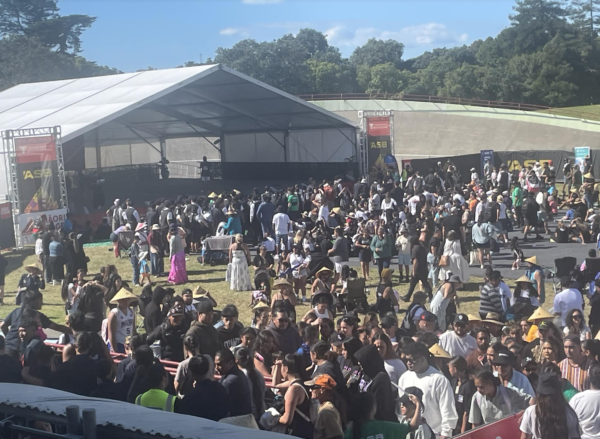
It reminds me of what Don Brash tried to claim in 2018 that the Haka was a dance of savagery that glorified domestic violence…
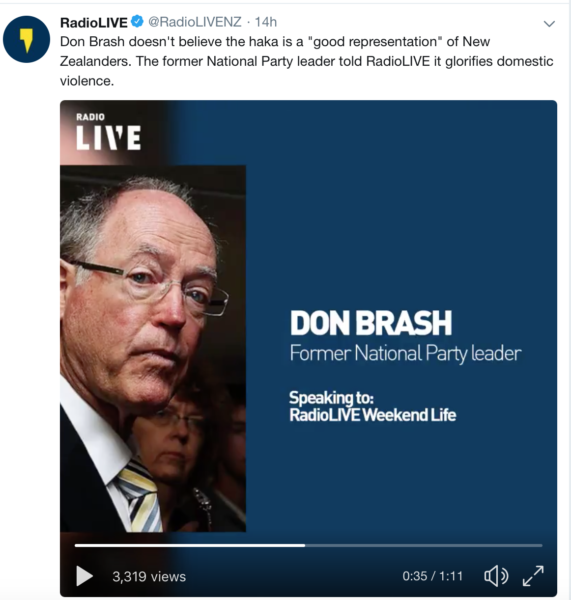
…claiming the Haka is a war dance is grotesquely ignorant.
It is a challenge, it is the respect of the challenge, it is deeply enshrined in honour and to misrepresent it as a war dance and to then suggest it glorifies domestic violence is insulting beyond belief because his insinuation is that Māori are a violent culture and hence all those social ills that plague them are kinda their fault.
To purposely misrepresent indigenous culture as an act of violence that glorifies other acts of violence is perhaps the worst thing Brash has ever done, which is really saying something because he’s just done so much that is damaging to race relations in this country.
David Seymour and ACT have picked up Don’s mantle and are attempting to kill off the Treaty by destroying the blueprint for Māori and State interacting with each other by destroying the Treaty Principles legislation.
As I looked around at this eruption of indigenous joy and celebration of culture, I thought that anything ACT and the feral racist banjo twanging hateful cracker settlers attempt by denigrating Māori simply won’t work.
70% of Māori are under 40, the future is brown and young and the feral racist banjo twanging hateful cracker settlers can only attempt to import more exploitable workers to keep the balance, but the reality for Luxon and Winston and David Seymour is that they and their reactionary redneck voters are dying, the young brown future of NZ is not.
My daughters team came third.
I was very proud of her and very proud of her team mates. The haka that roared into life from their classmates to celebrate and cheerlead their performance is still ringing around the Manukau Sports Bowl 24 hours later.
Our population is tiny, we aren’t a country, we are a large family and the sooner we start working together as a large family, the better for every one of our children’s futures.
Increasingly having independent opinion in a mainstream media environment which mostly echo one another has become more important than ever, so if you value having an independent voice – please donate here.
If you can’t contribute but want to help, please always feel free to share our blogs on social media.


Working as a tradesman electrician I often worked with South African tradesmen immigrants at a number of worksites.
They thought it surprising that most European Kiwis were monolingual, in South Africa it was accepted that everyone should be able to speak at least one African language. Living in New Zealand naturally some of them enrolled their children in te reo language classes and thought nothing of it.
I found it humbling to be bettered by white South African immigrants.
We gotta ask ourselves, (present company excluded), why, we the descendents of colonisers, are so reluctant to get our children to learn the native language of this land?
Great stuff. Of course parents ought to want their pakeha children to learn te reo you would be mad not to. In 1984 I took my two youngest pakeha children every day to a kohanga reo in Otautahi. I stayed with them. Learning pronunciation from that experience was wonderful for me and the two littilies and their 4 siblings. I had big sheets of printing paper hanging up in our living area with words and their Maori equivalent. We as a family all learnt from that time. I have of course done language courses but I would have to do Maori immersion to learn completely and that is just too much for me really. My children can pronounce Maori and my grandchildren know even more (they four year old able to count to tekau ma tahi) a number of them have been in the haka groups at school but I think and am hoping my great grandchildren will be fluent speakers of te reo. It is a rich beautiful language and we need to celebrate it. Ten years ago my 42 year old daughter, a midwife, applied for a job promoting breast feeding in a Maori organisation. She said to the interviewers my Mum always believed te reo should be taught in schools……….. they said where is your Mum we need her. And yes she got the job.
You must feel fulfilled, Martyn. Why have you not felt the need to learn Maori enough, to do so. You imposed your wants onto your daughter.
Chicken soup for the soul
A Chicken Soup for the Soul story is an inspirational, true story about ordinary people having extraordinary experiences. It is a story that opens the heart and rekindles the spirit. It is a simple piece that touches our readers and helps them discover basic principles they can use in their own lives…..
https://www.chickensoup.com/story-submissions/story-guidelines/#
A story about a man and his love for his daughter and the country they were born in.
We have more than enough hatred and division in this world.
If you read Martyn Bradbury’s post with an open mind this chicken soup for the soul will salve your bitter hatred and heal your wounded heart.
I suffered a brain injury when I was 18 which damaged the language area of my brain. I will mispronounce a word at times without realising – while I pepper my everyday use of certain Māori words I have always felt too insecure to attempt learning Te Reo myself in case my mispronunciation is jumped upon by some woke wanker who then screams racist at my mispronunciation. I get cancelled enough by the woke as it is, I dont want to have ‘racist’ added to the target.
Best blog post ever.
Awesome personal story, thanks for letting us in on it and its so true about what makes us unique is our Maori culture here in NZ. And our Pacific cousins. It’s rare and precious in the world. So glad you gave your daughter such an integral opportunity to being a NZrr and I guess she could say she belongs to the Pakeha tribe and her hapu was the school and her family.
Don Brash epitomises the word ‘gammon’. Whatever his argument about Māori culture it would be from ignorance.