
Marijuana Media: Police trial drones to hunt cannabis; Sungrown NZ bud available on prescription; First CBD medicine approved
It’s drones and cones this week on 95bFM’s Marijuana Media with Chris Fowlie from NORML and Jonny & Corey from bFM Drive – thanks to The Hempstore!
[Stream the pot-cast on 95bFM.com] [apple podcasts] [download mp3]
Police and helicopters: Cops use medical cannabis farm to train AI drones
Last week we discussed when “cannabis was the big deal for Police” and they conducted nationwide aerial surveillance to look for illicit crops. It was a risky and ultimately futile task which police appeared to abandon in recent years, but it turns out they’ve been investigating using drones to find illicit cannabis – and they used a licensed cannabis farm to train the creepy spy tech.
According to a report this week on Stuff, Police said the training exercise at a South Island farm that had Ministry of Health approval to grow cannabis was designed to see if cannabis could be “detected by a specialist camera system”.
Stuff talked to Sarah Helm, executive director at the NZ Drug Foundation, who said the idea of AI drones being used to search for illicit cannabis crops in the bush or on people’s private properties could be alarming to people who bought marijuana for medicinal purposes on the black market due to difficulties in obtaining legal prescriptions.
Ministry of Health surveys show almost half of cannabis consumers use it medicinally – yet only 6 to 10 per cent obtain it legally with prescriptions. Police conducting remote drone surveillance would have no way of knowing whether a crop was medicinal or not.
It also begs the question: where did police do this drone training? It was suggested to me that as the South Island’s only outdoor licenced medicinal cannabis operation of any size, was it Puro? The Marlborough farm boasts it is New Zealand’s largest producer of cannabis. Puro harvested 51,000 plants in 2022 and received a $13 million grantfrom MBIE to develop a blueprint for the cannabis industry (a June 2023 report shows what has been achieved so far).
In reply to an emailed question from myself, director Jo Scott said “Puro has no comment to make on this one – you’ll be aware there are around a dozen growers in the South Island. Have a great day”.
Tairāwhiti-based Rua said they wouldn’t do it. The NZX-listed social enterprise has worked with Waikato University to apply hyperspectral imaging technology but that was for assessing peak cannabinoids and plant health. CEO Paul Naske told Marijuana Media police had approached them, but they declined. For that, Rua gets our ‘Tegrity Farms’ Award.
Police raids for cannabis cause harm and don’t do any real good. A timely example this week: the Otago Daily Times reported “Home detention for ‘Robin Hood’ after $120k of cannabis seized”:
Sage Florence Tree, 28, appeared in the Dunedin District Court this week after a police aircraft spotted four cannabis plots at his home on February 10 — leading to the seizure of 81 plants.
Judge Emma Smith said the man had no appreciation of the level of criminality in the offending and suggested he may liken himself to “Robin Hood” or a “green fairy”.
“He is supplying drugs. He is addled. He has soiled thinking, doesn’t he?” Judge Smith said.
Since his arrest, the man had received a medical marijuana prescription due to his “genuine need” for the prohibited substance.
[Defence counsel] Mr More said Tree believed he was “providing a service to his community” as the cannabis was often incorporated into food and gifted to those who used it as a “preferred medication”.
“This is a man of good character,” Mr More said.
“He is not even within a bull’s roar of good character,” Judge Smith said before noting a “highly relevant” previous conviction.
Tree was convicted on three charges related to the cannabis operation and sentenced to seven months’ home detention.
This year, responding to police running helicopter cannabis hunting programmes in cyclone-hit areas, Green MP Chlӧe Swarbrick said we can’t pretend we have an evidence-based approach to drug policy “when these are the priorities during an emergency”.
Chlӧe called for the repeal of the 48-year-old Misuse of Drugs Act 1975: “Can you imagine a worst waste of resources?”
NZ’s first legal, sun-grown, cannabis bud
The Ministry of Health announced on Wednesday that several new products had been approved under the medicinal cannabis scheme:
Eqalis CBD30, Eqalis CBD120, Symetis T17 B52, Symetis T17 Gorilla and Cumulus T17 have been verified as meeting the minimum quality standard.
These can now be prescribed to anyone by any doctor – ask your GP or find a clinic here.
Aside from the two new locally-made CBD products under Cannasouth’s Eqalis brand, most patients will be interested in the Cumulus T17, from Cannasouth. In a statement, the NZX-listed grower said:
“This verification provides the market with the first New Zealand dried cannabis flower products that are 100% grown, processed, and packaged locally, for use by local patients.”
Cumulus is a locally-grown 17% THC flower approved as a “tea preparation for oral consumption”. Cannasouth grows the plants in a huge climate-controlled greenhouse in the Waikato, harnessing Aotearoa’s sunlight while protecting the medicinal crops from bird poop, harsh weather, and other variables.
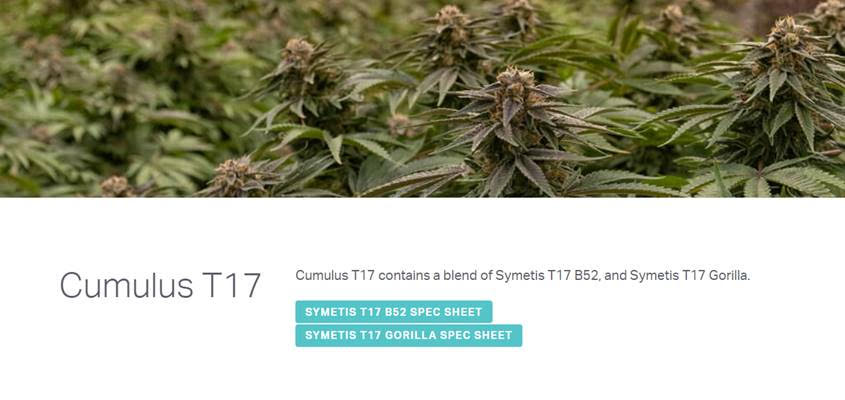
Unauthorised screen grab shows what’s in the local sungrown product
It looks like the Cumulus T17 bag is a mix of two types of cannabis, the Symetis T17 B52 and Symetis T17 Gorilla. Very interesting to have two types of cannabis in one product. Is it a granulated blend, pre-mulled and ready to go? I’m keen to hear any reviews from anyone with a prescription.
In a leaked spec sheet obtained by Marijuana Media, Cannasouth says B52 is “Runtz x Proprietary Local Sourced”. It “showcases a fusion of flavors, with hints of citrus, sweetness, and berries” and “flourishes with an abundance of trichomes.” The dominant terpene is Myrcene “which is associated with sedative and relaxing effects.”
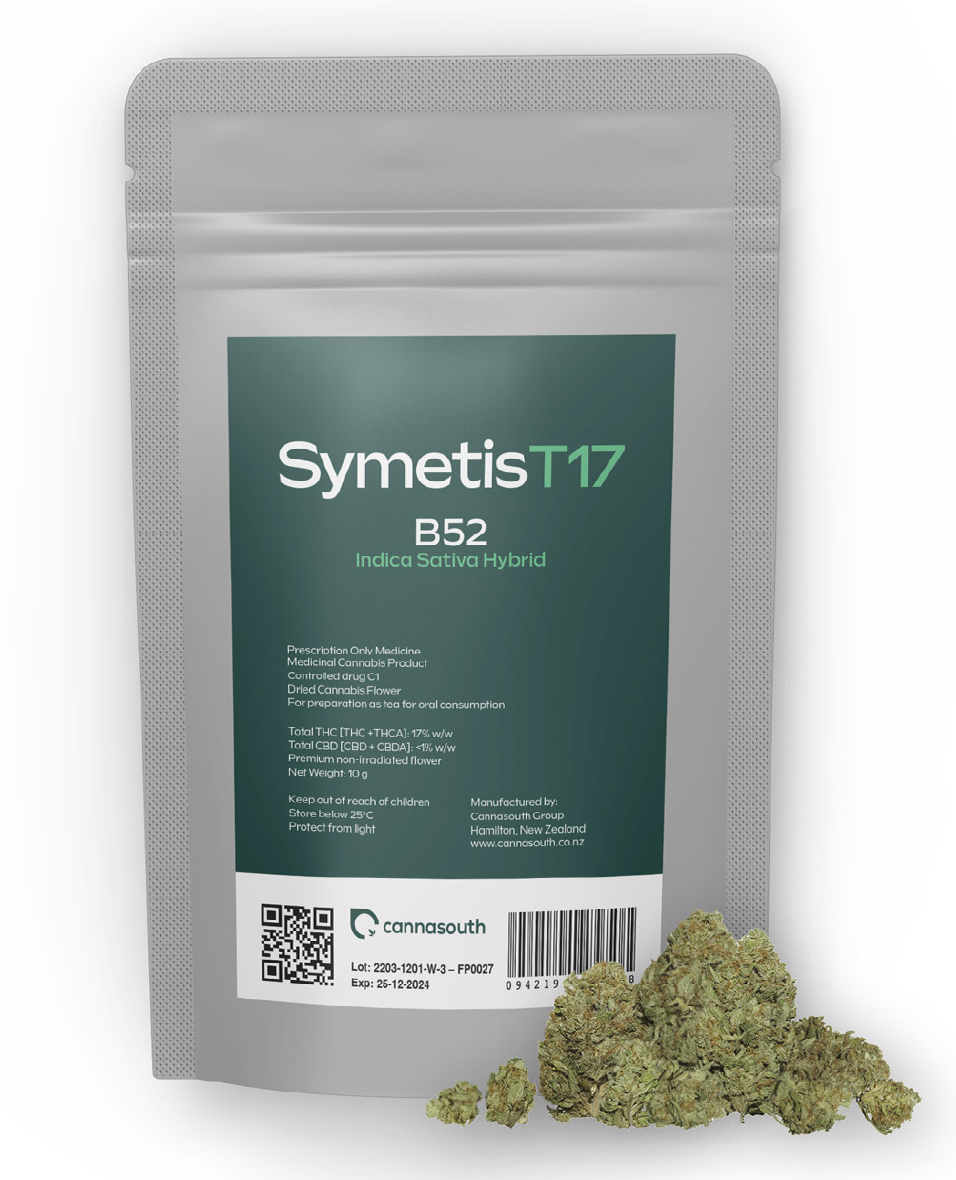
Gorilla is “Chocolate Diesel x Chem Sister x Sour Dub”, with “an intense and complex flavour profile”. Dominant terps are Limonene and Caryophyllene.
Cumulus, the blend of these, sounds tasty – and it’s great to see some local genetics in the mix. This is how local producers can do something different to everyone else.
I hear the price will be very competitive too, possibly the cheapest yet. Five years after the medicinal cannabis legislation was passed, patients will finally be able to access a product that is more affordable than the illicit market, and it’s locally grown.
Medcan industry hopeful of CBD changes
Further to our scoop that CBD products can be sold over-the-counter, a great report in the New Zealand Herald on Wednesday contained lots of useful information (see:Medicinal cannabis producers face hurdles getting products approved for sale without a prescription by Jenée Tibshraeny).
The report says “Kiwi medicinal cannabis producers are welcoming Medsafe’s decision to allow people to buy low-dose cannabidiol (CBD) without a prescription issued by a doctor. However, they expect it will take significant investment over a few years…”
That’s because OTC approval will require regular medicines approval, which often takes years of trials and many millions of dollars.
Helius is quoted saying they intend to run trials, and Cannasouth is focusing on technology to improve absorption. However Rua Biosciences’ said it was a low priority for them, with CEO Paul Naske commenting that doing clinical trials was “no small feat by any stretch of the imagination”.
First CBD prescription medicine approved
In a timely example of what is required, uber-corportate cannabidiol medicine Epidyolex has obtained provisional approval under the Medicines Act, making it New Zealand’s first CBD product approved as a regular prescription medicine outside the medicinal cannabis scheme.
Epidyolex is from the makers of Sativex and is the only US FDA approved CBD medicine. The strawberry-flavoured oral liquid contains 100mg of cannabidiol per ml of sesame oil base. It took billions of dollars to develop and obtain approved in the US, and is perhaps the world’s most expensive version of CBD.
But the good news is that Medicines Act approval here means Epidyolex can be prescribed like a regular medicine, and it has had the clinical studies to back up any therapeutic claims. This will reassure many doctors and may help reduce any stigma around using CBD.
The data sheet says “Epidyolex is indicated for use as adjunctive therapy of seizures associated with Lennox-Gastaut syndrome (LGS) or Dravet syndrome (DS) for patients 2 years of age and older.”
As an approved product Epidyolex can be marketed – but it won’t be eligible for over-the-counter sales, which are limited to so-called low dose products containing less than 150mg/day and no more than 4500mg/pack.
Low dose cannabidiol products are commonly available over-the-counter overseas, including convenience stores and gas stations in the USA, and supermarkets in the UK.
Coming up:
- First Thursday on K Road, with substance testing at The Hempstore, 3-7pm. We do this on the First Thursday of every month thanks to the NZ Drug Foundation. If you missed this one, find a testing clinic here.
- Auckland J DaySaturday 2nd December in Albert Park. Details here.
Marijuana Media airs every Thursday at 4:20pm on 95bFM, with your hosts bFM Drive’s Jonny and Chris Fowlie from The Hempstore. Stream or download the pot-cast for this show here or hundreds of previous Marijuana Media shows at 95bFM.com (or via iTunes / RSS feed). Thanks to The Hemp Store!





This fits with the theory of laws being made to suit the authorities’ requirements, not to help guide and safeguard a peaceful, harmonious, hard-working and honest citizenhood. No that’s not the sort of ‘hood we want think the PTB. They want exciting chases and splendid court cases like you see in the movies and tv and being able to stand tall before gatherings of the good people announcing about fighting crime and the bad people.
To be truthful, we know crime can be produced in the social laboratory that is the world, like finance can be produced; found when there is a will and the markets are carefully cultivated!
Crime becomes the scapegoat word for all the bad dealings of the populace that err away from the fragrant roses image of Good Society and Higher Culture. Stone crime in the marketplace and show it is separate from us who are such excellent people There is a cultural tradition of writing all bad happenings on paper and burning them as a helping, cleansing ritual which is an alternative way of standing away from badness or misfortune though. Think on this for society to use instead of crime as a focus for black thoughts and misdeeds..
Consider present or future laws to see if they make things better or just lock away or confront troubled or callous people without assisting to help in atonement and rehabilitation measures.
https://www.unity.org/article/how-use-burning-bowl-ritual-release-past
Writing out is definitely a way of lifting your spirit from burdening thoughts. Simple and you can do it yourself without involving a professional, or dogmatic friend or sanctimonious family member! Sometimes those nearest and dearest aren’t a help! After writing it out you need to get clear of it and this burning bowl ritual would be good, and not a fire hazard!
More about world and Chinese use of the burning ritual in a broader sense.
https://uhpress.hawaii.edu/title/burning-money-the-material-spirit-of-the-chinese-lifeworld/
For a thousand years across the length and breadth of China and beyond, people have burned paper replicas of valuable things—most often money—for the spirits of deceased family members, ancestors, and myriads of demons and divinities. Although frequently denigrated as wasteful and vulgar and at times prohibited by governing elites, today this venerable custom is as popular as ever. Burning Money explores the cultural logic of this common practice while addressing larger anthropological questions concerning the nature of value. The heart of the work integrates Chinese and Western thought and analytics to develop a theoretical framework that the author calls a “materialist aesthetics.” This includes consideration of how the burning of paper money meshes with other customs in China and around the world…