
GUEST BLOG: Danyl Strype – Work and Income is Beyond Repair – Scrap it!
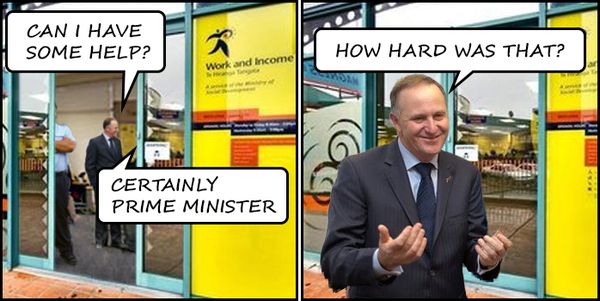
No doubt the suggestions in Dr Liz Gordon’s recent blog piece about Work and Income are well-intentioned, and its refreshing to see some ideas for welfare policy based on boots-on-the-ground research rather than bigotry and posturing. I would be happy to see copies of the service charter on the walls of all WINZ offices, and I totally support re-funding the benefit rights advocacy groups that were de-funded and marginalised by the Key government. But this just gets us back to where we were in 2008. I just can’t see how suggestions like these engage with the full scope of the problem.
Let’s start with a bit of background. The history of the creation and disembowelment of social welfare in Aotearoa is recounted in heart-breaking detail in Alistair Barry’s 2002 document ‘In a Land of Plenty’. This should be compulsory viewing for every kiwi, and I’d love to see Social Studies showing it to their high school students. Rather than trying (and failing) to do justice to this whole story here, let’s just focus on Work and Income New Zealand, lovingly known as WINZ.
WINZ is part of the Ministry of Social Development, not MBIE. But it was the result of mega-ministry reforms, just a bit further back in time. It was Clark’s government who created the current monstrosity, the Ministry of “Social Development” (or MiniSocDev as Orwell would have called it),
by merging the Department of Work and Income and the Ministry of Social Policy.
But where did Work and Income come from before that?
The clue is in the name. Work and Income was created in 1998, when Bolger’s National government merged the Employment Service, which was tasked with helping people with insufficient paid work find more, and the Income Support service, which was tasked with managing the payment of benefits (itself created by the Bolger regime in 1992 when they restructured the old Department of Social Welfare). Other, small departments were also eaten by the WINZ super-department, including the
Community Employment Group and Local Employment Co-ordination (initially WINZ managed student loans and allowances as well but this created such huge bi-annual logjams that Studylink was set up to deal with them separately).
That merger was a bad idea. The same set of case workers should not be tasked with both making sure people have all the social assistance they are entitled to, and making sure they get a job and stop taking it. It’s like trying to merge the retail workers and security guards in malls, so they’re all trying to get people to take stuff (by buying it) and stop people taking stuff (by stealing it) all at the same time. They’re just not compatible functions.
But I can tell you that even though the Income Support Service of the mid-1990s didn’t have to do anything employment related except make sure you were signed up with the Employment Service, they were no better to deal with than the WINZ of today. During the late 90s, I was part of the
Beneficiary Action Collective in Ōtautahi. We would deliver a huge cardboard Bastard of the Month certificate to a local WINZ office that had badly mistreated someone that month. Each month’s “winner” was picked from public nominations, and we were never short of nominees.
I’m forced to admit the attitude of staff towards beneficiaries did improve somewhat during the Clark years, but nothing about the WINZ structure was substantially changed, making it all too easy for Key’s government to flip it back into 1990s mode, then made it even worse. With staff who are either incompetent, abusive, or disciplined for being too helpful and moved to dealing with superannuitants. By contrast, I have dealt with the IRD on a number of occasions over the years. Despite what foaming-at-the-mouth propertarians say about their dealings with them, I have found IRD staff much more reasonable, respectful, and consistent than those at WINZ.
Reflecting on about 20 years of dealing with WINZ on and off, this is what I think needs to happen. Firstly, WINZ needs to be abolished. The mild reforms of the Clark years prove that it’s far too politicized to be reformed without just being deformed again by the next government. It’s a failed model. Just bin it.
Thirdly, all the Ebeneezer Scrooge discretionary benefits that require people to fill out yet another multi-page form every time they need some food, or new clothes for interviews, or medical care their benefit doesn’t cover, need to be abolished too. The funding freed up by doing so needs to be used to lift base benefits. They need to roughly doubled, so they become liveable again, and pegged to inflation so they go up automatically each year. Ideally in a way that would require future governments to undertake major reforms to change.
The income support functions of WINZ need to be handed over to the IRD, along with the funding currently given to WINZ to administrate benefits. IRD would treat benefit payments as non-recoverable “tax credits” (right-wingers love tax breaks). Accidental overpayments would simply be
added to the tax bill at the end of the year, rather than counted as evidence of “fraud” when no actual fraud has taken place.
The employment advice and work brokering functions of WINZ need to be handed over to a new Employment Service, under the control of the Department of Labour (I refuse to call it “Employment NZ”). At the same time, the Department of Labour needs to be broken free from MBIE and restored to independent Ministry status. It needs to be tasked with funding and creating fulltime paid jobs for anyone struggling to find sufficient work in the private sector, including by supporting the establishment of worker-owner and customer-owned cooperatives that can employ people in secure jobs.
The remaining MinSocDev needs to renamed to something that reflects what we really need in a poverty-prevention service. How about the Ministry of Social Justice? Or the Ministry of Social Equality? Ministry of Poverty Elimination? A name that makes it clear that it’s role is to identify and fix the structural holes in the flooring of the system that reproduce poverty, not to discipline people for having the misfortune to fall into those holes.
The public servants who are displaced by these reforms need to be offered a choice. They can be be re-deployed elsewhere in the public service where their skills and institutional knowledge can make a positive contribution, or take voluntary redundancy and try their luck in the private sector. This isn’t about beating up on public servants (or the PSA), but we have to be realistic that while some of the people working at MinSocDev do the best they can within a system that is broken by design, others should never be put in a frontline situation dealing with vulnerable people. Ever.
Anyone who isn’t thinking this ambitiously does not understand how unfit for purpose Work and Income is, all the way down its rotten foundations. Or they do understand, they just don’t really care to get this country’s social welfare house in order.





Brilliant, just brilliant! As someone who has had the misfortune of having to deal with WINZ, I whole-heartedly endorse Danyl Strype’s article – and the measures proposed. However, I AM a little surprised that somethings weren’t mentioned – like when case workers were paid a bonus for turning down help; and how job brokers get paid a bonus each time they place someone in a job, regardless of whether the job is permanent, or a couple of days worth.
Of all the people I have had to interact with at WINZ, I found only one decent worker – a woman. She ended up leaving though, on account of work-related stress. At the time, the case workers were to ‘go by the book’ so to speak, but apparently every day emails arrived counteracting the ‘book.’
WINZ – scrap it, and bury the remains in a unmarked grave, or in teh middle of the Atlantic.
Yes, I agree with much that was written here, a good post, also with some useful info on the history of it all.
” At the same time, the Department of Labour needs to be broken free from MBIE and restored to independent Ministry status. It needs to be tasked with funding and creating fulltime paid jobs for anyone struggling to find sufficient work in the private sector, including by supporting the establishment of worker-owner and customer-owned cooperatives that can employ people in secure jobs.”
Yesssss!
But not make-work. There are initiatives in the wings for modern enterprises/future-think products and skills. There is no way that the sacred private enterprise people will go down that road until the risk is barely there.
If we used your suggestion to create a ministry charged with upskilling the workforce, exploring new options, bringing new products and services into being, liaising with other departments to provide trained people power used to innovating and tackling tough issues – and to fill some of the gaping holes in the social fabric – such as better aged care and disability services…
Yesss!
And more workplace safety inspectors. Please. PDQ.
PS. Absolutely kill off ‘The Evil Ones’ (that’s how they’re known in our family). Start over.
So long as your ideas become more venturesome – not dwindling into orthodox mediocrity to suit the Fraidy Cats.
Nice to see a little history bought into the debate.
Even if this government doesn’t so this I have no doubt that at some point a future government will
ditto, that’s what I thought, Aaron. The historical perspective puts our current sd stte of ffirs into perspective.
Danyl – an excellent critique of WIN and its failings.
Implementation of a Universal Basic Income would do away with the need for a WINZ-style ministry altogether. WINZ staff could be redeployed planting trees or picking kiwifruit (minimum wage of course) to give them a “reconnection with community grassroots”. (Gotta love corporate BSjargon.)
Well, you know. Not enough jobs, definitely not enough jobs on the lower end of the spectrum, and those who have jobs on the lower end have been denied wage increases commensurate with productivity increases for a very, very long time. Using reasoning common in industrial organization and the rest of economics, you could make a coherent argument for making the labor pool smaller at the moment, especially in high unemployment groups – that’s effectively what many people are doing when they argue for lower temporary retirement ages. You’d point to how the ideal labor market is skewed by XYZ in reality and then discuss how this particular policy rectifies that by reducing the supply of labor for low paying jobs.* Anything that gets more money in more people’s pockets will be incredibly useful for scraping WINZ, if that’s even what this actually does.
If only we could actually give Adrian Orr a helicopter and say, “It’s okay, Adrian – no one’s going to come after you. Use it.”
*Which also sort of shows you how orthodox economics isn’t a science – it’s basically awesome sophistry.
Surely you’re not suggesting scrapping the Registered Seasonal Migrant Employees initiative? What about the plantations?
Because robots
Well, I doubt that will lead to better wages. Isn’t that what u were gunning for? waitwat
Yeah high LOLBAGZ. From a business perspective, they really don’t care about immigrants, but they do care about pushing the Overton window to the left on this issue for their real goal – more student visa scams and other educated immigrants for the tech industry. Business use the classic negotiating tactic by pushing for a far more ambitious goal, while still leaving room for compromise on more “skills-based” immigration, which is something that is far more likely to get some measure of bipartisan support.
The tech industry’s far and away number one cost is labor. Nothing else even comes close. This has caused big players in Flatscreen TVs try all sorts of shady tactics, including illegal employer collusion, to reduce wages for their employees. Trying to introduce a big influx of cheap workers through immigration to address a non-existent labor shortage is one of those tactics. The fact is that there is no labor shortage in the tech industry. There is, however, a shortage in labor at the price that major companies want to pay, hence the attempts to change the system in their favor.
To address your more general question, yes, I think that automation will significantly reduce the need for immigrants. We will always need some degree of immigration for entrepreneurs and genuine experts, but the vast majority of the needs of our labor market can be met by domestic supply. We already have a country of 5 million people with diverse skills and backgrounds, many of whom are still under or unemployed, so any company that claims they can’t fill a position simply isn’t offering enough in compensation.
Some positions will certainly be eliminated by automation, but I think that this should balance out fairly well with our aging population over the next couple decades. This should blunt the impact of jobs being eliminated, as there will be a corresponding reduction in the supply of labor as the boomers retire or move to casual work. Then eventually a UBI will become a necessity and WINZ will fade out. maybe sooner, maybe later.
well considered, could be accurate. all the best
> “This has caused big players in Flatscreen TVs try all sorts of shady tactics”
Hang on, are you saying there are companies manufacturing flat-screen TVs in Aotearoa? If so (and I doubt it), if migrants are coming in to work in those companies, it won’t be on the production line. The existing skills requirements wouldn’t allow that (*except* for seasonal work harvesting produce). It would have to be a specialized job, for which the employer had made a serious attempt to find a local candidate, and failed.
> The fact is that there is no labor shortage in the tech industry.
The only tech industry I’m aware of in Aotearoa – outside of a few pet projects soaking up huge amounts of public “research” funding from MBIE – is the software industry. There is no labour shortage, if you just want people to cart hardware around, but there are quite a few skills shortages, requiring highly educated people who can’t be trained in a few months at a code camp. Transnational workers are a legitimate way to fill those jobs, and many of those people will return to their country of origin to retire anyway (unless things really go to hell in a handcart there).
very well put, WINZ/MSD is definitely too rotten to be reformed, it has an entrenched culture that can actually reward staff (often PSA members) for NOT providing the assistance people seek!