
GUEST BLOG: Damon Rusden – “The anti-smacking bill – why you should support it”
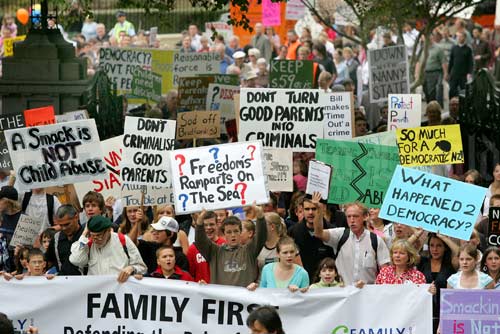
A recent spate of robberies committed by youth has had the National Party Kaikohe branch chairman demanding that corporal punishment be brought back into schools, and Winston Peters showing his distaste and desire to repeal the “anti-smacking” law via referendum. Their rationale is that repealing section 59 of the Crimes Act is the reason young folk like myself are running amok.
This brings back the age-old debate regarding the right of a parent to discipline your children. It has launched the issue back into public discussion, and with it the law change that so famously (most assume) led to the downfall of Helen Clark’s “Nanny state”.
The reason I fully support the law that “removed” the right to physically discipline your child is simple.
The “anti-smacking” bill was never about taking away your right to discipline your children. It was about taking away legal sanctuary for those who abuse children. A more apt term I’ve heard it referred to is the “anti-beating” bill. The legal argument of defining “discipline” in court led to parents who genuinely abuse their children, in cases were severe damage was done with a jug cord, plank of wood or a rubber hose, to name a few, and the perpetrators were able to walk away without any penalty.
I for one am glad that’s not allowed. My fear is that this safety net will be taken away because the real purpose never penetrated the public – it was drowned out by the institictual (and understandable in context) reactions of parents.
An important point is that the Act never stopped the discipline of your child – as a New Zealand First MP pointed out years ago, Sweden and Denmark have had a law like this for a while now and it hasn’t led to the dystopia of un-smacked children imagined. The author also emphasised police discretion, using as an example our laws regarding children attending school; while it’s needed, and the worst offenders are pinged, we as a society accept that children will have days off for various reasons. We as a society (generally) accept that a light smack is acceptable.
As for discipline as a method of raising your child, I understand the embedded belief of a light smack when children are misbehaving. I had it when I grew up, and I’ve seen my two younger sisters go through it. It sounds cliche, but we’ve (so far) turned out alright. I say this because this is the prevailing attitude of many people, and I can’t blame term for it. This is real and lived experience, and I understand that.
In saying this, it’s not the most productive way to discipline a child anyway. When my sisters (six and ten) do something wrong or misbehave, I raise my voice, and then tell them why what they are doing is wrong or unacceptable. Including the nuances of public vs private behaviour. It’s about establishing respect through a relationship, not smacking them. It’s better for them also – they learn why what they did is wrong with dialogue, simply speaking to them in a way that isn’t condescending. Children aren’t animals, and communication is far better than what would be (to them) considered arbitrary punishment.
Point being: while I sympathize with disciplining your children with a smack every now and then, don’t bring it back into law, and there are far more constructive ways to deal with misbehaving children.
So when Alan Price (the man who suggested we allow this back into schools) starts thinking this is the solution, my reaction was that he’s just being superficial. I remember high school vividly – and for those I know who went on to end up in prison for one reason or another, a cane around the arse wouldn’t have changed anything.
As for Peters, he’s just capitalising on public discontent because, well, election year. The problem with a redendum is that there are legitimate legal reasons this bill want through, and passed. Yet this strikes so much into traditional and (from the outside) reeks of suppressive government that I can intuitively say it would be repealed. Public opinion and non-binding referenda have show this. My problem is that it’s not only counter-productive, it’s not adressing thing real issue at all.
A lack of employment opportunities, being priced out of education and increasing swaths of poverty cycles perpetuated by inequality (leading to drug use) and a system that clings to archaic solutions has far more to do with troubled youth than a lack of canes. Tedious arguments about who can smack who is marginalising the underlying problems – problems that we need unity to tackle. So can we please stop this distraction and make some real progress on the issues affecting my generation.
If we’re talking about a “nanny state”, let’s consider how much the government is going to be forced to intervene on social issues that have quickly degraded and are reaching critical levels – in other words, to clean up the mess. Using anti-smacking as a political football is not going to solve anything.”
Damon Rusden is a chef, journalist and law student with an avid belief in civic education and accountability. He is also a Green Party candidate.


I support binding referenda. If we are going to have a majority rules democracy run by elected officials, we might as well have one where the public can step in and overrule those officials when they screw up. For every conservative non-binding referendum result I don’t agree with (eg the vote against the anti-beating Act), there’s a more important one I do agree with (eg the vote against the sale of public assets).
Besides, all the referenda with seemingly conservative results used intentionally leading questions, designed by the proponents of the referendum to essentially trick people into giving them the result they wanted. If referenda were binding, the question would have to phrased by a neutral party, and propose a clear and specific course of action, to which the public could answer “yes” or “no”. The anti-beating Act referendum was a classic case. The question posed in the referendum was:
“Should a smack as part of good parental correction be a criminal offence in New Zealand?”
To a supporter of the anti-beating Act, the question is so self-contradictory is doesn’t even make sense. It’s like asking “should a McChicken Burger as part of a healthy diet be a criminal offence in New Zealand”. But putting this aside, it’s important to ask “is a smack as part of good parental correction a criminal offence in NZ”? For those of us who’ve actually read s59, the answer is clearly “no, but a smack as part of bad parental correction [abuse] is a criminal offence, and so it should be”.
So given that intentionally misleading question, people could either answer “yes”, understanding that the unstated question they were being asked was “was the reform of s59 a good idea”. Or they could answer “no”, in which case they were effectively saying “by not completely banning smacking, the reform of s59 got it right”, which was the answer given by about 80% of the roughly 50% who voted. This result has been twisted by both supporters and opponents of binding referenda to say that a democratic majority voted against s59 (which they clearly didn’t).
The Greens 4 core principles includes one about appropriate level decision making. I think that in a representative democracy without an upper house, it’s absolutely appropriate for parliament to be held accountable between elections by the possibility of a binding referendum, and I’d like to see the Greens support them. It irks me greatly to have one reason to consider voting NZ First.