

Damning water report right when Farmers are attacking media for highlighting their pollution and about those asset sales
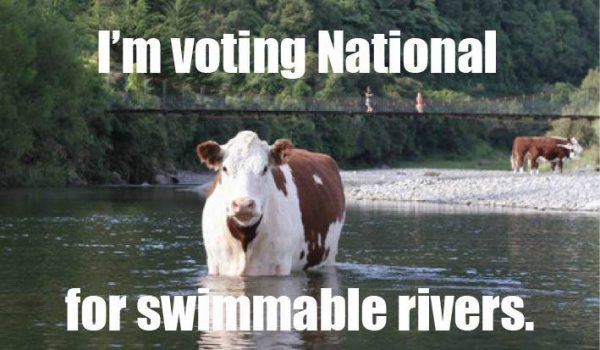
There are three realities about water in New Zealand.
The first is the scientific reality that dairy intensification is causing massive pollution of our water while creating climate change gases…
Reduce dairy cow number to stop water harm – ecologist
A minister’s remark that the intensification of dairy farming can’t go on is decades too late, says ecologist Mike Joy.
Freshwater ecologist Mike Joy said he had been calling for an end to dairy intensification for more than two decades.
He said some farmers were trying to reduce the harm, but more cows were still being put on the land, increasing the amount of nitrogen and fertiliser.
“Farmers making little incremental changes are great. But if you’ve got intensification happening … then the net result is things get worse.”
…The second is the ‘reality’ bureaucrats not wanting to embarrass the Government believe in…
‘Damning’ rivers and lakes report: Nitrogen levels rising, fish threatened
“The report doesn’t draw the obvious conclusions that the recent OECD report did, which makes much clearer links between irrigation, dairy intensification, and worsening water quality.”
…and the third is the reality as seen by the Dairy Industry whose denial at their damage of the environment is bordering on delusional…
Federated Farmers: It’s damn lies and alternative facts
The use of the words ‘opinion, damn lies and alternative facts’, generally combined with some fancy report from an organisation that has just jumped on the bandwagon, is wearing thin.
It used to be ‘lies, damn lies, and statistics’, now we’re fed irrelevant theories partially linked by academic economists engaged by organisations hardly anyone has heard of.
The latest few are around resource exploitation and climate change from two largely irrelevant organisations, the OECD and Globe NZ.I won’t even give the OECD report the time of day, as this is an organisation that has overseen the biggest financial crisis since the great depression and is totally happy with both Europe and the US continuing to print money as a way of getting out of jail. Another irrelevant, hot-air producing organisation.
…Farmers who have been allowed by their mates in the National Party to steal and pollute water with impunity are now so hyper sensitive that they attempted to gag Greenpeace drawing attention to their pollution and are currently attempting to boycott TVNZ, NZ on Air and Mazda for a very fair appraisal of their industry.
On top of this, Farmers are now sending in their corporate scientists to attack the credibility of critics in the corporate mainstream media.
Farmers feel they do the heavy lifting economy wise, are hugely in debt to dairy conversations and don’t have the technology to be as sustainable as environmentalists want.
Add in the intellectual and cultural snobbery, and you have all the ingredients for a virtual civil war.
I say let’s put the blame where it needs to go – the fucking National Government.
As the TDB pointed out many times as it was happening, one of the worst aspects of flogging off our power generation assets was that the money was sunk into irrigation. That’s right sleepy hobbits, the National Government sold our power generation companies and sunk $400 million of that into huge irrigation programs that created the intensification we are seeing.
Not only did we lose assets that made us more money than the sale, National blew that money on a $400million irrigation program that has birthed the intensification.
Include into this the fact senior National MPs also have personal vested interests in selling milk powder to China and you start realising that we have all been played. City dwellers, farmers, environmentalists – all of us. The National Government were the ones who put this madness in motion, they are the ones who economically vandalised NZ by selling off our power generation companies, they are the ones who blew that money on irrigation and they are the ones who have the vested personal interest in dairy intensification.
We need our farmers to produce sustainably and that requires investment and technology upgrades, what they’ve been given is an addiction to Chinese milk powder sales and horrific water pollution.
Let’s put the blame where it needs to go, the National Party’s short term cheapest option vision that gives not a damn about our collective environment or long term economic well being.


“In the end I think central government will have to intervene because many of the smaller towns simply do not have the cash nor skills to build, operate and maintain their treatment systems.”
This I agree on.
However, why do smaller towns not have the cash nor skills to build, operate and maintain their treatment systems?
Because both the Labour and the National Govt’s during the 90’s deregulated markets, meaning small towns that had industry, slowly destabilized. Those with timber mills, car assembly plant’s and meat works, struggled because of this and the irony, it will be the government that will have to repair the damages they inflicted.
Wikipedia
New Zealand Governments adopted policies of extensive deregulation from 1984 to 1995. Originally initiated by the Fourth Labour Government of New Zealand,[6] the policies of deregulation were later continued by the Fourth National Government of New Zealand. The policies had the goal of liberalising the economy and were notable for their very comprehensive coverage and innovations. Specific policies included: floating the exchange rate; establishing an independent reserve bank; performance contracts for senior civil servants; public sector finance reform based on accrual accounting; tax neutrality; subsidy-free agriculture; and industry-neutral competition regulation. Economic growth was resumed in 1991. New Zealand was changed from a somewhat closed and centrally controlled economy to one of the most open economies in the OECD.[7] As a result, New Zealand, went from having a reputation as an almost socialist country, to being considered one of the most business-friendly countries of the world, next to Singapore. However, critics charge that the deregulation has brought little benefit to some sections of society, and has caused much of New Zealand’s economy (including almost all of the banks) to become foreign-owned.[citation needed
The stated rationale for deregulation is often that fewer and simpler regulations will lead to a raised level of competitiveness, therefore higher productivity, more efficiency and lower prices overall. Opposition to deregulation may usually involve apprehension regarding ENVIRONMENTAL POLUTION[1] and environmental quality standards (such as the removal of regulations on hazardous materials), financial uncertainty, and constraining monopolies.”
“Good work” of the type you describe can only be the very beginning, as it will prove to be insufficient in years to come. Fencing, riparian planting and so forth will do little more than only delay the flow off, from the grasslands full of cows and cattle.
Andrew, no one is saying that urban areas don’t contribute to fouled waterways. But you seem to be going out of your way to fixate on urban sources whilst ignoring farming sources for nitrogen pollution.
Acording to the Waikato Regional Council,
ref: https://www.waikatoregion.govt.nz/environment/natural-resources/water/rivers/waikato-river/runoff-and-leaching/
Nitrogen run-off is sourced primarily from rural areas simply because it is a primary ingredient for fertiliser and cow manure. You’d be hard-pressed to find the same quantity of fertiliser and cows in down-town Hamilton, as you would in surrounding dairy farms.
The reality is that both urban and rural sources of pollution need to be contained. Ignoring rural ‘point sources’ is not helpful.
Of course the National Party and its lackey support partners in government are ultimately responsible for this looming disaster for your environment, same as other looming disasters.
But it is much worse, the common voters out there, they do not care enough, they do only ever leave the cities, where they live their pampered lives (that is the middle and upper class not sleeping rough or struggling to pay the rent and food bill), unless they may during their holidays venture out into the regions.
Then only may they be personally confronted with the state of affairs with our rivers and lakes, and only then may they feel concerned. But that is not enough, they will soon forget most of this again, after the brief few holidays in the year, and be pre-occupied with their work, careers, study, personal advancement, shopping for the latest model care, going to the supermarket and buy all those nicely, hygienically packaged consumer goods, including farm produce, and so forth.
Our media is subservient to the business sector, who pay their butter and bread, especially since publicly funded media has been near exterminated, and reduced to insignificance.
Who ever bothers listening to RNZ, it is mostly the more educated, but hardly the vast majority of voters.
So they keep voting by thinking of their wallet rather than anything else. Meanwhile agribusiness continues, farms get sold to the highest bidder, some overseas based, business gets outsourced, the supply chain gets taken over by such players as from Mainland China and a few other places, and we lose ever more control.
Fertiliser use is common, pesticide and herbicide use is common, organically grown produce is only a fringe product, often over priced, and besides of our water ways, the rest of much of our environment will follow suit, to be plundered, compromised and continually, gradually destroyed.
This petty show case reporting on some Kiwis or other native birds being released in a forest on some remote islands, or in the Hunuas, that is just to make people believe, oh, how “nice”, our government leaves us in “good hands”, they care.
It is BS, as these are mere token gestures, and rodents, cats and so forth continue to kill many native birds as you read this, 24/7.
The way NZ Inc is going, the environment will be mostly destroyed by the time this century ends, if humanity is still alive then.
Here’s the hope SOMEONE from Labour reads Countryboy’s posts!
The solution is we have to put New Zealand and its citizens FIRST instead of LAST on the list.
National are failing this country, for their and the other 1 percents gain!
Me agree to Kim Dandy,
Country Boy is a brilliant orator when warmed up.
Frank you are on the button when you said the urban areas are also contributing.
But what is missing in the urban runoff is the road runoff off and in particular heavy truck pollution from tyres brake and exhaust pollution as most overseas countries are heavily pointing this as a large undeclared source of pollution here.
A large Auckland road runoff pollution study was done by NIWA and Ministry of transport also.
The runoff of oil, tyre dust and even pollutants that drip off truck loads (stock and offal as well as city rubbish) which is sent now by road not rail, now are being targeted, and they found that the toxins are also entering the ground water and roadside drains into streams and rivers.
We really are now in more trouble as the national Junta are actually busy closing regional rail down and pushing more trucks onto those roads so we bare going the wrong way for sure, but Winston’s transport plan is to restore rail again throughout the country and make water cleaner and roads safer so why don’t we vote for this.
Winston’s party site on transport. http://www.nzfirst.org.nz/transport
RAILWAYS OF NATIONAL IMPORTANCE
New Zealand First will ensure that none of New Zealand’s railway lines and other strategic railways infrastructure will be privatised.
New Zealand First’s vision includes passenger train services along all rail routes between the main centres, with connecting coach services linking outlying areas or running services between centres which don’t have a railway line.
New Zealand First will develop a programme of railways of national importance (RONI) to ensure that better use of our railway network and services is achieved, with improvements and extensions where there is opportunity to significantly reduce dependence on the roading network, especially for heavy freight and bulk freight services, but also where passenger services can be redeveloped to attract sufficient demand over time.
“The report said about half of the pollution in rivers is probably human. This is due to a failure of towns across NZ to invest in sewage treatment maintenance and upgrades for several decades.”
WHICH TOWNS would those be, Andrew?
The other word in the sentence is “probably” which means they’re guessing.
I’m in my mid 50’s and I grew up swimming in the Kaueranga river which was crystal clear. Your say…”NZ hasn’t been ‘clean & green’ for a hundred years” is handpicked and has no evidence base to it.
I certainly would not venture near any river over the past 9 years.
Someone understands the inside story…..!!!
My serious concerns is that most Kiwis will not take this as serious as it is, the water pollution that is happening and in some places getting worse, due to intensified dairy farming and due to increased urban development.
When confronted with the choice between “jobs” and “living standards”, the bulk of the modern urban Kiwis and also most immigrants that have settled here will choose jobs and living standards before making any sacrifices for the environment.
Hence people only sign petitions in limited numbers, hence the Greens only get around ten percent of the vote, hence the consume, throw away and waste and pollute lifestyle continues unabated, hence more car registrations, hence more dairy production, hence more exports, bla, bla, bla..
As the MSM does only ever scratch the surface, but never offers much in the way of deeper insights and documentaries revealing the truth, and rather falls for desperate advertising paid for by their sponsors and business customers, fueling ever more consumerism and BS modern lifestyles, we will see little progress and change here.
People have their heads too deep in the sand or up their backsides, that is the other side of the story, hence the Nats get away with all this, they are not stupid. Privatise and underfund media, and you get less criticism and poorly informed citizens and voters, exactly what they want.
its not a choice the environment gets trashed there goes the tourist industry living standards and environment are connected our choice is do we allow one privileged group to destroy the public commons for there own gain. NO!
How many single digit years have these Dairy farmers,exploited our environment for their excess profit gather.
How many double digit years for our environment to recover.
.
farming is only 4.35 percent of gdp tourism is higher and these farmers are quite willing to trash the environment and put thousands of tourist jobs at risk there a selfish lot.
It is not so much cows walking in rivers…they have done this since time immemorial
…it is the huge excessive numbers of cows in the fields and the nitrate run off into our waterways and our rivers via the permeable soils, streams and aquifers
cows walking in rivers is not so much the point….NITRATE run- off is!
100% RED BUZZARD,
Since National are hell bent on pushing everything into a mad dash to increase “Productivity” NZ is showing the strain of every corner of our environment now, from loading yet more & more trucks onto our roads to less & less rail services.
Then more plundering of water & oil from out of our ground at an uncontrolled rate to now.
Then “Farming intensification” to pouring yet more & more immigrants into our small land,- we will become the “Dirty Little Country” we are becoming rapidly now under Nactional.
+100 …good points COUNTRYBOY…and great Post!
we have the cure to the wankerism of national
Body weight 1888 drop 1892 drop 1913 drop
Stone lb kg ft cm ft cm ft cm
14.0 196 89 6′5″ 196 4’3½” 131 5′1″ 155
13.5 189 86 6′8″ 203 4’5″ 135 5′3½” 161
13.0 182 82½ 6′11″ 211 4’7″ 140 5′6″ 168
12.5 175 79¼ 7′3″ 221 4’9½” 146 5′8½” 174
12.0 168 76¼ 7′6″ 229 5’0″ 152 5′11½” 182
11.5 161 73 7′10″ 239 5’2½” 159 6′2½” 189
11.0 154 70 8′2″ 249 5’5″ 165 6′6″ 198
10.5 147 66⅔ 8′7″ 262 5’8½” 174 6′9½” 207
10.0 140 63½ 9′0″ 274 6’0″ 183 7′2″ 218
9.5 133 60¼ 9′3″ 282 6’3½” 192 7′6″ 229
9.0 126 57 9′6″ 293 6’8″ 203 7′11″ 241
8.5 119 54 9′9″ 297 7’0½” 215 8′5″ 257
8.0 112 51 10′0″ 305 7’6″ 229 8′6″ 259
or we could just vote them out
Take a look at this National geographic documentary Martyn,
https://www.youtube.com/watch?
US where water runs out.
v=umadvwaEcuo&index=3&list=PLivjPDlt6ApSPfageQtSbStFHE3juy9jl
https://www.youtube.com/watch?v=X0cstUswnZQ&list=PLivjPDlt6ApSPfageQtSbStFHE3juy9jl&index=4
India where water runs out.
v=UKmwbXc1rmY&index=2&list=PLivjPDlt6ApSPfageQtSbStFHE3juy9jl
Who are the Water Mafia | Parched
Also these big companies buy giant water resources and sell them expensively to poor people… Coca Cola is partly cheaper than normal water in these regions. Like what the hell is wrong with this world?
Martyn, do a article on how the worlds money water barons are coming to NZ now to rape our water and bleed us dry with Nactional’s blessing the criminals they are to allow this.
+100 …great points CLEANGREEN….the Nacts are sooo corrupt…they are in bed with any overseas corruption and the ripping off of New Zealand’s natural resources
environmental accountants at the likes of pwc could work out the cost of the environmental damage iam sure the dairy industry would want to account for the damage to the environment on there balance sheets if they don’t then the economic costs are false