
BEN MORGAN – Putin’s propaganda collapses as the US steps up

In the first weeks of 2026, the US intervention in Venezuela has dominated headlines. However, in the snow and mud along 1,000km of contested frontline the Ukraine War continues. In board rooms, statesmen continue to discuss potential peace solutions but Putin seems unwilling to negotiate.
On New Years Eve, he stated that Russia was winning the war and would not accept peace ‘at any price.’ Later, speaking during Orthodox Christmas celebrations at St George the Victorius Church he described the war in religious terms, as a ‘sacred mission.’ However, this week Putin is very quiet as the strategic situation evolves detrimentally around him.
Putin’s optimism (or his propaganda) is still being proven wrong by Ukraine’s stoic defence of Pokrovsk, and by their recent recapture of Kupyansk. For all his bluster Putin is not winning the war on the ground. Russia captured less than 1% of Ukraine’s territory in 2025 and Ukraine’s strategic campaign targeting oil revenue has expanded.
Meanwhile, a ‘coalition of the willing’ met in Paris this week to negotiate arrangements for a potential ceasefire. After the meeting the US confirmed it is ready consider joining its European allies in providing security guarantees. Further in recent weeks, the US has seized two Russian oil tankers and Politico reports that Trump has ‘green lit’ a bipartisan Russia sanctions Bill. The Bill’s sponsor Senator Lindsey Graham is optimistic that it could be voted on by the Senate in the next couple of weeks.
A key part of this struggle from the Russian perspective is winning the ‘hearts and minds’ of American and European voters to convince them not to support the defence of Ukraine. Russia’s strategy is simple – it involves telling the world that it is simply too expensive to oppose Russia. Instead, the world should find ways to accommodate Russia or risk costly wars. Originally, Putin’s threat was direct – that Russia was a military superpower and supporting Ukraine put Europe and America at risk of war with Russia. However, Russia’s poor military performance and Putin’s unfulfilled threats have undermined this narrative.
Now Putin’s propaganda emphasises willingness to sacrifice. The new narrative is that Russia is willing to fight for longer to achieve its goals and that there is no quick or easy solution to the war. Putin hopes that Western leaders are unwilling to spend the money required to quickly and decisively defeat Russia. The alternatives are; either supporting a long, costly and uncertain war, or giving up. The latter is an easy and cheap option that Putin is banking on Western leaders taking.
The battle for Pokrovsk is central to this narrative because the relentless Russia assault required to capture the town demonstrates Putin’s willingness to sacrifice young soldiers to achieve his goals. The battle is a statement that regardless of the human cost Russia will continue to fight until it wins. A brutal approach that’s aim is to scare away Ukraine’s supporters.
Discussing the battle for Pokrovsk
On 2 December, Putin claimed that Russian forces had captured Pokrovsk. Unfortunately for Putin, Ukraine continues to maintain its foothold in Pokrovsk and in neighbouring Myrnohrad. And, looking more closely at the battle it is likely that many more Russians will die or be wounded trying to capture these towns.
The maps below provide an overview of the tactical situation. Russia has two ‘Combined Arms Armies’ (CAA) leading the assault. The 2nd CAA advancing from the south is focussed on Pokrovsk, and the 51st CAA advancing from the north towards Myrnohrad. See the map below. This is a combined force of approx. 140-150,000 soldiers. The Ukrainian formation leading the defence, 7th Rapid Response Corps, has a strength of approx. 30,000.
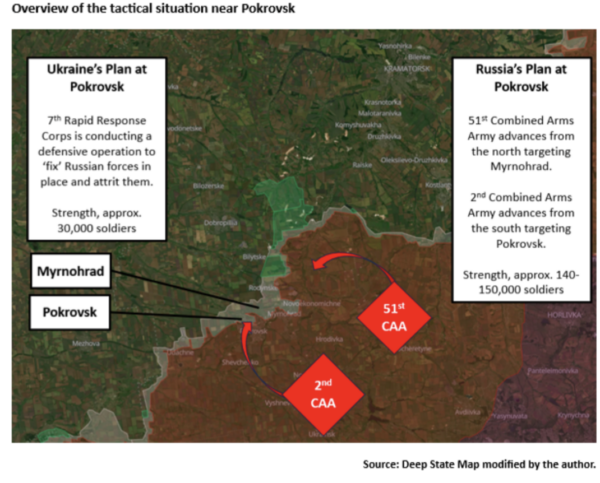
The attackers are aiming to capture the two towns, while the defender’s aims are to:
- Draw in as many Russian attackers as possible, ‘fixing’ them in place so that they cannot be used elsewhere.
- Destroy or ‘attrit’ as many Russian soldiers as possible.
Ukraine’s strategy is to use its forces economically to hold defensive positions, then wear down Russia’s ground forces and inflict such heavy casualties that Putin is forced to negotiate. Essentially, Ukraine is using Putin’s need for a tangible victory to inflict massive casualties on Russia. In November 2025, Shaun Pinner writing for the Centre for European Policy Analysis summed up the battle succinctly, writing that “Pokrovsk represents a place where Russia feels it must win, and where the Ukrainian armed forces are making them pay dearly for trying. It’s not a city now, not really. It’s a pressure valve. A choke point. A grinding wheel. To Moscow, it’s a banner they need to raise. To us, it’s extra time, and time is life in this war.”
And, this is not the first time Ukraine’s strategists have used Putin’s ego and desire for ‘any victory’ to inflict massive attrition on Russian ground forces. Avdiivka, Bakhmut and Chasiv Yar have all played a similar role, anvils upon which Russia’s ground forces are hammered. Generally, Russia will prevail eventually but with massive casualties.
Operationally, the battle for Pokrovsk is notable because a relatively small Ukrainian force is tying down and attriting approx. a quarter of Russia’s total combat power in Ukraine. And the military question for Russia is – for what? Even if Pokrovsk falls its utility as a transport hub has been compromised by the fighting and Ukraine has had time to reinforce its next line of defence. Putin will get a moment of glory but the military effect on the war is likely to be limited.
Looking more closely at the battle there is reason to believe that it will continue for some time yet. The Russians are advancing but rely on using re-entrants, wood lines, shelter belts and urban areas to avoid Ukrainian drones. Effectively, this means that the open ground to the west of Pokrovsk and Myrnohrad ‘blocks’ Russian manoeuvre and allows Ukraine to maintain limited logistics support to its defended areas. This ground also provides manoeuvre area for a withdrawal or a ‘spoiling attack’ to support a future Ukrainian withdrawal.
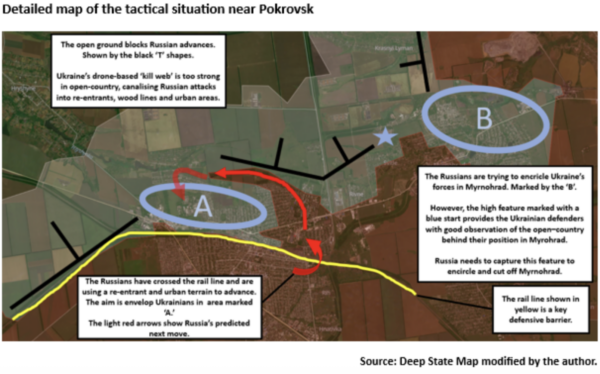
Before it can occupy Pokrovsk and Myrnohrad, Russia needs to compromise Ukraine’s ability to use the open ground. Therefore, Russia’s next moves are likely to be:
- Using the system of re-entrants, wood lines and houses to the north and west of Ukrainian positions in Pokrovsk to envelop the defended area.
- Capturing the high feature west of Myrnohrad (marked by a blue star) that dominates the local area.
Russia’s problem is that the ground currently canalises their assaults into relatively small and predictable ‘channels.’ For instance, re-entrants and wood lines that can be covered by artillery fire. It is noteworthy how drone surveillance and attack is being integrated into the tactics of combined arms operations. Drone based ‘kill webs’ blocking manoeuvre in open country and channelling an attacking force into relatively small areas where they can be engaged with artillery.
In summary, the conditions for Russian victory are not in place yet and at Russia’s current rate of progress the situation is unlikely to change suddenly. Therefore, expect to see the fight for Pokrovsk continue.
Ukraine’s wider ground operations
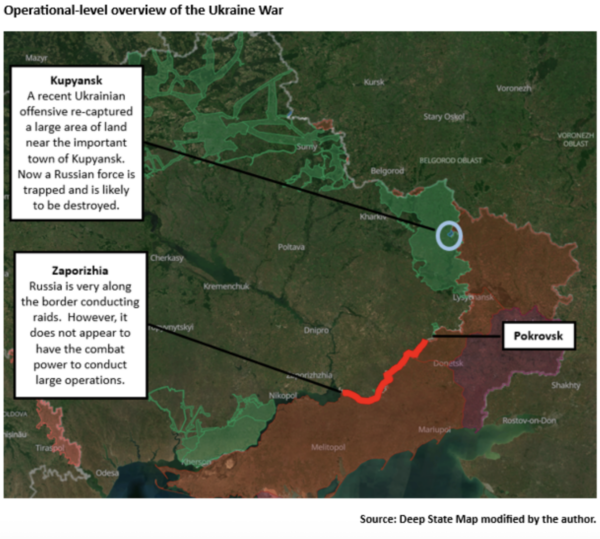
The impact of the fighting at Pokrovsk at operational-level is notable. Recently, Ukraine conducted a small but successful operation recapturing land near Kupyansk. Likewise, Russia is unable to develop sufficient combat power along the Zaporizhian border to conduct large operations. By ‘fixing’ a large percentage of Russian combat power at Pokrovsk, Ukraine has restricted Russian operational-level manoeuvre along the remainder of the front line.
Russia simply does not have the combat power to attack anywhere else, and at Kupyansk lacked the reserves avert a tactical defeat. Russia’s most dangerous course of action at this stage would be to stop the Pokrovsk offensive and quickly switch its main effort to another less well-prepared section of the front line. However, an operation like this would be difficult practically because it requires secret movement and redeployment of forces. And is probably politically impossible to consider when Putin is committed to capturing Pokrovsk.
The strategic situation – Ukraine disrupts Russian oil and the US gets tough on Russia
In late 2025, Ukraine increased the tempo of its strikes on Russia’s oil and gas industry. Ukraine’s drone and missile attacks are becoming more destructive because it has more cruise missiles, and better intelligence from the US to pick targets. Additionally, Ukraine is now also interdicting Russia’s tanker fleet, often far from home. Since the end of 2024, roughly 7-8 Russian tankers have been damaged in waters near Gabon, Russia, Spain, Libya, Turkey and Italy.
Most importantly, an outcome of this week’s meeting between European powers in Paris is a joint statement confirming the US is considering participation in providing security guarantees for a Ukraine ceasefire. NBC reported that “The United States for the first time on Tuesday backed a broad coalition of Ukraine’s allies in vowing to provide security guarantees that leaders said would include binding commitments to support the country if Russia attacks again.”
It is useful to consider the evolution of the US position. This week’s meeting in Paris was notable because it included US Special Envoy Steve Witkoff and Trump appointee Jared Kushner. A considerable change from past meetings that Witkoff conducted that excluded European input. This could indicate that the White House now understands that it makes sense to work with America’s allies rather than trying work around them.
An important participant in Paris was General Alexus Grynkewich, the current Supreme Allied Commander Europe (SACEUR). General Grynkewich commands NATO and before the meeting liaised with the alliance’s military commanders to ensure the proposal was supportable. The inclusion of Witkoff and Kushner is important because it maintains the relationship with Trump. However, it is vastly more significant that SACEUR was at the table because it demonstrates that security guarantees are being considered seriously with professional input.
European statesmen have played a delicate and difficult role managing the Trump administration and appear to be slowly changing its position on Ukraine. Bad news for Putin, who appears to have over-estimated his ability to manage Trump.
Conclusion
In conclusion, at the start of 2026 there is cause for cautious optimism. The key determinant of how long the war will last is whether the US supports Ukraine. Putin’s survival depends on keeping the war going until he can snatch some sort of ‘victory’ from the jaws of defeat. So, even if Russian forces are pushed back Putin will continue to feed young Russians into the war until he can claim victory. This will continue until Russians refuse to fight.
The catalyst for Russian refusing to fight is probably a cataclysmic defeat. In my opinion, Ukraine will eventually wear the Russians down to the point at which they collapse. European support means that collapse will come sooner, and if the US intervenes even quicker. The calculus of the situation has eluded Trump to-date.
Now though there are indications that people with influence on the Trump administration understand the situation. Putin’s recalcitrance has played against him and now US activity indicates increasing support for Ukraine.
Good news for Ukraine and good news for the world.
Ben Morgan is a bored Gen Xer, a former Officer in NZDF and TDBs Military Blogger – his work is on substack




It appears stand alone complex is a troll. No constructive thought of mind or rebuke. Just anti Pat for the sake of being anti Pat. Would really like to see reasoned debate by SAC or will the acronym always be known as Sad old C..T?
22 responses above, 11 from Pat. Get a job, do something useful Pat. Just take a break Pat, have a rest and leave us be.
“Further in recent weeks, the US has seized two Russian oil tankers…..” Ben Morgan
The US has not siezed any Russian oil Tankers, . Not ‘two’, not even one.
Zero, Zilch, Nada.
After being menaced by the US navy while crossing the Atlantic, The crew of the Venezuelan oil tanker Bella 1 in an act of desperation reflagged their ship as Russian and called on the Russians to protect them, the Russians claim they sent a nuclear powered submarine to the aid of the Venezuelan ship, but who knows, it never surfaced and no one ever saw it.
From Al Jazeera:
…The US special forces commandeered a Russian-flagged oil tanker with links to Venezuela in the North Atlantic after a weeks-long pursuit, drawing a sharp rebuke from Moscow. US forces have been pursuing the Marinera in the Atlantic Ocean since last month in the lead-up to the country’s military operation to abduct Venezuelan President Nicolas Maduro, which was carried out on Saturday…..
…..The ministry added contact with the vessel, which it said received “temporary permission” to sail under the Russia flag on December 24, was lost after US naval forces boarded it “in the open sea, beyond the territorial waters of any state”.
https://www.aljazeera.com/news/2026/1/7/us-attempting-to-seize-venezuela-linked-russian-oil-tanker-reports
From the BBC (as it happened):
….The US is carrying out an operation to seize a tanker linked to Venezuelan oil, an official tells CBS, the BBC’s US news partner.
Previously named Bella 1, its name has been changed to Marinera and it has also reportedly been reflagged from a Guyanese to a Russian vessel.
Russia has reportedly deployed a submarine and other vessels to escort an oil tanker – which is also being pursued by US forces – across the Atlantic……
https://www.bbc.com/news/articles/cdxj28xd542o
The Russians will not send a naval escort to protect Venezuelan oil tankers from US depredations, the Russians and the Americans are working together.
In a deal hammered out on the sidelines of the Putin/Trump meeting in Alaska, the Russian imperialists and the US imperialists agreed to work together to extract and ship Russian oil from the Russian far East. The very last thing the US would do is sieze a Russian oil tanker, that might be carrying US oil from the Sakhalin oil fields.
Conclusion
Imperialist powers are like warring brothers, sometimes they are enemies, sometimes they are family. Sometimes they work with each other to share in the spoils, sometimes they oppose each other to take the spoils of imperialism for themselves.
Quid pro quo:
We will let you fuck over Venezuela, if you let us fuck over Ukraine
Think I will bookmark this post, and in three months time I will revisit it, and have a good laugh.
HAHAHAHAH
588 net square kilometres liberated by Russia in 2023
3457 net square kilometres liberated by Russia in 2024
5559 net square kilometres liberated by Russia in 2025
Surely, Russia will fall soon
Yeah unless NATO decides to commit Seppuku and engage Russian forces directly in a ground war, this is a war of attrition that Russia will ultimately win.
Check out the disparity in population Ben .Putin can keep going way longer than Zelensky, who already has huge manpower problems and mass desertions, and despite shutting down rivals still faces increasing threats from within
Zionists like Ben will never stop sucking on Zelensky’s cut co*k.
There won’t be a ceasefire until Ukraine is defeated and accepts Russia’s terms. Pokrovsk has fallen. Livov has just 50 miles from the Polish border been Struck by an Oreshnik missile. Russia has retaliated by seizing US and other shipping in retaliation for the U$$$$ seizing an empty Oil tanker in the North Sea. Russia is on the up and up!
Ben Morgan; “in recent weeks the US has seized two Russian oil tankers”
In recent weeks the US has seized two Venezuelan oil tankers
And then we get a pro-war jingo on the other side, making an equally false claim.
jay11 January 10, 2026 At 8:06 am
“Russia has retaliated by seizing US and other shipping…..
Both of these statements are false to hide the embarrassing fact that these two imperialist frenemies are now working together, having come to an arrangement, to exploit Russia’s far East oil reserves and second, divide Ukraine between them.
Both of these false statements are examples of propaganda to hide the true nature of the US Russia relationship.
The Daily Blog – Korean War solution for Ukraine – Russia?