
Ben Morgan’s Pacific Update: Japan and China’s diplomatic spat, looking at the bigger picture

Japan and China are currently involved in a diplomatic dispute. The conflict started on 7 November when Japan’s Prime Minister, Sanae Takaichi spoke in parliament and linked the security of Taiwan to Japan. Takaichi said that a Chinese attack on Taiwan might trigger a military response from Japan. China responded to Takaichi’s comments by issuing travel advisory notices warning Chinese against travelling to Japan on 14 and 26 November, and on 19 November banned imports of Japanese seafood.
China is also flexing its diplomatic and military muscle. China’s Permanent Representative to the United Nations wrote a letter to the Secretary General that states: “If Japan dares to attempt an armed intervention in the cross-Strait situation, it would be an act of aggression. China will resolutely exercise its right of self-defence under the UN Charter and international law and firmly defend its sovereignty and territorial integrity.” A diplomatic threat reinforced by People’s Liberation Army live-firing exercises near Japan between 17-25 November.
It is also reported that China approached other nations like the US and France to put pressure on Japan. For example, the Wall Street Journal reported on 27 November that Chinese President Xi contacted US President Trump directly. The Wall Street Journal reported the call that caused Trump to tell Japan to ‘turn the volume down,’ although this is denied by Japan.
China’s response is noteworthy because it demonstrates a several features of Chinese strategy. For example, Taikaichi’s statements do not seem to be especially confrontational because any military operation to blockade or invade Taiwan could ‘spill over’ and impact on nearby Japanese territory. China’s response seems disproportionate, forcing observers to consider – Why?
A feature of Chinese diplomacy is trying to isolate Taiwan and frame the dispute as a bi-lateral, internal issue between the nation and its wayward province. Taikaichi‘s comments acknowledge the collective nature of security issues and by inference, Taiwan’s sovereignty.
The aggressive reaction’s immediate aim is to get Taikaichi to retract her statements by applying diplomatic, economic and military pressure. However, China’s other aim is to send a message to all nations that surround or support Taiwan – Stay out of the discussion, the conflict is between China and Taiwan and no-one else. Taikaichi’s statements, on the other hand, present the China -Taiwan conflict as a ‘collective security’ concern that impacts on neighbouring countries.
The concept of collective security is concerning for China because it provides a potential challenge to Chinese military power. China’s strategy to defeat collective security is the use of bi-lateral engagements on issues. By linking Japanese security to Taiwan, Taikaichi is challenging this strategy and reinforcing the idea that Taiwan’s status is a wider collective security issue. The comments indicate Japan’s security concerns, and should be assessed in the context of recent Japanese defence decisions that reinforce the Southern Island Chains linking it to Taiwan. See here for more information – https://benmorganmil.substack.com/p/pacific-brief-16-november-2025 .
Recently, Japan role is changed in the Pacific region. Its military is growing, alongside its integration with US forces in the Pacific. Its ships, planes and aircraft are exercising and visiting other Pacific nations, including developing a closer military relationship with Australia. Notably, Japan continues to provide foreign aid throughout the region.
The current activity is notable because it indicates that Japan wants to increases its engagement in regional collective security. Japan’s activity also indicates it is concerned by China’s assertive foreign policy. Japan is a large regional power and its unwillingness to backdown to Chinese pressure could be interpreted as Japan trying to position itself as a leader in the network of collective security partnerships evolving to deter possible Chinese military interventions. A trend that other Pacific countries like South Korea, Philippines, Australia and New Zealand will be watching closely, especially if US foreign policy becomes more unpredictable.
Japan’s new hyper velocity missiles, and moving air-defence missiles to Okinawa
Last week, two notable indications of Japan’s more assertive security posture were made public. The first of which was the successful testing of new hypersonic missiles. A hypersonic missile travels very fast, more than five times the speed of sound, so is difficult to intercept. Powerful militaries around the world are pursuing this technology and last week Japan tested its new Hyper Velocity Gliding Projectile (HVGP) Block 1.
The testing included loading and transporting the system’s launch vehicles onto ships and planes, and practicing firing the missiles. The HVGP Block 1 missile has an estimated range of 3-500 km and the Block 2 and 2B variants will increase the range to 2-3000km. The HGVP is also accurate enough to engage a ship or small land target.
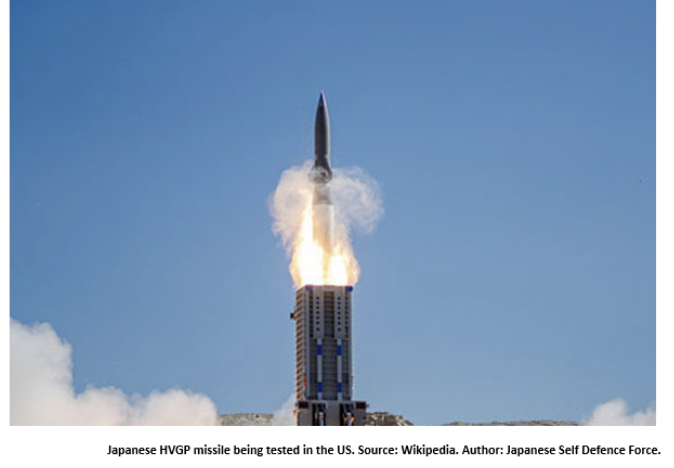
Japan plans to bring the HVGP Block 1 missiles into service in 2026, and 2/2B variants by 2030. The HVGP’s long-range means they are likely to be deployed on Japan’s largest islands Kyushu and Hokkaido, these islands large land area providing room for dispersion.
The HVGP is a significant increase in Japanese military capability and provides a tool for long-range ‘area denial,’ preventing Chinese carrier, or amphibious task groups from getting close to Japanese territory. However, the Block 2/2B HVGP also provides a ‘missile defeat’ capability because the missiles have sufficient range to attack similar Chinese or North Korean missiles, and their supporting surveillance, logistics, and digital infrastructure deep inland. For more information about missile defeat see – https://benmorganmil.substack.com/p/pacific-brief-25-september-2025
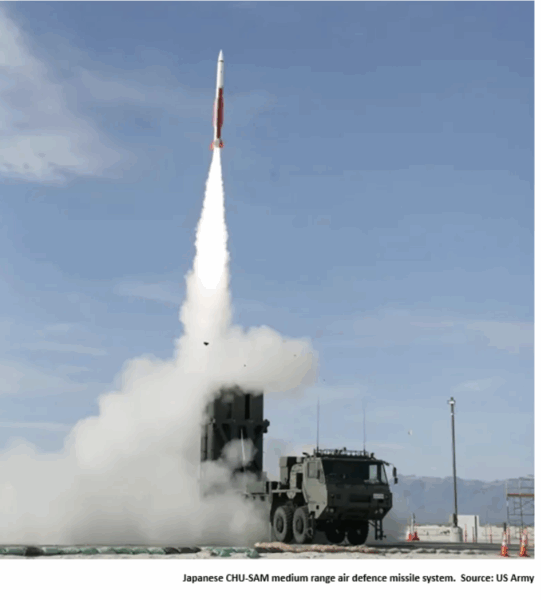
It was also announced last week that Japan is planning to install air-defence missiles in the Ryukyu Islands, also known as Okinawa. Speaking during a visit to a military base, Japan’s Defence Minister Shinjiro Koizumi said that Japan plans to station Type 3 CHU-SAM medium-range air-defence missiles at Yonaguni, in Okinawa approx. 110 km from Taiwan. The missiles have a range of more than 50km and will bolster local air defences.
Japan’s development of its long-range missile strike capability is another indication of how insecure the nation currently feels. Developing these types of weapons is expensive and time consuming, the investment is only warranted if there is a threat whether it is real of perceived. Likewise, the deployment of air-defence missiles to the Ryukyu Islands is similar indication of Japan’s concern’s about security.
US maintains a carrier presence in the South China Sea
American aircraft carrier, USS George Washington moved into the South China Sea on 17 November, replacing USS Nimitz. US Naval Institute News highlighting that “The U.S. is maintaining a steady aircraft carrier presence in the South China Sea as both allied and Chinese military activity remains high around the contested Scarborough Shoal off the coast of the Philippines.” The same source reports that another US carrier, USS Abraham Lincoln recently deployed to the Pacific out of its normal operational cycle.
The last Pacific Brief included a summary of recent activity in the South China Sea, noting the increasing tempo of military activity in the area. The deployment of US carrier task groups is a barometer of American concern, so the replacement the USS Nimitz in the South China Sea followed by the deployment of USS Abraham Lincoln should be noted by observers.
Melanesian update
A regular update on the Pacific’s least reported trouble spot; Melanesia.
West Papua, protests and jailed activists
West Papua or Irian Jaya is a province of Indonesia. It borders Papua New Guinea, splitting the large island of Papua in half. It was a Dutch colony until 1962, when it was transferred to Indonesia. Many West Papuans want independence and a small war has been fought in the territory since the Dutch left. In recent weeks, there has been an escalation in violence and pro-independence protests.
This week it was announced that four Papuan political prisoners were sentenced to seven months imprisonment on treason charges. In April, the activists delivered protest letters to government offices in Sorong. Letters that requested a peaceful negotiation with Indonesia’s president.
The arrests triggered violent protests, and the Indonesian government’s decision to imprison the activists may spark more animosity. The prison sentences seem disproportionate for the crime, possibly indicating a level of government heavy handedness that correlates with reports of Indonesia aggressively suppressing the independence movement.
It is a situation that echoes Timor Leste’s position 30 years ago, another province of Indonesia that’s independence struggle was quietly and violently suppressed because other regional powers wanted to maintain close relationships with Indonesia. The struggle in West Papua takes place far from mainstream media so gets little press coverage. However, the conflict de-stablises Papua’s central highlands on both sides of the porous and poorly controlled border.
Fiji truth and reconciliation process
Fiji is a small Pacific nation that has been blighted by military coups. In 1987 the nation had two governments removed by the military. This set a precedent and further coups followed in 2000 and 2006. Aside from the destabilising effect of a military intervention in civil government each episode included allegations of violence against individuals. Additionally, the first three coups included the introduction of laws that discriminated based on race against non-Fijians living in the nation. The fourth coup targeted the Great Council of Chiefs; a constitutional element of government that helps appoint members of the nation’s Senate.
In 2024, Fiji established a Truth and Reconciliation Commission to “promote social cohesion through healing and reconciliation by facilitating open and free engagement in truth-telling regarding the political upheavals during the coup periods from the year 1987 and to promote closure and healing for the survivors of these events.”
Laudable goals, supported by an internationally proven process. The Truth and Reconciliation Commission serves an important purpose and contributes to Fiji’s stability by providing an opportunity for the people involved in this history to state their positions, listen and build stronger civilian led governance.
Last week, Sitiveni Rabuka, Fiji’s current Prime Minister and the leader of Fiji’s first military coup spoke to the commission. An important speech, reported by Radio New Zealand here – https://www.rnz.co.nz/international/pacific-news/580341/fijian-pm-rabuka-blames-insulated-upbringing-for-racially-motivated-87-coups . Rabuka’s speech is an important contribution to Fiji’s national debate, and helps to reinforce the principles of civil government, reducing the risk of future military interventions.
Papua New Guinea’s 2026 budget provides insight into the nation’s challenges
Currently, Papua New Guinea’s parliament is debating the nation’s 2026 budget. This is noteworthy because it provides insight into the challenges small Pacific nations face managing security issues. The 2026 budget totals Kina 30.9 billion (approximately US$ 7,114,783) in expenditure and is approx. a 10% increase from 2025.
The budget is described as sensible and optimistic; 88% of the budget is funded from domestic revenue, overseas borrowing is reducing and the deficit is projected to drop. Deloitte’s 2026 Papua New Guinea Budget report states “The government has signalled discipline and long-term thinking – aiming for near-balanced budgets by 2027 and investing in development enablers.”
Deloitte also notes that the budget “contains major new funding in law & order, education, health, and infrastructure and maintaining programs such as the Household Assistance Package to ease cost-of-living pressures.” Indications that Papua New Guinea is keen to strengthen security and stability.
Radio New Zealand’s analysis says that credibility is one of the budget’s strengths and that “by setting realistic targets rather than grand promises, it signals a maturing of fiscal discipline.” Papua New Guinea’s budget appears sensible, and credible.
However, there are difficulties that should be noted. For example, provincial governor Allan Bird has criticised the budget for overspending and being too optimistic in its revenue projections. Bird points out that revenue received in 2025 was Kina 2 billion less than predicted. He is also concerned about transparency and fiscal discipline because the government has a history of spending on non-budgeted items, then reconciling the expenditure after the fact in the annual Final Budget Outcome. Behaviour that lacks transparency, and Bird’s criticisms remind us that Papua New Guinea faces serious issues with governance.
Governance is an important issue when the nation’s budget is so small. US$7,114,783 is a tiny sum of money to maintain state institutions in a country that’s land area is approx. 1.5 times larger than New Zealand, and slightly bigger than California. The nation faces internal security threats and there are ‘tribal wars’ and incidents of significant criminal violence. Additionally, like other several Pacific nations Papua New Guinea is a target of trans-national crime groups smuggling drugs, goods and people through it. The budget reminds us of how limited Papua New Guinea’s resources area and of how important assistance from other nations is to supporting governance, security and stability.
Ben Morgan is a bored Gen Xer, a former Officer in NZDF and TDBs Military Blogger – his work is on substack


The Trump Corollary to the Monroe Doctrine
Implications for the EU, NATO, Russia and China
https://www.aol.com/articles/trump-pledges-reassert-monroe-doctrine-190510562.html
The Whitehouse has published a document entitled, “National Security Strategy of the United States of America November 2025”
The National Security Strategy, released overnight, described Trump’s vision as one of “flexible realism” and argued that the U.S. should revive the 19th century Monroe Doctrine, which declared the Western Hemisphere to be Washington’s zone of influence. It also warned that Europe faces “civilizational erasure” and must change course……
Not since the original Monroe Doctrin has there been a more blatent re-statement of naked US imperialist intent.
Marx wrote that capitalism is the exploitation of man by man, and war of all against all.
Lenin wrote that imperialism is the highest form of capitalism.
I would disagree; Imperialism is the lowest form of capitalism,
The exploitation of man by man has been replaced with the exploitation of nation by nation, and war of all nations against all other nations.
Imperialism with its violent colonial occupations, regime change wars, and global inter-imperialist trade wars are taking us to the brink of world war.
Imperialism is the lowest form of capitalism, a new word had to be coined for imperialism’s highest realisation, “genocide”.
Monroe Doctrine
From Google AI
The Monroe Doctrine (1823) warned European powers to stay out of the Americas, but the Roosevelt Corollary (1904) expanded it, declaring the U.S. would act as the “World’s policeman”….
Marxist economists, Left Wing politicians, and even Liberals, decried the Monroe Doctrine for its naked statement of US imperialist intent.
Capitalist economists, Right Wing politicians and even neo-Liberals, distanced themselves from the Monroe Doctrine, claiming, the Monroe Doctrine was an aberration, no longer relevant to world affairs, ‘old fashioned’, ‘in the past’.
Mark Twain on US imperialism.
https://blogs.urz.uni-halle.de/twain/tino-boche-2/#
How to Hide an Empire
https://www.amazon.com.au/dp/0374172145?ref_=mr_referred_us_au_nz
Despite the Right’s shamefaced denial of US imperialism, as the above links show, US imperialism has always existed and continues to exist in the modern world.
No doubt the Right and especially the Centre Right will claim that the Trump Administration, National Security Strategy document, like Donald Trump himself, is an aberation, However the US establishment from a place of denying accusations of imperialism, began openly embracing imperialism and the Monroe Dontrine, nine years before Donald Trump became president;
Max Boot Feb 18, 2008
“America should be the world’s policeman”
https://www.youtube.com/watch?v=wPDjqZytdOQ&t=120s
The US imperialists are not the only imperialist that seek to be the World’s Policeman, US imperialist rival, China literally sends police globally.
https://irregularwarfare.org/uncategorized/policing-the-pacific-how-china-expands-influence-where-the-us-looks-for-allies/
……China builds influence through policing. In the Pacific Islands (where few nations have militaries), this divergence gives Beijing an opening to expand its reach, using law enforcement ties to cultivate dependence and erode sovereignty.
With only three Pacific Island Countries (PICs) having standing militaries (Fiji, Papua New Guinea, and Tonga), security and defense responsibilities fall on police forces in many states. The PRC has recognized that advancing police partnerships with PICs is an effective way to grow its influence at the expense of host nation sovereignty….
Lenin wrote; “Politics is conentrated economics”
Von Clausewitz wrote; “War is politics by other means”
Not being able to settle their economic differences by political means, the US and China are building up their military forces to settle their differences in this region by ‘other means’.
The immediate question for New Zealanders; ‘Do we want to be like Australia and sign up for this coming imperialist blood fest?’
or, ‘Do we want to stay out of it like Indonesia?’
https://www.aspistrategist.org.au/a-studiously-ignored-problem-force-projected-from-australia-must-go-through-indonesia/
…After the AUKUS security partnership was announced, Indonesian member of parliament Tubagus Hassanudin said the sea lanes ‘cannot be used for activities related to war or preparation of war or non-peaceful activities.’
….This is particularly problematic given Indonesia’s longstanding policy of non-alignment: Jakarta will not automatically support Western operations and may actively resist becoming entangled.
….. Indonesian foreign policy under President Prabowo Subianto, while more globally engaged, continues to prioritise strategic autonomy, focusing on balancing ties with the US, China and others while avoiding formal alignment.
…..allies cannot count on Jakarta adhering strictly to UNCLOS if it feels under pressure—for example, if it perceives its neutrality or sovereignty is threatened.
…..If Jakarta hedges or remains neutral, others in the region may follow its lead.
Good point. If Indonesia decides to sit this one out, so should we.
3 million Indonesians died in WW2
11 thousand New Zealanders died in WW2
Both countries have good cause not to join WW3
America First is a Zero-sum game,
Everyone else is last.
From Reuters:
Trump strategy document revives Monroe Doctrine, slams Europe
By Idrees Ali, Matt Spetalnick and James Mackenzie
December 6, 2025
https://www.reuters.com/business/finance/trump-strategy-document-revives-monroe-doctrine-slams-europe-2025-12-05/
Summary
New strategy document says US should bring back Monroe Doctrine
Document questions whether Europe can remain vital ally
Sweeping changes could revive suspicion and consternation among adversaries and allies….
WASHINGTON, Dec 5 (Reuters) – The United States will reassert its dominance in the Western Hemisphere, build military strength in the Indo-Pacific, and possibly reassess its relationship with Europe, President Donald Trump said on Friday in a sweeping strategy document that seeks to reframe the country’s role in the world.
The National Security Strategy, released overnight, described Trump’s vision as one of “flexible realism” and argued that the U.S. should revive the 19th century Monroe Doctrine, which declared the Western Hemisphere to be Washington’s zone of influence. It also warned that Europe faces “civilizational erasure” and must change course.
The document is the latest – and clearest – expression of Trump’s desire to shake up the post-World War Two order led by the United States and built on a network of alliances and multilateral groups, and redefine it through his “America First” lens.
“This ‘Trump Corollary’ to the Monroe Doctrine is a common-sense and potent restoration of American power and priorities, consistent with American security interests,” the document says,…..
[Good grief! You couldn’t get a clearer statement of imperialist intent and big power rivalry.]
….In the document, the administration took a dour view of its traditional allies in Europe, warning that the continent faces “civilizational erasure” and must change course if it is to remain a reliable ally for the United States.
The document is the latest in a series of statements by U.S. officials that have upended postwar assumptions about Europe’s close relationship with its strongest ally, the United States….
[It will all end in tears, and global imperialist war]
Ben also forgets to mention this being just another provocation by western power elites in asymmetric war against China which one day we will be tasked with supporting just as we are tasked with supporting the Banderite facists in Ukraine.
An NATO front which is quite rapidly now, in collapse. Diversion. It’s a neocon thing.
“Ben Morgan” fails to mention that Imperial Japan seized Taiwan from China in 1895, violently repressed the local population and continued to occupy the country until 1945. Given that history, it is not hard to see why China, and the people of Taiwan, would resent any suggestion of further Japanese military action in the region of China and Taiwan.
Morgan writes “Taikaichi’s statements do not seem to be especially confrontational because any military operation to blockade or invade Taiwan could ‘spill over’ and impact on nearby Japanese territory. China’s response seems disproportionate, forcing observers to consider – Why?”.
This is disingenous. Every observer who knows the history of China-Japan relations realizes that Taikkaichi’s statements are extremely confrontational and certain to provoke a fierce response.
I am sure that Ben Morgan knows his history and knows the answer to his own question.
He simply chooses not to tell us the facts that explain the Chinese reaction.