
GUEST BLOG: Bryan Bruce – Speed Kills-it’s that simple.
Transport Minister Simeon Brown and Regulation Minister David Seymourwant to raise some speed limits.
For example, they want to reverse the previous Government’s moves to lower speed limits outside schools and in regional areas, and increase the limit to 120 km/hr from 110 km/hr on some new motorways.
Brown’s argument is broadly economic.
“The previous government’s untargeted approach slowed Kiwis and the economy down, rather than targeting high crash areas of the network,”
David Seymour’s argument is that the blanket restrictions “ didn’t just make it harder for people to get where they wanted quickly and safely, they drained the joy from life as people were forced to follow rules they knew made no sense.”
(Source of quotes : https://www.beehive.govt.nz/
So, money and the joy of speed are what make sense?
Get a grip!
What about the value of human life? Where is the joy in the death of a mother,father, son or daughter from a speed related fatality?
The evidence is clear – slower speeds save lives.
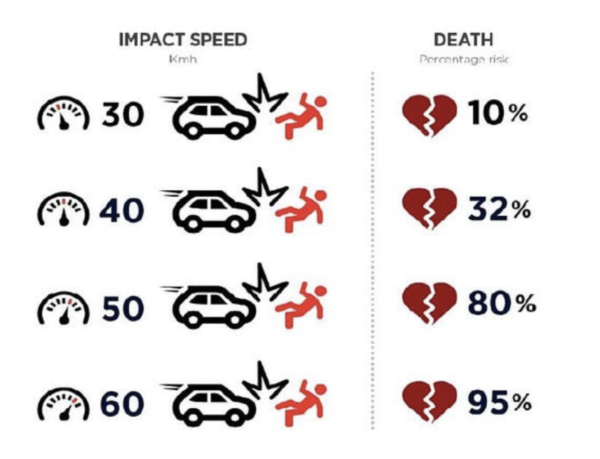
Auckland Transport in 2021 reported that roads where speed limits were lowered on 30 June 2020 “experienced a 47 per cent reduction in deaths in the 18-months following the changes, a reduction in all injury crashes of more than 25 per cent and greater than a 15 per cent reduction in serious injuries on these roads.” ( Based on annual figures for the period 30 June 2020 to 31 December 2021, when compared to the prior five-year comparison period.)
There are plenty of studies which show that higher speeds result in higher numbers of deaths an injuries. Here’s one published in 2022 in the peer reviewed Journal of Road Safety by road safety experts Soames Job and Colin Brodie completed Understanding the role of Speeding and Speed in Serious Crash Trauma: A Case Study of New Zealand,
Key findings from this paper show that more than 70 per cent of fatal crashes in Auckland involve speeding and total deaths and serious injuries (DSI) have reduced by more than 20 per cent since the introduction of the speed restrictions.
Rural roads where speeds were changed on 30 June 2020 have seen a 71 per cent reduction in deaths and more than a 25 per cent reduction in serious injuries
What research have Seymour and Brown done before launching their proposed money and joy reforms?
Answer – we are not told and my guess is that either they haven’t done any, or are choosing to turn a blind eye to the compelling evidence for ideological reasons that trumpet the rights of the individual over our duty and responsibility for the well-being of others.
Speed restrictions are a good example.The individual gives up their desire to travel as fast as they want for the collective good and the right to life.
You can make a submission on the Brown/Seymour proposal to change the speed limits here:
Bryan Bruce is one of New Zealand’s most important and respected documentary makers. His work is available on bryanbruce.substack.com







clearly reading all the comments above Kiwis are a bunch of self centered fuck wits
“… are choosing to turn a blind eye to the compelling evidence for ideological reasons that trumpet the rights of the individual over our duty and responsibility for the well-being of others”.
Not wrong there. The Right have always leant to asserting individual rights rather than advancing collective responsibility. Reducing speed restrictions is simply an extension of this ideology.
What about the right of the majority? After all, that is the crux of democracy.
Limits on many highways have been reduced to 80kmh or 90kmh, while roads around schools are now 30kmh.
The majority of New Zealanders said the 100kmh speed limit on the open road should be left as it was, according to a Waka Kotahi survey in December 2022.
Local backlash has often been seen, with people complaining that speed limits were being lowered despite community opposition.
Wairarapa commuters were outraged when the speed limit on a major stretch of State Highway 2 was cut to 80kmh in January. The majority of about 1300 submissions were against the speed reduction.
It is the first highway stretch that National said it would consider reversing back to 100kmh if elected.
Labour’s candidate for Wairarapa, Kieran McAnulty, also wants the highway returned to 100kmh.
https://www.rnz.co.nz/news/political/499775/potential-obstacles-to-national-s-promise-to-increase-speed-limits
In fact, speed doesn’t kill. High negative acceleration is what’s doing the killing, as in Newton’s Second Law. Physics isn’t nation dependent, and for example Germans can legally do 160kph and have a fraction of our road deaths/km driven.
Joking aside, road research scientists in this county say that speeding and drinking combined only account for approx. 19% of fatalities. All the rest is a combination of inattention and incompetence.
The real issue in this country is the consequence of an error. Nod off for a second at the wheel on a properly designed motorway and most likely the barriers will keep you on the carriage pointing in the same direction, but in sunny NZ you’ll either be launched off into a fern clad gully if you drift left or hit a Kenworth logging truck head-on if you drift right. Regardless of your speed, either will almost certainly kill you.
The solutions:
Motorways with carriageway separation and Armco barriers.
Better driver training
Bad, reckless driving kills. Driver training in NZ is a sick joke.
There is little to no public transport in small centre’s that us why we have so many cars.A bad driver is a bad driver at any speed. Seymour is right about taking the joy out of motoring by 80 km limits on roads that were 100 km for years with no on going accident hot spot problems .⁸
Trevor. Plus some rather unsuitable persons driving cars. Yes, one can live and work easily without a car in great cities like London with decent public transport and trustworthy cabbies on the streets, but New Zealand has no great cities, and even our good railway network was vamoosed, for reasons beyond my comprehension.
Blaming bad drivers amongst other things is valid but the point is that bad drivers driving slowly kill fewer people than bad drivers driving quickly.
IMHO – slow and inconsiderate drivers are a major reason for recklessness. just pull over to the left and allow people behind you to pass safely. NZ roads are full of brain dead zombies who have no awareness, or worse, frightened little numpties who are so petrified they can’t function in a motor vehicle.
Ever seen a little Chinese lady with her head barely reaching above her chest-hugged steering wheel merging with fast motorway traffic at a snail’s pace ? That’s a bit scary. So was driving on a German autobahn with no speed limit, but everyone managed ok; much better cars too.
The faster they go, the less time they’re on the road, the less chance they’ll hit someone
Bryan, what is your stance on tolls and congestion charging?
Would like to hear your thoughts on this below
https://www.nzherald.co.nz/nz/former-transport-minister-michael-wood-ignored-official-advice-not-to-toll-aucklands-penlink-road/66GRLMK5SBG5NM3YA43FCIBBQM/#google_vignette
Why not just ban private cars? Cuts emissions, consumption, invigorates public transport & saves lives. What’s not to like?
That’s the plan – see below
https://www.youtube.com/watch?v=IYHSieA3tWA
There is little to no public transport in small centre’s that us why we have so many cars.A bad driver is a bad driver at any speed. Seymour is right about taking the joy out of motoring by 80 km limits on roads that were 100 km for years with no on going accident hot spot problems .⁸
Just remember driving & private vehicle ownership is like freedom, it’s a privilege we can no longer afford.
Try selling that to voters.
Just do it! It’ll save lives!
Remember if something saves a single life, it’s worth it. Don’t let democratic processes get in the way.
Actually, those morons hanging out of car windows and shouting and barking at passersby mightn’t be worth saving.
All lives matter Pip.
You want to override democratic processes?
Well, best you piss off to an undemocratic country where you will fit right in.
Really? I thought New Zealand love to ram through poorly thought-out laws whilst ignoring standard democratic processes. Isn’t that what Ardern did?
She also pissed off.
Come on, Ardern did.
And NZ was “safer” for it.
It didn’t come without creating an array of problems
Moreover, that’s a guesstimate.
We don’t exactly know what alternative actions would have been taken to make a precise comparison.
But we’re safer, right?
Right?
I don’t agree with 120km but 110 on a road like transmission gully is perfectly safe.
Many people speed without incident.
Therefore, your assertion that speeds kills is incorrect.
It’s that simple.
In New Zealand for the years 2020 – 2022, driver speed (defined here as driving too fast for the conditions) was a factor in 34 percent of fatal crashes, 21 percent of serious injury crashes, and 17 percent of minor injury crashes.
Interesting side note. Speeding drivers in speed-related crashes are less likely to wear safety belts than drivers in crashes where speed is not a factor.
https://www.transport.govt.nz/statistics-and-insights/safety-annual-statistics/sheet/speed#:~:text=The%20more%20serious%20the%20crash,percent%20of%20minor%20injury%20crashes.
When people think of serious crashes they tend to think of things like drunk drivers, extreme speeds and people acting recklessly.
But a new study from the AA Research Foundation challenges these perceptions and found many crashes involve everyday people not doing anything extreme.
And note this:
An error by the road user was involved in over 90% of both fatal and serious injury crashes
https://www.aa.co.nz/membership/aa-directions/driver/crash-causes-what-happened/
Speed kills but Slimeon Brown wants faster roads when stupid NZers can’t and don’t want to even stop at a pedestrian. I use one daily and the number of drivers that speed past is disgusting.
Yep. Dreadful drivers – tailgating and overtaking are pretty appalling too, lane changing idiotic.
Don’t worry, National are building a mega prison at Waikeria for those dreadful drivers convicted of speeding and killing others.
It won’t do anything for the deceased or their loved ones however, so thanks’ Slimeon Brown, I’m sure in that peanut sized brain you worked that out!
Seymour’s mates often have flash cars and they want to drive them as fast as they can. Simple as that. They “know” that they are much safer than anyone else on the road no matter how fast they might go. I wouldn’t mind if they did that and crashed, except they take innocent people with them. Some small compensation as they tend to lose a shitload of money if they do.
Home-grown New Zealanders are also lousy drivers, discourteous, inconsiderate, and dangerous. The Brits, Italians, Germans and even the French, all do it better than our lot do.
you obviously haven’t driven italian B roads
wORK SAFE SHOULD TAKE THESE TWO CHUMPS TO THE CLEANERS .
The first rule of health and safety is DO NO HARM .
The second is TAKE ALL PRACTICABLE STEPS POSABLE TO PREVENT HARM .
tHESE IDIOTS ARE DOING EXACTLY THE OPPOSITE .
Exactly how is life inside your bubble wrapped cardboard box GW?
Hope you aren’t eating meat or carbohydrates which contain carcinogens or imbibing any micro plastics.
AndI I most certainly hope you don’t cycle to work (do you even work?) because that is highly dangerous and should be banned.
Aren’t 2/3 of road deaths in urban areas pedestrians?
Surely banning pedestrians would save the most lives.
And cyclists of course. The statistics are very clear.
Speed does not kill by itself. Driving at 120km does not kill by itself. There has to be a range of other factors such as bad roads, bad drivers, bad weather conditions, bad cars maintenance or simply bad luck.
If speed is the only reason for the kill rate the answer is to only allow shanks pony for transport (for real ponies kill people too.)
Nefarious argument.
So why did Waka Kotahi (NZTA) spend tens of thousands (at least) on ads telling us that “speed kills”? You know, ‘the faster you go, the greater the mess’ message. There’s more than an ounce of truth in that!
Get real, Gerrit, face facts.
Who knows why they spent tax payers money on the stupid ads, The PMC will spend tax payers money on anything and everything without any measure of accountability or outcome.
Did the ads work? No,
But hey we have 30km, 60km, 80km, speed limits that are religiously policed as a revenue gathering exercise. Case in point; Taupaki Road in west Auckland is a straight bit of highway with a speed limit of 60km (has to be straight so that the radar in the patrol cars can pick up speedsters) with at least one (have seen two there once) patrol car there everyday virtually all day. Yet the nearby Scenic Drive, a twisted and curvaceous stretch of road favoured by cyclists is 80km and no patrol car in sight.
Waka Kotahi is run by the PMC and gone feral.
I would be interested to see if the accident and fatality rates are higher on the Waikato expressway than say the current state highway 1, north of say Warkworth. Higher limit through that stretch in the Waikato but I would bet that, due to the road, it’s safer. I certainly think lower limits around schools should stay but you can’t say location and road surface aren’t relevant in the discussion. It’s hard to say this because I now border on detesting these two individuals.
What percentage of real ponies compared to automobiles speeding kill people?
Plenty of evidence to suggest that speed kills, as all that you mention wont kill people if the correct speed is driven to those conditions.
Nefarious argument
Your comment has provided the evidence that idiots will always exist, changing the speed limit will not change the number of idiots on the road so see if your imagination can understand the difference between a crash from 100 kph and 120 kph. Evidently kinetic energy increase quadratically, not linearly, with speed so let that sink in as well.
What a stupid argument, we all know that speed leads to all sorts of injuries, whether it be sporting, falling from a great height and hitting the ground at speed