
An end to inhumanity to whales is still a dream
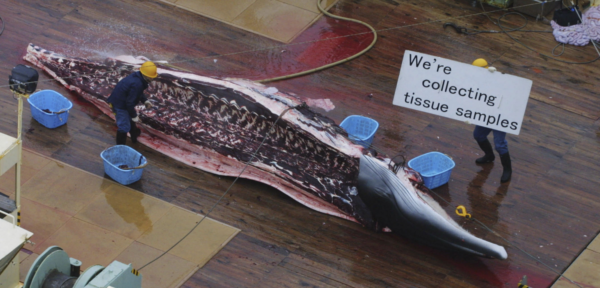
Japan has announced it will leave the International Whaling Commission, withdraw its ’scientific’ whaling fleet from the Southern Ocean and focus on ‘commercially harvesting’ whales from its own territorial waters.
This is a victory for whales – isn’t it? Certainly for some whales, but prospects for an end to inhumanity to whales, are still pretty grim.
Japan says the IWC has been subverted by conservationists, compromising its original agenda of conservation for sustainable whaling. But conservationists say Japan has subverted the IWC by harpooning whales in the Southern Ocean Whale Sanctuary, and selling and stockpiling their meat under the guise of scientific research.
Japan says whale numbers have sufficiently recovered from the whaling days so they can be harvested sustainably without threat of extinction. In the Southern Ocean they have targeted Humpbacks, Minke and Fin whales, killing at least 333 whales last season alone, including up to 200 pregnant females. Japan’s killed tens of thousands of whales outside IWC rules, and Sea Shepherd say they would have killed 6000 more if the group hadn’t confronted illegal whaling operations, obstructing the harvesting of whales, and bringing this inhumanity to the attention of the world.
It’s true the Antarctic Minke whales number up to a few hundred thousand, though they’re data deficient and numbers may be declining. But because of previous whaling by developed countries, other whales number much fewer – in the hundreds, or thousands, and losing individuals can impact on a whole population. Humpbacks have one of the longest migrations in the world, and because migration knowledge is passed through mothers to their young, the loss of an adult female to whaling in the Antarctic, can lead to a loss of a whole lineage in the Pacific. Scientists can now tell us where different individual and groups of whales migrate past and to. They have even identified them by name – a well-known breeding female whale called Aunty often seen with her calves in Queensland was also seen by the Japanese whale hunters in the Southern Ocean. These large, intelligent, social, cultural whales are important as populations as a whole, but as individuals too.
Given what we know about whale sentience, intelligence and ability to feel pain, no matter how many whales there are, harpooning them is wrong. Because of their size, there’s no way to humanely kill a whale at sea, and Greenpeace witnesses to whale harpooning report it’s a long painful, bloody death that can take several hours. Whaling for whatever purpose, is vicious. It’s wrong to kill whales, for sustainability reasons in at least some cases, but its cruel and inhumane disrespect for intelligent life, in all.
It’s wrong to kill whales in the Southern Ocean, as it is wrong to kill them in Japanese territorial waters. Though there are sustainability questions there too. The Japanese whales and dolphins may be more threatened than even the Antarctic species.
Japan’s withdrawal from the IWC means an end to the farce which has seen vote buying and the ‘scientific research’ sham, and shows the weakness in a regime without an enforceable, binding mandate.
Social views about whaling have generally changed since countries caught more whales than they could harvest even to fuel industrial revolution. It’s appropriate that the IWC brief articulates the global general anti-whaling consensus. It shouldn’t be about managing whale populations so there are plenty for countries to harvest. It should be about managing whale population growth so that our oceans are healthy and sustainable for all their inhabitants, for resilience against the damage we’ve done already, and to atone for the destruction of species and ecosystems, now that we’re not killing them directly, now that most of us have seen the light. It could be about us realising we’re not the only ones with a right to the oceans, and that nature isn’t expendable or subservient to our arrogant claims to extractive and harvesting prerogatives. But this view is in conflict with Japan’s, and any nation’s sovereign claim to marine ‘resources’, which are actually ends in themselves not just property.
Yet, these Japanese developments are a progress of sorts, bringing intractable differences to a head. The impasse that saw Japan ignore Australia’s 2014 successful appeal to the International Court of Justice challenging Japan’s scientific whaling has been resolved. Japan has saved face, withdrawing from the whaling waters, and the Commission, on its own terms, an independent and sovereign actor, uncowed by convention, international judiciary or western public opinion.
Apparently, running the whaling programme down there in the deep south was hugely expensive, especially in the face of Sea Shepherd’s dedicated and popular persistence. Sea Shepherd’s brave and bravado-filled televised anti-whaling campaigns got too expensive too, and this year they announced they wouldn’t be heading off to Antarctica to hold Japan to account. Ironically – it’s only now that Japan have said they’re not going either.
Japan has accused the western world in the past of hypocrisy. ‘Look at our meat industry, the way we treat intelligent social animals like cows and pigs’ they say. ‘We often keep them in terrible conditions, then slaughter and eat them. At least whales swim freely before they’re killed’. But that we should improve our own animal welfare standards is no excuse for other countries to reject internationally recognised recommendations and norms themselves.
New Zealand is no exception. For several years running, the IWC has recommended that we do more to save Māui and Hector’s dolphins. (One year, NZ was the only country that abstained in an otherwise unanimous vote). When NZ’s Foreign Minister, Winston Peters, condemns Japan for its whaling at home or on the high seas, he should be mindful of the concerns about what we’re doing to the world’s smallest dolphins, here, too. His party has a big role to play in deciding the future of these tiny endangered cetaceans in coming months, as the Government develops a public Threat Management Plan which should lead to better protection. Let’s hope there’s respect for the IWC here, as it’s expected in Japan.
The IWC was the first international body attempting to ensure the sustainable use of living species. If anything, its role should be further developed. Its conservation mandate should be celebrated – stewardship for the flourishing of whales is a noble and important objective in itself. And because no-one ‘owns’ the world’s whales, and whales know no nation, decisions about their recovery, management and preservation are appropriate at international level.
The IWC has been unable to compel compliance, and some states have rejected or ignored its norms and scientific recommendations. That’s a case for stronger sanctions and rules. But instead, there’s a prospect that Japan’s withdrawal might lead to other countries such as South Korea following suit resuming commercial whaling, and/or withdrawing from the IWC altogether. Iceland and Norway also currently kill whales in defiance of the international ban.
Elsewhere, whales continue to be threatened by ship strike, pollution, seismic testing, climate change, noise and entrapment in live and ghost fishing gear. The whales and dolphins of the world, our collective heritage, individuals of intrinsic value themselves, need more protection, from us, and from the Japanese. An end to inhumanity to whales, remains a dream.


People who live in a country where its actually legal to eat the young of endangered native fish ie eat “white bait fritters” aren’t really in a position to tell anyone else what to do.
Anyone who wants to see how the Japanese “harvest” cetaceans in their own waters needs to see the excellent but chilling documentary ‘The Cove’.
http://www.thecovemovie.com/
It’s also worth learning about the role that ‘keystone’ species play in keeping ecosytems in balance. Here’s a short video on how whales affect climate change, narrated by George Monbiot:
https://www.youtube.com/watch?v=IIPrWXnn0ZU
And when our own public servants are treating one of the warriors of the sea – Pete Bethune – in such a despicable fashion, I guess New Zealand itself should feel shame that these mpi loudmouth highly paid louts, attacking genuine activism, have not been dismissed.
https://www.stuff.co.nz/environment/108954302/activist-pete-bethune-fears-thompson–clark-spied-on-him-under-direction-of-mpi