
Whenever I hear old people complaining about hospitals my first thought is ‘who did you vote for’
Patients referred for orthopaedic surgery not even making waiting lists
GPs say patients who desperately need hospital treatment are increasingly not even making it onto waiting lists.
An excerpt of a letter to a GP from Palmerston North Hospital’s orthopaedic clinic earlier this year – obtained by RNZ – confirms some referrals are being knocked back due to “lack of resources”:
“This decision is forced upon us by a lack of sufficient resources to enable us to see all patients referred to us within the limits of the Ministry of Health waiting time targets.”
Until recently, former Palmerston North mayor Heather Tanguay, 80, was one of those people living in limbo, waiting for a specialist appointment about her painful hip.
“I would lead a hīkoi, if I could, of those waiting for surgery, but sadly we would not make it – so many are now unable to leave their homes,” she said.
Her condition suddenly deteriorated a few weeks ago.
“It was horrible – it felt as though my hip was going to collapse, so I went to the [Waitakere Hospital] emergency department].
“The fantastic doctor apologised for the situation, that it would take 300 days to be seen in the public system, and then he could not say, when or if even, I would ever have surgery.”
Her GP tried to get her bumped up the list.
“We were told there was no way, they were not reprioritising anyone.”
Tanguay’s only option was to pay privately for a hip replacement.
She felt fortunate that she was able to afford the $25,000 to $35,000 operation, but said it made her angry to think of how many older New Zealanders would not have the money.
“It’s neglectful, shocking. It is a sad state of affairs when those who have given so much in the past to their country, now lie in their homes in pain waiting, waiting and waiting.”
…hear that folks, she’d lead a hikoi if her hip wasn’;t giving her gyp!
Whenever I hear Boomers complaining about Public Health underfunding and their hospitals imploding, I wonder, ‘and who did you vote for then love’, because there is a very clear reason the public health system is imploding, and that’s because lots of boomers voted for this Government!
In the Budget, National allocated just 2.9% increase to health services but inflation was 3.3% and population growth 2.6% while an ageing population adds more to costs!
National gave 2.9% for health but we needed 8% to stand still, is the electorate dumb enough to fall for National’s latest manufactured public service crisis to introduce more failed free market reforms?
The Minister says we can’t afford $1.4billion for health but we could borrow $12billion for tax cuts???
I don’t think people appreciate just how radical our neoliberal reforms were to public services and no where can you see the grim truth of throwing out egalitarianism and progressive fairness for money and profit margins better than this brilliant Stuff article that highlights the terrible legacy of fucking over our public health system.
Look at these stats and gasp in horror at what we have wrought…
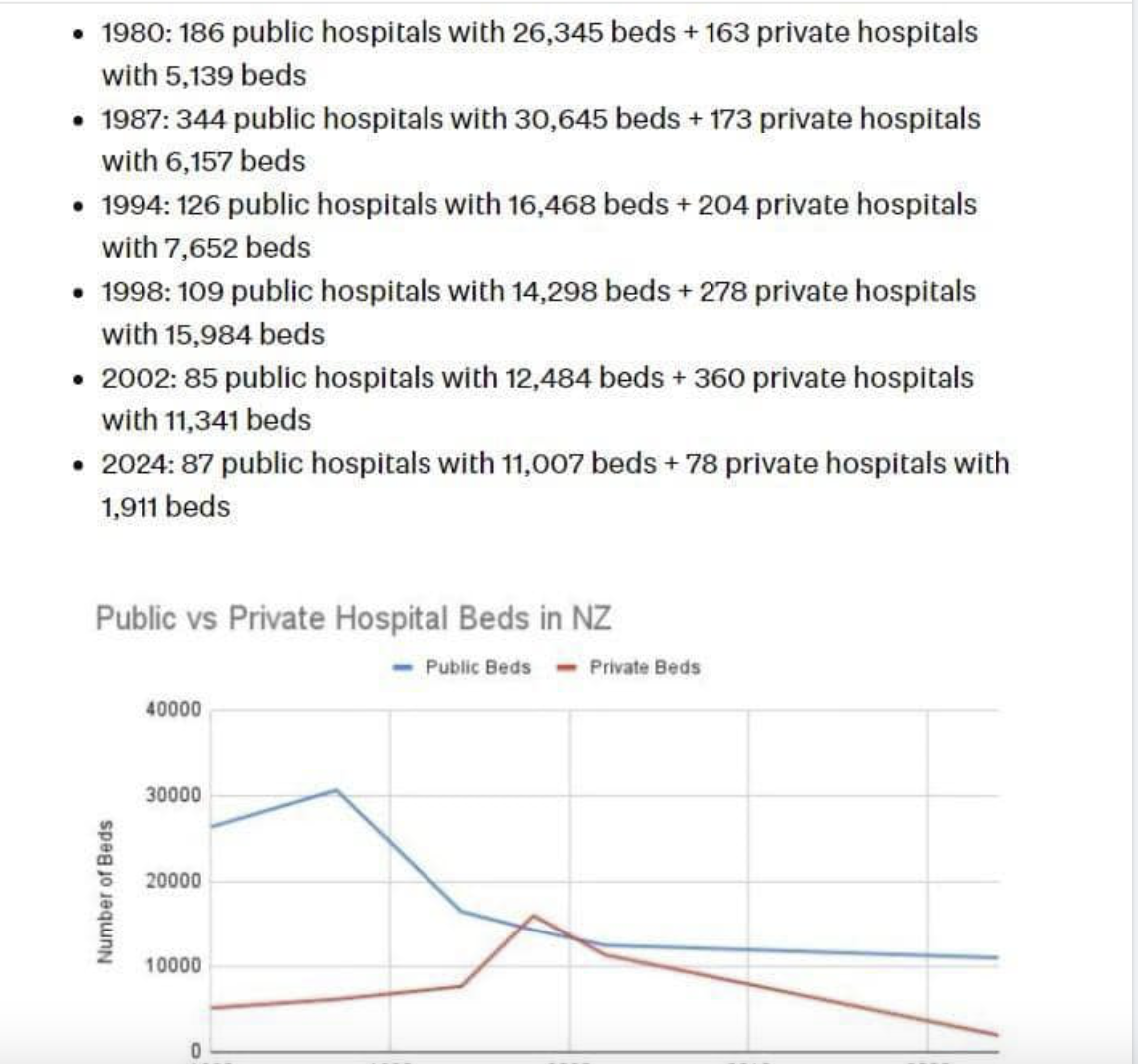
…people claim this can’t be true, but the facts stack it up and it is true.
We have progressively decreased taxing the richest to fund out public services until the public services fall over and the public scream ‘something must be done’ and the Right ‘here’s something’ and they privatise a little more and you get even less.
So who did you vote for again Boomer? Every Boomer complaining about poor public health should be asked that question each time they complain and this purposeful underfunding of public health.
Who did you vote for?
Increasingly having independent opinion in a mainstream media environment which mostly echo one another has become more important than ever, so if you value having an independent voice – please donate here.



Martyn – Heather Tanguay, aged 80, is not a boomer.
In most countries the baby boomer cohort covers people born from 1946 to the mid 1960s. https://www.britannica.com/topic/baby-boomers
In New Zealand the term baby boomer is often used as an insult and a form of othering. To clarify for those who persist with the notion that baby boomers are all the elderly, or who seem to believe the term applies to people when they become eligible for National Superannuation: the NZ baby boom cohort covers people born following the end of World War Two – from 1946 through to the early 1970s – i.e. people aged from about 52/53 through to age 78/79.
Some people who insult baby boomers are probably included in the cohort, and don’t understand its historical significance or know the time-frame.
The NZ phenomenon is explained in the following links:
https://teara.govt.nz/en/families-a-history/page-5
“Page 5. Baby boom begins: 1945–1959
As soldiers returned at the end of the Second World War, New Zealand experienced the first stage of the baby boom – high rates of early marriage and increasing family size. The fertility rate for Pākehā women rose and this continued until the early 1970s. Women generally married young and became mothers soon after marriage. In the mid-1950s, Pākehā women had on average 3.8 live births while Māori women experienced on average almost seven….
https://teara.govt.nz/en/families-a-history/page-6
Page 6. Baby boom continues: 1960s – early 1970s
During the 1960s and early 1970s most women were still marrying early and focusing on parenting, but the ex-nuptial birth rate rose, divorces increased and married women were more likely to be in the paid workforce. Conventional family arrangements were challenged as feminism began to have an impact. Changes in women’s lives and aspirations had implications for men as lovers, husbands and fathers…..”.
A nationalized medical scheme was a great idea back in the 1950’s when wool was worth a pound(sterling) per pound and the world was experiencing a post war protein shortage. But those days are long gone, and our productivity hasn’t kept up with our wants. We’re a poor country that thinks it’s still rich. Higher taxes will just drive the wealthy and their wealth away which may even reduce overall government revenue.
A part of the problem is the Boomer population bulge the age when their bodies are falling apart, necessitating expensive procedures. I know this because I am one! Maybe a temporary fix is to prioritize those in work over the retired. Hard decisions have to be made.
I swear by the non-existent gods, you are gullible tool of the 1%.
Constant intergenerational baiting is as tiresome and immature as it is misleading.
I sure didn’t vote for them and will never do so. I just wish Labour would wake up and present a real alternative
I have never ever voted National nor NZFirst nor ACT instead I supported Labour, Te Paati Māori or Greens.
Hi Bomber I have always voted Labour I thought they would look after their Seniors after they had paid their tax for.sixty years
You get who you vote for, smoking,guns,guns at tangi’s a thick PM who’s letting Mr. 8 %and 6 % run riot within the coalition. Will heads roll over the navy ship will Collins resign!!!. NO no and no because each member of this awful government is in it for itself. Be afraid the new police commissioner talked about arming the police on his very first press conference. We will have no hospitals, schools or ferries but plenty of guns. There will be war cultural or otherwise and we know who to thank for it the racist greedies who always want more at the expense of their less well off neighbors.
Another boomer here that did not vote for them .I broke my leg durrng covid just after the end of the first lock down.The orthopedic surgeon said we were lucky we had the labour government in office because if national had been in office I would not of had surgery because the hospital would have been paralized with covid patients and sick staff .At best I would have had a plaster applied and sent home to hope like hell and would be now classed as disabled .Now they are in charge with no pandemic and things are way worse .One can see what would have happened in the pandemic with these clowns ,Spain ,France or Italy anybody.?
Did the media tell you COVID was all over? Deaths are still up. I still have to mask, glove, & wash the shopping to care for someone that cannot vaccinate.
unfortunately covid and long covid are here to stay.
Vamptonius: “Did the media tell you COVID was all over?”
Are you replying to Gordon? He didn’t say Covid was gone. He mentioned the pandemic.
A raging pandemic is a different beast to an endemic disease, now extant.
Winter Energy payment ring a bell, shame for you to be loosing it!
Hi Martyn,
This is one boomer who did not vote for them. I voted Green because I felt they had a better taxation policy than Labours pathetic offering.
This is a second who didn’t vote for them.
I am the 3rd boomer who didn’t vote for them or labour. Hence why all this went to the Greens.
https://www.facebook.com/share/p/1Eswu9kaNk/
Neither labour or national have the political will to bring it about.