
When 654 suicides is ‘encouraging’
Suicide rate shows slight drop after record-high year
Mental health experts see a small silver lining after New Zealand suicide deaths hit their lowest point in three years.
Figures released by Chief Coroner Deborah Marshall showed 654 people died from suicide in the year to June 2020, a drop of 31 deaths from the 2019 total of 685.
The suicide rate in New Zealand is now 13.01 deaths per 100,000 people, down from 13.93.
The horror of our suicide rate gives us a glimpse behind the ‘she’ll be right’ facade of our culture and the dark torment of an alpha male macho mental landscape that is terribly fragile.
Our under funded social infrastructure, our ‘me first’ consumerism, our 30 years of neoliberal mythology, our disconnection from one another, our untreated pain, our lack of hope from grinding poverty in a first world country, our damaged masculinity, the intergenerational consequences of colonialism, our unspoken rage culture, our inability to express emotion beyond anger – all of this demands questions we don’t want to hear as a society and the shame of suicide continues to hide and smother any healing.
In a society that has no religious faith and all the cultural maturity of a can of coke, the bonds which keep us attached are frail and disconnected. In our fetishisation of individualism we have lost the central part of the human condition – connection.
We have traded in our interwoven threads of whanau, friendship and kin for a rat race of success that few ever win.
The reason we can’t talk about suicide is because we can’t stand to talk about the dark treacle of self hate and loneliness at the core of consumer culture. We don’t dare confront the hollowness of our existence on these far flung crags of rock for fear of what we will reveal about ourselves.
Damaged individuals competing for a self identity too fragile for the storms and tempests of life.
Thanks to neoliberalism, we are further from each other than ever before.
Look at the manner in which our suicide rates jumped after the neoliberal reforms of the 1980s, where we moved away from the communal towards the individual…
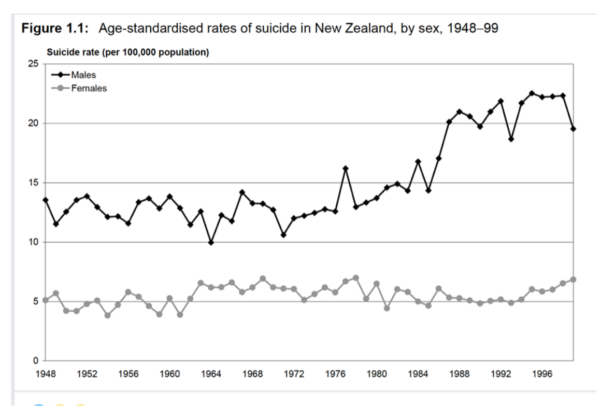
…we huddle frightened on these lonely rocks at the end of the world and slowly one by one slip off into the swallowing dark. Until we are prepared to confront many of the individualism-over-all myths and rebuild our tattered communities, our suicide rate will remain reminding us of our whispered deceptions.
We refuse to ask the why of suicide because we are too frightened to know the answer is a reflection of the shallow and lonely community we have become. Instead we reel off a list of phone numbers whenever we dare mention suicide as if that means a fucking thing.
Aotearoa’s sons are broken and no one wants to admit that.
Increasingly having independent opinion in a mainstream media environment which mostly echo one another has become more important than ever, so if you value having an independent voice going into this pandemic and 2020 election – please donate here.
If you can’t contribute but want to help, please always feel free to share our blogs on social media.


And don’t forget our fetishism for multi-culturalism either. A cultism that splits us into a Them vs Us.
That’s any type of capitalism. After all, if we were a healthy community then the capitalists wouldn’t be able to beat down individuals and make a profit from them.
yes!
“In our fetishisation of individualism we have lost the central part of the human condition – connection.”
all of the things you mention are important in influencing suicide.
however i would add that we need to call out the professions that we have left in charge of mental health.
they perpetuate the individualism and blindness to connection.
there are alternatives to the dominant mainstream psychiatric and psychology paradigms but they are marginalised and hard to find when you want help. people who work from postmodern, collaborative, narrative paradigms don’t get employed in mental health system.
the mainstream has tried to coopt these paradigms but end up teaching them as methods or techniques rather than paradigms. because they ask professional to give away their power to interpret behaviour, define what is wrong with us and prescribe treatment from a position of expertise. of course the professions within the mental health system cannot give up their expertise to interpret, or they may lose their position in the professional heirarchy that they have fought long and hard for.
the professional hierarchy and ideologies have a lot to answer for.
and thats not even mentioning what they do to kaupapa maori approaches that are tokenistically relegated to “non-clinical” and positioned as “complementary” to the “real” work.
we cant seriously address the huge numbers of people still walking around stunned from the severe trauma they experienced in childhood without doing something different.
that has to be done in a place where connection can flourish, that is outside the current mental health heirarchy.
The graph doesn’t show last 20 years. NZ has been on a slow decline since high of 15.1 in 1998 to 11.3 suicides per 100,000 in 2016 (last year for Stats NZ figures). Still a lot of work to be done in this area, regardless of who’s in government.
See https://wellbeingindicators.stats.govt.nz/en/suicide/
In my youth when someone “new” moved into the neighbourhood, my mother would bake some scones or pikelets & ask me to take them to the new neighbours with the message: “When you have settled in, I look forward to coming over to meet you.” I don’t bake, but otherwise welcome any “new” neighbours. No-one else (where I live in small-town NZ) does what I do. Also, the “new neighbours don’t say “Hi” when they see me – so interesting a change in Kiwis’ behaviour. I also say hello to most folk when I’m out walking. I think we are responsible for much of our own isolation/loneliness/disconnection. When I was a young woman, I’d barely say “Hi” to a mouse, let alone another human being. I think each of us needs to take a courageous step as often as we can every day in order to connect with our fellow human beings.
Right on the money Issy.
I walk most days and always make a move to say thanks if on oncomer socially distances, good morning/. afternoon/ day or hullo to anyone I meet on the way. Even a nod and a smile if the person seems shy.
Older folk get a comment and even a conversation as I get to know them.
Young Mums need recognition for the important and often lonely job they do – the most important job around so spare them a special smile and a nice comment about their little one/s if you can.
Communities become closer when you take time to acknowledge others and they will learn to respond if its new to them.
Don’t leave kids out either.
Sadly, with what is coming -declining employment opportunities, mass unemployment, lack of money, and, for many, lack of hope- we must expect the suicide rate to increase.
Those who have put their faith in ‘the system’ and constructed their world-views on the basis of consumerism and artificial living are going to be amongst the most susceptible to depression and suicide as the entire globlised neoliberal-consumeristic society collapses over the coming months, with most of it exposed as a sham, and with political so-called leaders seen to be powerless to halt the onslaught of reality.
Talking of which, here is an example of powerlessness to halt the onslaught of reality on a resource-depleted overheated planet:
‘California fires: massive blazes spread as state strapped for resources’
https://www.theguardian.com/world/live/2020/aug/21/california-fires-wildfires-latest-news-updates
Excelent peice Martyn one of the best I have read on the subject but add the young men incarcerated, who die by accident, and then the young men who gain solace by escapeing our shores, then the chances of a mother spending time with her 25 year son are not good
Thankyou Martyn.
Brilliant and so timely.
The underlying cause for suicide among teenagers is what is not being addressed. It’s the white elephant in the room.
Maybe the first thing to be done is to recognise and describe what the phenomenon we refer to as ‘neo-liberalism’ ekshully is (in this space, going forward). Winning the battle against any adversary is to understand its/their vulnerabilities. And its a bloody big battle when half the MPs and the people’s reps have either known nothing else other than its religious or cultist values, or that they’re quite comfortable with adopting its baubles when it suits.
Eventually, it’ll die a natural death – the mathematics that are associated with it don’t really add up (Natives get restless, Yoof gets impatient etc, while its political class dither and dive, spin and look for excuses).
What I fear most is that the longer the neo-liberal virus/religion/cult/culture/etc. lingers, the more chance its defeat will be violent (probably in a Mussolini lamp post sort of way). At which time, I’ve no doubt I’ll be expected to feel compassion and outrage for all those that actively engage in its so-called ‘principles’ and who’ve benefited from its shit, and a passing ‘poor wee dear’ for its victims.
Fuk ’em. No can do
Agree with most of this powerful statement.
Yet the causes of suicide run much deeper than neo-liberalism. The ‘fetish’ of the individual is not learned, or unlearned, it is endemic in capitalism which makes workers into individual sellers of their labour power through their relation to capitalist owners of the means of production.
The result is alienation from ones work; from the product of one’s work, – the fetishism of commodities where workers confront the the value of their own ‘alienated’ labour-power contained commodities when they are consumed; from others, and finally from oneself.
Most find ways of adjusting to the alienated life, but they are still ‘damaged’ by having to live hollow, unfulfilled lives. This is the norm for capitalism; the suicides are those who cannot adjust.
The figures that MOH should also publish are those who ‘attempt’ suicide, and how often. One study which looks at the ‘economic costs’ (!) of suicides and attempted suicides reports the latter at 10 times actual suicides. Who knows how many more unreported attempts are made. Who wants to know? https://www.health.govt.nz/system/files/documents/publications/thecostofsuicidetosociety.pdf
Agree with most of this powerful statement.
Yet the causes of suicide run much deeper than neo-liberalism. The ‘fetish’ of the individual is not learned, or unlearned, it is endemic in capitalism which makes workers into individual sellers of their labour power through their relation to capitalist owners of the means of production.
The result is alienation from ones work; from the product of one’s work, – the fetishism of commodities where workers confront the the value of their own ‘alienated’ labour-power contained commodities when they are consumed; from others, and finally from oneself.
Most find ways of adjusting to the alienated life, but they are still ‘damaged’ by having to live hollow, unfulfilled lives. This is the norm for capitalism; the suicides are those who cannot adjust.
The figures that MOH should also publish are those who ‘attempt’ suicide, and how often. One study which looks at the ‘economic costs’ (!) of suicides and attempted suicides reports the latter at 10 times actual suicides. Who knows how many more unreported attempts are made. Who wants to know? https://www.health.govt.nz/system/files/documents/publications/thecostofsuicidetosociety.pdf
Not one suicide is acceptable zero tolerance to say 654 suicides is encouraging is an utter joke.
Yes and to use suicide as a response to health vs economy is just so vile..and people vote for David Seymour who is a disgrace!
What can one do but first agree with Martyn? And then look at yourself and what you can do to help. There would not be many NZers unaffected by suicide of someone they knew or someone close to them. Life does have its dark existential side–we all have a use by date–but most of us do not know exactly when. Even the chirpiest aspirationals know in their hearts it will all be over one day. So what should be the response? Well there is no obvious “meaning” to life as such imo, so we all need to construct some meaning and looking out for each other and conducting society in a collective, co-operative way, supporting each other seems a good way to go.
Neo liberal individualist psychology has fucked so many people up majorly. Institutional knowledge of citizen participation in public affairs etc has faded since the 80s. Miserable underemployment and all the rest. Just listen to tradies bullying each other on a building site, or passive aggressive office managers, and you instantly get what Martyn is talking about. Some of the ‘surprising’ suicides are macho guys who looked to have it all going for them.
At least various right wingers have been proven wrong so far, with their predictions that putting the “many before the few” in the Covid outbreak–essentially people before capitalism–would lead to huge increases in mental problems and suicide.
Be nice to someone everyday, even in a small way. Just listen rather than necessarily talk and push advice.
Get politically active–because alienation, poverty, and despair are above all the result of oppression and capitalist exploitation and environmental destruction.