
This is what Corporate Feudalism on a burning planet looks like
Billionaires’ wealth surged $6.5tn over past decade, Oxfam reports
The wealth of the world’s 3,000 billionaires has surged by $6.5tn (£4.8tn) in real terms over the past decade, according to Oxfam, equivalent to 14.6% of global output.
In total the richest 1% of the global population has gained at least $33.9tn in real terms, which the charity said was “enough to end annual global poverty 22 times over”.
The figures come as various governments face growing calls to introduce a wealth tax on the international elite.
Let’s have a new deal on the Billionaire Class….
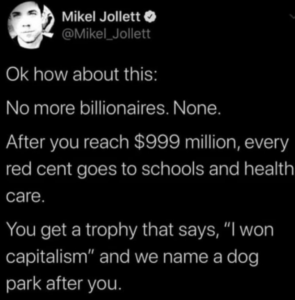
….or this too…
Who is brave enough to back Brazil’s global tax on billionaires? The answer will define our future
The response to the pandemic was one test of that proposition. Now the world’s governments face another. Last week, Brazilian climate minister Ana Toni explained a proposal put forward by her government (and now supported by South Africa, Germany and Spain), for a 2% global tax on the wealth of the world’s billionaires. Though it would affect just 3,000 of the super-rich, it would raise around $250bn(£195bn): a significant contribution either to global climate funds or to poverty alleviation.
Radical? Not at all. According to calculations by Oxfam, the wealth of billionaires has been growing so fast in recent years that maintaining it at a constant level would have required an annual tax of 12.8%. Trillions, in other words: enough to address global problems long written off as intractable.
You would need to perform Olympian mental gymnastics to oppose Brazil’s very modest proposal. It addresses, albeit to a tiny extent, one of the great democratic deficits of our time: that capital operates globally, while voting power stops at the national border. Without global measures, in the contest between people and plutocrats, the plutocrats will inevitably win. They can extract vast wealth from the nations in which they operate, often with the help of government subsidies and state contracts, and shift it through opaque networks of shell companies and secrecy regimes, placing it beyond the reach of any tax authority. This is what some of the global “investors” in the UK’s water companies have done. The money they extracted is now gone, and we are left with both the debts they accumulated and the ruins of the system they ransacked. Get tough with capital, or capital will get tough with you.
The Brazilian proposal, which will be put before the G20 summit in Rio in November, has already been dismissed by the US treasury secretary, Janet Yellen, who suggested there was no need for it. On whose behalf does she make this claim? Not ours. Wherever people have been surveyed, including in the US, there is strong support for raising taxes on the rich.
In the two years following the start of the pandemic, the world’s richest 1% captured 63% of economic growth. The collective fortune of billionaires rose by $2.7bn a day, while some of the world’s poorest became poorer still. Between 2020 and 2023, the five richest men on Earth doubled their wealth.
Billionaire wealth impoverishes us all: astonishingly, each of them produces, on average, a million times more carbon dioxide than the average global citizen in the bottom 90%. Billionaires are a blight on the planet.
Yet, because they are the true citizens of nowhere, shifting their wealth and residence between jurisdictions, they pay far lower levels of tax than the most downtrodden of their workers. Oxfam has calculated, using records unearthed by the investigative journalists ProPublica in 2021, that Elon Musk pays a “true tax rate” of 3.27%, and Jeff Bezos less than 1%. Falling tax rates and the clever workarounds designed by the lawyers and accountants serving the ultra-rich help to explain the growth of their fortunes.
Wealth that could otherwise support public services and public wellbeing is siphoned out of nation states. As the global rich accumulate ever greater economic power, and find ever more inventive ways to evade democratic restraint, they become more potent than many governments. There’s a word for this: oligarchy. Some of them use this power to demolish democratic safeguards. To give one example, they have lobbied successfully to pull down the rules and caps on campaign finance, until, in some nations, they appear to wield more influence over elections than the electorate.
…if we want to build the social and physical infrastructure we need to radically adapt to the realities of catastrophic climate change, we need to tax the rich!
I’m not looking for socialism here folks, just basic garden variety regulated capitalism!
There are 14 Billionaires in NZ + 3118 ultra-high net worth individuals, let’s start with them, then move onto the Banks, then the Property Speculators, the Climate Change polluters and big industry.
You should be angry, NZ Capitalism is a rigged trick for the rich and powerful. The real demarcation line of power in a western democracy is the 1% + their 9% enablers vs the 90% rest of us!
Do not allow their smears of ‘Envy’ dilute the righteous rage you should all be feeling!
There’s no point making workers pay more to rebuild our resilience, tax the rich!
-Sugar Tax
-Inheritance Tax
-Wealth Tax
-Financial Transactions Tax
-New top tax rate on people earning over $300 000 per year.
-Capital Gains Tax
-Windfall profit taxes
-First $10 000 tax free
Neoliberalism is a failure for the people and a win for the mega wealthy.
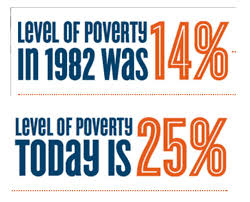
Lift the tax yoke from the workers and the people and place it on the mega wealthy and have them pay their fair share for once!
In 2010, the 388 richest individuals owned more wealth than half of the entire human population on Earth
By 2015, this number was reduced to only 62 individuals
In 2018, it was 42
In 2019, it was down to only 26 individuals who own more wealth than 3.8 billion people.
In 2021, 20 people own more than 50% of the entire planet.
And now in 2025, the real-terms gains of $33.9tn for the world’s richest 1% is ‘enough to end annual global poverty 22 times over.
This isn’t democracy, this is a feudal plutocracy on a burning Earth
The Big Tech Tzars have manipulated our collective fear, ego, anger and insecurities through social media in a way that has led to the largest psychological civil war ever launched against one another.
We are but meat bags secreting hormones addicted to dopamine rewards for fat, sugar, salt and sex in a cultural landscape of individualism uber allas where we sing sweet secret lies to ourselves to make sense of a world around us that is frightening and in constant entropy.
Meanwhile, the planet burns and every aspect of our existence is monetarised for big data to sell us more stuff we can’t afford. We are alienated and anesthetized by a consumer culture that keeps us neurotic and disconnected. Our work, our existence, every move we make are all built to suck money to a minority class that sits above us while under neoliberalism, globalization, financialization, and automation, our existence as individuals has only become more disposable.
There is a point when you will rise against this because a burning planet will force you to stand.
We need to be kinder to individuals and far crueller to corporations.
Increasingly having independent opinion in a mainstream media environment which mostly echo one another has become more important than ever, so if you value having an independent voice – please donate here.


Bloody GST on repairs and maintenance on my old house so it can go for another 50? years and I have to pay a tax on that to the government, inflationary and poor system of tax gathering. We should have an 0.5% Financial transactions tax. People come here and think everyday should be Christmas for them. It was a a dirty deal from Labour. When I was in Switzerland in the 70’s I think they had 15% GST and I feel that we became so pretentious that we thought that following the Swiss was a recipe for making the spongers rise, and they were right in that. I didn’t understand how our agricultural economy worked until a Chinese tutor cautioned us at a course I took. We have been as ignorant as the German people emotionally wound up that gathered in tight lines and helmets in front of Hitler.
What infuriates me is that we have done this before and it works.
We taxed wealth. The sky did not fall. The rich did not flee taking their wealth with them.
‘During World War I, revenue from income tax increased greatly, becoming the largest source of tax, in place of customs duties. But, still only 12,000 people of an adult population of 700,000 earned above the £300 threshold and were taxed. The top rate was 43.75% in 1921. Tax rates were lowered in the 1920s and in 1930 the top income tax rate was set to 29.25%, and the threshold lowered to £260 of annual income.[7] By 1939, and before World War II, the top rate was 42.9%. During the war, there were huge rises in the top rate, taking it to 90%. It dropped to 76.5 percent by the end of the 1940s. The working class still paid little or no income tax.[8] The top rate was 60% in 1982, until Robert Muldoon’s National Government raised it to 66% that year.[9]
The Fourth Labour Government, with David Lange as prime minister and Roger Douglas as finance minister, introduced a goods and services tax in 1986 and then reduced the top income tax rate from 66% to 48% in 1988 and then 33% in 1989.[10] The Fifth Labour Government raised it to 39%[11] in 2000. It was cut again by John Key’s National government, and again a 39% rate was reintroduced by the Labour government in 2022.
Goldsmith Paul Te Ara: The Encyclopedia of New Zealand
https://www.nzae.org.nz/wp-content/uploads/2012/04/NZAE-Calculating-Average-Marginal-Tax-Rates-for-NZ-1907-2009.pdf New Zealand Association of Economists Annual Conference. 16 June 2011.
Please note that Paul Goldsmith, present National Party Cabinet Minister is the historian forced to acknowledge New Zealand’s prosperity during the years of high taxation.
Recording the truth but not putting it into practice.
Bryce Edwards strikes me as a perceptive political commentator – although his link to the ivory tower may troublesome. The fact that The Platform publishes his work is perhaps more troublesome.
https://theplatform.kiwi/opinions/the-2025-nbr-rich-list-once-again-shows-who-runs-this-country
In a recent piece he argues the Rich List tellingly reveals economic priorities: to quote, “property development and investment dominate, with multiple fortunes built on what economists recognise as classic rent-seeking behaviour – extracting wealth through ownership and monopoly rather than through productive innovation or adding real value”.
Now if Mr Edwards is correct – and few would argue against him – that’s where the trouble lies. Not with wealth in itself – although the accumulation of wealth is usually associated with exploitation of some kind – but with the way wealth is now created, and by extension the favourable regulations that allow this to happen – if property investment and associated tax regulations in NZ are anything to go by, rent-seeking behaviour is in fact actively encouraged.
If the wealthy are required to drive the economy, as we are repeatedly told, how do we encourage productive innovation and the addition of real value? And, for good measure, discourage predatory rent-seeking behaviour and withdraw the privilege of monopolies.
This is all very good in theory. Lets collect a billion dollars, a hundred billion, hell lets
make it a trillion. Then what. Name one government or one international organization
that we could trust to actually address the problems that face us and help the people
who need help.
ignoring the rest of the world, I wouldn’t give our current government one more cent
that I already have to. What are they going to do. continue to shit all over the poor, over
Maori, ignore the sick, the homeless. Fuck them because they will just find new ways to
channel it back to their rich donars.
While any plan to tax the wealthy is good they usually control the government and other NGO’s so any increased tax income is likely to be frittered away with needless schemes and excessive salaries/consultant fees so those under pressure receive little to actually help them.