
The thing I hate most about NZ Suicide – we never dare ask why
Suicide stats were quietly released last week.
Like a cultural scab we no longer pick at because the shame is too great and the weeping wound too painful to even acknowledge.
Number of suicides reaches 10-year peak, new data reveals
New Zealand had the highest number of suicides in 10 years in 2016, according to the latest provisional data released by the Ministry of Health.
The data shows 553 people died by suicide in 2016, the highest number of suicides in New Zealand between 2007-2016.
It was up from 529 in 2015, and 510 in 2014.
Males were the most represented in the figures, with 412 committing suicide in 2016, compared to 141 females.
Numbers for Maori were also high, with 135 deaths – 99 of which were male.
The rate of Maori who died by suicide was 20.3 per 100,000, with non-Maori at 9.5 per 100,000.
Young people aged 15-24 had the highest rate of suicide, with 16.8 per 100,000, while the rate among people aged 25-44 was 16.3 per 100,000.
The horror of our suicide rate gives us a glimpse behind the ‘she’ll be right’ facade of our culture and the dark torment of an alpha male macho mental landscape that is terribly fragile.
Our under funded social infrastructure, our ‘me first’ consumerism, our 30 years of neoliberal mythology, our disconnection from one another, our untreated pain, our lack of hope from grinding poverty in a first world country, our damaged masculinity, the intergenerational consequences of colonialism, our unspoken rage culture, our inability to express emotion beyond anger – all of this demands questions we don’t want to hear as a society and the shame of suicide continues to hide and smother any healing.
In a society that has no religious faith and all the cultural maturity of a can of coke, the bonds which keep us attached are frail and disconnected. In our fetishisation of individualism we have lost the central part of the human condition – connection.
We have traded in our interwoven threads of whanau, friendship and kin for a race where no one wins.
The reason we can’t talk about suicide is because we can’t stand to talk about the dark treacle of self hate and loneliness at the core of consumer culture. We don’t dare confront the hollowness of our existence on these far flung crags of rock for fear of what we will reveal about ourselves.
Damaged individuals competing for a self identity too fragile for the storms and tempests of life.
Thanks to neoliberalism, we are further from each other than ever before.
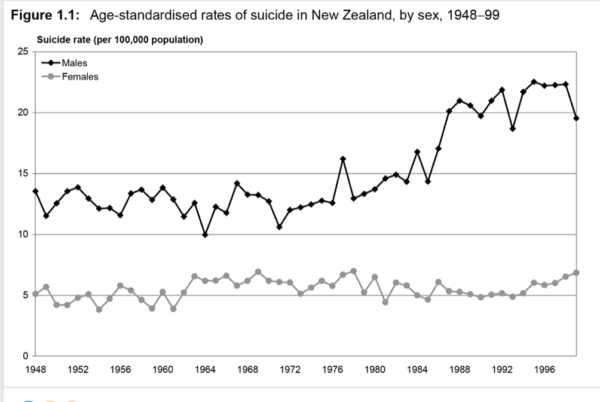
Look at the manner in which our suicide rates jumped after the neoliberal reforms of the 1980s, where we moved away from the communal towards the individual…
…we huddle frightened on these lonely rocks at the end of the world and slowly one by one slip off into the swallowing dark. Until we are prepared to confront many of the individualism-over-all myths and rebuild our tattered communities, our suicide rate will remain reminding us of our whispered deceptions.
We refuse to ask the why of suicide because we are too frightened to know the answer is a reflection of the shallow and lonely community we have become. Instead we reel off a list of phone numbers whenever we dare mention suicide as if that means a fucking thing.
We are broken and no one wants to admit that.


Maria Bradshaw’s research paper “It takes a village” attacks a few sacred cows and recommends that the suicide issue be moved from health to a social agency.
It’s an important read.
https://www.researchgate.net/publication/317579112_It_Takes_A_Village_The_case_for_adopting_a_social_approach_to_suicide_prevention
Wonderfully expressed and powerful article. I don’t buy for an instant the line that a gaggle of health and social engineering experts at the Ministry of Health waffling over all the data will be able to offer anything more than the customary cliches. Racism, colonialism, (shall we all leave then?) the housing shortage. You won’t though, hear anything like this reality: ‘Look at the manner in which our suicide rates jumped after the neoliberal reforms of the 1980s, where we moved away from the communal towards the individual… ‘
I’m just reading Michael Hudson’s ‘…and forgive them their debts’ and discovering that debts from the bronze age on, meant actual indebtedness from which, periodically, citizens were released by rulers and temple complexes for reasons which were entirely logical and aimed at preventing the atomising of society and the retaining of its connectiveness and cohesiveness for very practical reasons from the rulers point of view.
Then there is the alchemical understanding of depression. Once known as melancholia and the gateway to transformation; not something to be rejected as an illness and attacked with pharmaceutical drugs.
Tribal people with a shamanistic tradition understood this very well.
As a matter of fact so did early Greek philosophers like Parmenides. A new raft of scholastic interpreters of classical texts have emphasised the shamanistic roots of Western philosophy.
So there is a great deal to discuss and consider and who needs the sorcery of advertising, public relations and social engineering?
critical points, flawlessly put Archonblatter
Archonblatter, you are so correct being sceptical about the Ministry of Health. Any mental health issue conducted under their auspices is a sick joke, when they are part of the problem.
All over NZ there are people with physical and mental health issues exacerbated by lack of care, lack of treatment, and lack of concern from a Health Dept staffed often by drop-outs from mainstream medicine and, historically, second- rate Poms.
We have societal problems which won’t be fixed by committees of the enablers – but bucketfuls of money will go to the consultants, per usual. Our values are skewered.
For what needs doing today, a panel of supermarket checkout operators with student loans may be more pragmatic and much smarter than yet another govt task force- but because they are also unknowing victims of neoliberalism – go dig up our grandmother’s graves, or seek out our wise elders- on marae – ancient academics- the poets and the painters.
Policy makers, possibly always, can see the objects of their policy as undeserving or inferior nuisances, which may handicap them before they even start. I sat on one benefit review committee once, and I don’t think that we did a particularly good job, or cared that much either.
depression is huge now and people aren’t nice we need to put a lot of work into this area
depression=hopelessness and stagnation
hence need for action and hope
I resent those phone numbers at the end. They imply everything is handled.
With the Suicide Mortality Review Committee, hosted by the Health Quality and Safety Commission, the Coronial process and the DHB Adverse Event process, I think that we are quite advanced at asking the ‘why of suicide’ in Aotearoa New Zealand. Let’s just hope the setting up of a Suicide Office in the Ministry of Health and the new Suicide Prevention Strategy and Action Plan pulls all the learning together, so we can really get on and do something about these unacceptably high rates of tragedy in our communities. You are right to say that is where much of the solution lies, not necessarily in more services, or more professionals, but in more connected, open and compassionate communities. We need to think about fairness, inequity and bias, particularly racism. We need to be more comfortable to sit with people we love, in and through their distress. We need to think ‘why so many men’ and ‘why so many Māori’? We need to open our hearts to our neighbours, colleagues and friends, as well as our families and whānau. We need to care, more and consume/isolate ourselves less!
+100
In Australia, suicide rates spiked after their gun buy back.
I don’t think anyone is serious about wanting to know what other people find important in their lives , the truth is too inconvenient for those who know better.
Then suicide rate is no mystery. It never has been.
Poverty, loss or community involvement, loss of prospect to meet simple life goals such as being fed, getting income, resolving mental anguish and lack of community recognition that help is needed.
Being alone in a community.
The greater the inequity and hopelessness, generally the less the society can support suicidal prospects
Redistribution of health and wealth has to be a start.
+100 Great Post!
….we need another Internet /Mana Party