
The Mendacities of Mr English: the covert agenda of high immigration
.

.
Context
Bill English was recently caught on-the-spot when challenged why National was permitting high immigration at a time when unemployment was still high, and rising.
Make no mistake, National has opened the floodgates of immigration because it is an easy way to artificially stimulate the economy. This was pointed out in May 2011, by then-Immigration Minister, Jonathan Coleman, who trumpeted the contribution made by immigration to economic growth;
“All of us have a vested interest in immigration and I’m pleased to share with you some specific actions the Government is taking to enhance Immigration’s contribution to the economy, service improvement and changes to business migration.
[…]
…I’m confident that you will acknowledge the partnership approach that Immigration is now taking to provide tangible improvements to help support New Zealand’s economic growth.
[…]
Considering the economic challenges the country faces, lifting immigration’s economic contribution takes on more importance.”
Justifying the need for high immigration to generate economic growth, Coleman cited “New Zealand [going] into deficit in 2009 after several years of surpluses and the economic situation has been compounded by the September and February earthquakes” and unsustainably “borrowing $300 million dollars a week to keep public services ticking over“.
Coleman admitted that “If we were to close off immigration entirely by 2021… GDP would drop by 11.3 per cent“. He revealed that, “new migrants add an estimated $1.9 billion to the New Zealand economy every year“.
Easy money.
The downside to high immigration has been to put strain on critical services such as roading and housing, and reduce demand for locally trained workers to fill vacancies. There is a downward pressure on wages, as cheaper immigrant-labour is brought into the workforce.
As Treasury pointed out in June last year;
“There is a concern that recently there has been a relative decline in the skill level of our labour migration. The increasing flows of younger and lower-skilled migrants may be contributing to a lack of employment opportunities for local workers with whom they compete.”
Faced with increasingly negative indicators from high immigration, English was forced to explain why we were seeing high immigration at a time of rising unemployment;
.
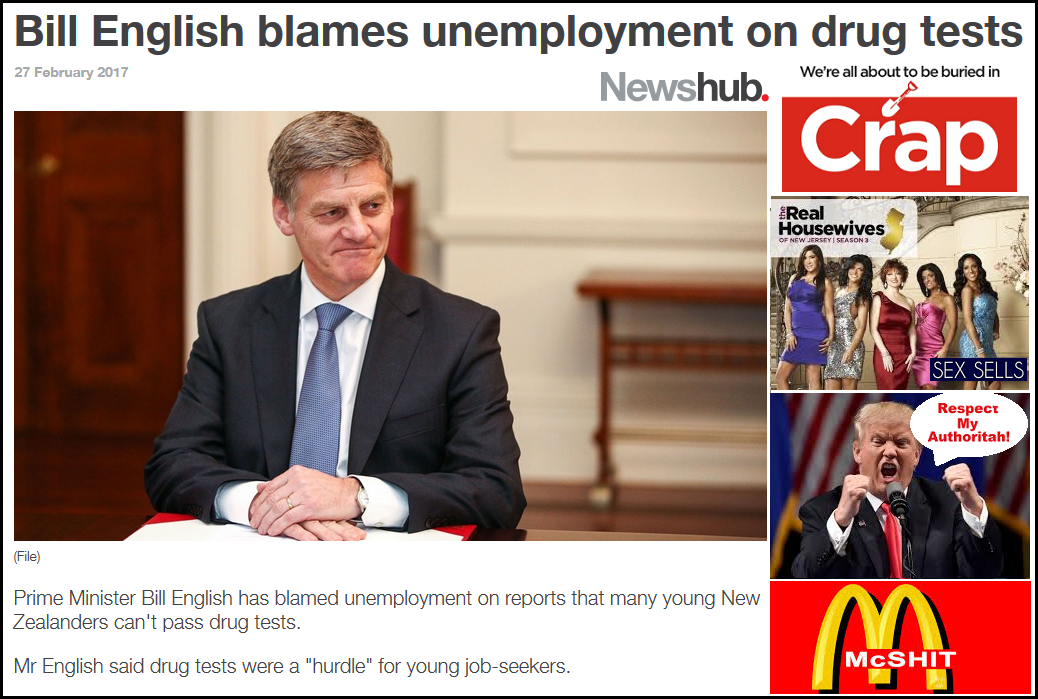
.
English’s response was predictable if not offensive.
.
Playing National’s Blame Game
As per usual strategy, English defaulted to National’s strategy of Default Blame-gaming. When in trouble;
- Blame the previous Labour government
- Blame ‘welfare abuse’/Release a ‘welfare abuse’ story in the media
- Blame Global Financial Crisis or similar overseas event
(If the trouble is Auckland-centered, Default #4: Blame Auckland Council/RMA/both.)
This has been the pattern of National’s policy to shift blame elsewhere for it’s consistently ineffectual policies;
.

.
The Blame Gaming was applied recently to National’s appalling do-nothing record on housing;
.

.
Resorting to Deflection #2, English had the cheek to blame young unemployed for our high immigration level;
“One of the hurdles these days is just passing the drug test … Under workplace safety, you can’t have people on your premises under the influence of drugs and a lot of our younger people can’t pass that test.
People telling me they open for applications, they get people turning up and it’s hard to get someone to be able to pass the test – it’s just one example.
So look if you get around the stories, you’ll hear lots of stories – some good, some not so good – about Kiwis’ willingness and ability to do the jobs that are available.”
His comments on 27 February were echoing previous, similar sentiments in April last year, when he again abused unemployed workers as “hopeless”;
.

.
Quite rightly, English’s comments were condemned by many. English admitted that his comments were based solely on “anecdotal evidence” . This is the worst form of evidence possible as absolutely no confirmation by way of actual, real data is involved. “Anecdotal evidence” panders to prejudice – a difficult thing to shift even when real evidence proves to the contrary.
Real evidence surfaced only a day after English made his slurs against the unemployed, when it was revealed that out of over 90,000 (approx) welfare beneficiaries, only 466 failed pre-employment drug tests over a three year period. That equates to roughly to 155 failed tests out of 30,000 per year.
Government figures show beneficiaries have failed only 466 pre-employment drug tests in the past three years.
[…]
The Ministry of Social Development said the 466 included those who failed and those who refused to take the test.
Some failed more than once.
The ministry did not have the total figure for how many tests were done over the three years, but said there were 32,000 pre-employment drug tests in 2015.
Those 466 over a three year period consisted of (a) those who failed the test, (b) those who refused to take the test, and (c) some failing more than once.
Put another way, 155 failed tests out of 30,000 per year equates to half a percent fail rate.
Which means that 99.5% of beneficiaries are clean, according to MSD’s own collected data.
There was further confirmation of low fail rates from another media story. On the same day as the Ministry of Social Development released it’s data on failed drug tests, The Drug Detection Agency revealed that fail-rates were as low as 5%;
While the rate of positive tests has remained at about 5 percent, the company is doing more tests and therefore failing more people, said its chief executive, Kirk Hardy.
“We’ve seen an increase overall in our drug testing and we now, annually, conduct about 144,000 drug tests,” he said.
Looked at another way, 95% of the workforce was clean.
Which simply confirms Bill English to be the typical manipulating, lying, politician that the public so consistently distrust and despise.
However, English has his own sound reasoning for blaming welfare beneficiaries for this country’s immigration-caused problems. He has to do it to obscure the two reasons why National has opened the tap on immigration as far as they can possibly get away with…
.
Cargo-cult Economics
Remember that in May 2011, then-Immigration Minister, Jonathan Coleman revealed;
“If we were to close off immigration entirely by 2021… GDP would drop by 11.3 per cent“.
A 11.3% fall in GDP would have pushed New Zealand into a deep recession, matching that of the early 1990s.
This was especially the case as only a few years ago the economy was suffering with an over-valued New Zealand dollar. Manufacturing and exports had slumped;
.

.
Combined with the multi-billion dollar Christchurch re-build, mass-immigration was National’s “quick-fix” solution to boosting the economy. It might cause problems further down the track, but those were matters that National could address later. Or better still, leave for an incoming Labour-Green government to clean up the resulting socio-economic mess.
This is quasi-cargo-cult economics, 21st century style.
.
The Not-so-Free-Market
In Coleman’s May 2011 speech, he also referred – indirectly – to the second rationale for opening the floodgates of mass-immigration;
“If we were to close off immigration entirely by 2021… The available labour force would drop 10.9 per cent“
This was critical for National.
A crucial tenet of free market capitalism (aka neo-liberalism) is that the price of labour (wages and other remuneration) should be predicated on supply and demand;
The higher the wage rate, the lower the demand for labour. Hence, the demand for labour curve slopes downwards. As in all markets, a downward sloping demand curve can be explained by reference to the income and substitution effects.
At higher wages, firms look to substitute capital for labour, or cheaper labour for the relatively expensive labour. In addition, if firms carry on using the same quantity of labour, their labour costs will rise and their income (profits) will fall. For both reasons, demand for labour will fall as wages rise.
Note the part; “At higher wages, firms look to substitute capital for labour, or cheaper labour for the relatively expensive labour“.
Mass immigration may or may not supply cheaper labour per se, but more people chasing a finite number of jobs inevitably “stabilises” or even drives down wages, as migrants compete with local workers. As pointed out previously, this is precisely what Treasury warned off in June last year;
“There is a concern that recently there has been a relative decline in the skill level of our labour migration. The increasing flows of younger and lower-skilled migrants may be contributing to a lack of employment opportunities for local workers with whom they compete.”
National is wary of wages rising, thereby creating a new wage-price inflationary spiral, reminiscent of the 1970s and 1980s. English said as much on TVNZ’s Q+A in April 2011;
Guyon Espiner: “Can I talk about the real economy for people? They see the cost of living keep going up. They see wages really not- if not quite keeping pace with that, certainly not outstripping it much. I mean, you said at the weekend to the Australia New Zealand Leadership Forum that one of our advantages over Australia was that our wages were 30% cheaper. I mean, is that an advantage now?”
Bill English: “Well, it’s a way of competing, isn’t it? I mean, if we want to grow this economy, we need the capital – more capital per worker – and we’re competing for people as well.
[…]
Well, it is a good thing if we can attract the capital, and the fact is Australians- Australian companies should be looking at bringing activities to New Zealand because we are so much more competitive than most of the Australian economy.
[…]
Well, at the moment, if I go to Australia and talk to Australians, I want to put to them a positive case for investment in New Zealand, because while we are saving more, we’re not saving more fast enough to get the capital that we need to close the gap with Australia. So Australia already has 40 billion of investment in New Zealand. If we could attract more Australian companies, activities here, that would help us create the jobs and lift incomes.”
National is circumventing their own neo-liberal ideology by importing large numbers of workers, to drive down wages (or at least permit only modest growth).
In times of scarce labour, wages should grow. Demand. Supply.
This is the counter to recessionary-times, such as the 2008 Global Financial Crisis, when wages remain static, or fall, due to heightened job losses and rising unemployment. Supply. Demand.
But National is subverting the free market process by ‘flooding the labour market’ with immigrant labour. The price of labour cannot rise because National has interfered with the process of supply by widening the field of the labour market. The labour market is no longer contained with the sovereign borders of our state.
This reveals “free market economics” to be a fraud. It is permitted to work unfettered only when it benefits the One Percent, their business interests, and their ruling right-wing puppets.
The moment there is a whiff that the “free market” might benefit workers – the goal-posts are shifted. (Just ask Nick Smith about shifting goal-posts.)
The game is fixed. The dice are loaded. We cannot hope to beat the House at their game.
Time to change the game.
Inevitable Conclusion
Welfare beneficiaries. Drugs. Drug testing. It was never about any of those.
The real agenda is for National to create a false impression of economic growth and reign-in wage growth, through immigration. Anything which threatens to expose their covert agenda is to be countered. Especially before it becomes fixed in the public consciousness.
Welfare beneficiaries are very useful as National’s go-to scapegoats. Or herring of a certain hue…
.

.
Postscript: A case of REAL workplace drug abuse
Meanwhile, in what must constitute the worst case of workplace drug abuse, took place on 14 June 1984;
.

.
…Muldoon had made up his mind. In one of the biggest miscalculations in our political history he decided that he would go to the country. At 11.15pm a visibly intoxicated Muldoon made his announcement to waiting journalists.
.
.
.
References
NZ Herald: Beyond the fear factor – New Kiwis can be good for us all
Fairfax media: NZ unemployment jumps to 5.2 per cent, as job market brings more into workforce
Fairfax media: New Zealand’s economic growth driven almost exclusively by rising population
Beehive: Immigration New Zealand’s contribution to growing the economy
NZ Herald: Budget 2016 – Feeling the Pressure
NZ Herald: Treasury warns of risk to jobs from immigration
TV3 News: Bill English blames unemployment on drug tests
Radio NZ: Employers still struggling to hire NZers due to drug use – PM
Radio NZ: Farmers agree Kiwi farm labourers ‘hopeless’
Radio NZ: Tens of thousands drug-tested, hundreds fail
Radio NZ: Drug use not the whole worker shortage story – employer
NZ Herald: Willie Apiata our most trusted again
Radio NZ: Exporters tell inquiry of threat from high dollar
Wikipedia: Cargo cult economics
Economics Online: The demand for labour
TVNZ: Q+A – Guyon Espiner interviews Bill English – transcript
Radio NZ: Unemployment rises, wage growth subdued
Statistics NZ: When times are tough, wage growth slows
Fairfax media: Shock rise in unemployment to 7.3pc
TVNZ: Frontier Of Dreams – 1984 Snap Election
Additional
TV3 News: Government gets thumbs down on housing
Other Blogs
The Standard: English hammered on druggies smear
Previous related blogposts
Election ’17 Countdown: The Promise of Nirvana to come
When National is under attack – Deflect, deflect, deflect!
National under attack – defaults to Deflection #2
National under attack – defaults to Deflection #1
.
.
.

.
.
= fs =





Up-date on Radio NZ; http://www.radionz.co.nz/national/programmes/mediawatch/audio/201835196/pm-puts-his-anecdote-on-the-line
What’s a little exploitation between mates?
https://www.pressreader.com/new-zealand/marlborough-express/20100819/281646776444009
and with said traffickers:
http://imgur.com/YkudbRf
Bill English’s mates:
https://www.pressreader.com/new-zealand/marlborough-express/20100819/281646776444009
And here they are having a good old time together:
http://imgur.com/YkudbRf
Nothing to see here, move along!
English has inadvertantly done us a favour.
1. He’s come out as a liar, or at best, a fool who parrots anecdotes and masquerades them as “evidence”.
2. He’s prompted real facts top become public, and shown that unemployed are not drug-abusing lazy layabouts.
This is how he’s entered election year, by shooting himself in the foot.
Nice one, Bill. Can we have some more please??
But with his “reset” talk for retirement and superannuation, Bill has now put the cat amongst the pidgeons, he is nearly as good at that, as Trump is with his Twitter account.
Outstanding work, Frank. It certainly makes English look to be a lying manipulator, along Paula bennett’s lines.
The irony is that in putting out his anecdotal bullshit he opened the discussion up and allowed real facts to get out into the public arena. So next time he tries this strategy, it will backfire again on him.
Keep holding truth to power, mate.
Great post!
Immigration is also being used as a way to break the NZ welfare system up.
With Health, education and superannuation all under threat.
Unemployment, disability and other benefits are already being destroyed by National. Working for families is being eroded by National.
We are already hearing that National are thinking of putting Superannuation age up. This seems odd when they allow aged parents of migrants into NZ who have access to benefits like health and so forth after a few years.
The government could just have visiting rights for migrant parents but not let them access health and super services but for some reason even though we can’t seem to afford it for Kiwi workers anymore, they have a policy to fund new aged parents coming into NZ (often as free babysitters, who then get supposedly ‘granny dumped’ and have to go on welfare).
The government policy is not fair. It is also creating disharmony within groups as resources are not enough. It should be the governments job to ensure everything is fair and that they are protecting their citizens including the 1 in 5 migrants and their children already settled in NZ and the next generation’s prosperity – not destroying it by having deliberate poor policy decisions to make a quick buck and hide their disastrous economic performance, at the expense of many.
Key and now English are doing a Muldoon, they are destroying NZ for their own selfish ideology while removing savings ability out of NZ and running up debts – that the next generation will have to pay for.
Not to mention the environment which is being polluted and destroyed by National – again using fake statistics to hide it.
Oh yes, talk about our welfare system, and I can tell you that I met so many new migrants, who frown on the welfare system in NZ, as it does in their view promote laziness and irresponsible conduct.
Many of the new migrants are either socially conservative and “value oriented”, believing in their own “hard work”, as that was why Immigration NZ allowed them to come in, to work “hard” and “prove themselves”.
Others are convinced capitalists and neoliberals, who are happy to vote for ACT any time, they believe also in self responsibility, or in family looking after the needy, not the government.
The immigration policy of NZ Inc is so structured to favour the competitive, the determined, the opportunists and the hard nosed business operators. They come here to “contribute” in their way of understanding, and when they see people here less fortunate or less able, they often judge them harshly, and question the welfare system.
This is of course all wanted by the government of the day, as they want divide and rule as a system, and they want endless competition for jobs, for business and for everything else.
It is a system designed for opportunist capitalists, and convinced capitalists are the “desired immigrant”, there is no doubt about it.
This also ensures National and ACT a steady supply of new supporters and voters by the way.
How many lies can the people of this country keep swallowing… It is sickening to watch.
Bill English is just doing what he is required to do by the transnational banks and corporations that run the western world: maintain the banks’ [fractional reserve banking and charging interest on money created out of thin air] Ponzi scheme a little longer and provide markets for corporations to sell more stuff. And provide opportunities for local opportunists to rort the system.
The fact that between them banks and corporations are wrecking the planet and causing massive overpopulation (or even destroying their own children’s futures) is of no interest to politicians, whatever ‘colour’ their political party.
If Labour or the Greens were to ever gain power they would promote the short-term interests of banks and corporations, declare the ‘need for immigration, and promote continued use of the dysfunctional GDP system which is at the heart of dysfunctional economic system because it assigns positive values to negative factors and negative outcomes..
Cowardice, deceit and betrayal are the bywords of the age we live in, Frank.
And nothing will change until the western world’s liquid fuel supply goes into severe decline (almost certainly between 2018 and 2022).
I still don’t understand how immigration is our problem. As we all know immigration stimulates the economy – so why don’t we focus on redistributing wealth and resources away from the rich to the poor? We’ve done the opposite for 30+ years.
As I mentioned on another post: “If we never let those immigrants in over the past 30 years, then we’d still have a housing shortage because our housing policies and economic ideology are the problem. The 50% of Aucklanders who were born overseas have contributed to our economy and paid a shit-load of taxes. If we never let them come in, but still had neoliberal policies shaping our housing, then we’d still have a housing shortage. The market won’t have delivered us housing over the last 30 years regardless of immigration levels. Now Wellington and Dunedin are having housing squeezes – the crisis is spreading there. And it’s not because of immigrants, it’s because of our social and economic policies.”
The same goes for roading and other costs – we live in a car culture. We’ve invested silly money into roads and highways, and ignored public transport. Auckland is poorly designed and should have had a subway built years ago.
Yes, we have immigrants coming in and filling unskilled work, but that work often pays poverty wages anyway – I’d say that is where the problem is.
IMO Neoliberalism can happily exist without immigration. UK and USA won’t solve their ideological crisis by getting tough at the boarder, and nor will NZ. If we work on strengthening our employment policies, then migrant workers won’t be exploited, and we’ll have livable wages. The ERA2000 is our problem, not immigration.
In just a few words, resources are finite, not endless, and the more people live in a particular geographic area, and rely on particular limited resources, the higher the stress on the resources.
We can all try and become vegetarians, try to adjust to living in studio apartments in multilevel apartment blocks, and try to eat, use and share as little as necessary, but even then, one day a limit will be reached.
The limit seems to be distant in NZ, but that may be only due to our over reliance on fossil fuels for energy (transport) and for products we make and use (plastics and various other things).
Try replacing fossil fuels with regenerative resources, and we will struggle to house and feed the present population in acceptable ways.
Also, I note, and have had endless experiences proving this, that Immigration NZ is instructed by law and so forth, to seek out “suitable” migrants, who need certain skills, qualifications, or at least study here to get them, and then to try all to convince a local employer of their “worth”. Others are invited as wealthy investors and some allowed in as family members or refugees.
But for the most, the environment in which immigration occurs is highly competitive, and I have come across such competition for jobs and opportunities, which is becoming ruthless here in Auckland. Some migrants are angry and feel discriminated if NZers get preferred for jobs, some NZers are angered by migrants getting certain jobs. Many migrants feel they can only do lower skilled jobs, as the better paid do often simply go to Kiwis, who also assist their buddies and family into jobs if they become vacant.
There is increasing tension all over the show, and that is a result of the levels of immigration we have. If we had an ideal world, things may be different, but the environment in which immigration occurs is one of competition and proving your worth, like a bottomless spiral, where some do all to underbid or outbid the competitor.
So we have disunity, we have people work 60 or 70 hour weeks, who work in minimum wage jobs and even some paid less, in effect.
That is what I see, what others observe, and hence some of us are seriously concerned about the future. This country cannot simply serve as a Noah’s Ark for all those escaping less fortunate places, as we need to change the whole global economic system to bring back balance and stability. At present individuals compete, companies compete, countries and populations compete, at all levels, and it is self destructive.
I’d still argue that the problem is inequality and our economic ideology, not immigration.
The problem isn’t we don’t have enough resources, the problem is that a few people have too many resources.
I disagree. I think the problem is inequality, and then blaming immigration becomes the symptom. We’ve seen that with Brexit and Trump.
Do you live in Auckland Fatty? It’s bursting at the seams. National’s high immigration policy is making inequality worse.
“Do you live in Auckland Fatty? It’s bursting at the seams.”
I don’t live there. I don’t think it’s bursting at the seams. I’ve been there and many other cities around the world – many of which are far more crowded than Auckland. Auckland is a shitty city because of policy decisions made over decades. John Banks was the mayor there – so yeah, it’s going to be a shitty city. How about a subway 2 decades ago like other livable cities? The traffic problems are not due to population – they’re due to stupid decisions about transport. Easily fixable if people voted for them, but they vote for more highways and roads. People voted for inequality – they voted to give the rich more money, spend little money on public transport, and spend a lot of money on roads. Auckland is built on a property bubble – this is the result of policy decisions and our economic ideology, not immigrants. We need to think about inequality in terms of money and resources, not immigration.
“National’s high immigration policy is making inequality worse.”
Yes and no. I agree that our current immigration system is making inequality worse – I want to see changes to our immigration system. But it’s not immigration that’s the problem. I prefer Kim Dotcom’s immigration policy before Labour’s – lol at Labour. We could bring in more people, and we need to, but we should stop bringing in highly educated and rich people. It’s not immigration I have a problem with, or the number…it’s the way immigration is designated by class.
We need more immigrants coming in to sustain the health and retirement costs of baby-boomers. And we need to ensure more equality. We can have more immigrants and more equality – that’s easy if we just view our inequality problems from a class perspective.
Half of the left want to see an end to immigrants who are taking poverty wage jobs. That’s weird to me – do we really limit our demands to keeping immigrants away from our poverty jobs? We need to demand more than that…seriously, that’s lame. We may as well forget about politics if that’s our demand.
It’s just a lot easier to blame foreigners for the ills facing New Zealand instead of the neoliberal policies advocated by both Labour and National. I reckon most of the people commenting on here have no clue how to difficult it is to come to New Zealand as a foreigners. My partner and I are “skilled immigrants” and it was quite difficult to come here, I can only imagine the loops the undesirable unskilled immigrants are forced to jump to come to New Zealand.
I wonder if Australia will start advocating the expulsion of the 400k+ Kiwis taking jobs from hard-working Aussies. I wonder what that would do to the “finite” resources in New Zealand.
We are talking about a global problem, over population and un-sustainability of an ever growing population. Do we want to join the rest of the world and in the end have the same problems?
Another great summary of facts there, thanks Frank!
Here is a graph that gives you an impression of where we were in 2013, but the last two years have brought us even more immigrants, hence the high net immigration gains per annum. While some will be students that may return to their home countries again at some point of time, Immigration NZ (as so within the framework of government policy) do ENCOURAGE students to also work and apply for residency:
Here a graph from 2013:
https://data.oecd.org/migration/foreign-born-population.htm
And look at this report from 2014:
http://www.npr.org/2014/10/29/359963625/dozens-of-countries-take-in-more-immigrants-per-capita-than-the-u-s
“The Settler Nations
Immigrants make up more than a fourth (27.7 percent) of the land Down Under; two other settler nations, New Zealand and Canada, weigh in with 25.1 and 20.7 percent foreign-born, respectively. That’s compared with 14.3 percent in the United States.”
Immigration NZ offers the following to students coming here:
http://nzstudywork.immigration.govt.nz/work-rules-for-students/working-on-a-student-visa/
http://nzstudywork.immigration.govt.nz/work-rules-for-students/staying-to-work-after-study/
https://www.newzealandnow.govt.nz/resources/staying-to-work-after-study
For the NZ government we have, this is a “win win” situation, as they sell education for high fees (exports) and at the same time get often highly motivated or rather desperate students who come here to find higher costs to live and study than expected, so they go on the job market and compete for ANY job with the locals, keeping wages and salaries down.
Ask Mike Treen re the percentages of immigrant and student workers in fast food restaurants, at Sky City Casino and so forth.
Employers and the government love this cheap source of workers, who are in some cases even prepared to do deals where they work for less than the minimum wage, simply to earn some money at all.
And as our “unemployment statistics” criteria is based on the fact that you care deemed “employed” when you work only at least one hour or more per week, we can see, how much BS is behind the stats we get presented.
One should rather look at the underemployed rate, which must be between twelve to fifteen percent, to understand how high local unemployment really is.
And while the opposition is slowly able to convince the usually biased or hopeless MSM that they have a point when criticising the government, the MSM now does at least sometimes ask Bill English and others re the high immigration we have.
Pushed in a corner, all that hopeless Mr Blinglish can come up with is, to blame young Kiwis to be drug users who have bad habits and fail drug tests for jobs. That is of course BS also, so we get nothing but BS or no real answers at all, see also Bill English on The Nation today:
http://www.scoop.co.nz/stories/PO1703/S00045/the-nation-lisa-owen-interviews-bill-english.htm
I did, Mike. It was an ‘illuminating’ interview. Not because of English’s waffle (enough waffle to send a diabetic into a sugar-coma!), but because of his supercilious, arrogant responses to Lisa Owen’s questions. The smug attitude should have been sufficient to turn off any voter-viewer who was watching and listening. He was like a Sixth Form Prefect being interviewed by a Third Former for a school mag; barely tolerant of being asked ‘impertinent’ questions and with a grin that suggested he thought he had better things to do.
This is a man who has none of Key’s smarminess or “likeable blokiness”.
If this is what he has going forward into September’s election, I’m guessing the Nats may be in for a big shock on the night of the 23rd.
Indeed, Mike.
And Stats NZ’s decision last year to re-define the status of unemployed jobseeker eliminates those who use the internet for job-seeking. (Like, what else would unemployed use to look for jobs in the second decade of the 21st century?!)
Unemployed figures were arbitrarily reduced on 29 June 2016 when Stats NZ announced;
More: https://fmacskasy.wordpress.com/2016/11/14/2016-ongoing-jobless-tally/
Stats NZ called the revising downward of unemployed numbers as an “improvement”. I call it a deliberate fudging of figures.
It means that unemployment is much higher than the current official rate of 5.2%.
You are onto it, Frank, as always. The immigration fueled “growth”, which is rather low on a per capita basis, will be a kind of bubble that will soon burst, as it leads to all kinds of socio economic issues.
We have about 43 of our health service work force who are immigrants, but a significant number do not stay for all that long, as the much praised “clean, green, relaxed lifestyle” they are promised does not turn out to be what they anticipated:
http://www.asms.org.nz/wp-content/uploads/2017/02/IMG-Research-Brief_167359.5.pdf
“Why do IMGs leave New Zealand?
While New Zealand’s specialist workforce is becoming increasingly dependent on IMGs, growing from 35% in 2000 to 43% in 2014 (and still growing), IMGs have poor retention rates.
Currently about a quarter of IMGs are lost within three years of gaining vocational registration, rising to almost a third by the fifth year post-registration. In a Medical Council – commissioned survey of a small number of IMGs (51) requesting a Certificate of Good Standing and who were leaving New Zealand, 41% of respondents had only intended to stay in
New Zealand for a short period at the time of arrival; 24% left New Zealand for family reasons, 22% left to take up other professional opportunities or higher training, and 16% left for higher remuneration.” (page 5)
So we have a fair bit of revolving door migration, or a kind of transfer station scenario, where new immigrants stay a while, and then leave for greener pastures, in Australia or elsewhere.
Add also the low wage jobs in elder care, where we have high numbers of virtual slave workers at or just above the minimum wage, again with a very high proportion of immigrant labour:
https://www.hrc.co.nz/files/2614/3019/0144/NZ_Aged_Care_Workforce_Survey_report.pdf
“What are the work conditions like in aged care?
We can no longer dispute that wages are low in aged care in both residential and home/community care. Wages average little more than the minimum wage which in 2014 was set at $14.25 per hour. As a comparison point, the New Zealand Living Wage for 2014 was set at $18.80. In residential aged care, many caregivers are paid less compared to other occupations within residential aged care. Indeed, this argument was made in the landmark case under the Equal Pay Act 1972, won by Kristine Bartlett and the Service and Food Workers’ Union against her employer. Some describe the low wages in care work compared to other occupations as ‘wage penalties’ .” (page 8)
We have underfunded primary health care, which ‘Insight’ reported on yesterday, on RNZ:
http://www.radionz.co.nz/national/programmes/insight/audio/201835159/insight-nz's-gp-service-in-a-'critical-condition‘
Thus like with infrastructure and other issues, we are heading towards a disaster scenario, where we will struggle to provide the required services at the required standards to the many new immigrants we presently welcome with open arms.
Not only are schools and ECE centres bursting at their seams here in Auckland, not only are roads, streets and motorways not keeping up with accommodating additional traffic, not only do we have a housing and accommodation crisis, where people now sleep in garages, caravans and cramped, overcrowded flats, we will have a health system that is in danger of collapse, as the endless lies by this government bring tens of thousands of hopeful and desperate, whose expectations cannot be met, and which will also of course affect the local born and bred Kiwis.
Thank you Mr Key, Mr English and the rest of the gangsters that run this show.
.
…but if you work one hour a week now days at $14.75 per hour you are classified as employed?
That’s correct, Tamati.
This is the Stats NZ definition, from their website;
ref: http://www.stats.govt.nz/browse_for_stats/income-and-work/employment_and_unemployment/HouseholdLabourForceSurvey_HOTPDec13qtr/Definitions.aspx
In the first paragraph, a worker has to be working only one hour per week to be counted as employed.
In the second paragraph, a worker doesn’t even need to be paid to be counted as “employed”.
That shows how questionable Statistics NZ’s data is on this subject.
Shocking! Natz are complete fabricators to class 1 hr of work as being employed.
I’ve also had relatives being shoved onto courses they don’t wan’t to do and have to take out student loans instead of being on the unemployment benefit.
Clearly the growing unemployment statistics is the tip of the ice berg! Makes you wonder how many unemployed or semi employed people there are out there, falsely being written out of the statistics by the National government.
Yes, and the government here, same as other ones in the so called “developed world”, they all like to claim they follow INTERNATIONAL GUIDELINES, such as those by the ILO and Eurostat:
Definition for being in employment:
https://stats.oecd.org/glossary/detail.asp?ID=779
“Context:
The Community Labour Force Survey defines employment (in accordance with the International Labour Office) as follows:
Persons in employment are those, aged 15 years and over and living in private households, who during the reference week did any work for pay or profit for at least one hour, or were not working but had jobs from which they were temporarily absent. Family workers are also included
The European System of Accounts (ESA) defines employment as covering both employees and self-employed persons, who are engaged in some productive activity that falls within the production boundary of the system.”
See also this:
https://stats.oecd.org/glossary/detail.asp?ID=778
And here the definition for being unemployed:
https://stats.oecd.org/glossary/detail.asp?ID=2791
This is what in their eyes “seeking work” must mean:
“The specific steps may include registration at a public or private employment exchange; application to employers; checking at worksites, farms, factory gates, market or other assembly places; placing or answering newspaper advertisements; seeking assistance of friends or relatives; looking for land, building, machinery or equipment to establish own enterprise; arranging for financial resources; applying for permits and licences, etc. ”
So if you just look at ads, but find nothing that you feel qualified or capable of, and hence do NOT APPLY, you are therefore not even considered unemployed, as you did not register or “actively” sought or applied for a particular job.
Of course, given the massive influence that the neoliberals and business lobbies have had on international organisations, such as the ILO and also OECD, the terminology has been defined according to what also pleases these powerful vested interest groups.
100% Frank! 🙂 What a depressing shower the bunch of NATS are. They know the price of everything but the value of nothing! 🙁
Neoliberals Know The Price Of Everything And The Value Of Nothing
http://www.countercurrents.org/2017/01/16/neoliberals-know-the-price-of-everything-and-the-value-of-nothing/
declining real wages are not contrary to neoliberal economic theory….indeed they are a fundamental goal of neoliberal globalisation…otherwise known as ‘the race to the bottom”.
http://scholarworks.wmich.edu/cgi/viewcontent.cgi?article=3666&context=jssw
I guess this is the stuff the Bilderbergers like John Key and Ruth Richardson discuss at their meetings in Europe the NWO, getting wage costs under control?
Why do we have a major drug problem here in New Zealand are our people that badly educated and disillusioned they are plying themselves with illegal substances or are we soft on the distributors and suppliers of these drugs?
We need to address the problem?
Drugs are very carefully controlled and distributed. It’s huge business. The “busts” that we see given publicity are just window dressing to keep the population believing that “every effort is being taken to bring these terrible traffickers to justice”. I think many in the police force are innocent. I think just as many are not. Corruption is rife in this country and the sellouts sit in parliament and in corporate offices. Drugs are big, big money and the bribes are huge. Strong people within strong communities can address the problem and that, IMO is the only way of solving this awful problem.
I think that’s a near certainty, given that even after the biggest busts there is no tangible effect on either supply or price on the streets of the drug involved. So the busts are at best a waste of time (they don’t “protect” the consumer) or at worst a cynical means to control supply.
Brilliant stuff. People bringing this to attention have been harassed
And followed too, even Auckland uni researchers.
Kia ora, thanks for that Jones.
I’d like more info on your reference to researchers and others being harassed. Feel free to email me at fmacskasy(at)gmail(dot)com so we can discuss this further. As per usual, I offer sources complete anonymity if requested.
Um..http://www.tradingeconomics.com/new-zealand/external-debt
Nothing adds up, nothing makes any sense, garden path gets longer, debt gets bigger http://www.nationaldebtclocks.org/debtclock/newzealand, takeover by the Chinese elite any day and we will be paying homage to the Red Dragon, or is it green, or maybe yellow. http://www.zerohedge.com/news/2014-04-03/chinese-are-buying-large-chunks-land-across-america-and-zillow-now-enabling-it
but I guess we bought into the “100% pure we’ve never had it so good” meme that we fell asleep with our beer, chips spilling onto the sofa.
But then again, we’ve been led by the rogues of City of London and then by the assassins of the U.S. Military Industrial Complex and now we are trained to follow anything that struts, puffs and huffs.
Wrong we are a rockstar economy, John Key and MSM have told us so.
Yep, alternative facts, I bet.
Spot on analysis. Nothing wrong with carefully managed immigration, but you need to have in place sufficient infrastructure, housing and jobs for them. National has been cynically doing it solely to goose the GDP figures to make them look like they are great economic managers (as opposed to “reckless” social expenditure from the left), when in fact the exact opposite is true.
‘Nothing wrong with carefully managed immigration’ except that the quality of life continually falls as each person’s share of resources progressively declines and the land base that support ALL LIFE gets ruined. and, of course, the natural systems that are self sustaining get replaced by artificial systems which are totally dependent on petroleum and have NO LONG-TERM FUTURE.
Yes, when we look at the OECD GDP per capita figures, New Zealand is lagging behind many other developed countries, and is somewhere in the middle field of the OECD.
See page 10 graphs showing NZ’s GDP per capita is below the OECD average, as incomes have not kept up with “growth” (page 9):
https://www.oecd.org/eco/surveys/New-Zealand-2015-overview.pdf
GDP level per capita and productivity up to now:
http://stats.oecd.org/index.aspx?DataSetCode=PDB_LV#
http://stats.oecd.org/index.aspx?DataSetCode=PDB_LV
NZ compares with countries such as the Slovak Republic and Israel, and is well behind many other countries in Europe and elsewhere. It is just over 50 percent higher than Chile’s.
We are sold “growth” that is hardly keeping up with others, in a low end catch up phase, and income distribution is uneven, and lags behind other nations’ income situations.
While Australia has lower growth on a nominal basis, Australians still enjoy much higher living standards.
Anyone who quotes GDP in anything other than a derogatory manner just doesn’t get it. GDP is FRAUD!
Do some research and wake up, please!!!
Come on, no matter what kind of system we have, GDP measurements are just one tool to measure economic activity, and it is the commonly used one. There are of course some flaws or issues with every instrument to measure any economic activity, but what else would you propose as an alternative?