
National Terrorism Threat Level Unchanged But Described As Possible Under Updated Language – NZSIS

New Zealand’s National Terrorism Threat Level (terrorism threat level) remains unchanged following an annual review by the Combined Threat Assessment Group (CTAG), an inter-agency group hosted and led by the New Zealand Security Intelligence Service (NZSIS).
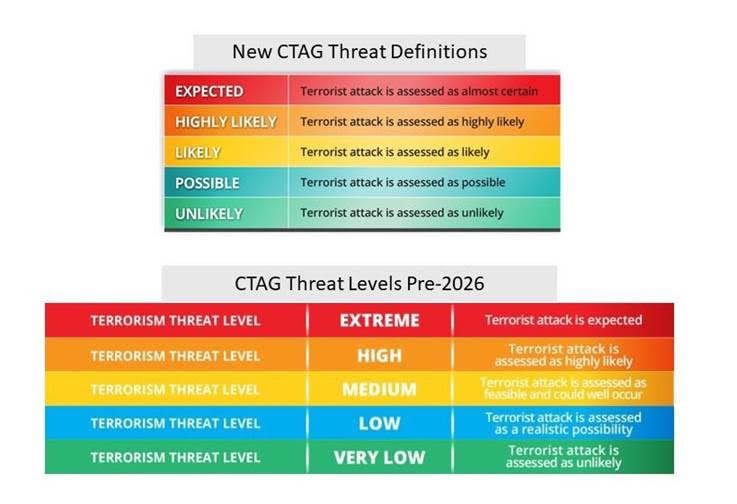
Using newly updated language, the terrorism threat level is assessed as POSSIBLE which is equivalent to the previous level of LOW. The change in language, previously signalled by the NZSIS, reflects efforts to explain the terrorism threat level in a more meaningful and accessible way for the public.
The terrorism threat level is formally reviewed annually, but can change at any time based on events and the current intelligence picture for New Zealand. It considers the domestic terrorism context and relevant international threat factors, drawing on both classified intelligence and publicly available information.
“For some time NZSIS has talked publicly about the deteriorating global threat environment, and we have seen that deterioration continue,” says Director-General of Security Andrew Hampton.
“We are not yet at a point where the impact of this on New Zealand requires a change in our domestic terrorism threat level, but we are dealing with increasing complexities which makes it harder to detect terrorism threats.
“Although the terrorism threat level remains unchanged, we should not be complacent. A small number of individuals in New Zealand continue to express intent to undertake an act of violent extremism. Some almost certainly have access to the basic capabilities needed to carry out an attack.
“The threat level of POSSIBLE is exactly what it says under our new language – a terrorist attack in New Zealand is assessed as possible. This is something we should all be concerned about.
“When we talk about increasing complexity, we mean a growing crossover of ideological and none-ideological violence, and a greater ‘shopping around’ between different ideologies by individuals. Individuals fixated on violence with mixed, unstable or unclear ideological perspectives remain a particular concern. It is also getting harder to determine whether individuals are ideologically driven, or just fixated on violence in itself.
“It is important to note that, as we’ve previously said, there is no one ideology which dominates in the New Zealand threat environment. We see in our investigations White Identity-Motivated Violent Extremism and Faith-Motivated Violent Extremism, as well as Politically-Motivated Violent Extremism and individuals motivated by online conspiracy theories.
“International events, including attacks offshore, continue to feature in online extremist narratives. This enables people to connect without knowing the real identities and motivations of others they are dealing with. However, generally speaking we are not seeing this progressing from online rhetoric to violence targeted within New Zealand. We do remain concerned about how young people are being exposed to violent extremism in the online environment.
“The most likely form of attack in New Zealand remains someone acting alone, who has radicalised online, uses basic weapons such as a knife or vehicle and takes steps to avoid detection.
“As I’ve said many times NZSIS is not all seeing and all knowing, and nor should we be in our democracy. We work closely with domestic and international partners, but national security is not exclusively owned by us. The public has a vital role to play. I encourage everyone to check out the range of resources we have available, including our guide to recognising the signs of violent extremism.
“If you have information of concern you want to tell us about then get in touch – and call Police on 111 if there is an urgent threat to public safety.” said Mr Hampton.
Notes:
New threat level definition language
The Combined Threat Assessment Group (CTAG) has adopted new language to define the national terrorism threat level. This change was signalled by NZSIS in 2024.
The new definitions aim to explain the terrorism threat level in a more meaningful and accessible way for the public. NZSIS was also aware that some communities did not feel the old definitions were a true reflection of the threats they faced.
The new definitions retains the five levels as previously used, but with new language for each level.
While the current threat level remains unchanged, the previous level of LOW is now POSSIBLE under the new language.
Here are the new and previous threat definitions for direct comparison:
Notes:
- The National Terrorism Threat Level has been unchanged since November 2022. The current level is POSSIBLE – previously described as LOW under old language.
- The National Terrorism Threat Level is continually assessed by the Combined Threat Assessment Group (CTAG) and can change at any time in response to global and domestic events and intelligence reporting. It is also subject to an annual review.
- The National Terrorism Threat Level informs relevant government agencies about the likelihood of a terrorist attack in New Zealand to ensure that they are appropriately placed to mitigate any risks. However, it has become increasingly used by NZSIS as part of ongoing engagement with communities and sectors to raise awareness of national security risks.
- Assessment of the National Terrorism Threat Level is carried out in consultation with agencies including the Department of the Prime Minister and Cabinet, New Zealand Police, Department of Corrections, New Zealand Defence Force, and the Ministry of Business, Innovation and Employment.


