
MEDIAWATCH – Sir Ian Taylor is so wrong to defend Erica Stanford from claims of white supremacy
Last week an Erica Stanford decision was branded ‘white supremacy’ … Really?!
Racist….
That’s not a word I ever expected to read in the context of decodable books. And yet, there it was.
Last week headlines ran hot, linking racism to a decision made around the use, or more accurately, the non-use of Te Reo in decodable books for early learners.
Another missive from an out of touch knighted rich arsehole.
Sir Ian Taylor is so wrong to defend Erica Stanford from claims of white supremacy.
What Sir Ian and almost every single journalist who has reported on Erica’s banning of Māori words and radical NCEA changes is who is actually advising the Minister on these changes, because the millisecond you start exploring that, it suddenly takes a very dark turn towards white supremacy and racism.
Erica Stanford is an amazing salesperson, but who has designed what she is selling?
The decision to ban all Māori words for under 5s is being driven by advisers who have been caught quoting some pretty questionable race ideology.
The justification on phonetics is simply not true…
|
QPEC totally condemns the decision to sabotage At the Marae. In its explanation, the Ministry actually acknowledges “these words reflect everyday language used in classrooms and communities.” Then in the same sentence, in an embarrassing display of pedagogical rigidity, the Ministry claims “the higher number [six words] presented decoding challenges within the phonics sequence used in the series.” The evidence worldwide suggests the opposite. From the 1960s onwards, projects like the Bilingual Education Project at the Ontario Institute of Education in Toronto have established quite categorically that young children have a natural ability to absorb several languages at the same time, without damage to other functioning like learning to read. Indeed, acquiring more than one language leads to greater verbal ability in general. In Aotearoa NZ, te reo Māori has the added advantage of a close fit between print and sound — closer than there is between English language print and sound. So one irony of the Ministry decision is that censoring Māori words will actually limit both the development of reading abilities and the advantages of bilingualism. And another is the ludicrous decision to delete Māori words from a book that focuses on the Marae, the central location of Māori culture. We should bear in mind that the decision may have less to do with the Ministry and much to do with the prejudices of the Coalition Government. |
|
As Waatea reports, Bruce Jepsen, president of Te Akatea, the Māori Principals’ Association, says the decision not to reprint “At the Marae” was racist and white supremacist. We agree. |
…Who are the advisers of Erica’s purge on Māori words in ?
TDBs educational blogger Allan Alach makes the point..
The education of our pre-school children is at risk, in danger of being dumbed down to meet Atlas Network goals.
…the mainstream media are refusing to even acknowledge any of the back ground advisers for Stanford in making this decision.
Let’s not forget that Elizabeth Rata was appointed despite Ministry concerns to appoint her!
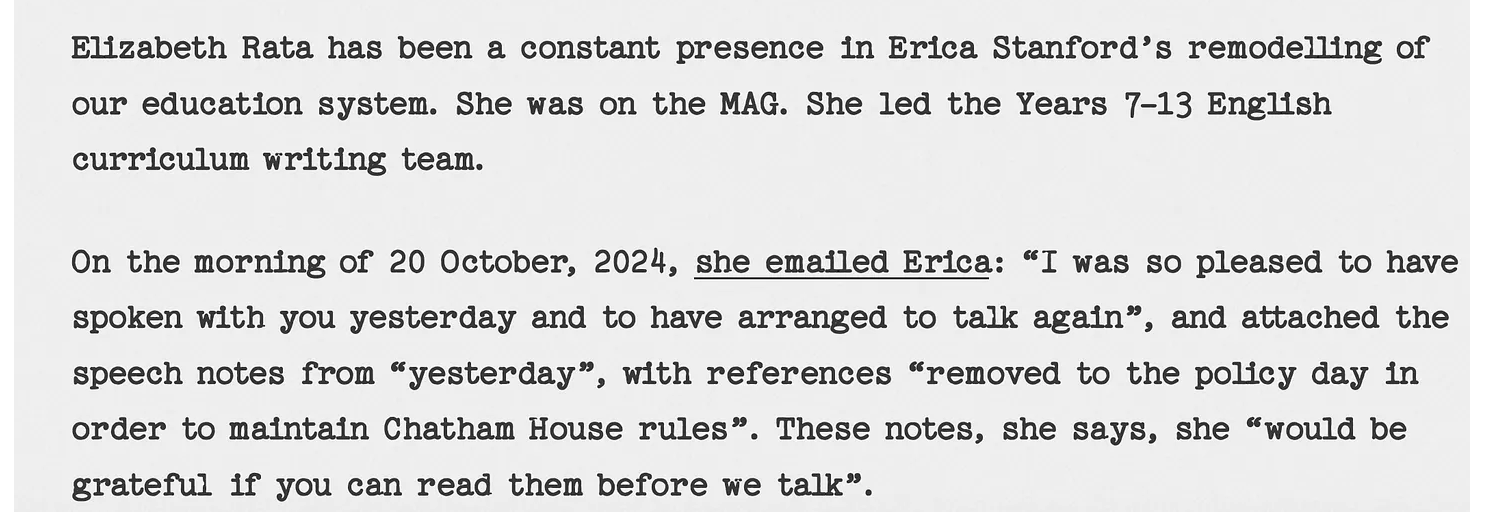
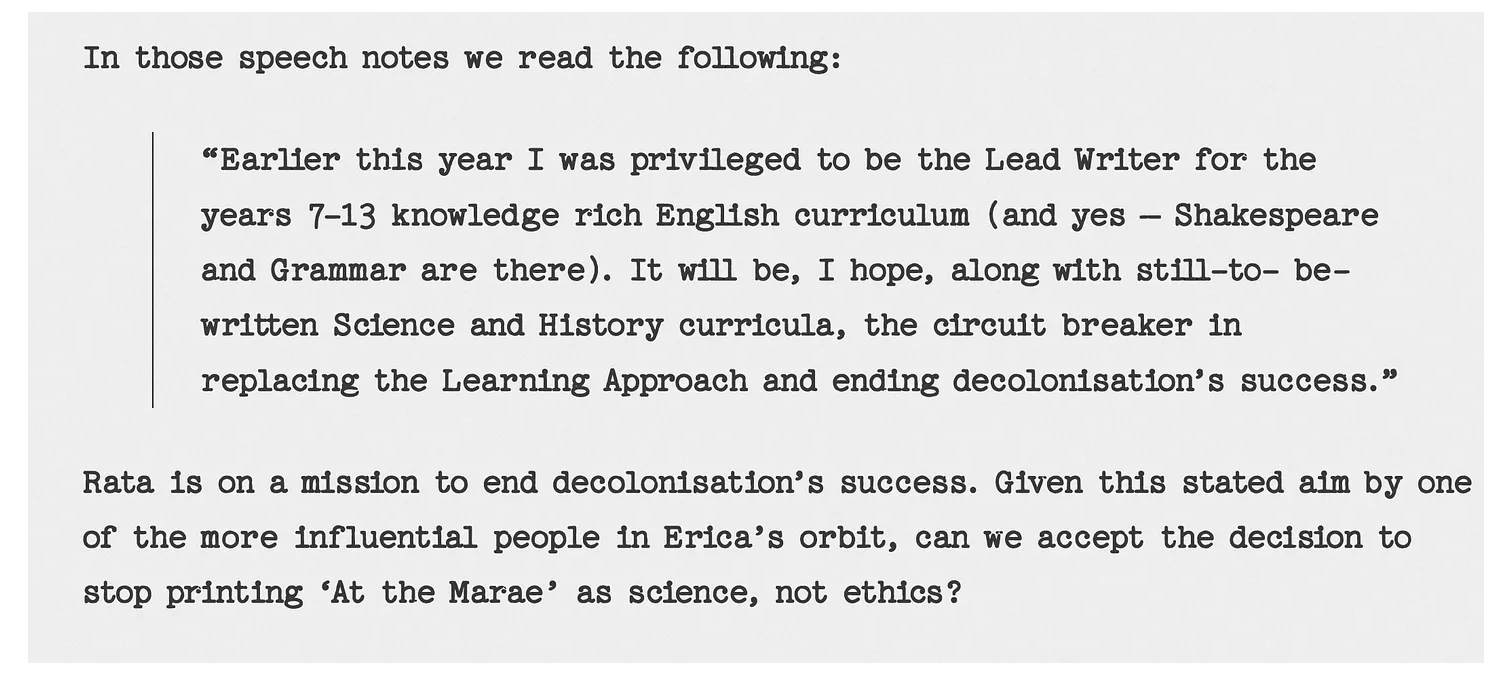
Rata rails against the “Learning Approach” and decolonisation, the “political agenda to transform New Zealand”.
…why are we allowing these priorities literally banish Māori out of our children’s books?
When you have an educational activist working against ‘decolonisation’s success’, (her words not mine) surely alarm bells should be ringing?
The Minister’s defence that removing Māori words from books for under 5s is a phonetics decision and not an attack on the Māori language would sound believable if she hadn’t appointed an extremist to do this exact outcome.
Right Wing International think tanks like the Atlas Network are openly hostile to indigenous rights because the Atlas Network are funded by those constantly stealing indigenous land and assets.
We have right wing educational activists with links to NZ think tanks who are connected to the Atlas Network, and they are advising the Minister on policy that will over time censor all Māori words in books for those under 5, purposely making it more difficult to connect to the indigenous identity because they consider that identity is too politicised.
This is a carefully constructed and well camouflaged trojan hose acting in the interests of extreme advocates.
Here is the main adviser to Erica at the ACT Party conference raging against ‘ethno-nationalism’…
…the fact that the mainstream media have not picked up on any of this is a shocking indictment on their lack of research skills!
Erica is on the hook for this anti-Māori, Atlas Network attack on Māori in education and banning the language for children is just the beginning of the purge.
Sir Ian Taylor is so wrong to defend Erica Stanford from claims of white supremacy.
Increasingly having independent opinion in a mainstream media environment which mostly echo one another has become more important than ever, so if you value having an independent voice – please donate here.


It beggars belief. I would have thought that te reo Maori is phonetically less complex than English – a language that is well known for phonetic/ spelling irregularity. So what’s the argument about decoding difficulties. What’s is the basis of the claim that “the higher number [six words of te reo Maori] presented decoding challenges within the phonics sequence used in the series.” That’s just smoke and mirrors and quite frankly BS. Clearly its an ideological agenda.
Universities are inherently political places … more correctly, Schools and Departments adopt certain ideologies at different times, usually based around the beliefs and positions of the tenured academics, the Professors. Governments of the day can then get compliant academics – consultants – to provide the intellectual justification for their ideological causes.
But is Rata such an outlier in her exposition of the Learning Approach and of the decolonization of education. How many up there in the School of Critical Studies in Education share this view, a view that “equates the inclusion of iwi, hapū and whānau knowledge and values into teaching with an emptying out of academic knowledge” (to cite a recent article online). A few te reo Maori words in kids readers are neither here nor here – and arguably a cultural and linguistic asset in a “officially” bilingual nation – but under the ideological regime then become a target.
Or is noone prepared to stand up to her? Universities are by nature places where academics do have different views and where ideas are contested, but I don’t see much academic pushback on Prof Elizabeth Rata. I don’t see others who are equally if not more qualified – and are high in the academic pecking order – to comment on linguistics, reading pedagogy and more broadly bilingual education calling her to account. Maybe they know better to tangle with the School of Critical Studies in Education. Maybe they feel its not their place to comment, at least in public. But if they value their pledge to being the critic and conscience of society they should be saying something.
The irony is that Prof Elizabeth Rata herself most likely sees her position as upholding the role of critic and conscience.
We all need to remember we are a Pacific Island nation and have two languages as do our pacific neighbours .We are not a suburb of London or Washington .We have for so long seen our fellow islanders as a source of cheap labour and have veiwed our selves as superior .
We need to remember our so called freinds in the North only really see us as bottom feeders who are stupid enough to supply canon fodder in their endless wars .
We bitch and moan about China moving into our area ,but we have enabled that to happen because we have been kissing northern arses for generations and have neglected our own back yard .
Is sir Ian going to stop saying Whanganui and say fonganuy instead .?
I can stand just so much of the ‘we’. Mea culpa but most of us here have been trying to be good Kiwis throughout our lives. The nation is up itself, was only on equality when it suited. When I started my adult uni courses I learned the difference between equity and equality – it can be seen in that often-used comic strips with the fence to the sporting ground and the three children spectators, taller to small. All have the equality opportunity to see, but the smallest has to call on equity,’ being the smallest he needs extra help, a box to stand on then he can see like the others.
But in our general lives and education, we can’t be bothered thinking such things out and just go on mumbling about one way for all, when it works out the whole is mostly enjoyed by the one. It amazes me how hard it is for ordinary everyday people to differentiate. I think that kids could start running projects at school so they can see how things work out. People are full of idealistic BS I have noticed. Learn to appreciate one another, that helps when sharing is and distribution involved. To get equality, enabling and co-operation is required, it doesn’t just happen, we aren’t all the same whatever group we are in.
Sir Ian was another of the Winston era that were not allowed to speak Te reo at school. They were punished if they did. It justifies why Sir Ian doesn’t see racism when it is clear as daylight that this is in fact what it is.
Removal of the 6 Maori words from these books is symbolic of this government’s anti Maori stance. Even the Maori in this government are anti Maori . They can splutter all they like but they are a racist bunch. Remember this Maori will still be here long after this bunch of racists have gone. Long after the Erica Stanford’s the David Seymour’s the Winston Peters, the whole ACT caucus have all gone . They will be gone but Maori will still be here stronger than ever.
Back in the 1980s this good Maori man introduced Maori words into his tv show. He would be worth 100 Stanfords and Ratas hoist on their own pou.
Olly Ohlson https://www.youtube.com/watch?v=U5R_bs8gy3k
https://www.1news.co.nz/2023/11/09/newsmakers-olly-ohlson-the-tv-presenter-who-introduced-te-reo-maori-to-a-generation/
…Mr Ohlson named Mauri Hauora,,,,
Dec.1/18 https://www.odt.co.nz/lifestyle/magazine/making-difference-0
Imagine all the privileged kids morning talks or first story writing…
In the holidays we went to …….. um um um
Wait bullet
Lake white
Big hill
Two spears
Big abalone
Don’t need AI to clone us and take away critical and creative thinking skills WE GOT ERICA AND HER DUMB F# to do it for us. I mean it’s working when you got gormless, Luxie, Bob1 and his blackshirts crew
Oh shit can’t say Tahiti or Rarotonga or Uluru or most of the States with their native American names
It is racism no matter how you put it and it’s a big step backwards for our country in race relations.
Pick your battles man…
I noticed that Stuff didn’t allow comments on his article, perhaps they knew that your view is widely held among our population. He is determined to go down fighting for this government for some reason though.