
It’s the Economy – stupid!
Woke Dogma Activism on Twitter sees everyone less mentally ill than them as privileged and everyone more mentally ill than them as toxic – not much of a Broadchurch recruitment attraction to that tiny woke kingdom.
And so it comes to pass, despite the best virtue signalling intentions of the middle class woke, poor people are not sitting around the kitchen table cancelling people for misusing pronouns, hate speech or mispronouncing te reo, they are freaking out about the economy…
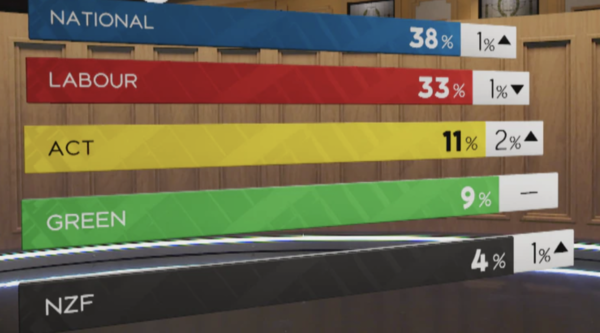
Poll: Economic pessimism soars to 10-year high
Kiwis are feeling more pessimistic about the economy’s immediate future than at any other point in the last decade, today’s 1News Kantar Public Poll shows.
Respondents were asked: “Do you think during the next 12 months the economy will be in a better state than at present, or in a worse state?”
Of those polled, 18% responded ‘better’, 21% responded ‘same’ and 61% responded ‘worse’.
…No amount of ticker tape tantrums can sway Fed Chair Powell any longer, the reality of unwinding $25Trillion in quantitive easing is upon us and Powell has to keep pushing the stake into the heart of these Global Zombie Corporations because there is nothing else left in this Late stage Capitalism meltdown.
All that debt, all that speculative bubble in property and stocks, all of it is about to get hit be demand side and supply side destruction.
If the Fed comes out with 100 point raises rise, the pressure will be on Orr to follow with 100 points.
What Treasury are wanting to claim is inflation is dropping because demand is dropping, but this is a supply chain and scarcity problem as well, as Consumers retreat, the natural scarcity of products also compounds issues by driving prices up even as people can’t afford them.
The super rich and super wealthy will benefit, middle classes and below however will suffer.
With supply chains broken, with geopolitical tensions bringing supply chains back to friendly territories and the inflationary pressures of bringing those supply chains home, the day of reckoning here suggests a spectacular 1929 stock market crash.
NZ House prices are predicted to drop 32%, inflation could hit double digits in December and Orr has no choice but to ramp up interest rates.
Reserve bank Governor Adrian Orr is ratcheting up the OCR to levels many Kiws haven’t seen in decades as he intends to crash the economy into a recession so as to save the economy .
The $51billion Labour used to juice the economy and inoculate us from the worst of the pandemic inadvertently transferred a trillion dollars in wealth value to the richest Kiwis and according to the Reserve Bank Governor the price to pay for that inflationary pressure is the slashing of 115 000 jobs.
Why should the poorest pay most for inflationary pressures that enriched the wealthy?
Increasingly having independent opinion in a mainstream media environment which mostly echo one another has become more important than ever, so if you value having an independent voice – please donate here.
If you can’t contribute but want to help, please always feel free to share our blogs on social media


The trillion dollars of wealth growth to the richest kiwis that you talk aboutwas to everyone who directly or indirectly owned property or shares. Basically 65 to 70% of the population. Not really a classification of “richest”.
In any event the alleged “transfer” you talk about was not a transfer from one group to another, it was an overall wealth bubble stimulated by the the availability of cheap money, the lowest interest rates since 1840. Cheap money boosted the perceived value of assets. The reverse is happening as money becomes dearer. The wealth bubble is rapidly being unwound by the reduction in property and share prices. In fact we are not far short of the full trillion wealth bubble being fully reversed. Once property and share prices fall by 20 to 25% the entire trillion has been unwound.
I suppose some people actually capitalised on the wealth bubble by selling at the top of the market, and not reinvesting that money back into property. These would be mostly people near retirement who sold and downsized. They now have much more cash than they would have anticipated a few short years ago. However that is not most property owners. Mostly they continue to own their houses, farms, businesses and shares. Their sudden increase in wealth based on valuations has just as suddenly disappeared.
Hundred percent right, cheap easy money was always going to end up with a “correction”. Any incoming government is going to be faced with the fall out of what happens after because despite talk of inflation this is essentially deflationary. Their challenge will be to keep people in their homes, businesses, farms and investments. As a nation of home owners, small businesses and agriculture neither Labour nor National appear to have any policies or inclination in that direction.
Yes, most of the new ‘wealth’ is just paper numbers. My house has increased in value, according to the city council, by almost 100% in a mere 3 years. Makes no difference to me. But my house loan repayments (colloquially ‘The mortgage’) are going to almost double in the near future. The wealth doesn’t and never did exist but the expense definitely does..
Cheers.
It is the STUPID ECONOMY!
Economics has the features of a religion. Joan Robinson in her book “Economic Philosophy” says “Economics is not only a branch of theology.” before explaining how economics has tried to “win itself the status of a science.” The dogmas of growth, equilibrium, and the virtue of a ‘free’ market ‘efficiency’ appear like essential creeds to be held by a religion. Other ideas held by heterodox economists such as satiation, limits to growth, private debt criticality, thermodynamic laws, and chaotic processes are treated as heretical. Heretics must be censored and excluded from publishing. While religions appeal to strong positions of faith, (faith is evidence-free self delusion) economists rely on assertions, presumptions, assumptions, supposing, and just pretend. The religious have their trust in divine intervention while economists have their trust in the ‘free market’ and its assumed automatic returning to an equilibrium. False assumptions lead to a false theory. All economic textbooks are saturated with the word assume and its equivalents and do not use real observed data scientifically to propose theories. Economics is not a science. Economics is evidence free. Science is verified knowledge, verified by evidence. Evidence is acquired by observations, observations that are measured and are repeatable. A theory based on the evidence is improved by being able to make confirming predictions. Evidence is improved by using an experiment that would prove a theory false actually fails to fault the theory. If economics was a science it would not ignore discrepancies in its assertions and evaluate them as a science would. If economics were a science it would be able to make accurate predictions.