
Is misleading free range egg outrage middle class angst at its most meaningless?
I buy free range eggs.
I try to always source groceries that are as ethical as possible.
The idea that any thing has suffered for my consumption of it makes me lose my appetite .
But I also appreciate the irony in that statement and subjective nature of that position because the consumption of any animal will lead it to a certain level of discomfort or suffering.
Vegans and Vegetarians will be rolling their eyes at me.
And well they should.
I have been amused at how huge a story this misleading of eggs has been because on one hand it seems remarkably self deceptive of anyone to pretend they thought buying bargain basement free range eggs was legitimate and on the other hand aren’t we all being deceptive when it comes to eggs?
To my first point, look at this…
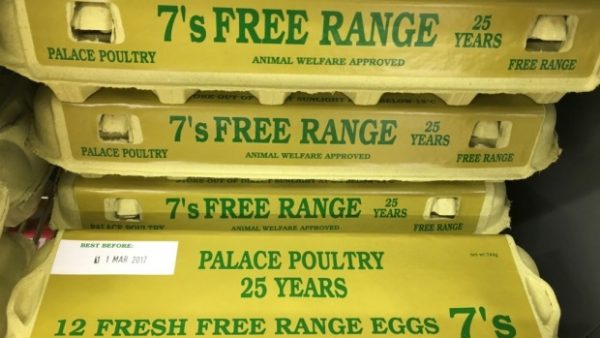
… did anyone honestly think these were free range?
The deal I make as a consumer attempting to be ethical is an acknowledgement that the product I am going to purchase will be slightly more expensive than everything else and there is going to be slightly less of it.
That’s the deal. We pay more for an ethically produced product and we will need to do with slightly less of it.
Buying Palace Poultry with its budget prices always seemed like a scam.
Which it looks likely to be.
To my second point, aren’t we all being deceptive when it comes to eggs?
As blogged by Christine Rose this weekend…
Consumers had been led to believe that by buying free range eggs they really were supporting better quality of life for laying hens. But this week’s revelations have shown that not only is there scope for cynical marketing by unscrupulous egg traders and dealers, but also that loose definitions mean there’s no guarantee of a good life for hens even on ‘free range’ farms, even if you wanted to ‘do the right thing’, by hens and paid more for it. Not only are your eggs not necessarily free range when they’re labelled as such, but your hens are likely to suffer regardless. Even if you think you’re buying free range eggs, you may not be. Free range eggs may come from caged hens, and what is generally classed as free range can come with adverse conditions for hens anyway.
…but it’s these numbers that really show up the lie of free range…
New Zealanders consume about a billion eggs a year, and eggs from caged hens make up about 75% of the market. About 5% of laying hens live in barns, and about 19% are what’s vaguely ‘free range’. Organic eggs make up about 1% of egg sales. That means most egg buying New Zealanders don’t care enough or can’t afford to pay more for eggs that support hens’ wellbeing, natural living and freedom.
…if we want to be real about the well being of chickens when it comes to eggs we would first stop deluding ourselves that the current scheme is anything other than a scam, demand far more stringent codes of welfare and accept that the cost will rise.
Or we stop eating eggs altogether.
Moaning about your bargain basement egg being a misleading rip off when that must have been evident at the point of purchase seems a tad precious.




When I ask my customers if they want a bag…and they um and er and nervously fiddle with their books…because they do… but plastic bags are ‘bad’…so I give them a minute and then say…”oh its a brown paper bag”…and their faces light up in joy…especially as its BROWN paper…so I give them a moment of relief…then an enlightening talk about paper production and its negative effect on the environment…
The main environmental difference between a paper bad and a plastic bag is what happens after your customer is finished with it. Paper bags biodegrade very quickly, whether they are composted or just chucked out the window, whereas plastic bags just breaks into smaller and smaller pieces which don’t biodegrade for hundreds or thousands of years, and ends up in the oceans where they are consumed in increasing quantities by plankton eaters. That’s after they’ve finished blowing around suffocating wildlife, something paper bags aren’t strong enough once in the environment to do.
Paper manufacturing methods have often been pretty toxic, true, but a lot of work has being done in recent decades to research and implement more eco-friendly paper production. A brown paper bag these days is most likely made from recycled paper, instead of one-use pulp that’s been bleached and then coloured. Anyway, this is the responsibility of the manufacturer, and to a less degree your employer, who chooses where to buy paper bags for your workplace. Whereas what happens to the bag after it’s been used is the responsibility of the customer, so it’s no wonder they prefer paper to plastic, and so they should.
Since NZ is renowned for its successful small business philosophy, why aren’t we following that idea instead of these giant factories that only produce misery ‘for man and beast’? Slightly more than 5, though 🙂
The reason I only average 2 eggs a day is the chooks are old, and I don’t kill my pets.
I know that life, Robert Atack. More than five chooks, eggs until they decide it’s time for their egg laying break, then I go and buy eggs for us and food for the hens and then when they pass away, we have a burial plot.
Chefs Hugh Fearnley-Whittingstall and Jamie Oliver and comedian Ricky Gervais have done a huge amount of work to publicise the commercial Frankenstein egg stuff in our food, that we never thought to check.
Now there’s this: https://www.thesun.co.uk/news/2971869/free-range-eggs-stickers-bird-flu/ free range chickens shoved into barns because of avian flu.
How can anyone trust that decision, when in the USA https://www.theguardian.com/vital-signs/2015/jul/14/bird-flu-devastation-highlights-unsustainability-of-commercial-chicken-farming. Intensive factory industry using living creatures is dangerous to everyone’s health.
And what an insult to call industrial layer hen factories ‘farms’. Having a farm and being a farmer suggests some relationship with the living creatures that produce a farmer’s income, which means they all deserve respect and proper treatment.
Has anyone bothered to check out what warrants being called a real farmer in New Zealand and what is actually an investor motivated purely by profit and not ‘the good life’ that farming purports to be and that demands New Zealanders’ current loyalty in the face of water use and pollution? How much taxpayer money goes to supporting greedy over-stretched investors when it should only be going to ethical farmers genuinely needing our support?
The increasing meaninglessness of the word “farm” became evident to me when people started talking about “wind farms”. I just checked the etymology and was fascinated to discover that it comes from a French word meaning “lease” or “rent” paid to landlords:
http://www.etymonline.com/index.php?term=farm&allowed_in_frame=0
Replace “landlord” with “bank” or “investors” and its still pretty accurate.
I just have 5 chickens that give me 2 eggs a day.
And it’s not just the egg you buy, tortured chicken eggs are in all your cakes and commercial foods.
Snap. I also have 5 chooks. Three Silver Campines (they lay pure white eggs) and 2 Lavender Araucanas (they lay blue eggs). They’re ultra fat and very happy and fully free range. Also produce on average 2 eggs/day between them.
‘Is misleading free range egg outrage middle class angst at its most meaningless?’
Only when you forget what you’re fighting for – layer hens. Any publicity on how layer hens are abused for NZers’ benefit must be useful to get the full story of exploitation of all our voiceless food providers ‘on the table’.
Middle class angst indeed. Not only is the middle class slowly joining the lower paid through greedy govt policies but often, alongside retirees, they are the only ones that still have time to breathe and advocate as opposed to those worn down while surviving in ‘zero-hour’ equivalent pseudo jobs for low wages, which is what government wants – people easier to control.
************
It is stated often by free market lovers that the more consumers demand to buy something, the more the market will provide and sell for less. So, it is supposedly reasonable to buy something cheaper than it used to be as free range eggs are becoming more sought after.
A vegetarian friend of mine believed that market theory and now feels exploited by greedy, lying business.
Free market and free range only succeeds under honest business practice, with honest government oversight and penalties actually carried out. We’ll be a long time waiting for that.
If only free range with safe access to outdoors and a low rate of birds are stocked, that immediately assures an even playing field for all sellers of eggs. People will then choose to limit their intake of eggs if necessary. By allowing cruelty into the market with caged birds and animals that muddies the pricing.
If only people remembered that they are eating birds and animals, or consuming something from those without a voice, they would consider their actions more humanely. I would like to think so.
It is chilling to see how big a % are still in even crueler battery cages until 2022.
It is only a humane government that will tightly control the exploitation of live creatures for our tables, which will enable real animal welfare. New Zealand does not have that.
Let’s get it.
How many eggs are exported from New Zealand that are from layer hens in battery cages or colony cages? Are any countries demanding caged egg imports from NZ? That should be stopped; we are exporting animal cruelty.
In the Netherlands in 2015 all birds were culled from a caged egg factory when bird flu was evident. So the caged egg laying apologist Dr Jacqueline Rowarth was incorrect when she said caging chickens was the safe way to go recently.
I heard on RNZ a week ago that the chicken farmer said he supplied them to his regular guy and never could check where and how they were marketed after they let his farm.
He said I had no problems before and wondered why now?
Ever it was someone with no-scruples using his company to stuff cheap slate caged eggs into the boxes.
Next we will have date stamped and origin on each egg after this.
In Planet key our country has taken on John keys slick tricks everyone is into it now.
Remember what Mum always said about hanging around with some kids at school, she would say;
“son! remember it only takes one rotten apple in a bin to make the whole bin rotten.”
Why would we expect any business nowadays to be honest after the example set by the most dishonest leadership of this country in our history.
Ironically the purported truth wrapping the lie that is the source of the eggs sums up that example perfectly.