
GUEST BLOG: The High Cost of Fast Fashion – Is it time for a revolution and mandatory grading?
Slavery was historically condoned due to scientific and religious beliefs. Today, the driver of modern slavery is no longer shackles and slave ships; rather one of the major contributors is consumer choices and an insatiable demand for cheap and fast clothing. The repercussions for those workers manufacturing the clothing (which are more prominent in developing countries) are sweatshops, meagre wages and working conditions that no New Zealander would ever consider acceptable.
As Kiwis, we like to think of these issues as ‘far away’ or not our problem to own. However, the truth is many New Zealand consumers purchase imported clothing and are therefore contributing to this problem without realising it. Rather than remaining naive, we propose that Kiwis become more accountable for their actions.
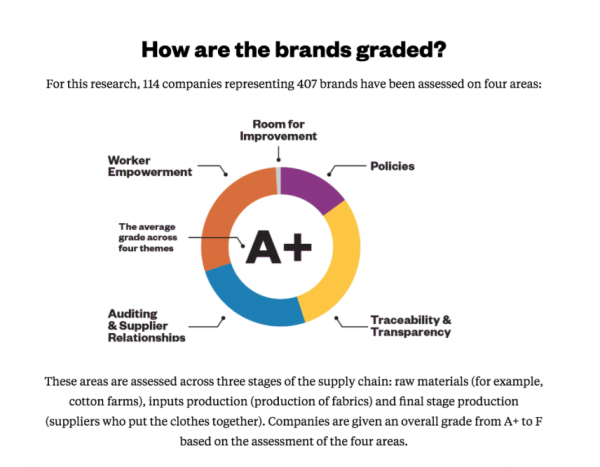
The 2018 Tearfund Ethical Fashion Guide was recently released. This report tracks the systems that companies have in place to uphold the rights of workers and to trace the supply chains of garments from the cotton field to the final product. Ultimately, the business/brand receives a grade from A-F, indicating the ethical standard of the company. This grade aims to provide information to consumers that wish to make informed purchasing decisions, a similar concept enforced at restaurants to grade health standards.
It is here that we pose the question: should it be mandatory for clothing stores to be graded? The grading system would encourage greater transparency and be effective in endorsing ethically produced clothing from a legislative and social accountability perspective. It is currently fashionable to use words such as ‘sustainable’ or ‘ethically produced’ in marketing, but who holds these stores accountable for verifying such statements?
With the current political talks around the potential introduction of the ‘Modern Slavery Act’, it is a prime time to have this discussion. In the NZ Herald on the
18 April 2018, Minister Iain Lees-Galloway, Minister of Immigration, was quoted saying that “the prevalence of human trafficking and slavery, both in New Zealand and in our global supply chains, is an increasing concern not just for the Government but also for businesses and consumers”. This is a large issue with no simple answer, but could the government partner with organisations such as Tearfund who are a global stakeholder and have credible existing systems and research?
Finally, in boiling the issue of ethically produced clothing down to how the individual can combat modern slavery, we challenge you as the reader to look at the Tearfund Ethical Fashion Guide. Begin to ask questions about “where are my clothes made? Do they come from factories where workers are treated fairly, with a decent livable wage and working hours?”.
How comfortable would you be to eat at a restaurant graded an ‘F’?
Buying clothing with the same rating should give you the response of revulsion.
The Tearfund Ethical Fashion Guide can be found here https://www.tearfund.org.nz/ethicalfashionguide
By Katherine Macdonald, Stephanie Greenfield, Abdulla Kalisy and Hannah Williamson (Massey University Students).
Bio: Katherine Macdonald, Stephanie Greenfield, Abdulla Kalisy and Hannah Williamson are 3rd year Massey University students. The group are working on a public engagement project which seeks to bring awareness to the Tearfund Ethical Fashion Guide and also to encourage the discussion of whether it should it be mandatory for clothing stores to be ethically graded.


Let’s be realistic, the chances of mass clothing manufacturing coming back to NZ in the near future isn’t likely. So in the meantime, yes, an ethical grading on the source of our clothing products would be wonderful.
However, to say we have an “insatiable demand for cheap and fast clothing” isn’t all fair. Look at the income of the majority of NZers and the cost of what’s left of locally made clothing, ie we can’t afford it. Many of us would prefer to support the local economy (not just clothing) but the hash reality is it’s too bloody expensive in relation to our income! And not everything required is easily sourced at Op shops.
Unintended or deliberate consequence- price the consumers out of the local market, force the local business/industries offshore or out of business because the local market can’t support them, make us more reliant on cheap goods so no reason to increase wages?
“Begin to ask questions about “where are my clothes made? Do they come from factories where workers are treated fairly, with a decent livable wage and working hours?”.”
I am extremely concerned where my clothes aee made and in what conditions.
I would begin by asking the PM and the leader of the National Party if the TPPA contains any remedies to slave labour producing our consumer goods and if not, why not??
I would be interested in a categorisation of clothing manufacturers and I’d be damned if I’d buy clothing where the workers were exploited.
To the students undertaking this project, please keep at it.
How about we go back to making the clothing here again and pay proper wages so working people can afford to buy them. This would also mean the government don’t need to prop up businesses by subsidising low wages through working for families.? Yes globalisation has lifted millions out of poverty. This has been at the expense of the working class in the developed world. A managed transition to a global economy would have benefited both groups and maintained a larger group of consumers in the west to buy the product produced elsewhere. Instead push back is occurring in the west often not targeted at those who bought this about. Witness Trump and Brexit.
And on the other side:
when was the last time you tried making clothing from the cloth and pattern to the final fitting?
The costs are phenomenal and the raw materials are becoming harder and harder to find, not to mention the fading of skills in home sewers (as in sewing, not effluent).
If you are faced with growing kids, plus social media, plus overloaded evenings and weekends – you’d be thanking those women who are toiling for sixteen hours of the day in fire-traps for clothes you can manage to buy after paying either the mortgage or the rent.
It’s no excuse at all: it is simply the continuation of using poor migrant women to produce clothing at rock bottom prices.
https://en.wikipedia.org/wiki/The_Song_of_the_Shirt
https://en.wikipedia.org/wiki/Triangle_Shirtwaist_Factory_fire
And also-poor women buying because the means for make and mend have gradually departed from the everyday due to societal change.
The alternatives are…?
A good proposal team;
As consumers we have human rights to recvieve before payment every item all particulars surrouding the development, origion, production site and any other information deemed adequate for purchase so if it was made by slave labour they should warn this or reject for sakle this item.