
GUEST BLOG: David Tank – How I want to bring back the Moa and Save the World.
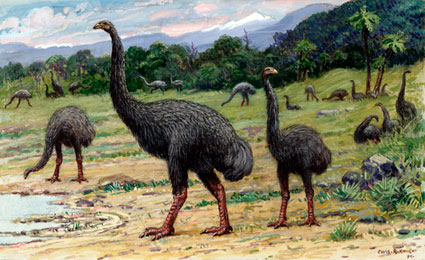
I’m a bloke who has very good idea’s many of which you already know about, even if you don’t know they were mine. Now I don’t claim bungee, but I was there the moment AJ had his light bulb moment…and it was me that said “make all three movies at once!” and got Jackson a better deal than he asked for. I even once gave Steve Jobs one of his “great ideas” renowned thief that he was…look up the IMAC G4.
It’s just something I do…I see things others don’t…even if it seems obvious in hindsight to all…Hell there is even a TV ad about me…”What do you think Dave?” Not that I know much about farm services…but hey! “Put Llama’s in it” I said…”I like Llama’s.”
Not that very many know it’s based on a real person…life’s funny like that.
You see a long time ago I learnt that if you don’t have the resources or the connections but you want to get something done then don’t get precious about it give it to the folks who can do it and do it right, even if it meant you get nothing in return. So I did…many times. Mostly intentionally.
It must have been all that early childhood bullying I suppose…and well you know…blab a billion dollar idea once and you look like a loser, blab a dozen billion dollar idea’s then maybe, just maybe, it’s because you’ve got a plan…
And yeah I did have a plan…or rather do have a plan. I want to save the world. And the next stage of it means going public.
So read this…
My letter to the Prime Minister
Re: Bring back the Moa!
A formal request for your support of “The Moa Prize,” a “crowd sourced” innovation prize for advances deemed in the best interests of the people of New Zealand and the World in general.
Dear Prime Minister,
I believe the greatest danger to our chances in dealing with the challenges of our time is the sense of hopelessness that most of us feel when we consider the damage we are doing to ourselves and our planet.
Not so long ago we held as an article of faith that our ceaseless inventiveness and industry was a force for good and that there was nothing we could not accomplish if we set our minds and collective will to it. We held that “progress” as we called it was a good thing and would only make things better.
But our modern lives have rendered us cynical and often bitter and now such an article of faith is viewed as naive. I contend that we are the poorer for this loss as without such faith our capacity to exert a collective will and to influence and shape our future in positive ways is diminished.
It is great ideas that unite us in action but if we cannot share an optimism in those ideas we cannot carry the majority to agreement and make them a reality. It is optimism that will inspire the faith we need in ourselves if we are to fix the problems that beset us and our world.
I believe we should seek to inspire a renewal in that collective optimism and demonstrate our capacity to do great things by doing a great thing, something that can serve as a tangible symbol of our hope for a healed world and our ability to deliver it.
I want to bring back the Moa, the Huia and the Hokioi (Haasts Eagle).
As you may be aware there have recently been great strides in our understanding of the science and technology needed to establish “de extinction” as a viable proposition. Recent reports have indicated that such an eventuality is no longer considered decades from reality but rather only a matter of a few years.
Should the will be there to pursue it.
It is also a matter of record that the available genetic material makes the Huia a prime candidate for such a restoration as, if to a lesser but still considerable degree, is the Moa.
These and the Hokioi are birds that excite the imagination of people not just in New Zealand but all over the world. They are the stuff of legend, their loss emblematic of the harm we have caused our natural world and to learn of their extinction fills all with sadness.
But if we bring them back they will instead become living symbols of our hope and intention to heal the wounds our rise to dominance on this planet has caused our living world. Their recreation will inspire all and by doing so aid us in pursuing the measures we need to take if we are indeed to make managing climate change the “nuclear free moment” of our generations.
Seriously.
As you will recall I have written before concerning my idea for “The Moa Prize” a series of “crowd funded” innovation prizes for advances deemed in the best interests of the people of New Zealand and the World in general.
You will also recall my desire to offer such prizes for innovations that will lead to homes that generate a sufficient surplus of renewable energy that they make a significant contribution to our growing electrical power generation needs. Demand that is set to grow dramatically and rapidly as we transition to a fossil fuel free transportation network.
However it has always been my intention to also offer this prize for the successful de extinction of the Moa, indeed I regard offering it as essential to the success of the concept of a crowd sourced and funded innovation prize series.
To even attempt to bring back the Moa is a thing that will capture the imagination of the world and aid greatly in raising the monies needed to make this concept a reality, as will our Governments endorsement of it.
My intention is create “The Moa Prize” as a Crowd Sourced and Funded Innovation Prize Series that offer substantial prize monies for specific innovations. These prizes will vary in value from $5 million to $100 million and will start with five bounty’s paid upon the delivery of each innovation. Those who suggest an innovation will receive five per cent of the prize money.
These are the first five prizes to be offered:
De extinction:
1. Produce a viable breeding population of the Dinornis robustus The South Island Giant Moa. $10 million
2. Produce a viable breeding population of the Heteralocha acutirostris The Huia.
$10 million.
3. Produce a viable breeding population of the Harpagornis moorei The Hokioi or Haast Eagle. $10 Million.
The Great Leap Forward:
4. A solar powered Kitset Home that pays for itself by selling electricity.
$50 million
5. A solar powered Conversion Kit that can also turn our current homes into power stations. $100 million
Entrants will need to partner with NZ scientists and industry.
Subsequent to this my intention is to establish an on line presence that will invite all to submit an idea of benefit to both New Zealand and to all the people of the world. Anyone will be able to comment and to “upvote” and to pledge money should that particular idea become an official “Moa Prize.”
These idea’s must be optimistic idea’s and ones of genius and each must aim to help heal our planet and bring peace to all its peoples. They should also make us smile.
It is my contention that the establishment of such a means of capturing innovative ideas and making them a reality is the missing part of the global innovation infrastructure our technology now allows.
Should this Prize become a reality I will also ask that our Government agree to items four and five being supported by the provision of a subdivision under Kiwibuild that will serve as a “competition village” where entrants can demonstrate their solutions.
And to agree to offer contracts to the winners for the mass production of these houses in New Zealand both in order to satisfy our housing needs and to lay the foundations for an industry capable of exporting this solution to the world.
As you will recall I have previously suggested we build a State House for the 21st Century.
“The house that jack built 2.0!” A home were no child will ever be cold or damp or hungry. I will repeat that request.
Finally, you will recall that in my last correspondence I reported to you that I was the person that suggested to Elon Musk and Space X that they should attempt to send a Tesla Roadster to Mars on the first launch of their Falcon Heavy rocket.
No doubt you have seen the footage of their success in doing this and have, perhaps, like me marvelled at the absurd and yet beautiful sight of the “Starman” orbiting the Earth in a convertible electric car.
Of all the things I have seen in my mind’s eye that have become a reality this is the one that fills me with the most pride. That little red car launched deep into our Solar System with a cheery “don’t panic” sign on the dashboard is a thing of joy to behold, particularly if one’s sense of humour encompasses a delight in the absurd.
I remind you of this as whilst putting an electric car into deep space is a fundamentally absurd idea it was done to serve a serious purpose because it too serves to bring attention, funds and legitimacy to my project.
So I will repeat my request made in that previous correspondence. I would like you to call Elon and ask him to support and promote “The Moa Prize” to his legions of admirers around the world, and indeed to his fellow Silicon Valley “technocrats”. I would like you to ask him to help us bring back the Moa.
It is a call he is expecting, or rather, hoping to receive.
I trust that there are some amongst your advisors who understand the tremendous boon the potential association I offer could be for our country and our world…and all for one phone call. I urge you to do this.
And of course should you or one of your Senior Advisors like to discuss this matter further with me I would be happy to make the time.
Yours faithfully,
So there you go folks…laugh or scoff all you want, but ask yourself would you really turn down the opportunity this represents when it only takes a phone call to find out? And then go ask the Prime Minister the same, maybe you will get the courtesy of a response because to date I haven’t.
Let me know how you go.
David Tank is a political activist and member of the NZ Labour Party, he helped to establish the Green Party in 1990 and has previously worked as a Journalist, Editor, Political Advisor, Kiwifruit worker, barman and as many other things.
He is currently a candidate for Tauranga City Council and the author of a petition seeking to set the date of the weed referendum for 26th January 2019.
Mr Tank grew up in Tauranga, leaving in 1984 to study Journalism in Wellington and left NZ for Australia in 1993. He returned to NZ and Tauranga in 2012.


I like the passion here, and the desire for more funding for big projects that will help biodiversity in NZ. There are a couple of points that need mentioning…
I am a conservation genomics researcher, now with a permanent research/teaching job.
No scientist in the world can clone a chicken with current technology. This is despite having a sequenced genome, and live cells, and eggs by the billions, and laboratories specialising in chicken physiology and reproduction. Birds are actually incredibly hard to work with, and while de-extinction may happen in my lifetime, it’s going to be on mammals well before a bird gets a look in.
Furthermore, one bird does not a species make. We have critically endangered birds now that have so small a gene pool they may go extinct despite having lots of birds all of whom are well looked after. This is called an extinction vortex whereby small populations lose genetic variation, become less fit, loose numbers, and then this spirals down. De-extinction needs to make many highly diverse birds – each costing hundreds of millions (if the technology existed which it currently doesn’t). Your estimates of 10 million for a viable population of any of these birds hugely underestimates the cost of many of the parameters of this research.
I am not all doom and gloom, and I believe that we should be moving towards big ideas in conservation, but the way to do this is long term funding increases in science funding for the environment. DOC have been criminally underfunded by the National Party for almost a decade, and science and innovation funding have similarly consistently lagged well behind Australia. There are minimal funding options for postdoctoral research in New Zealand, few permanent research jobs at the end of it, and minimal funding for the research when you do get the permanent job.
The next big step is lots of little steps, and these involve increasing the investment in science and conservation funding – giving scientists the freedom that some of this research will be dead ends, and that is fine because if you knew it would work it wouldn’t be called science. Putting some (small) amounts of money as prizes to accomplish giant tasks is not the solution. This is misconstruing science as a business or marketing exercise, a simple answer to a complex question, which unfortunately won’t work.
Prizes work for design competitions when the science is done. Having jobs and long term funding works for increasing science. The solution is giving scientists enough funding to stay in NZ and pursue their ideas – many of us dedicate our lives to conserving our toanga, and many more would be able to do so if they didn’t have to leave science in order to afford food and shelter!
My experience with engineering students is that if you give them any increase in budget they will still spend it all on beer 😀
On a serious note Australia does have a huge capability in the space market with all the knowledge and industry to go seriously at it but no government support beyond minor investments. Wouldn’t mind a joint AU/NZ space agency to advance both of our capabilities (peacefully). The CSIRO has significant involvement in NASA programs, the volunteer Australian Space Research Institute (ASRI) also exists as well as a number of programs in academia. The fact Australia in 2018 doesn’t have a dedicated stand alone space agency and New Zealand does ruins a lot of egos.
Now that New Zealand has developed a space agency of her own the benefits of an ANZ collaboration puts New Zealand in the drivers seat. Our space industry is more interested in agri tech at this stage according to Shawn Ovis who is outstanding in his field.
There are people who think a space industry is a wast of money and they’re wrong. Keeping skills relevant and cutting edge will help economies of scale in solving the big problems.
This sincere but unfocused screed sadly reveals how little understanding most people have about how real innovation happens.
You can’t just offer a prize and imagine people are going to pull together some dream team and work potentially for years for free for a prize you promise you will crowd source the money for. Making such offers is kind of naive.
Like anything, success in innovation requires teams, and teams of teams, and sponsors with very deep pockets. Which is why the X Pize and others like it are only entered and won by large corporations. Hence why not many of the prizes or winning submissions have purely social ends.
Maybe Blue Sky isn’t your strong suit. Scale back your ambitions friend. Try taking something very small, but very important, like how to feed a family of 4 for less than $50 a week, and solve that. Stop trying to save the world in your head. Instead, solve one fundamental, universal problem, then roll that out in your neighbourhood; it will spread like wildfire.
If we on the Left spent less time daydreaming of a better tomorrow, and more time actually feeding, housing and educating ordinary Workers, we would soon have an invincible tidal wave of newly woke Socialists, ready for political change. Instead, we have idle talk, a Culture of Complaint, and castles in the air.
Maybe it’s time to take a cold shower and re-evaluate everything, ’cause what we’re doin’ now sure as hell ain’t workin’.
Faark no. And please let me explain so no one gets salty.
If you’ve got the secrete sauce, and that secrete sauce gives you a shot at a million dollars. Just take it.
A lot of people think that stability is a secure $50,000 salary year on year out. Then they’ll go out and borrow 5 or 10 times that amount and pay it back over time for no real gain so after a life time of paying debt you finally get back to zero before you realise what real freedom is about. So you believe this is safe because there’s zero risk.
So let’s calculate quickly your down side risk if you left your job to pursue your passion. So what’s less than $50k? It’s $40k, or $30k so your down side risk is fifty thousand dollars. So the real down side is likely only very small because your likely to earn some where around $50k even if you left your job and got a new one.
So that’s the down side but the upside is all the money in the world. It’s literally infinite. So even if you have a small chance of earning all the money in the world your down side is very minimal and your upside is huge.
So in this scenario where you’ve got a salary of $50k people tend to anchor themselves to that number and take on liabilities that this number can pay for, and that to me is more risky. And this is why risk is subjective and not a 2 dimensional risk reward as if small dollar figures are less risky because its subjective to your own personal situation so in the scenario you think it’s not risky but it is because you’re taking on more and more liabilities so you can’t asses risk objectively. So in that jobs example we looked at down side and upside risk, but if you have lots of liabilities you can’t asses that objectively.
In terms of science and innovation if you put your self in a situation where you have zero down side risk and repeating it and infinite amount of times then your potential upside is infinite.
So you have to step outside yourself and asses yourself objectively and work towards that situation. It’s difficult to do but it’s something that just has to be done, otherwise you’ll always remain in a situation where you can’t asses risk objectively.
So if you can calculate risk and reward correctly, and do it an infinite amount of times and do that well you will become successful.
Most people will say let’s focus on predator free nz first. I say stuff that let’s do both.