
GUEST BLOG: Brian Easton – The Future of New Zealand Capitalism?
‘Far too many New Zealanders have come to view today’s capitalism, not as their friend, but as their foe. And they are not all wrong. That is why we believe that capitalism must regain its responsible – its human face.’ Winston Peters.
Announcing that he was going with Labour, Winston Peters said that he was committed to making capitalism in New Zealand more human. One could write a book on possible meanings of ‘capitalism’ and libraries on the potential, or not, for improving it. We must be briefer.
Suppose Peters means that the current economic, political and social life (i.e. capitalism) has been captured by neoliberalism. He intends to maintain the market economy with its private property arrangements and liberties but he does not accept the neoliberal antagonism towards public initiatives. He is intending to return to the liberal track that was being followed before the Neoliberals took over in the 1980s. This does not involve a return to the Muldoon management era; perhaps he has in mind what men and women of good faith hoped for from the 1984 Labour and the 1990 National Governments.
Housing Policy (illustrating Neoliberal thinking)
Neoliberalism deeply frames public thinking, even though there are is only a handful who still openly profess that ideology. Take housing policy, one of the marked failures of the previous government. It is not accidental that responsibility for the policy was fragmented among three portfolios (and National had at least three other ministers who were also ‘responsible’).The neoliberal approach, implemented in the early 1990s, does not see any need to manage the housing sector as a coherent whole nor for some governing framework or plan. What is needed is a unified Ministry of Housing which can coordinate the various parts of an exceedingly complex sector and which does not implicitly adopt a neoliberal framework. (I recommend this reservedly; new agencies take time to establish.)
Profit Seeking and the Public Service
The neoliberal framework is remarkably persistent and pervasive. Why is it necessary for so many public activities to make a profit? Commercial targets distort their purpose. Take RNZ (Radio New Zealand). Obviously it must operate within the resources it is given. But what is the point of receiving a government grant, some of which is paid back in tax? There are a lot of government agencies like this, including hospitals, research institutions and universities. They are not capitalist enterprises but pursue the public good by other means. The Clark-Cullen Labour Government may have blunted the distortion but the rotting carcass of neoliberal thought remains.
Is competition always necessary? In some sectors – education for instance – it distorts behaviour. But doubts can also apply in the market sector. Does it make sense to regulate a network industry like the postal service by competition? Perhaps New Zealand Post should buy out competing services and offer a unified mail service?
The Fetish of GDP
Behind this commercial approach is the fetish for GDP. The market output of the economy is not the same as the wellbeing of its people although it is not uncommon to confuse the two notions. The neoliberal approach is even more pernicious because its policies focus on the growth of real GDP. (Whether they achieve that goal belongs to another venue.) It argues that without immigration, GDP growth would be lower. But an increase in GDP does not necessarily increase New Zealanders’ command of material output. It seems likely that any recent growth in their real incomes has been lower than the reported growth in GDP per capita, with the difference going to the arrivals.
I am sure there is no single index which can displace GDP. Better if we have a portfolio of measures reflecting the complexity of the human condition. If we insist on equating GDP with wellbeing, we need to think about its distributional implications.
The measure of material output treats every output dollar the same. But is that true for incomes? Amartya Sen, one of the truly great economists of the late twentieth century, suggests we should measure income increases in percent terms instead of absolute dollars. Take away $1000 from an income millionaire reduces their income by 0.1 percent. Give the $1000 to someone on $10,000 increases theirs by 10 percent. He proposes a measure of ‘real national income’ which recognises this.
Focusing on Sen’s real national income would revolutionise tax and distributional policy analysis. Many economists might respond that Sen is introducing an ethical judgment. But what Sen is showing that the practice of treating a dollar received by a millionaire as valuable as the same dollar to the poor is also an ethical judgement. Value judgements have already been slipped into the analysis of those who treat GDP as a measure of wellbeing. The judgement is pro-rich and is used to discourage redistributing income to the poor.
Government Spending
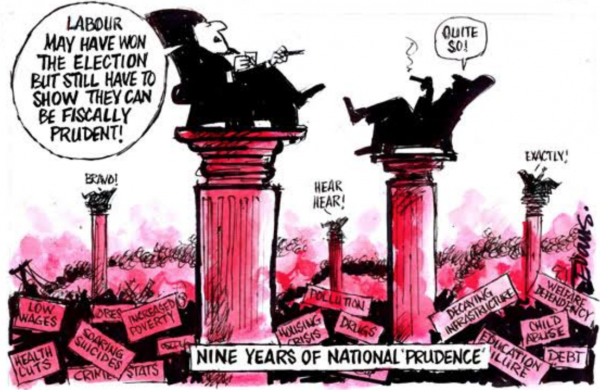
Moving from the neoliberal approach may involve additional government spending which neoliberals reject. But a fiscal conservative (that is, the government needs to prudently manage its finances) need not be an Austerian (there is no case for additional government borrowing or additional taxation). Cautious borrowing may make sense if removing anomalies in the tax system does not generate sufficient additional revenue; perhaps tax rates may have to be raised.
Does it make sense to fund the additional infrastructure needed for immigrants out of current taxation? Surely that part of the public building program should be funded by additional public borrowing. Admittedly the need will be less if immigration levels come down a bit, as the new government promises (but there will still need to be some construction for additional immigrants and to catchup the backlog).
Decentralisation
Another useful step would be to decentralise political power. Neoliberals support decentralisation to individuals. The consequence is that the power of one-person-one-vote is replaced by one-dollar-one-vote, which has uncomfortable social outcomes if the income distribution is very unequal. But New Zealand neoliberals do not contemplate decentralisation of power to collective entities such as local bodies. Central government is not enthusiastic either; strong local bodies are a check on its power. (The combination in the Rogernomic and Ruthanasia years of neoliberals in command of central government proved exceptionally brutal; ironically so, given their belief in decentralisation. One of the few centres of resistance was at the local level.)
What inhibits decentralisation is the lack of an adequate local funding base; local body rates tend to be clumsy and inequitable. Among the possible additional sources are giving power to local bodies to levy a tax on petrol and to levy water usage to fund the mitigation of the consequences of the water draw-off and re-injection. Revenue sharing from GST proceeds also makes sense.
The Idea of Neoliberalism
Rooting out neoliberalism (which is not the same thing as an inquisition on those who sincerely hold the belief) is not just a matter of changes in institutions and policies. We need to deal with it in our thinking, to avoid being unconsciously dependent upon these defunct economists.
One step would be to withdraw implicit government support of neoliberal thinking. We allow some to avoid paying full tax by being non-residents for income tax purposes. Yet they may still participate in political life by funding political activity and research. Since taxation is the price of citizenship, paying partial tax does not entitle one to full citizenship. We should take into consideration when determining an individual’s residential status their political involvement in New Zealand. Too much, they become citizens and pay tax on all their income. Since neoliberalism tends to be most common among the rich, that would discourage a current bias in political funding.
It is not for the government to direct intellectual activity outside the public sector. But it can foster it. Removing commercial incentives from universities is a way. Or consider the case for extending the role of RNZ which Labour has promised. RNZ is not anti-neoliberal; rather it provides a broad balanced platform where public issues may be discussed. Generally advocates of neoliberals do not do well there because their funding does not give them additional leverage; they work best where it is one-dollar-one-vote not one-person-one-vote.
Appointments matter. Astonishingly the Clark-Cullen Government appointed neoliberals to positions of authority; in at least one case it set back good policy evolution many years. (In fairness it must be added that its appointment of muddled thinkers with warm hearts also got the government into some dreadful policy muddles.)
Reducing the influence of neoliberalism in our thinking does not by itself lead to the kinder, gentler and more egalitarian society which Peters seems to seek. But the neoliberal assumptions which underpin so much of policy need to be replaced by something which is both closer to economic reality and more consistent with the human condition. If that does not happen, many will conclude in three years’ time that the new government is still a foe rather than a friend.
‘Far too many New Zealanders have come to view today’s capitalism, not as their friend, but as their foe. And they are not all wrong. That is why we believe that capitalism must regain its responsible – its human face.’ Winston Peters.
Announcing that he was going with Labour, Winston Peters said that he was committed to making capitalism in New Zealand more human. One could write a book on possible meanings of ‘capitalism’ and libraries on the potential, or not, for improving it. We must be briefer.
Suppose Peters means that the current economic, political and social life (i.e. capitalism) has been captured by neoliberalism. He intends to maintain the market economy with its private property arrangements and liberties but he does not accept the neoliberal antagonism towards public initiatives. He is intending to return to the liberal track that was being followed before the Neoliberals took over in the 1980s. This does not involve a return to the Muldoon management era; perhaps he has in mind what men and women of good faith hoped for from the 1984 Labour and the 1990 National Governments.
Housing Policy (illustrating Neoliberal thinking)
Neoliberalism deeply frames public thinking, even though there are is only a handful who still openly profess that ideology. Take housing policy, one of the marked failures of the previous government. It is not accidental that responsibility for the policy was fragmented among three portfolios (and National had at least three other ministers who were also ‘responsible’).The neoliberal approach, implemented in the early 1990s, does not see any need to manage the housing sector as a coherent whole nor for some governing framework or plan. What is needed is a unified Ministry of Housing which can coordinate the various parts of an exceedingly complex sector and which does not implicitly adopt a neoliberal framework. (I recommend this reservedly; new agencies take time to establish.)
Profit Seeking and the Public Service
The neoliberal framework is remarkably persistent and pervasive. Why is it necessary for so many public activities to make a profit? Commercial targets distort their purpose. Take RNZ (Radio New Zealand). Obviously it must operate within the resources it is given. But what is the point of receiving a government grant, some of which is paid back in tax? There are a lot of government agencies like this, including hospitals, research institutions and universities. They are not capitalist enterprises but pursue the public good by other means. The Clark-Cullen Labour Government may have blunted the distortion but the rotting carcass of neoliberal thought remains.
Is competition always necessary? In some sectors – education for instance – it distorts behaviour. But doubts can also apply in the market sector. Does it make sense to regulate a network industry like the postal service by competition? Perhaps New Zealand Post should buy out competing services and offer a unified mail service?
The Fetish of GDP
Behind this commercial approach is the fetish for GDP. The market output of the economy is not the same as the wellbeing of its people although it is not uncommon to confuse the two notions. The neoliberal approach is even more pernicious because its policies focus on the growth of real GDP. (Whether they achieve that goal belongs to another venue.) It argues that without immigration, GDP growth would be lower. But an increase in GDP does not necessarily increase New Zealanders’ command of material output. It seems likely that any recent growth in their real incomes has been lower than the reported growth in GDP per capita, with the difference going to the arrivals.
I am sure there is no single index which can displace GDP. Better if we have a portfolio of measures reflecting the complexity of the human condition. If we insist on equating GDP with wellbeing, we need to think about its distributional implications.
The measure of material output treats every output dollar the same. But is that true for incomes? Amartya Sen, one of the truly great economists of the late twentieth century, suggests we should measure income increases in percent terms instead of absolute dollars. Take away $1000 from an income millionaire reduces their income by 0.1 percent. Give the $1000 to someone on $10,000 increases theirs by 10 percent. He proposes a measure of ‘real national income’ which recognises this.
Focusing on Sen’s real national income would revolutionise tax and distributional policy analysis. Many economists might respond that Sen is introducing an ethical judgment. But what Sen is showing that the practice of treating a dollar received by a millionaire as valuable as the same dollar to the poor is also an ethical judgement. Value judgements have already been slipped into the analysis of those who treat GDP as a measure of wellbeing. The judgement is pro-rich and is used to discourage redistributing income to the poor.
Government Spending
Moving from the neoliberal approach may involve additional government spending which neoliberals reject. But a fiscal conservative (that is, the government needs to prudently manage its finances) need not be an Austerian (there is no case for additional government borrowing or additional taxation). Cautious borrowing may make sense if removing anomalies in the tax system does not generate sufficient additional revenue; perhaps tax rates may have to be raised.
Does it make sense to fund the additional infrastructure needed for immigrants out of current taxation? Surely that part of the public building program should be funded by additional public borrowing. Admittedly the need will be less if immigration levels come down a bit, as the new government promises (but there will still need to be some construction for additional immigrants and to catchup the backlog).
Decentralisation
Another useful step would be to decentralise political power. Neoliberals support decentralisation to individuals. The consequence is that the power of one-person-one-vote is replaced by one-dollar-one-vote, which has uncomfortable social outcomes if the income distribution is very unequal. But New Zealand neoliberals do not contemplate decentralisation of power to collective entities such as local bodies. Central government is not enthusiastic either; strong local bodies are a check on its power. (The combination in the Rogernomic and Ruthanasia years of neoliberals in command of central government proved exceptionally brutal; ironically so, given their belief in decentralisation. One of the few centres of resistance was at the local level.)
What inhibits decentralisation is the lack of an adequate local funding base; local body rates tend to be clumsy and inequitable. Among the possible additional sources are giving power to local bodies to levy a tax on petrol and to levy water usage to fund the mitigation of the consequences of the water draw-off and re-injection. Revenue sharing from GST proceeds also makes sense.
The Idea of Neoliberalism
Rooting out neoliberalism (which is not the same thing as an inquisition on those who sincerely hold the belief) is not just a matter of changes in institutions and policies. We need to deal with it in our thinking, to avoid being unconsciously dependent upon these defunct economists.
One step would be to withdraw implicit government support of neoliberal thinking. We allow some to avoid paying full tax by being non-residents for income tax purposes. Yet they may still participate in political life by funding political activity and research. Since taxation is the price of citizenship, paying partial tax does not entitle one to full citizenship. We should take into consideration when determining an individual’s residential status their political involvement in New Zealand. Too much, they become citizens and pay tax on all their income. Since neoliberalism tends to be most common among the rich, that would discourage a current bias in political funding.
It is not for the government to direct intellectual activity outside the public sector. But it can foster it. Removing commercial incentives from universities is a way. Or consider the case for extending the role of RNZ which Labour has promised. RNZ is not anti-neoliberal; rather it provides a broad balanced platform where public issues may be discussed. Generally advocates of neoliberals do not do well there because their funding does not give them additional leverage; they work best where it is one-dollar-one-vote not one-person-one-vote.
Appointments matter. Astonishingly the Clark-Cullen Government appointed neoliberals to positions of authority; in at least one case it set back good policy evolution many years. (In fairness it must be added that its appointment of muddled thinkers with warm hearts also got the government into some dreadful policy muddles.)
Reducing the influence of neoliberalism in our thinking does not by itself lead to the kinder, gentler and more egalitarian society which Peters seems to seek. But the neoliberal assumptions which underpin so much of policy need to be replaced by something which is both closer to economic reality and more consistent with the human condition. If that does not happen, many will conclude in three years’ time that the new government is still a foe rather than a friend.
This article was originally published on Briefing Papers at http://briefingpapers.co.nz/the-future-of-new-zealand-capitalism/ and is published under a Creative Commons License.


The post is duplicated.
No need to parrot on and on
Reducing Poverty – constantly and determinedly – will bury the past liberal insanity. It will also bury the nincompoops who tried to sell it to us.
Higher Taxes on the very wealthy- as used in prosperous Nordic countries – will assist Poverty reduction.
Cutting immigration will reduce the amount of infrastructure that we will have to provide – and which the Capitalists totally failed to provide – will also bury evil Liberalism.
Lifting the Status of Education – as in Nordic Countries – and providing free education will also cause Liberals to roll up their matts – and bugger off.
Stressing The ancient wisdom of caring for Humans, Animals, Environment, and fostering Art, Imagination, Productivity and Pride – will abolish the slavery of capitalism.
Interesting and thoughtful article. Easton is always an interesting commentator to read.
I think that surely a prescription for a new human capitalism in NZ needs to recognise that monetary policy is not the key tool to stabilise and humanise capitalism. It is too blunt an instrument and at the zero lower bond there isn’t much room to move any more. Surplus obsessions from governments have just immiserated households. Austerity doesn’t work.
A new paradigm should be focused on nuanced fiscal policy with the recognition that fiscal policy can both stablise inflation and create full employment.
The artificial rules of fiscal responsibility also have to be abandoned and deficits run that ensure full employment and create adequate demand.
At the risk of sounding like a broken record, I support the MMT movement and think that is the way forward.
Personally I can agree with everything Brian Easton said on a principled stance alone. Except for maybe the bits about “The Fetish of GDP.” Ok so let’s assume we’ve implemented a new style of measuring the GDP. But how useful was that extra 10% increase in real income? Was it for, as is only natural in a property speculating nation to pay down the mortgage debt, the student debt, the credit card debt. Or simply increase the debt. Great care must be taken to expand choices beyond payday lenders, so as not to create a new class of investor that didn’t save, further fuelling the neoliberal divide that Mr Easton points out in his article. But more broadly I agree and the ideas stated should probably be implemented right away.
What I don’t agree with is the GDP fetish and Amartya Sen is one example of that. A half of his work is known the other half which is in the same paper is not known. The other half won Mr Sen a noble prize for his great studies of famine comparing the famines of Mao’s China to that of the famines of India. Which has good comparisons with New Zealand. Both colonised and became independent. So similar in many ways with NZ except for the large population thing leading to great starvation. But similar on development and so on.
Now I presume no one agrees that Mao’s China was geat. But what ever one thinks of Mao’s China it had pretty successful health outcomes that Mr Sen’s studied as apart of looking into the great Chinese famines of the 30’s so 20 million dead, and he treats that as a political crime. Basically an ideological crime. He thought that It’s not that the centre wanted to kill people he thought that you couldn’t get any information from totalitarian society because there was no information flow up or down. So the people simply didn’t know what was happening. And there wasn’t any commentary or critical analysis so they didn’t do anything about it.
In India he points out that India is a capitalist democratic society and he did get information because it flowed up and down with in India’s democratic society and India didn’t suffer any more Famine because the British got kicked out. But since independence India hasn’t suffered a major famine. And this is the well known part of Amartya Sen’s work, and shows how awful the accounts were.
Take a look at the other half of his papers and it compares mortality rates of India and China since independence. Now China for China they went way down, but for India they went way up. So China instituted rural health programs and instituted preventative medicine in rural health populations. In India they didn’t do any of that, they followed capitalist principles of doing for people who are on there own. And the death rates in India declined much more slowly. And if you look at the gap you can quote there own conclusions. “Every 8 years India out as many skeletons in its closet as China did during its years of shame.” And this is a study from 1947 to 1979. That’s a hundred million deaths in India and it’s pretty serious. And they also treat that as an ideological crime too. Because it all came from government policy. They could have instituted rural health care and so on but they didn’t. Well that half of the study is unknown and unreported.
But Sen got a Nobel prize for it anyway and it’s hard to miss because it’s in the same paper. But that doesn’t fit the requirements to save the family home and that’s our ideological crime.