
Good Corp, Bad Corp
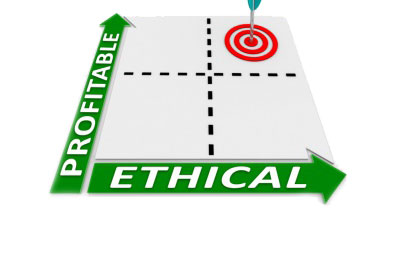
Last week, Facebook’s share price had the largest one day drop in Wall St history, at almost 19%. They were punished not only because members of the public care about abuses of their privacy, but also because investors are choosing not to invest in companies that behave unethically.
Other companies like Volkswagon and BP have been punished by investors for breaching the public’s trust, and companies known as good having good ethics, have benefited. The pay-off for good companies is supported by growing evidence of higher returns to investment funds that tilt towards good social, environmental and governance practice (ESG).
There is now a strong body of research that compares responsible investing to conventional investing. In perhaps the most comprehensive review of the literature ever undertaken, Deutsche Bank (2012) looked at more than 100 academic studies of sustainable investing around the world, 56 published research studies, 2 literature reviews and 4 meta-analyses. The research found that responsible investment was shown to have a positive impact in 77% of studies, 22% showed no impact, while only 1% had a negative impact.
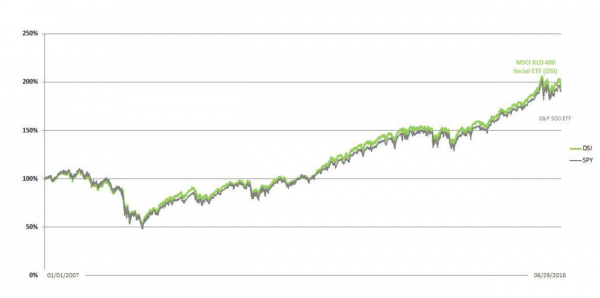
The responsible investment index with the longest timeframe is the MSCI KLD 400 Social Exchange Traded Fund (ETF). It shows consistently higher returns than the comparator index, the S&P 500.
Research suggests higher returns are driven by a number of factors. The most obvious one is that corporates that cause damage get fined by regulators. However, even in the case of large fines levied on BP, there are far higher costs caused by the other factors.
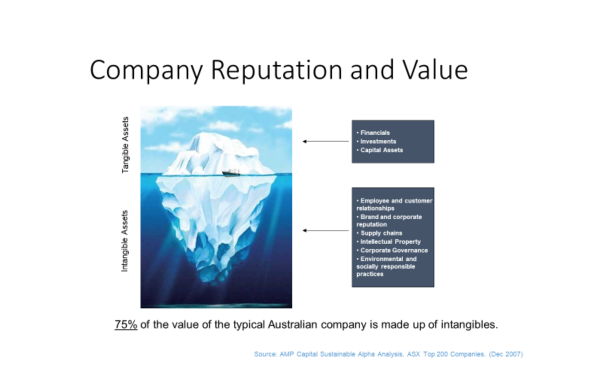
Typically, intangible assets of companies account for around three quarters of overall shareholder value. Companies invest heavily in building and managing their brand and corporate reputation. When they behave unethically, the value of their brand and corporate reputation suffers. This is a far more significant effect than the direct actions of consumers who leave Facebook or choose not to buy BP’s petrol.
But the third factor is even stronger. Investors don’t want to buy the shares of companies that behave badly. Share price movements are more significant than would be suggested by the change in company profitability.
For many years there have been progressive increases in the number of people who want companies to behave ethically, and are prepared to take action if they don’t. This is expressed through choosing whether or not to buy branded products, often amplified by boycotts or public campaigns. Now this action is extending to the way people invest their money. The niche world of ethical investment is becoming a force to be reckoned with.
The number of investors who are prepared to act on their values is on the rise. This has its counterpart in the increased number of investment fund managers that take environment, social and governance issues into account in their investment – over US$70 trillion in assets under management are now members of the Principles of Responsible Investment.
The responsible investment movement in New Zealand lags good practice internationally. Most Kiwisaver funds, for example, still invest in sectors like gambling, pornography and fossil fuel production, and show little evidence of managing portfolios according to ESG practices.
Mindful Money wants to change this. There is growing evidence that good ESG practices benefit our climate stability, the environment and people; it allows investors to feel good about how their money is invested; and it means they earn good financial returns. Win win win.
Barry Coates is Founder and CEO of Mindful Money
Feedback welcome to: info@mindfulmoney.nz


BP stocks look like they are fine. Did they get ethical over the last year as they started new projects in Russia, Egypt and Azerbaijan , or maybe investors don’t actually give a toss.
Its more a case of people moving investment from say Facebook to Amazon, then back again according to whatever headline is in the news that day.
And the majority of investors are chasing ‘Growth Potential’..hence Amazon, which seems to be heading for world wide domination of pretty much all consumables, looks ‘better’ than FB which has already accessed its most profitable markets.
Quoting Why We Can’t Afford the Rich:
An interesting point made in that book was that 2/3rds of income from shares came from share trading and not from the rentier income of owning shares. And the point that the author made about that was that the company didn’t actually see any of the price increase at all which means that the people buying the shares after the initial stock offering weren’t actually investing in the companies. They were simply after the rentier income.
The majority of people will still lose out because of the bludgers rentier ways.