
Evolving a Multi-Party Democracy
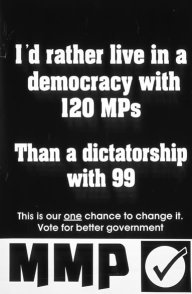
Mainstream journalists continue to struggle with multiparty governance. And the amplified rhetoric resulting from their struggle creates doubts amongst the captive consumers of mainstream media.
While we wait for the votes to be counted in our 2017 election, now is a good time to review the evolution of party-based government in New Zealand, and to consider the impediments to progress towards mature multiparty democracy.
Formal party politics began in New Zealand in the 1890 election, using a voting system that worked all right when geography prevailed over philosophy, and only two candidates contested electorates. This plurality system – incorrectly called ‘First Past the Post’ (in many contests with more than two candidates, nobody passes the 50% post) – creates amplified binary politics, with two political groupings (broadly ‘labour’ and ‘capital’) shutting out independent voices. (‘Amplified’ in the ‘winner takes most’ sense, meaning that, in win-lose politics, the winner’s percentage of seats in parliament is almost always higher than its percentage of the vote.)
This evolving two-party political order reached its logical endpoint in New Zealand after 1935, with the increasingly bourgeois Liberals (relabelled United from 1928 to 1935) coalescing with National’s principal precursor party, Reform. ‘Independent’ MPs more explicitly took sides. Petit-bourgeois rural and small-town oppositions formed an uneasy coalition with Labour.
From the 1940s the forces for genuine multi-party politics startled to rumble, culminating in the formal registration of the Social Credit Political League as a political party. During the 1940s, Social Credit voters drifted from Labour to National. Social Credit, which did not easily fit into the spectrum of mainstream political analysis, then became the independent ‘spoiler’ of New Zealand politics. In 1954, in its first election, the League gained 11% of all votes, mainly at National’s expense. Today we can identify the Social Credit constituency (though not necessarily the policies) with Winston Peters’ party New Zealand First.
The next genuinely independent political force arose in 1972, as the Values Party, the forerunner of the Green Party. Indeed, Values got 5.2% of the vote in 1975. By the 1980s the New Zealand public was largely ready for multiparty democracy. Values sympathisers became frustrated by the perceived greater need to unseat the Muldoon National government by voting Labour. And vice versa in the Lange-Douglas era.
The political class, however, was not sympathetic to multiparty politics. The ‘meat and drink’ of the political class is the binary politics of the labour-capital spectrum. (Note that we should not necessarily equate ‘politicians’ with the ‘political class’. A significant minority of Labour and National MPs identified with the diverse concerns of their regional publics, and not with polarised politics. Mainstream media, however, was the bedrock of the political class.)
In 1991 it was Jim Bolger – a Prime Minister less a part of the political class than most politicians – who gave us the opportunity to switch to an electoral system that embraced multi-party democracy. And it was on that basis that New Zealand voters took the opportunity to shift from binary to multiparty politics, to the chagrin of the political class. Labour remains deeply ambivalent on MMP. Despite having been shut out of political power for the most part, it had been uncontested as the principal party of opposition. In a two-party political order, Labour could never come worse than second.
The public who voted for MMP in 1992 and 1993 understood this as necessary step towards multiparty democracy, and looked to a parliament where all (or at least most) parties in parliament contributed to New Zealand’s governance. Minority multiparty government started in 1995 with the formation of ‘Right of Centre’ (ROC) and United as governing partners to National. The Alliance and New Zealand First were already in parliament. (After the 1996 election, Peter Dunne was the sole survivor of these new parties.) Multiparty governance in New Zealand began before the first MMP election in 1996.
After the 1996 election the political class railed continuously about Winston Peters, his alleged surfeit of power, and much nonsense about ‘tails wagging dogs’. Prime Minister Bolger (born 1935) was adaptable, comfortable with the outcome, despite personally preferring the binary system that he had lived his life with. Many of his National caucus were not so comfortable. In spite of electoral arithmetic, they sought to purge their government of its coalition partner. They started by replacing Jim Bolger with Jenny Shipley.
In 1998, Labour and the Alliance could have formed the government with New Zealand First that they had unsuccessfully sought in 1996. Instead Labour and the Alliance looked to an early general election. National ran a minority government full term, with the support of New Zealand First and Alliance fragments (eg Mauri Pacific). To those on the right of the political class, MMP was a shambles. The public however saw instances of issues being resolved with multiparty input. This was “MMP is action”. New Zealand was far from an anarchy. And Labour in 1999 had its own good reasons to not push back against the evolving multiparty system.
In 1997, the Green Party decided to leave the Alliance in 1999. After 1999, Labour was able to form a formal minority coalition with the Alliance. Formal coalitions represented the way that the political class responded to multi-party democracy. Coalitions – marriages if you will – reduced multiple parties to two, in effect. Formal coalitions were an attempt to continue with binary politics in the face of an electoral system that delivers multi-party outcomes. (This represented the opposite of the 1950s and 1960s, when Social Credit pushed for multi-party politics in the face of a system that delivered single-party binary governments.) The Green Party supported the Labour-Alliance government on matters of confidence. New Zealand First, still in Parliament on account of Winston Peters’ narrow win in a three-cornered contest in Tauranga, gave Labour options if the Greens pressed too hard for policy gains.
Under multiparty democracy, the political class wants to reduce through marriages (polygamous if necessary), the plurality of parties to two opposing blocs. New Zealand First has always been resistant to this political pre-election matchmaking. (So, in 2002, was Peter Dunne’s United rump party; now called United Future.) This is why the political class detests Winston Peters so much. In 2002, Labour formally coalesced with Jim Anderton’s fragment of the Alliance. And they arranged a less formal deal with United, which gained a bounty of votes when ‘Corngate’ reduced Labour and Green support. Many people who normally identified as National supporters voted United, looking to weight the inevitable centre-left government towards the centre and away from the left. United looked like a political-class centre party, that would ‘prop-up’ the larger of the main parties, and do little else. Closer examination – mostly after the 2002 election – showed that United had become a Christian party, not unlike Colin Craig’s Conservative Party that amused us a decade later. The Christian parties have to be seen as independent of the ‘political class’, even if they normally would not contemplate supporting a Labour-led government.
2005 saw a very important development of multi-party politics. Winston Peters negotiated a role that has now become normal. A senior politician can become a senior member of a minority government’s ministry without being in Cabinet; without being subject to the requirement of Cabinet unanimity. (My guess is that, in 2017, Peters will negotiate the Deputy Prime Ministership on the same basis that he became Minister of Foreign Affairs in 2005. In return he will commit to not voting against the Government on matters of confidence and supply.) While the political class was uncomfortable with this development, any weaknesses of that third-term government were not a result of that innovation of multiparty constitutional case law. The Green Party meekly supported the Labour minority government, in part because joining a Brash-led minority National government was complete anathema to a party that, since the demise of the Alliance, had assumed that party’s role on the Labour-Capital spectrum. The Green Party, in 2002, had ceased to be an independent contributor to a multiparty system. Part of it had joined the left-wing of the political establishment, reinforcing rather than challenging the binary worldview of the political class.
2008 saw the first of three National-led minority governments. And National showed that it had learned to live with the multiparty system. National and Act were together enough to govern. However Peter Dunne, as a senior politician, was invited to sit at the governing table. So was the Māori Party, an independent multiparty voice. Māori had three reasons to participate in a multiparty National-led government. First it had not long split from Labour, which in the mid-2000s had proved itself to be particularly insensitive on key Māori issues. Second, non-participation would have made Māori an ineffective opposition party, much like the Green Party had become. Third, National had significant leverage over the Māori Party. National (with Act) had a policy to abolish the Māori electorates; that policy sat in John Key’s open bottom drawer.
In 2011, Peter Dunne’s one-man United Future Party gained the same amount of power that Winston Peters’ New Zealand First Party had in 1996 and in 2017, with just 0.6 percent of the vote. This did not upset the political class then however. United Future in 2011 was an inter-party, rather than an independent party of the ilk of Values, Social Credit and New Zealand First. In 2014 we had a repeat of 2008; National had a majority, with Act. In 2015 – after the Northland by-election – United Future (with 0.22 percent of the vote) gained “100 percent power” if we are to adopt some of today’s journalistic rhetoric aimed at Winston Peters. In reality, National had three support partners. Government legislation required the support of two out of three.
2017 represents the first election in New Zealand since 1996 (and, before that, since 1928) where, post-election, there are two viable contenders for the role of Prime Minister. (Australia, albeit with a binary electoral system in the lower house, had such an election in 2010, when the identity of the Prime Minister was not known once the votes were counted. It took three weeks of complex negotiation to confirm Julia Gillard as Prime Minister.)
I would like to see the whole binary concept of an Opposition to evolve into extinction. In the binary system, the appointed Leader of the Opposition feels obliged to move a vote of no confidence. It’s pointless theatre. At present we have a minority National Government. It can ‘govern’ by turning to the support of any one of the three opposition parties; which means that it can only pass legislation negotiated with or supported by at least one of those parties. It would lead National to take the political flak associated with any economic downturn or housing correction, while enabling Labour and Green to develop attractive and innovative policy platforms. By now Labour must realise that more of the muted neoliberal mush that they have been offering this century will not suffice. For example, Labour can offer income tax cuts (aka increased equity benefits) enabling more people to escape from poverty without being mired in bureaucracy. And, Labour can learn that rental-housing security should take priority over home-ownership, as a remedy for the housing crisis. Subsidising a few relatively privileged young people onto the property ladder is not good ‘politics for the many’.
Alternatively, if Jacinda Ardern does become Prime Minister – as leader of a Labour, New Zealand First, Green coalition – she will need to emphasise that she is leading a Coalition government, not a Labour government. As such, she could lead an explicit three-party government, while all three parties make independent plans for 2020.
New Zealand does need a ‘political class’ party to the left of Labour. This can be achieved if elements on the left of Labour form a new New Labour Party with the class elements of the Green Party. Such a party should be able to include a Labour electorate MP (Louisa Wall?), and to come to an arrangement with actual Labour to not contest that electorate.
The other ‘independent’ half of the Green Party can negotiate with the likes of Gareth Morgan and Vernon Tava, and build a platform on the basis of becoming an independent Environment Party, while also promoting anti-bureaucratic tax-welfare reform. This would give two independent parties – one environmentalist, one nationalist – who will happily negotiate with both Labour and National to create future governments in which both independent parties are a part of.
Three independent parties, actually. The Māori party lost-out in 2017 because it tried to be an electorate party, when it needed to be an independent list party; like New Zealand First is, and like an Environment Party could be. They could have been suggesting to Māori voters that they should vote Māori while feeling free to vote for their Labour electorate MP.
How can we get an independent Māori voice in Parliament? The Māori Party – with Mana – can reinvent themselves as a truly independent voice, in the same way that New Zealand First is, and an Environment Party could be. It would be best that they can gain one electorate MP, probably in a Māori seat. The obvious person now would appear to be Dr Lance O’Sullivan, standing in Te Tai Tokerau. Indeed Labour should support such an initiative, realising that it can benefit from an independent Māori Party contributing to Labour-led governments. Thus Kelvin Davis should switch in 2020 to becoming Labour’s most senior list MP.
To summarise, New Zealand is well placed to develop a mature genuine multi-party democracy. Labour and National could continue to be pragmatic binary parties, with each having a conscience party to its extreme. In addition, there could be three independent parties, each of which could pay a constructive role ‘at the table’ of either a red-hued or a blue-hued government. The impediment would be that the mainstream political media, epitomising the binary politics of the political class, would have to relearn their craft.


A nice idea, but I don’t see why the parties are just going to do that. I would propose the following structural changes to being about a similar outcome:
The largest party (or alliance of parties, declared before the election) should always, and exclusively be able to, populate the cabinet and therefore run the government and have the power to spend. This would mean almost all governments would be minority governments. Meanwhile in the parliament supply bills (raising money through taxes, etc) and other laws are passed by a case-by-case majority which doesn’t necessarily have to be the same set of parties.
The upshot is that there is never post election negotiations, the largest party or party alliance always sets the Prime Minister and Cabinet; each new law, law change, or tax bill is decided on a case-by-case basis by the parties in parliament; and there would be no budget spending votes in parliament, Cabinet would approve the budget instead.
This would provide some separation between the legislative and executive functions of government, which I think is needed although it would be easy to go too far.
I imagine National and Act would formalise their alliance, while Labour and the Greens would likely form an alliance too. NZ First and possibly the Maori Party and TOP would never be able to get Cabinet positions and would instead focus their efforts on proposing law changes instead, which is what I think minor parties should be about anyway.
Good to reflect on the history of how we got here and that indeed, love them or hate them, NZF are a true independent party.
Total agreement about dispatching the binary structure – “government” and “opposition”. That will need some structural change in the way parliament is run and in its physical layout.
The current house is laid out in adversarial hierarchical mode with the “government” and “opposition” on opposite sides with front bench and back bench and these parties sit closer to the Speaker. How it’s going to work is all set up in the architecture.
Time for a house that is set in a semi-circle and where the placement of members in the house is drawn by ballot – that’s a big leveller immediately and would promote a far more collegial atmosphere over the current fortress mentality.
Probably not much favoured by the “political class” for whom it’s all a power game. But for us who pay the bills and suffer the outcomes maybe not such a bad thing.
NZ is an oligarchy (control of the many by the few), which is ultimately controlled by banks and other corporations. And the so-called democracy can justifiably be described as -to quote- ‘the best democracy money can buy’.
That dismal state of affairs will remain so until the corrupt, Ponzi, financial system collapses…..as will happen some time in the next decade (perhaps fairly soon), since the financial system it is totally dependent on looting and polluting the environment and exploiting people.
Since we are now on the cusp of the biggest discontinuities in human history, historical perspective, though interesting, are irrelevant.
Needless to say, those in the political area are determined to ensure that none of the critical factors that will actually determine the future of this country are ever discussed, since their various Ponzi schemes and rorts are dependent on the populace being totally unaware of what is actually happening and where we are heading.
‘It is difficult for a man to understand something when his salary is dependent on not understanding it.’
Interesting times, indeed.
In first past the post, the voter must make a compromising decision. Choose the better of two evils.
In a proportional system, the politicians must make the compromise. This is not exactly better, but has the advantage of allowing more voices to be heard and a more diverse class of politicians to enter parliament. It also produces growing frustration, when those voices are neither heard nor listened to.
Philosophizing about proliferating political atomisation may give opportunity to ambitious activists, but ultimately compromise is made and a unitary government is formed.
Analytic political representation is not more nimble in enabling change than agglomerative structures. The binary US parties have changed in recent years with eyewatering speed through internal contest. Indeed, creating purified parties is likely to encourage voters to retreat irremediably into gated communities.