
Dear Kiwis – your debt and under regulated capitalism is what’s killing you, not co-governance, not bilingual signs, not alienating Trans activists
Nation of Debt: Kiwis pay by credit, debt rises amid cost of living crisis
Kiwis are spending more on their credit cards to keep up with the rising cost of living, prompting a warning from a financial expert who says it won’t be sustainable in the long term.
The outstanding balance on personal credit card debt has risen from $5.495 billion in May 2022 to $5.63b in May this year, Reserve Bank (RBNZ) figures show.
Credit card spending fell during the pandemic as people paid down their debt as they couldn’t spend money as easily during lockdown periods.
But since September outstanding balances have risen each month for the same comparable month the year before.
Personal finance lead at Sorted, Tom Hartmann, said Kiwis appear to be using credit debt to handle cost of living pressures, based on data from credit bureau Centrix.
We are trapped in a banal debate about drunk driving Ministers, counter productive get tough on crime cheerleading bilingual road signs, co-governance and alienating Trans rights rhetoric!
People struggling to make ends meet are not sitting around the kitchen table cancelling people for misusing pronouns.
The debt that many first time home owners are being strangled by as over heated house prices are now met with ever increasing interest rates, people are using their credit cards just to pay the bills and the cost of living feels like you are being mugged every time you go to the supermarket.
The woke middle class activists have been tricked into providing the right with culture war ammunition that is now being shot back at us.
People struggling to make ends meet are screaming for solutions and are voting against their economic interests for the Right when the political project of the Right is to underfund public services, complain about those underfunded services and then promote privatisation as the solution to those underfunded services!
The real power struggle in NZ isn’t Left vs Right, it’s between the Professional Managerial Class Consultants vs a self serving Public Service!
The Professional Managerial Class Consultants push to ensure corporate interests like their profit margins and dominant market share are always protected and woven into any watered down regulation while the self serving Public Service fight for more money to fund their latest glass palace.
We face an existential crisis in the form of the climate and the demand to radically morph into adaptation mode is far greater than any political party is currently envisaging.
Your anger, cynicism and fury at the political failures is legitimate but let’s be clear, a National/ACT Government is no solution to the problems we face, they will only exacerbate them.
Dear Kiwis – your debt and under regulated capitalism is what’s killing you, not co-governance, not bilingual signs, not alienating Trans activists!
Increasingly having independent opinion in a mainstream media environment which mostly echo one another has become more important than ever, so if you value having an independent voice – please donate here.
If you can’t contribute but want to help, please always feel free to share our blogs on social media


The wealthy and ambitious could be called ‘barons’. Wars seem much more romantic at a distance, but hell to be in. We are in a similar war to one in 13th century, with barons now.
Everything seems to be circular not straightforward!
As observers in the 21st century can we form some wise and practical ideas from looking at human history of the past. We are still humans. under limiting pressure from too many ideas and scenarios, complacency of the value of simple education, and beset by suffocation from our wealth system, death by a thousand cuts from rampant climate changes, the relentless march of the robots and IEDs of all sorts including, importantly, Innovate Educational Disasters into our lives and existence, and their fellow human travellers.
Here is a brief history of the English/French? barons against King John. …King John in June 1215 was forced to put his seal to “The Articles of the Barons” by a group of powerful barons who could no longer stand John’s failed leadership and despotic rule…the original Magna Carta. “The law of the land” is one of the great watchwords of Magna Carta by standing in opposition to the king’s mere will.
The Magna Carta of 1215 contained clauses that theoretically noticeably reduced the power of the king, such as Clause 61, the “security clause”, which allowed a group of 25 barons to override the king at any time by way of force, a medieval legal process called distraint that was normal in feudal relationships but had never been applied to a king. After a few months of half-hearted attempts to negotiate in the summer of 1215, open warfare broke out between the rebel barons and the king and his supporters. (But one problem of disagreement leads to a widening of dissent.),,,The war began over Magna Carta but quickly turned into a dynastic war for the throne of England. The rebel barons, faced with a powerful king, turned to Louis, the son and heir apparent of King Philip II of France and the grandson-in-law of King Henry II of England…
(The barons later moved again)in favour of John’s nine-year-old son, Henry III, and the war dragged on. Louis’ army was finally beaten at the Battle of Lincoln on 20 May 1217. Also, after a fleet assembled by his [Louis of France] wife, Blanche of Castile, attempted to bring him French reinforcements but was defeated off the coast of Sandwich on 24 August 1217, he was forced to make peace on English terms. He signed the Treaty of Lambeth and surrendered the few remaining castles that he held.
The treaty had the effect of Louis agreeing he had never been the legitimate king of England. That formalised the end of the civil war and the departure of the French from England.
https://en.wikipedia.org/wiki/First_Barons%27_War
And “dear kiwis” are f’ing stupid when it comes to things like CGT. Some idiot with a vested interest says something like “it’s not the Kiwi way” and thats somehow a positive reason not to implement. We should be learning by now “the kiwi way” is the wrong way.
True… but there’s also a failure of imagination.
A political party could, for example, suggest that if elected they would take Peter Thiel’s wallet out of his pocket and rifle through it, giving the contents to people born here. That would be popular with 99% of New Zealanders. The only person whose interest it would be against is only a paper citizen here.
As ever, the money power attempts to distract the common people with anything but a solution to the problem of usury.
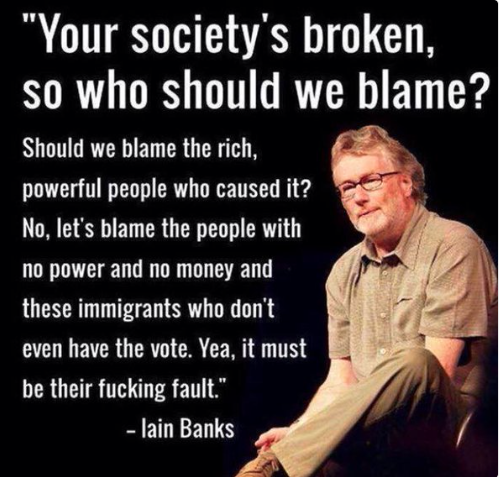
“your debt and under regulated capitalism ” aka what I would call corrupted politics is indeed the problem. ‘co-governance, bilingual signs, Trans activists’ and so on are big-money, created concoctions designed to divide and distract the people from the rotten influence that big, big money has on politics. This is an age old problem that unfortunately for us, is growing in scale. Don’t let big money interest concoctions, side track you from what is really going on — the capture of Govt by big, big money. Ian Banks in the picture above denotes the point perfectly.
Dead right. A tiny group of people own nearly everything, and control all the politicians through campaign contributions.
More people need to start going on strike, because real wages are still in reverse, as the five-decade collapse in living standards continues. Savings rates, which never really recovered since the 1970s, are down again too.