
Darkness At The End Of The Rainbow?
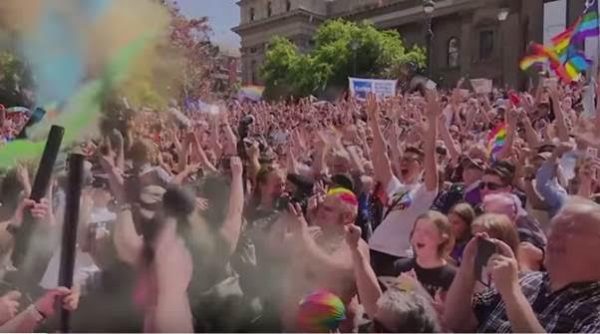
WEDNESDAY, 15 NOVEMBER 2017 will go down in Australian history as Marriage Equality Day. In an unprecedented national plebiscite, 61.6 percent of the 79.5 percent of voting-age Australians who returned their postal ballots voted YES to marriage equality. With this resounding vote in favour, Australia joined the rest of the world’s progressive nations in rejecting homophobia and discrimination.
But, Wednesday, 15 November 2017 will be remembered for something more than Australia’s endorsement of marriage equality. It will also be recorded by social historians and psephologists as the day conservative Australians were required to accept a forceful and irrefutable message confirming their minority status in Australian society.
Hostility towards homosexuality is one of the most reliable markers of the authoritarian personality. It will, therefore, come as a profound shock to people of this personality type that their attitudes are not shared by an overwhelming majority of the population. That nearly two-thirds of their fellow citizens see nothing untoward about same sex couples getting married will deliver a shattering blow to their perception of “normality”. They will be dismayed by how far the world has strayed from their “traditional values”.
For some, the events of 15 November 2017 will prompt a thorough-going reassessment of their moral and political expectations of themselves and their fellow Australians. If they are lucky, this reassessment will liberate them from the debilitating effects of conservative ideology, fundamentalist religious beliefs and authoritarian attitudes. For many others, perhaps a majority, however, the discovery that their hatreds and prejudices towards the LGBTI community is shared by just 38.4 percent of their fellow Australians will evoke a very different – and potentially dangerous – response.
For these conservatives, the plebiscite outcome will be interpreted as irrefutable proof of how sick and sinful their society has become. Religious conservatives, in particular, will have no difficulty accepting their minority status. After all, doesn’t Jesus, in Matthew’s Gospel, enjoin them to enter in by the strait gate? “[F]or wide is the gate, and broad is the way, that leadeth to destruction, and many there be which go in thereat”? And doesn’t he also say that “strait is the gate, and narrow is the way, which leadeth unto life, and few there be that find it.”
No, the Christian fundamentalists will not be in the least bit surprised to discover that 61.6 percent of their neighbours are going to Hell.
Political conservatives and authoritarian personalities will have a much harder time of it, however. For their brand of politics, 15 November 2017 can only have been a profoundly delegitimating experience. Electorally, it could very easily signal their imminent marginalisation. “Mainstream” politicians will now have to adjust to the fact that social liberalism, which they understood to be confined to the effete inhabitants of the inner-cities, is actually embraced by a much more extensive cross-section of the Australian population. For many, on both sides of the parliamentary aisle, it will rapidly become advisable to evince a more progressive and tolerant political persona.
For the diehards, however, it is not yet the time to lay down their arms and surrender to the bacchanalian throngs gyrating joyously in the streets of Sydney and Melbourne. They still have eleven cards left to play.
The more sharp-eyed and ruthless members of the Liberal and National party rooms will have noticed that of the 17 federal electorates which voted “No” to marriage equality, fully 11 of them are held by the Australian Labor Party. In the strategically vital “Western Suburbs” of Sydney, the seats of Greenway, Chifley, McMahon, Fowler, Warriwa, Blaxland, Watson. Barton and Parramatta – all of them held by Labor MPs – voted “No”. Some, like Greenway, only very narrowly. (53.6 percent) Others, like Blaxland, by a huge margin. (73.9 percent!) In socially-liberal (some would say, radical) Melbourne, the only electorates which rejected marriage equality were the Labor-held seats of Calwell and Bruce.
There is simply no way the Labor Party can defeat the Liberal-National Coalition if even a handful of these eleven safe seats slip from the Opposition’s grasp. And while, in normal times, any suggestion that a seat like Chifley might be lost to the Liberals would be greeted with full-strength Aussie derision, it remains an awkward fact that we are not living in normal times.
Prior to 8 November 2016, the very idea that the states of Michigan, Wisconsin and Pennsylvania might be about to fall to Trump would have been met with loud American guffaws. But not after 8 November. Lashed and goaded in just the right way, the normally left-voting inhabitants of places like Michigan – or Chifley – can end up doing the strangest things.
For progressive Australians, 15 November 2017 will forever be bathed in all the vibrant colours of the rainbow. But, for the conservative ideologues, the religious fanatics and the authoritarian personalities trapped in their suffocating character armour, 15 November 2017 will be registered as nothing more than a temporary setback. The bigots might concede that, on this memorable day, they have lost a battle. But, for them, the war against a society grounded in gentleness, tolerance and love will go on.





This topic cannot be solved by the old device of drawing a line and calling one side victims and the other side oppressors. Some economic conservatives are socially liberal (ACT) and some economic liberals are socially conservative (NZF). Some social liberals don’t like gay marriage, whereas some social conservatives do. Whether some people feel uneasy or not, fundamentalist Christians are not pushing LGBIT people off buildings. Some Anglicans did not vote yes, but that’s democracy. This article wasn’t one of CT’s best.
This legislation doesn’t just change the nature of homosexuality, it changes the nature of marriage. Perhaps it changes marriage rather than changing homosexuality.
That isn’t a value judgement , as much as an observation that I don’t see can be disputed. It doesn’t matter to me personally , but I can imagine some deeply religious people of any faith being unsettled by the change.
Perhaps it is for the better of society , I don’t know.
D J S
I know people who are all for legalising same sex relationships, but are strongly against calling the unions “marriage”.
I wonder how many voted NO on those grounds.
Good point. Many people considered conservatives are actually fine with what people get up to in the privacy of their own homes, but take a religious view of marriage as a sacrament. As said in another comment here, the lines are not easy to draw. People can be ‘progressive’ in one area, but not in others.
all this talk about Muslims, I thought I’d look up the politicians most opposed to same sex marriage, like Ian Goodenough (Liberal) who thinks procreation is too complicated when gay parents use surrogates or what-not, and that children need ‘protecting’ from that sort of carry-on…
or Andrew Hastie, “a churchgoing, squeaky-clean ex-soldier who spoke about protecting Australian values and Western liberal democratic traditions.”…
so, again, a man with issues….
and I guess these same issues are just a reflection of certain individuals in society. So while I have no doubt that traditionally conservative immigrant groups are a factor, the ‘No’ vote probably reflects good old fashioned Australian intolerance.
The same sense of goodwill and love of their fellow man that allows Australians to think Manus Island is a good thing.
https://thewest.com.au/opinion/complexities-of-gay-marriage-are-too-risky-ng-ya-117261?r=1
http://www.theaustralian.com.au/life/weekend-australian-magazine/sas-commander-liberal-party-rising-star-how-far-can-andrew-hastie-go/news-story/327a82373c4e90755402c1388506a502
Dawla Islam:
https://www.youtube.com/watch?v=DiWHuASg-KU
Having recently lived in Sydney for some years, I am aware that the Western suburbs have large numbers of muslim residents. Their opposition to same sex marriage is well known and, I suggest, their vote is the reason for the “no” in those electorates.
I wish Chris Trotter like TDB would be as open to criticism, expressed by some, to his earlier post, but nevertheless, respect for this post.
This isn’t the standard, Kiwi blog.Blog posts aren’t for authors to get into arguments. They’re for followers to argue over.
Never was before.
“Hostility towards homosexuality is one of the most reliable markers of the authoritarian personality.”
Is hostility towards homosexuality a reliable marker of other human characteristics? In those districts highlighted are there commonalities amongst the populace? Religious affiliation for example? Ethnic background for example?