
Bitcoin – A Glimpse At Our (Grim) Economic Future
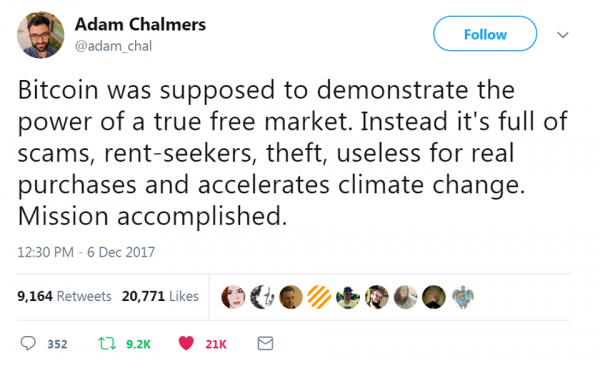
There’s been quite a lot of mainstream media attention on the Bitcoin phenomenon recently. And while any amount of prognostication about whether its runaway increases in value represent a bubble can be found pretty much wherever one cares to look, there’s one aspect of the present Bitcoin boom that I think’s been somewhat under-discussed.
Namely, the way in which what we’re seeing right now is arguably a ‘glimpse into the future’.
And I don’t mean that in the simple sense of currency being decoupled from states [not least because recent developments in both Venezuela and Russia appear to suggest that you can perfectly viably run cryptocurrencies *as* a state .. and potentially have them actually ‘worth’ something, so to speak], nor the Cyberpunkishness of Darknet-denizens paying for elaborately staged murders or exceedingly cheap-for-quality hard-drug procurations.
Instead, if we take a look at how Bitcoin is actually produced – ‘mined’ – these days, it basically features a relatively small number of people and operations using pretty excessively large ‘mining rigs’ of linked computers with super-massive processing power and power-requirements, solving largely pointless [except insofar as they generate more precious bitcoin] mathematical equations, with virtually nil human input required beyond the setting up of the rigs and the paying of the powerbill.
Or, in other words, this is *exactly* how a pretty broad swathe of economic activity is going to go down over the next few decades. Human “operators” – capitalists, entrepreneurs, bourgeoiCPU, whatever … presiding over effectively automated workforces … who do ever more ‘stuff’ to generate a nominal economic return, that’s probably functionally pointless except insofar as it leads to some electrons indicating nominal value flowing around an increasingly digitized economy.
While, at the same time, draining ever further quotients of *real* resources out here in the non-cyber world [in this case, power-inputs – but no doubt all manner of other things, too, with time], to turn into largely imaginary [except for its somewhat subjectively agreed upon worth by an investor clade] ‘output’.
And meanwhile, you’ll have this ever-expanding class of regular ol’ Humans who’re basically ‘locked out’ of the whole thing, because they have neither the investment capital necessary to set up an operation of their own inside an increasingly hard-to-get-into market [I mean seriously – the level of coin, bit or otherwise, required to buy the hardware necessary to run a commercially viable mining rig is *ridiculous*, let alone the power-bills] , nor the technological skills to viably participate in this cyber-economy in other ways that’ll effectively allow them to make ends meet without assistance.
Personally, I think this whole setup is pretty fundamentally wasteful. Of a whole lot of things. Of the aforementioned physical resources, for a start [because seriously – you’re not producing anything tangible via bitcoin-mining except an ongoing arguable “bubble”]; but also of a huge swathe of yet-living human potential. Who are now, after all, just straight-up “surplus to requirements” in so many senses of the term.
But at the same time, it’s interesting to consider the way in which Bitcoin and its generation shows that straight-up a lot of the way in which wealth is derived in our economic system [whether present or [near-]future] doesn’t actually involve any real effort on the part of the presumptive main beneficiaries of same, other than the initial set-up of capital goods and *maybe* some wrangling of finance here and there.
It’s then ‘distributed’ out by the owners & employers of capital to various beneficiaries from same – whether investors, perhaps, or whatever workforce they’ve got under them in their operation, or whomever’s selling the next round of hardware, software, and other resource-inputs [like POWER! UNLIMITED POWER!] which might be needed to keep the whole thing operational in the short-to-medium-to-long term.
OF course, to bring this back to those aforementioned ‘surplus’ humans who aren’t capable of supporting this whole venture … that’s where things start to get a bit messy. Because these people have no share of the wealth that’s thusly generated, whilst it’s quite plausible that the rest of the economy which they might otherwise be employed in, is steadily atrophying and dying.
The impacts of having an ever larger swathe of your population with ever less money to spend is pretty obvious – both in economic terms; but also, dependent upon what welfare/redistributive apparatoi look like in your society, quite probably in human/humanitarian terms as well.
Where am I going with this?
Well, one of the main arguments people often have against a UBI, is that it entails giving people money for nothing. And that isn’t necessarily true imo , on grounds that a lot of people perform a helluvalot of unpaid and unrecognized labour *anyway* [think caregivers and homemakers], with a UBI arguably forming a partial recognition & remuneration for that. But I digress.
This misses the point that increasingly, on into the future, the way that income is derived for *just about everybody* outside of an ever-narrowing field of occupations, is going o be precisely that – income that is handed to them not through any actual hard work or effort on their part [again, barring initial set-up bist and pieces, for the most part] … but instead simply as a result of property rights [i.e. a return on increasingly entirely automated capital].
Phrased in these terms, then, when we talk about a UBI we are not simply suggesting that it’s one serious way by which an economy might avoid straight-up crash as a result of greater automation being a thing.
But rather, we are making the case that in a vaguely similar manner to the investor/’miner’ class, one’s right as a stakeholder in the Nation effectively entitles one to a comparable income-stream as a result of this and this potentially alone. [Whether one wishes to get into the extent to which individuals-as-citizens actually play a role in ‘investing’ in the Nation and supporting its existence through their ongoing civic behavior, or whathaveyou]
Or, to say it another way … if it is necessary for ongoing economic activity for people to be able to spend money, and we have effectively ‘decoupled’ the main source of income for a pretty important [economically] portion of society from actual effort [although ‘risk’ is perhaps another matter], then why do we not look more favourably upon continuing this ‘decoupling’ for the rest of society at large with a view to *ensuring* that people actually *do* have the ability to spend such money as may be necessary to keep the economy as a whole ticking over.
And I would rather suspect that the power-inputs and other such things hat would go into supporting a UBI scheme would be far an away less wasteful all-up than what we’re presently seeing with Bitcoin.


Bitcoin is Cryptocurrency 101. These days there are a lot of much better coins and for some the mining is using the power to keep the currencies up with the checks and balances needed and the rewards are a form of interest available to all.
I’m not going to recommend any coins as better, faster, private, safer or interest bearing but they are all out there and I’m sure you can google them.
I believe big companies (Apple, Microsoft) will probably get their own along with countries.
There’s a limit of 21 million Bitcoin and we’ve mined 16 million already. So once that’s all mined Bitcoin 3.0 or some other coin will emerge and try to take over the hash rate.
Software is eating the world.
Correllary: if you don’t know how to code, you will get eaten.
It’s possibly a glimpse into the future but it’s most definitely a glimpse into the past. We’ve been here before.
Long ago the private banks created their own private currencies. This inevitably led to the collapse of the economy through excess money being created and not all currencies being accepted (hence legal tender) and so those currencies were made illegal and so was counterfeiting.
The problem is that those laws were made nearly 200 years ago and haven’t been updated for the new technologies available today. Essentially, BitCoin and all the other crypto-currencies are skirting an age old law because they’re not printing any notes.
BitCoin and similar crypto-currencies need to be made illegal ASAP. Along with that I’d also make the private banks creating money (another flaw in the law) also illegal.
Bitcoin isn’t a currency.
“Long ago the private banks created their own private currencies”
The unreferenced Positive Money article you linked this to is based on the same ahistorical just-so stories told in the ‘Money is Debt’ animated film:
https://en.wikipedia.org/wiki/Money_as_Debt
A more carefully researched version of the history of money, coinage, banking, and so on can be found in anthropologist David Graeber’s book ‘Debt’. In it, he explains that the value of the first coins were based not on the exchange value of the metals they contained, but the demands by kings that their subjects pay tax in them. This allowed the kings to issue the coins to soldiers, and have their subjects provision them, allowing large standing armies to become economic.
Bank receipts for deposited gold were used as a rough-and-ready currency by gold miners in Aotearoa during gold rushes (and no doubt in other gold fields). But the origin of the private banking monopoly on the issue of new money had nothing to do with people banking gold coins with “goldsmiths” and using their receipts as currency. As Doug Rushkoff explains in his book ‘Life Inc.’, this came about during the dawn of the first corporations, when kings banned local currencies, and demanded their subjects use money issued by a corporate bank they had given a royal charter (and from which they generally profited themselves). According to Graeber, the first British Pound was created by the Bank of England when they monetized a debt of owed to them by the king of the time.
So the key problems facing NZ at this current time are massive household debt due to insane housing costs, huge wealth and income inequality, persistent labour under-utilisation of upwards of 11% causing social decay.
How is Bitcoin to solve these problems? Or any cryptocurrency? Gold?
Or any other speculative commodity?
The answer is they can’t.
What can? Harnessing the power of the state to manage the economy using fiscal policy, to regulate the financial sector and to better redistribute purchasing power and access to real resources.
For that you need a fiat currency that you can have democratic control over how it is spent into the economy or alternatively taxed away.
Bitcoin’s value could plummet over night if just one of its major owners decided to sell. Or alternatively it could increase over night if a tulip-mania is unleashed. A hyper deflation if you like. It is impractical as a means of exchange or unit of account. It is risky as a store of value. And, most importantly, you can’t pay taxes with it.
The last thing we need is a new gold standard or a global euro.
It baffles me as to why well-meaning anarcho-socialist geeks get trapped into thinking its the answer.
Any basic research into commodity currencies or fixed money supplies shows you why the idea is not a good one. It relies on price and wage deflation to restore output. In fact, the attraction of commodity money or lots of different private money sources seems very Austrian/Hayekian to me…. a strange bedfellow for the Left. More radical libertarian than socialist or social democratic.
At times I worry though that like the dotcom bubble or the sub prime bubble, the crypto bubble may be our next un-doing.
Sensible comment there CS.
Natural “Rule of law is = you cant get something for nothing forever.
We are close to the U.S.dollar losing its status as the world reserve currency .Does the U.S. have a plan B, rather than lose its hegemony? There is perhaps evidence for bitcoin being an NSA engineered psyop to roll out a one -world digital currency. Consider the following!
https://www.naturalnews.com/2017-12-10-evidence-points-to-bitcoin-being-an-nsa-psyop-roll-out-one-world-digital-currency.html
Technically, the US$ stopped being the Reserve Currency when it stopped being backed by gold as required by the Bretton Woods Agreement which made it the Reserve Currency. The governments of the world have just gone along with the delusion that the agreement is still in place.
Of course, now they call it the petro-dollar and there’s evidence around that Saddam Hussein was going to charge for Iraqi oil in Euros and thus break the US$ monopoly for oil with the result of the Second Gulf War.
Crytocurrencies are set up exactly like Ponzi schemes. The low hanging fruit is “mined” by the founders and early adopters and then the folks further down are forced to invest ever more resources for an ever decreasing rate of return while the price rises for those that already have the currency. Fun fact, just 1,000 people hold 40% of all Bitcoins – that’s somehow an even worse statistic than we have for our fiat currencies.
http://www.businessinsider.com/40-percent-of-bitcoins-are-held-by-just-1000-people-2017-12/?r=AU&IR=T
It is also one major government’s regulation away from being either banned outright or taxed out of existence – after all, which Government is seriously just to going to roll over and accept the mainstream use of a currency that directly competes (and dodges tax) with their central bank?
Finally, that Bitcoin is in a bubble is almost impossible to deny at this stage.
http://www.marketoracle.co.uk/Article60967.html
100% Nitruim,
No-body will see any return from their investment after prices for a bitcoin reach that level exceeeding the expected/believed value of that coin.
It is a Ponzi scheme and when the top tier sells out when the highest value is believed to be reached the crash will occur afterwards.
I fear that some will be burned as we saw happen over the Financial Companies meltdown of 2003-2005.
There are no regulartory mechanism there to fall back on afterwards with Bitcion as there wasn’t over the financial meltdown.
The way bitcoin has been embraced by society (not bitcoin itself ) is a perfect demonstration of the forces that underlie neoliberalism. It’s like market forces working, demonstrating the motivations driving them precisely. Mindless, useless, wasteful avarice totally irrelevant to the needs of society.
A good article.
D J S
Talk about criminal waste… i want my time back after reading this information-free diatribe.
Before ranting about a complex subject like crypto currencies, you should know at least a little bit about them.
Crypto currencies are the greatest force for good that we have seen in economics since the publication of the Communist Manifesto. They have liberated thousands of people from the death grip of the Ruling Class, whose primary means of maintaining their hegemony has always been control of the money supply. That’s all up for grabs now. Thank Satoshi Nakamoto, who knew exactly what he was doing in this regard when he invented bitcoin.
I consider that the profound inability of the NZ Left to grapple with even the most basic concepts of economic systems and banking to be a fatal flaw. You mention a UBI – if we ever get a ubi, it will be because some socialist like myself uses the tools of crypto currencies to create one.
Another great weakness of the Left in NZ is the inability to conceive of a vibrant socialism that is not predicated on the State, and especially not issuing from Left wing institutional power. In other words, a socialism created by people themselves, thru their own collective efforts, which causes the State to actually whither and die. If the very thought of such a thing gives you chills, or if you can’t imagine any form of socialism that doesn’t involve the NZ Labour Party and its nearly 100 year old power structures, then I’m speaking to you.
If we are ever to see true communism and freedom from the drudgery of work in our lifetimes, it can only come through our ability to wrest the control of the money supply from Capitalist governments and banks. Curwen my friend, you definitely need to go back to school on this subject.
Nobody
Before a crypto currency can replace bank issued/debt money it has to shake off this speculative chaos. At the moment they are all impossible to use as a means of exchange because their price in terms of other world currencies , and hence in terms of any useful commodity is so hopelessly unstable. The finite quantity is a major part of what creates and will maintain this price instability.
For a crypto currency to become the major world medium of exchange it must be stable cf. commodities and other currencies. To this end a successful one would need to be tied to a constantly changing average of all or at least most major national currencies, which this technology lends itself to beautifully, and be automatically issued to meet demand, and extinguished automatically when demand falls off so as to adjust supply to maintain constant value. Not limit volume to boost value.
While it remains a speculative phenomenon it is useless as a currency and no threat to the hegemony of world banking.
D J S
No they aren’t. They’re the greatest force for economic and societal collapse since the Roman oligarch’s tried to pay off the barbarians.
Of course, we do have the same system as the ancient Romans so it shouldn’t be a surprise that we’re heading to the same end.
No, he didn’t have a freaken clue. Probably failed to read basic history.
An individual cannot survive without society. Rather important point that because society is the state. We individuals that make up a society are the state – it is not separate from us.
This is basic logic.
Yes, we need to get rid of capitalism and the hierarchy but we can’t do without the state.
I doubt anything will happen the way you see it basturd. I expect Lightning Network to create new utility and value and that miners will benefit from it by collecting more on-chain transaction fees.
That said here are some princes weed FAQ for those how missed the train:
Q: Who should I trust?
A: Nobody.
Q: When should I sell?
A: Never.
Q: Is Bitcoin dying because ____?
A: No.
Q: What have I gotten myself into?
A: Nobody knows.
You see normies who grew up in the indoctrinated system of control don’t like it when so thing like Bitcoin comes along with zero controls or governing body. It freaks them out that a bunch of geeks with to much time on there hands can come to get her and inquire and create.
It’s difficult for normies to conceptualise Bitcoin because they need something they understand to reference it. What our distinguished college over here fails to understand about Bitcoin is that there are no fixed points because he misunderstands basic theoretical physics particularly “wave functions that cover the state of the Bitcoin systems of systems, and, planck’s constant which covers energy and decay.
You see normies visualise things in the real world so they can find it easier to understand. So when they hear peer to peer exchange they think of it in a linear straight line so there limited minds can understand, whether apples or oranges are being traded. And they think that’s what happens physically, so if I put some smokes in a boom tube those smokes will go down the type to its destination, never mind if some one receives it.
But we are not trading physical goods per Se. Instead you have to think of the Bitcoin community as a cloud. And then give probabilities about when transactions occurs in a particular area of the cloud. So as way of a for instance, there are coins like “XPG” which is tied to the amount of oil lift in the ground. The more oil in the ground the higher the price. It’s not really a peer to peer exchange but normies need to think about it in terms there minds can understand.
Bitcoin is just a formless photon of energy bouncing around the cloud and there is no telling when or were it will take physical form in order for normies to understand.
That ends Bitcoin 101. This was a basic understanding of Bitcoin. It won’t help you identify entry points into Bitcoin or how to make money from crypto currencies.
It’s just basturd is wrong a lot. Watch out for him his information is as bogus as Andrew or Gosman.
Nobody is going to make money out of a crypto currency that works as a currency. That’s the whole point. Banks make money thru interest on the money they create out of thin air when they make a loan; for a crypto currency to work it must side-step the profit making in it’s own creation so as to replace the bank money created to enslave us all in debt. If there’s any point in it, it has to be profitless in itself or it just joins the bank money already in circulation, enriching those that control it instead of liberating us all from debt slavery.
D J S
Bitcoin isn’t meant to replace fiat. It was sent here to destroy it.
“Yes, we need to get rid of capitalism and the hierarchy but we can’t do without the state.”
Please explain what the state would look like if it involved neither capitalism nor hierarchy. Hierarchy is one of the state’s core characteristics. Without it, there could be an institution(s) that carry out some of the functions currently regulated and financed by the state (eg search and rescue, firefighting, missing persons investigations etc), but they would not, by definition, be a state.
Bitcoin is permission-less notification of ownership or transfer. So if I wanted to sell a car I would have to get a stamp. But if I title put that title on a Blockchain it can become an actual crypto asset. But imagine if a bank wanted to prove it had reserves with out expending the man power to audit and check everything. You could just go to the Blockchain with out regularly auditing banks. Especially if your a small to medium sized business with out the ability to track large volumes of data. And it may or my not be necessary for lawyers to spam judges with case law.
It’s a parody. Is it a world envisaged by Orwell or a step further down the road?
A nations computing power is a strategic asset that’s lessoned the burden of strength and closed the gap between men and woman in the work force.
Bitcoin is just another form of “speculation” like all the other money making schemes that will force us into another very large depression as we saw during the late 1920’s.
Lesson here = “you cant get bloody money out of a stone”
Bitcoin can be converted into fiat currency but it isn’t a currency.
The easiest way to explain is this. Banks use double entry bookkeeping. So I loan you a dollar and you’ve repayed me X amount goes in two different columns.
Bitcoin is Triple entry bookkeeping. So I give you a dollar and you give me a widget and THEN you get a receipt.
Welcome to the 21st century normie
That’s the cold of street mentality taking hold. One minit your on top and the next you’re a casualty. It’s going to take a hold of you if you let it.
Bitcoin is decentralised so there is no governing body controlling it or its developers and this is what normies are really bumping up against.
The saying is “absence of evidence is not evidence of absence” and in this particular case, the relevant principle here is Occam’s Razor. The simplest explanation that uses the least amount of assumptions is more likely than the one requiring all manner of brain twisting. Additionally, it takes an order of magnitude more energy to refute bullshit than to generate it. And I’m talking about Bitcoin competing against the $300tln global debt that no ones talking about.
Good long-term investing requires three things:
1. an edge of some kind
2. conviction that you’re right
3. patience to wait until you’re proven right
Miss any of those and you will get rekt. People overestimate #1 and underestimate #2 and #3.
There are a million ways of making money and Bitcoin is just one of them and it’s perhaps the steepest learning curve outside of NASA. In terms of data processing, on-chain data sizes remain small then technological advancement may outpace them and thus the real cost of running a node may drop. So switching from micro processors to known quantum processors with 1000X heat and energy efficiency.
Until it’s easier to buy a bigmac with Bitcoin rather than cash it will be for us, not normies.
“Bitcoin is decentralised so there is no governing body controlling it or its developers and this is what normies are really bumping up against.”
BitCoin is *technically* decentralized, but the idea that this means nobody controls it is wishful thinking on the part of digital goldbugs. Most of the mining is controlled by a handful of operators, most of them in China, and most of the development decisions are based on what’s good for the miners, and the handful of capitalists who have swapped the largest chunks of real wealth for BitCoins.
Two years ago there were only 5 people who had “commit access”‘; the ability to change the code of the core BitCoin software that both miners and other users all run. Now there are 4. They are the kings of BitCoin (yes, all men), with absolute control over its development.
As former BitCoin developer Mike Hearn explains in a blog post almost two years ago, BitCoin is different from almost any other open source software project, because nobody wants to BitCoin core to “fork” (different versions taking the software in different directions) because they fear it will spook investors, resulting in a ‘run on the banks’ (in this case more people trying to sell their coins than people wanting to buy them) and the bursting of its bubble.
https://blog.plan99.net/the-resolution-of-the-bitcoin-experiment-dabb30201f7
Bitcoin is much more than a peer to peer payment system Satoshi talked about in the White Paper as a digital cash system. I think once you get past the financial aspects of Bitcoin it becomes a lot more interesting if you apply it to hospitality, the arts, the music industry.
Think of any type of economic activity that requires a trusted third party then the block chain may help you disintermediate and get rid of that third party and remove the potential for corruption or any number of speed ups.
An out of the box approach for the use of this technology is, and one of the most difficult thing every one is trying to figure out uses for this technology. So we’ve got assets and currencies and all these things we’re familiar with. Amd now how can we use this technology abit different and one of the things the U.S is going through right now is the use of police dash cams and the controversy around whether fotage is authentic or if it’s been tampered with. Well if there was a Blochchain backing the video and every single frame was cryptographically provable that it came next in a series, then any one could go back and prove that there was a gap there because the math doesn’t add up. Or that a frame has been edited because the frames don’t match between it or around it. That’s a sort of a quick out of the box example of how to apply this technology.
Musicians and other content creators spend a lot of time on IP, how every one gets payed, who gets payed, or ripping off other people’s music, ect. And these costs to the music industry could be a lot lower if it was backed by a Blockchain.
With regards to tokenisation or micro payments. This is a theory of truly being able to pay for things on demand. So paying for streaming by the second or by the kilobyte is being able to transfer these really tiny amounts of value. There by paying as you go instead of ahead of time. It could also be powerful for unlocking human capital around the world. At the moment we have vast amounts of human capital in third world conditions that probably don’t have any internet connectivity and there’s a ton of smart people just out there waiting to be pulled into the global economy, and once we’re able to distribute cheap Internet access on smart phones to these people we’ll be able to unlock there intellect and human capital and even be able to pay them while Siri acts as a low lvl star fleet com badge. And a lot of these people have never known what $5ph or $7ph is. And if people in 1st world countries are able to leverage this human capital at greatly reduced expenses. Of course there would be a rebalancing and the first world economies would go down for a time. But I can only see that as good for the global economy.
I’m hoping to give you guys an idea about what people are actually working on and where Bitcoin might go in the future.
Firstly, you’ve completely missed my point. Cryptocurrencies distribute processing work, but they concentrate power. They shift the elite power over the way money systems work from governments and banks, to small groups of Silicon Valley software developers (those with “commit access”). If they replaced existing money systems, all of the public interest oversight of the powers governments and banks have to manage money systems – oversight systems that have been built up over centuries – would have to be rebuilt from scratch around those software developers. This is not progress.
Secondly, the micro-payment utopia you describe won’t work, for psychological and economic reasons, not technical ones that can be solved by better software. I drank the micro-payments Kool-Aid for a few years too, it’s an appealing idea. But they were thoroughly debunked in this article by Clay Shirky, and nothing he wrote has been changed by the emergence of blockchain technology:
http://www.shirky.com/writings/fame_vs_fortune.html