
ACT’s straw-man argument attack on Willie Jackson for Regulatory Standards Bill criticism is not the flex they think it is
Regulatory Standards Bill: Does David Seymour’s bill allow companies to sue for compensation?
The legislation sets out “principles” for regulation. These don’t have legal effect – not following them isn’t unlawful – but they are intended to guide what is “good” and “responsible” regulatory practice.
One of these principles is the concept that property shouldn’t be taken or impaired unless there is fair compensation for that.
This has led to concern among some commentators that, once enacted, the legislation could lead companies to require compensation should their property rights be negatively impaired. For example, landowners getting compensation if they aren’t allowed to do something on their private property.’
Public law expert Dr Eddie Clark of Victoria University said this concern has been “overblown”, pointing to a specific section of Seymour’s bill which explicitly says it does not create any new legal obligations in this way.
That provision in the legislation says: “This act does not confer a legal right or impose a legal obligation on any person that is enforceable in a court of law.”
Clark told the Herald: “Some of the concerns that have been raised about it aren’t actually the things that you should probably be most concerned about with this bill.”
Seymour, who’s in charge of this with his Regulations Minister hat on, said thelegislation is about improving transparency. He said it ensures future bills are assessed against the proposed principles, but any findings about their consistency are non-binding.
“It does not give anybody any additional legal rights. The people that are saying that are either not capable of understanding what the law is about or worse, are deliberately making mischief,” he said.
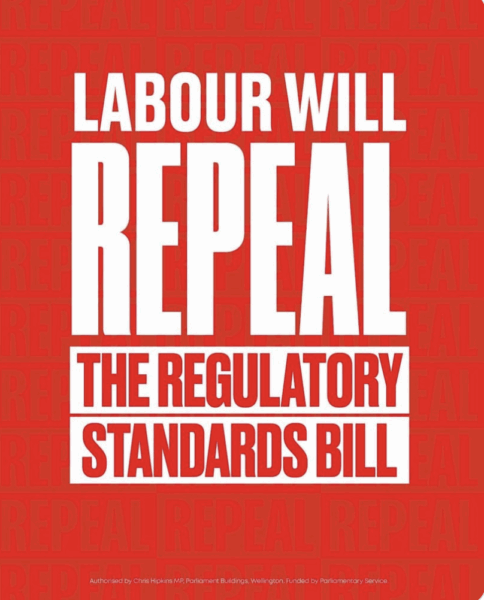
Labour has promised to repeal the legislation within 100 days if it re-elected to power. One of its most vocal opponents is Willie Jackson, who has called Seymour’s bill “dangerous” and “rotten”.
His criticisms focus on the legislation including what he deems “Act” and “libertarian” values that he believes come at the expense of “community values, Māori values [and] New Zealand values”.
Jackson has also said it would “allow corporations to put their property rights ahead of our human rights”.
“It would allow polluters to pollute no matter the environmental costs; it would allow the wealthy to dictate to the community; and it would allow corporate interests into the very heart of our democracy.”
The Herald asked Jackson on Tuesday whether he acknowledged the legislation did not impose any legal obligations enforceable within the courts.
He initially noted his distrust for Seymour and said “we know what their intentions are”, but eventually saying: “No, I don’t acknowledge it, don’t believe it, don’t trust it. I don’t trust them.”
To that, Seymour said that “thankfully” it’s not up to Jackson to interpret the law.
…couple of things.
ACT’s straw-man argument attack on Willie Jackson for Regulatory Standards Bill criticism is not the flex they think it is.

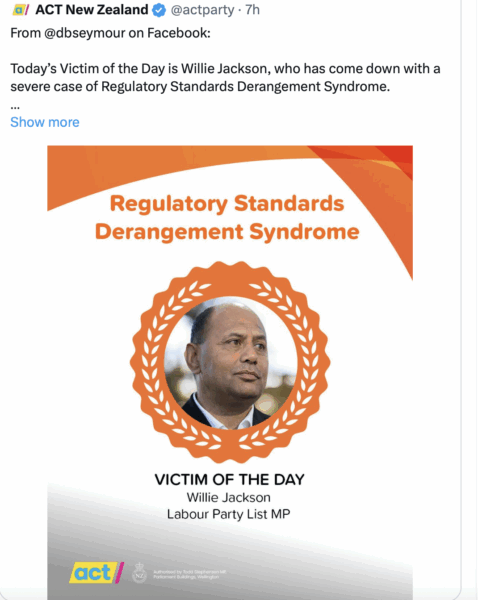
Anne Salmond: Victim of the Day
Over the past week, something remarkable has happened. The Deputy Prime Minister of New Zealand has fronted an online campaign of harassment of scholars who have shared their views about his Regulatory Standards Bill, naming each of them as a ‘Victim of the Day.’
Each scholar has been accused of ‘Regulatory Standards Derangement Syndrome,’ a description borrowed from Donald Trump’s followers, who accuse his critics of ‘Trump Derangement Syndrome.’ The portraits of each scholar are placed on David Seymour’s Facebook page under this banner, and labelled ‘Victim of the Day,’ with online responses invited.
The use of the term ‘Victim of the Day’ is, at best, careless. In the United States at present, political violence is escalating, with senators and their families being physically assaulted, even shot and killed. This has been associated with online incitements against individuals. No one in New Zealand, least of all the Deputy Prime Minister, can be unaware of these developments.
In the United States, too, direct attacks by the Trump administration on universities, university scholars and their students have escalated from attacks on individual academics to attempts to take direct political control of what is taught on university campuses, by whom, and to whom, backed by the deployment of armed force including police and ICE agents.
When universities such as Harvard have resisted these attempts, they have been punished by defunding their research and threats by the Trump administration to their right to admit international students. These and other attacks are happening to universities and other scientific institutions across the United States.
At a time like this, it is extraordinary that a Deputy Prime Minister here should initiate an online campaign of intimidation against university scholars, using Trumpian rhetoric and tactics to harass them for exercising their academic freedom.
In the United States, as in New Zealand, the independence of universities and academic freedom are designed as checks and balances on executive power, with the rule of law and the freedom of the press. All of these freedoms are being assailed in the United States at present.
In New Zealand, the concept of academic freedom is specifically enshrined in legislation. Section 161 of the Education Amendment Act 1990 stated: “161 Academic Freedom 1. It is declared to be the intention of Parliament in enacting the provisions of this Act relating to institutions that academic freedom and the autonomy of institutions are to be preserved and enhanced.”
A similar clause was carried over to the Education and Training Act 2020, s 267: “academic freedom, in relation to an institution, means — (a) the freedom of academic staff and students, within the law, to question and test received wisdom, to put forward new ideas, and to state controversial or unpopular opinions.”
This requires that academics are free to offer commentaries within their fields of expertise without direct intimidation and harassment by politicians.
Without this kind of freedom, new ideas and discoveries are unlikely to emerge. In academic inquiry, they must be rigorously tested against the evidence, including robust exchanges and peer review. For this to work well, the debate has to be reasoned and civil.
Academic freedom is a very old doctrine, designed to protect universities from those who seek to control research and teaching to advance particular political agendas, as in the United States at present. Such ambitions are typical of totalitarian, autocratic regimes, with the USSR and South Africa under apartheid as previous examples.
This can come from any political direction. In New Zealand, for instance, the Education Act 1989 was drafted in response to an attempt by the Fourth Labour Government to take control over ‘what was taught, by whom and to whom’ in New Zealand universities.
That effort was vigorously resisted, and as a result the Education Act was passed and enshrined academic freedom in our legislation, along with a section that requires universities to ‘act as critic and conscience of society.’
That, I think, is exactly what the ‘Victims of the Day’ were doing when they were attacked by the Deputy Prime Minister. From an array of different disciplinary perspectives, they were analysing and discussing the Regulatory Standards Bill as contributions to public debate.
…the hypocrisy of pretending to protect free speech and then launching an enemies list of critics is fucking dark and crypto-fascist.
With this social media enemies list, ACT are inviting their crazed, foaming, reactionary, racist activists to target these critics and take NZ a goose step closer to the hyper sectarian politics of MAGA’s America.
Note that ACT aren’t countering their critics, they are personalising and targeting critics.
Even for ACT, this is a deplorable step towards political violence.
ACT are openly fanning that now with this campaign and they deserve nothing but contempt for these tactics.
That the rest of the Political Mainstream Media are allowing ACT to get away with this, is a recognition of how so much of our Fourth Estate Guard Dogs have all been neutered into property journalism clickbait desperately screaming ‘it’s never been a better time to buy a house’, as if their job depended upon it (because in this media environment – it does).
ACT should be condemned for this kind of dirty politics, especially from a Party who claims to support free speech!
Increasingly having independent opinion in a mainstream media environment which mostly echo one another has become more important than ever, so if you value having an independent voice – please donate here.


Seymour the multinationals glove puppet is soon to find out the hard way just what the vast majority of voters think of Act. I don’t believe National will lose any further votes to Act rather take more back as the steady rise of Labour frightens the Nat support base to consolidate.
The Regulatory Standards Bill has sparked significant debate in New Zealand, with critics raising multiple concerns beyond its potential impacts on the Treaty of Waitangi and environmental laws. Here are some key negative implications that New Zealanders should be aware of:
1. Threat to Parliamentary Sovereignty & Democracy
The bill could shift power from Parliament to the courts by allowing judges to issue “declarations of inconsistency” against laws that violate its regulatory principles (e.g., property rights, economic freedom).
This may lead to judicial overreach, where unelected judges can influence or block legislation passed by elected representatives.
Unlike countries with constitutional bills of rights (e.g., the US or Canada), New Zealand’s system traditionally relies on Parliamentary supremacy, meaning laws are made by MPs, not courts.
2. Risk to Public Health & Safety Regulations
Laws protecting public health (e.g., smoking bans, food safety rules, vaccine mandates) could be challenged if deemed too restrictive on businesses or individuals.
Workplace safety laws (like those enforced by WorkSafe NZ) might face legal hurdles if companies argue they impose excessive compliance costs.
3. Harm to Social Welfare & Housing Policies
Policies aimed at reducing inequality (e.g., rent controls, tenant protections, wealth taxes) could be undermined if they conflict with the bill’s emphasis on property rights and minimal regulation.
Government housing initiatives (like Kāinga Ora developments) might be delayed or struck down if opponents argue they infringe on private property rights.
4. Increased Cost & Delays Due to Litigation
The bill could flood courts with lawsuits as businesses, lobby groups, and individuals challenge regulations they dislike.
Taxpayer money would be spent defending laws in court, diverting funds from essential services.
5. Undermining Indigenous & Human Rights
Beyond the Treaty of Waitangi, the bill could weaken protections for other minority groups, such as Pasifika communities or disabled New Zealanders, if policies supporting them are deemed “too restrictive” on others.
International human rights commitments (e.g., UN declarations on Indigenous rights) may be harder to enforce if they conflict with the bill’s principles.
6. Economic Uncertainty & Investor Risk
While the bill claims to promote economic efficiency, constant legal challenges could create business uncertainty, discouraging investment.
Foreign companies might exploit the bill to challenge NZ regulations (e.g., environmental or labour laws) under investor-state dispute mechanisms in trade agreements.
7. Potential for Corporate Influence Over Law
Large corporations and wealthy individuals could use the bill to lobby against regulations that affect their profits (e.g., financial sector rules, environmental restrictions).
This risks creating a two-tier legal system, where well-funded groups can challenge laws, while average citizens lack the resources to do so.
8. Conflict with Climate Change & Sustainability Goals
The bill’s focus on minimising regulatory burdens could hinder New Zealand’s ability to enforce strong climate policies, such as:
Carbon pricing mechanisms (e.g., the Emissions Trading Scheme)
Fossil fuel phase-outs (e.g., offshore oil drilling bans)
Sustainable farming regulations (e.g., freshwater rules)
Conclusion: A Risk to NZ’s Progressive Policies?
The Regulatory Standards Bill, while framed as a way to improve regulation, could have far-reaching negative consequences—from weakening democracy to harming public health, Māori rights, and environmental protections. If passed, it may lead to years of legal battles, slow down progressive reforms, and prioritise economic freedoms over collective wellbeing.
Would you like an analysis of which political parties support/oppose the bill and why?
Thanks you, Stephen. Concise and helpful.
Our laws developed over years to suit us, not foreign corporations.
Seymour thinks we ought to have laws that suit his donors and friends at atlas.
ACT CAN NOT COUNTER THOSE ACADEMIC POINTS BECAUSE ACT KNOW THOSE PEOPLE ARE CORRECT IN WHAT THEY ARE SAYING .
No the bob the fister and trev the bot will have some pathetic one liner about my spelling or some other weak 1 liner to support ACT .
Like the squeezed middle who are now bleating because they are now the new bottom feeders fist and trev may well find they are unable to mow the lawns because they have an electric mower which cut big oils profits .
Does it occur to David Seymour that denigrating his opponents makes me, personally, respect them more? Surely there must be others who feel this way?
Seymour is telling us the people to rally behind in a unified opposition.
You are right when you say this is REALLY fucking dark, basically creating a hit list. How is the Acting PM of NZ even permitted to post such a list of people for their analysis and criticism of a bill? Shows you how desperate Seymour is to get this bill passed.
At last Labour is actually standing up to something with their promise to repeal it if it passes.
Stevie, you were never going to vote ACT, so Seymour doesn’t care what you think.
That’s right. Narcissists don’t care what anyone else thinks, not even their supporters, who should learn that their support is unappreciated and therefore pointless.
Attention, either good or bad, is what they crave most. Addicted to attention.
I guess it’s a form of derangement and being unhinged.
It doesn’t make them good political candidates unfortunately.
Whatever narcissists say about other people is usually a sign that they, themselves, are like that.
MSM falls into the trap of giving their attention to the narcissist, thus feeding their addiction.
People who aren’t constantly seeking attention are much more intelligent. AND, a great deal easier to live with, as NZ is finding now, to our cost.
True but I know people that voted for him due to their hatred for Jacinda and now see the error of their ways .
‘Stevie, you were never going to vote ACT, so Seymour doesn’t care what you think.’
Yes Ennius, but I can influence other people and Seymour cares what they think.
I mean are you ignoring me?
Nothing outside Seymour’s ego occurs to him. Yes, he gave power to those he attempted to put down, and meanwhile, simply proved he doesn’t understand the meaning of Freedom of Speech.