
A nitrate emergency exacerbated by intensive farming – a community poisoning itself
ECan declares nitrate emergency amid rising water pollution protests
Canterbury Regional Council, known as Environment Canterbury (ECan), has carried a motion to declare a nitrate emergency at its final meeting today.
The vote was nine for, seven against.
Some councillors and government ministers said the council calling the motion in the last meeting before local elections was grandstanding and a political stunt.
Dozens of protesters had gathered outside the building demanding action.
There is a beautiful karma is there not in Corporate Dairy Farmers polluting and poisoning their own rural whanau with nitrates?
The furious response by the corporate dairy Farmers shows you how deep Greenpeace’s campaign has cut…
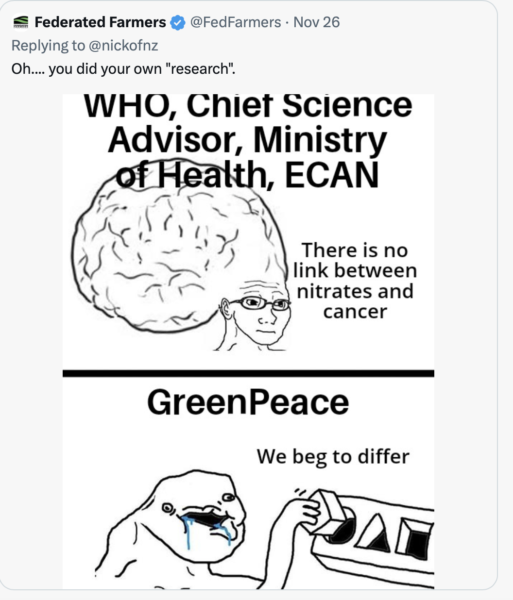
…when your Twitter account reads like it’s being run by Sean Plunket, you aren’t winning!
What’s the Government’s response to this polluting of the water ways their farming communities are dependent upon?
Why more pollution of course…
The Green Party says the Government has handed companies “a free pass to pollute”, with a law change to make it easier to send waste down rivers.
Parliament voted on Thursday to approve the second phase of the Government’s Resource Management Act amendments.
At the 11th hour, just a few days before Parliament was set to debate the bill, Resource Management Minister Chris Bishop introduced an amendment to allow farmers to pollute streams and rivers to the extent that the water colour would change.
By giving councils the ability to approve pollution that would cause the “conspicuous change in the colour or visual clarity” of freshwater, Bishop went beyond his initial proposal to make some pollution a “permitted activity” that won’t require resource consents.
Once again our water gets polluted and shat in to appease the bloody Farmers!
The pollution created by intensive farming is leeching into the water and causing those communities to get sick and the refusal to do anything about that pollution means the consequences follow the next generation…
Greenpeace extends invitation to Gore District Mayor to work together on drinking water crisis
…watching those communities scream at environmentalists as they get sicker because the environmentalists are right would be funny if it weren’t so sad.
In totally unrelated news, Environment Canterbury has approved dairy conversions for over 15,000 additional cows in six months because no matter what the question is in NZ, the answer is always, ‘More cows’.
Increasingly having independent opinion in a mainstream media environment which mostly echo one another has become more important than ever, so if you value having an independent voice – please donate here.





Hear hear Bozo.
Water. We take it for granted in a land of where it rains a lot – well in some places it does. Where there is variable rainfall water means everything, specially if you’re trying to grow something. The water-hungry dairy industry is in full focus – and for good reasons – but you can look anywhere for how water use impacts on the environment and ultimately on communities. Avocado growing in the far north lowering the water table and causing salinization. And now on the Dargaville coast more intensive avocado growing, this time drawing on a man-made reservoir built in partnership that will deliver for some but with long term implications for all local residents. Water, the forgotten resource. Californians know all too well the importance of water. Australians too. Ask those who live down stream on the Murray River.
Big payouts for dairy farmers! A cooperative to the benefit of all? Nah, another spin on privatizing profits and socializing the costs. And the cost here – well, its water quality… and in the bigger picture social wellbeing as communities struggle to source clean water. Canterbury in particular but lots of other places too it seems. No doubt some dairy farmers are aware of the issues but when the industry has been corporatized to the extent is has been individual voices matter little. Why it is allowed to happen will be something historians look back on in disbelief.
I came across this wee song about the nitrate issues in Canterbury that highlights what the headlines have been saying for some time now.
https://www.youtube.com/watch?v=_JsPp_lq8Aw
Your all for more shit Bob bad enough the shit that comes out of your mouth
Your all for more shit Bob bad enough the shit that comes out of your mouth
It’s not as if many of us weren’t warning twenty five years ago of exactly these consequences.
Waipa council has a rural water supply because the water is undrinkable on most farms in the Kaipaki and south of there and has been for years
Farmers spoken today, our Federation Election care, a Party, eradication promise of other rogue trees and other pests, not human.
How about our water power reforms, what about, jist that, these reforms, in charge of born to rule Minister Watts, eh Bugsy, slouch in our Parliament like a old school, born to rule, Bugsy, behave.
I think it’s a mistake to believe that “communities” exist in any meaningful form – by which I mean a form that is an effective restraint on selfish behaviour that might harm the common interest.
Market capitalism makes such a thing very difficult to even imagine, let alone implement. If daily economic life is structured as competition for survival, communities are formal entities rather than substantive ones.
So it’s no surprise that economic drivers mean most farmers are unconcerned about the downstream effects of their actions. What matters more to them, is whether the costs of fixing the problems they cause can be externalised onto current or future taxpayers.
This is not because farmers are bad people, but because the rules of the game make it economically rational to do what they do.
It’s hard to disagree @ AB. Canterbury dairy farmers don’t meet the criteria for bad people. By the same thinking however we could say that the early sealers and whalers and their enablers = even the early bushmen = were not inherently bad people. Their ignorance of ecological matters – let alone the ethics of it all – was par for the times exacerbated by lack of education. I dont think we can give the same lenience to Canterbury dairy farmers and their enablers. Bad people they may not be but failure to own their actions puts them on the wanted list.
Yes, I think that’s fair enough. Environmental understanding develops over time, and at a certain point destructive actions become indefensible, even if they are understandable.