

GUEST BLOG: Dave Brownz – Democracy for Dummies
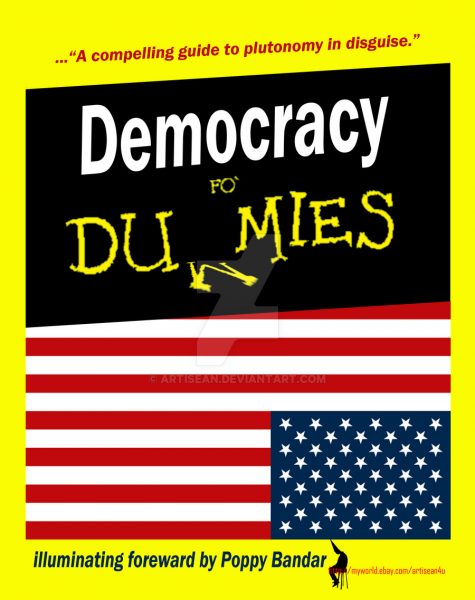
Bravo Rachel Stewart for taking on the ‘sour Old Men’. It is true that a few ‘grown-up boys’ chose to lecture her in public. That is their problem. Not that I mind being a sour old man. What I am sour about is not the end of ‘democracy’ but the general ignorance about ‘democracy’. That is not confined to any particular gender or generations, but to all those in thrall of what passes for democracy in capitalist society.
For historical reasons explored below most people actually believe in bourgeois democracy, and it is not a personal failing, but one which is imposed in the popular culture like baby milk powder. These are not the dummies. They are those who have a professional/intellectual stake in defending bourgeois democracy against all the odds. They include those criticise Rachel for diagnosing its deathly state, and not Rachel herself who is asking the question of why democracy is not working.
But what is this democracy and why are those who defend it when they should know better dummies? For me, dummies are like useful idiots, they glorify their ignorance of the social reality and make do with superficial common sense platitudes because they do it for a living. They are the contemporary priests. So, democracy is the weapon of goodness we use to destroy badness. Sounds like a religion because when you analyse its origins it has the same roots.
Copernicus proved that the Earth was not the centre of the universe. Darwin proved that humans evolved and were not the progeny of any ‘intelligent design. Einstein overturned our dogmas about space and time. And Karl Marx proved that ‘democracy’ in capitalist society was a ruling class idea and part of the ruling class state. Those who are paid to challenge these new scientific discoveries and promote the defence of bourgeois democracy as the solution to capitalism’s problems are dummies.
Maybe it is news to Rachel, but she is not the first to predict the death of ‘democracy’. Marx did so after 1848 when the revolutions in Europe began to go into reverse. The French Revolution gave birth to ‘democracy’ as the political ideology of the bourgeoisie who rose up to overthrow the feudal state and impose a bourgeois state. Equality, Fraternity! What better slogans for the new society based on a new class division of the bourgeoisie as property owners who exploit landless workers. Because workers would accept their exploitation if they believed themselves to be the equal of their employers – as sovereign citizens capable of contesting power in a ‘democracy’.
Bosses had good reason to believe this would work since they cynically promoted capitalism as an equal opportunity society. You see, they worked hard for land because they or their forebears had acquired it by abstaining from consumption and saving up their capital. As Marx wrote, they willfully suppressed history as one of merciless rape, plunder and genocide in the ‘original’ accumulation of their land and wealth. If workers did not accept this bourgeois myth of the origins of capitalism when confronting by class inequalities, most would remain trapped in the ‘false consciousness’ of ‘democracy’ as capable of reforming capitalism.
So while capitalism was of its nature based on class struggle, it survived as long as it could escape the blame and point the finger at either landlords, employers or workers as exceeding their fair share of wealth. This meant rejigging he system not overthrowing it. If workers were equal citizens they could vote a majority of their representatives into parliament and equalise incomes. Bourgeois democracy therefore was the solution to all the problems of capitalist inequality. But such democracy was a fraud, because while on the surface democracy could legislate equal distribution in income, it could not cancel surplus value, so that workers would never be citizens equal to employers.
Marx explains this in his theory of commodity fetishism. Most of the best scientific discoveries are simply because they resolve anomalies. Marx discovered that capitalism is a society in which commodities sell at their price, but that in the case of one commodity, labour-power, produced more value than the value of its wage. Commodities produced for sale in the market embodied a total value comprising the value of the wage, all the value used up from machinery etc in the process of production, and surplus-value. Thus the capitalist paid the wage, retained the invested value used up in production, and then pocketed the surplus-value as profit. So how could workers who were exploited by producing surplus-value, and were thus by definition unequal in production, become equals with their employers in politics?
Having discovered that workers were exploited in production Marx explained how this unequal relation of production was automatically inverted as an equal relation of exchange. Because the commodity incorporated value and was appropriated by the employer, the existence of surplus-value was masked within the total value of the commodity. This inversion of unequal production relations into equal exchange relations Marx calls ‘commodity’ fetishism. The value appeared to be inherent in the commodity and not in the labour-power that created it. Moreover this value appeared to distribute naturally into what Marx called ‘revenue’ classes, depending on their fair share of value earned as rent, wages and profits.
Arising from this fetishised appearance of equal exchange, the ideology of bourgeois democracy emerges, complete with the state that belongs to all citizens. That is why Marxists call bourgeois democracy the “democratic dictatorship” of the bourgeoisie because it fetishises individual citizenship as sovereign, and masks a class exploitative state and destructive society. As mentioned above, bourgeois democracy came under challenge early in its life when the class war against workers drove down wages and conditions and threatened to destroy the working class as the basis of capitalist profits.
The most enlightened capitalists like Robert Owen, or the Cadbury family, reinforced the fetishism of bourgeois democracy by supporting reforms like the 10 hour act and better wages and conditions. Ever since, liberal bourgeois like William Pember Reeves, Chomsky, or Piketty, despite growing inequalities, crises and world wars driven by falling profits, have staked their reputations on defending the democratic principles of commodity fetishism. That is, whatever is wrong with capitalism is due to an aberration in which one or other class, sometimes workers, but mainly bosses, have used their power to increase their income share at the expense of the other.
Yet, nothing comes of attempting to reform the capitalist state that acts to defend private property and to reproduce the working class as alienated, exploited bourgeois subjects. The dummies, priests of capitalism, pretend that the inherent evils of capitalism can be resolved by voting for one or other faction of the ruling class, right, centre or left, to legislate the further exploitation and inequality in the name of bourgeois democracy, equality and liberty.
The good thing about Rachel Stewart’s charge that ‘democracy’ is dying is that it invites a further questioning of bourgeois democracy as the solution when it is very much part of the problem. The real solution is the end of capitalism and the beginning of ‘workers’ democracy’.
Dave Brownz is TDBs guest Marxist blogger


Hi David
I don’t know how long we are supposed to go on discussing this on the daily blog but it’s an interesting and vital subject so we’ll see if they continue to indulge me.
The differences in our views may be semantic; I think of capitalism as a system of free enterprise in which anyone can set up a business and compete in the marketplace with his or her product or service on an equal basis to everyone else, and the classical questions of “Why What and for Whom ” are decided by a multitude of people making these choices for themselves individually.
This has to take place within a framework of rules that society puts in place through elected government to keep the options open to everyone and the system fair and equitable. This essentially means protecting against the development of monopolistic control of resources etc; The opposite of what governments have been doing for the last 30 years.
You seem to be defining “capitalism” as the extreme lasses faire version, or distortion of capitalism that has been in existence for this period, and the period leading up to the 30’s depression.
The catastrophe of WW2 , and the economic circumstances that led to it were a wakeup call to leaders and economists and they examined the history that had led to that disaster and greatly improved the framework that capitalism operated within, with cooperation from all the western democracies, and did a pretty good job . It worked pretty well for 2 generations till people forgot what can happen to capitalism when it gets out of hand , and neoliberalism is the result. Same all over again.
The weakness of democracy is that when everything seems to be going OK people don’t engage in it. They focus on things more immediate to their daily lives, this allows political parties to be quietly taken over by vested interests and subverted as you and Marx describe. But when it goes badly enough awry enough of the right people can get involved and improve it as after (not during) WW2.That would be my evidence to your question.
I have in the past had the idea of a non elected administration chosen by random ballot to govern, with one third being subpoenaed every year and serving 3 years. Some would of corse be useless (what’s new?) but enough might have enough clues to make sensible decisions without bias and little opportunity to be predisposed to serve any particular interest but the countries’. Just a thought.
Do we really disagree?
D J S
David, yes, and if you go back and reread the main post you will see why. The way capitalism behaves is not an aberration. Underlying the events of decades, is the long-term dynamic of capitalism from it origins on the ruins of feudalism, through a series of inevitable depressions and wars, to its current terminal crisis and impending collapse. There is no room or time for tinkering in whatever sense, only wholesale social revolution.
Thanks, and while I enjoy debate in your case there is no meeting of minds.
The French didn’t invent democracy, the Greeks did.
All through I was wondering just what your replacement of democracy was going to be.
Given the comprehensive criticism of democracy as we know it, the preferred alternative demanded infinitely more attention than you have afforded it.
What is “worker’s democracy” ? Is it democracy in which some sections of society are excluded?
More explanation please.
D J S
“Workers democracy” is the class equivalent of “bourgeois democracy”. The difference is when the working class rules it will be the vast majority (some say 99%) and democracy will be the means of planning productdion to fulfill workers’ needs on the basis of their ability and preventing the bourgeoisie from staging a come-back to destroy humanity. For the first time in history, democracy will mean the rule of the majority class. Workers democracy will disappear when class rule disappears along with the state when it it becomes redundant in a non-class society.