

Broken markets, corporate power & the limits of competition Reform

New Zealand’s competition crisis isn’t accidental — it’s structural, political, and fiercely defended by those who profit from it.
This is AI Bryce at his best…

These are all “broken markets” contributing to the “broken New Zealand” we are currently experiencing. There’s rising public discontent about this oversized corporate power and how it is exacerbating the cost-of-living crisis. But can we do anything about it? Will politicians do anything to fix these uncompetitive markets?There’s a glimmer of hope in the Government’s current proposed reform of the Commerce Act 1986. It might sound boring, but the “Commerce (Promoting Competition and Other Matters) Amendment Bill” is the most significant competition law reform in nearly two decades, and could potentially make a real difference in reining in the monopolistic behaviour that characterises the New Zealand economy, reducing growth and productivity.
Why competition reform matters now
Why this reform has come about
What the Government got right
What’s good about the Government’s bill
Where the Bill falls short
Problems with the Government’s bill
How corporate lobbying shapes policy
Big business fights back
Beyond broken markets — who really holds power
The “Rip-Off New Zealand” problem remains
…AI Bryce is 100% right.
We refuse point blank to regulate capitalism in this country.
We have this issue in the under-regulated NZ economy with monopolies, duopolies and oligopolies taking over alongside a lack of investment into the infrastructure we need for rapid climate change adaptation.
I believe we should be tapping our ACC and NZ Super funds to directly invest in NZ alongside bringing in Māori Capitalism…
New report highlights dramatic growth in Māori economy
Māori contributions to the economy have far surpassed the projected goal of ‘$100 billion by 2030,’ a new report has revealed.
The report conducted by the Ministry of Business, Innovation and Employment’s (MBIE) and Te Puni Kōkiri, Te Ōhanga Māori 2023, shows Māori entities have grown from contributing $17 billion to New Zealand’s GDP in 2018 to $32 billion in 2023, turning a 6.5 percent contribution to GDP into 8.9 percent.
The Māori asset base has grown from $69 billion in 2018 to $126 billion in 2023 – an increase of 83 percent.
Of that sum, there is $66b in assets for Māori businesses and employers, $19b in assets for self-employed Māori and $41b in assets for Māori trusts, incorporations, and other Māori collectives including post settlement entities.
In 2018, $4.2b of New Zealand’s economy came from agriculture, forestry, and fishing which made it the main contributor.
Now, administrative, support, and professional services have taken the lead contributing $5.1b in 2023.
Could Māoridom become the competitive friction against the self-interested Public Service that well regulated Capitalism demands?
I believe it could and deserves investigating by the Left.
Allowing Māori Capitalism to co-fund and co-own essential investment would be a step towards realising the promise of the Treaty while protecting NZ from foreign investment.
It was embarrassing that National organised an investment summit and forgot about Māori.
Daniel McLauchlan is one of the greatest political columnists in New Zealand and his critique of the NZ bureaucracy is worth reading…
The dogmatic political left invests its faith in the bureaucratic state; the dogmatic right trusts oligopolistic free markets – leaving New Zealand with crumbling infrastructure and corruption
…the Political Left have allowed the self-interested Public Service and the Professional Managerial Class to push self interested virtue signals rather than structural change and increased capacity of the State!
David Seymour says the Public Service is Left wing, bullshit!
If only this was true!
The Wellington Bureaucracy isn’t left wing! It’s a self interested Professional Managerial Class who use identity politics to mask their neoliberal hands-off-do-nothing-but-build-glass-palaces fiefdoms.
Oh they do the reo, and expose their pronouns and militantly ride bikes, they are effortless in their use of inclusion as a means to dominate and control the narrative, but they are a middle class clique, not left wing egalitarianism.
The Wellington Bureaucracy is a culture war of woke middle class Identity Politics aspirations backed with State funding, they may aesthetically be Left but they sure as fuck aren’t economically Left.
To brand the Public Service as ‘Left’ misdiagnoses the disease, symptom and patient!
The real power struggle in NZ isn’t Left vs Right, it’s between the Professional Managerial Class Corporate Consultants who influence policy to maintain their dominance and profit margins vs the self serving Public Service wanting to spend taxpayer money on their latest glass palace.
The Politicians are merely a masquerade of democracy to ensure participation that generates legitimacy, but the real power is between the Corporate Consultants who influence all policy to keep NZ deregulated and the self serving Public Service who are in it for their own fiefdoms.
The only chance any truly progressive movement gets in NZ politics is to ram your changes through in the first 100 days of any new Government.
That stops the self serving Public Service from stymieing your agenda and it stops the corporates from influencing it.
If we want true progressive policy to tax the rich and remove costs from peoples lives, it needs to be rammed through in the first 100 days or it won’t happen.
That’s why Labour have been so feckless and useless, they had no 100 day plan in 2017 and they didn’t expect to win an MMP majority in 2020 and had given up in 2023!
They effectively became captured by the self serving Public Service and the Corporate Consultants.
Daniel talks about the lack of actual competition to the self-serving Public Service and to that effect Māori Social Service Providers could easily become the competition the self serving Public Service needs while building State capacity with a Ministry of Green Works.
The lack of results from a self serving Public Service riddled with Corporate Consultants could finally be challenged by Māori Social Service Providers that treat everyone who comes, but in a Māori cultural setting.
That development can drive the self serving Public Service to be far more responsive and force actual results out of them.
It’s allowing regulated capitalism to inject the dynamic of competition while building State capacity.
Imagine a scenario where Iwi joined forces with the State to create a 3rd Supermarket Operator with a focus on lower costs to customers, better work conditions for workers and better prices for suppliers.
Or expanding existing community health groups that are open to the entire community but run within Kaupapa Māori.
Same with Māori schools.
You can generate the competitive friction Capitalism requires while building up the State, not denigrating it.
Right now we have over half a million Kiwis accessing food banks per month while the corporate slop in schools only provides food with barely any nutrition…
NZ school lunches ‘half the energy’ kids need – new research
…here is an opinion piece demanding we stop waiting for a foreign owner to step in and solve out Supermarket Duopoly…
Stop waiting for a foreign hero: NZ’s supermarket sector needs competition from within – Opinion
…I agree.
Let’s work with Māori Capitalism and build a fairer more equitable outcome that also protects essential infrastructure like food security while also adopting the values of a Green Post Growth economy.
The reality is that Billionaires are killing us on a burning planet and post growth Capitalism is here…
…in the words of Professor Wayne Hope from his new incredible book, The Anthropocene, Global Capitalism and Global Futures…
The corporate ambit of emissions culpability also includes transnational finance capital. In October 2019, journalist Patrick Greenfield drew from the think tank Influence Map and business data specialists Proxy Insight to examine the investment holdings of BlackRock, Vanguard and State Street. Their combined portfolios presided over US$286.7 billion of oil, coal and gas company shares administered through 1 712 funds. These figures excluded direst and non-listed fund holdings. Such investments were, and are, used to manage major funds involving pensions, university endowments and insurance companies. These figures reiterate the general principle of corporate culpability for carbon emissions and point to the contribution of global finance. Further to this matter, Bank of England Governor Mark Carney surmised that multi trillion-dollar world capital markets were financing projects and activities likely to raise average global temperatures 4% more than pre-industrialised levels.
As global networks of fossil fuel extraction, refining, industrial use and related financial investment produce carbon emissions, wealthy elites dominate carbon consumption. Explaining the process first requires a short excuses on wealth distribution, luxury consumer culture and class. Clearly, global wealth growth benefits super-rich individuals from the TCC. The richest 1% of the world’s population took 38% of all additional wealth between 1995 and 2021. Just 2% went to the bottom 50% of humankind. For the same period, billionaires’ share of total global wealth grew from 1 to 3%. Tim Di Muzio, writing in 2015, depicted such differentials as a global plutonomy whereby economic growth powered and consumed mostly by the wealthy few, excluded the vast majority. With huge money surplus to spend on precious metals, property portfolios, home residences, retreats, first-class travel, cars, yachts, jets, exclusive cultural pursuits and leisure activities, the rich and super rich demarcate social prestige among themselves. Individuals, families and groups strive to symbolically out-consume their class peers, while the upper-middle classes aspire to emulate their superiors. The entire set-up, led by the dominant owners of capital, is ecologically unsustainable.
Although modest and poorer households also generate greenhouse gases through everyday activities such as shopping, commuting, food preparation and basic leisure activities, high-end discretionary consumption is more carbon intensive. Thus, economy class plane trips compared to first-class passages account for much less carbon dioxide per person. Luxury automobiles encourage a greater individual carbon footprint than standard vehicles, buses and trains. Counter-consumption campaigns such as eco-labelling for food and travel options have not shifted the prevailing pattern of carbon use inequality. As reported by Oxfam in 2015, the richest 10 of people produced half of the planet’s individual consumption-based fossil fuel emissions, while the poorest 50% contributed only 10%. The Top 1% emitted 30 times more carbon dioxide than the poorest 50% and 175 times that of the poorest 10%. The 2022 World Inequality Report broadly confirms these statistical trends and precedents a fascinating intra-class data. As of 2019 the richest 1% of individuals emitted around 100 tonnes of carbon dioxide on average, per person, per annum. More dramatically, those within the top .1% emitted 467 tonnes and the top 0.01% 2550 tonnes. The calculations demonstrate that high echelon gradations of carbon dioxide emission correlate with the gradations of capitalist class wealth. David Kenner’s research on overconsumption posits that rich one-percenters rarely make the link between luxury consumption and climate change impacts such as hurricanes, floods, heatwaves and forest fires. More commonly, they use “their extreme wealth to try and insulate themselves and continue their carbon intensive lifestyles”.
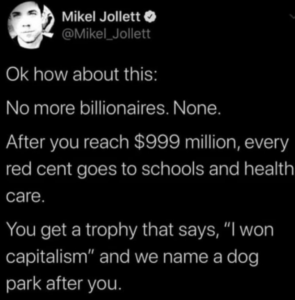
Let’s have a new deal on the Billionaire Class….
….and this too…
Who is brave enough to back Brazil’s global tax on billionaires? The answer will define our future
The response to the pandemic was one test of that proposition. Now the world’s governments face another. Last week, Brazilian climate minister Ana Toni explained a proposal put forward by her government (and now supported by South Africa, Germany and Spain), for a 2% global tax on the wealth of the world’s billionaires. Though it would affect just 3,000 of the super-rich, it would raise around $250bn(£195bn): a significant contribution either to global climate funds or to poverty alleviation.
Radical? Not at all. According to calculations by Oxfam, the wealth of billionaires has been growing so fast in recent years that maintaining it at a constant level would have required an annual tax of 12.8%. Trillions, in other words: enough to address global problems long written off as intractable.
You would need to perform Olympian mental gymnastics to oppose Brazil’s very modest proposal. It addresses, albeit to a tiny extent, one of the great democratic deficits of our time: that capital operates globally, while voting power stops at the national border. Without global measures, in the contest between people and plutocrats, the plutocrats will inevitably win. They can extract vast wealth from the nations in which they operate, often with the help of government subsidies and state contracts, and shift it through opaque networks of shell companies and secrecy regimes, placing it beyond the reach of any tax authority. This is what some of the global “investors” in the UK’s water companies have done. The money they extracted is now gone, and we are left with both the debts they accumulated and the ruins of the system they ransacked. Get tough with capital, or capital will get tough with you.
The Brazilian proposal, which will be put before the G20 summit in Rio in November, has already been dismissed by the US treasury secretary, Janet Yellen, who suggested there was no need for it. On whose behalf does she make this claim? Not ours. Wherever people have been surveyed, including in the US, there is strong support for raising taxes on the rich.
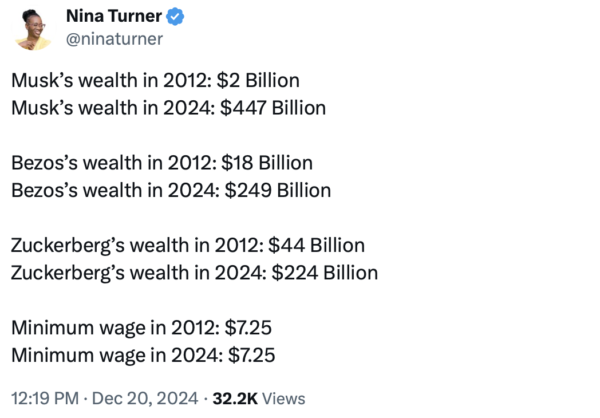
In the two years following the start of the pandemic, the world’s richest 1% captured 63% of economic growth. The collective fortune of billionaires rose by $2.7bn a day, while some of the world’s poorest became poorer still. Between 2020 and 2023, the five richest men on Earth doubled their wealth.
Billionaire wealth impoverishes us all: astonishingly, each of them produces, on average, a million times more carbon dioxide than the average global citizen in the bottom 90%. Billionaires are a blight on the planet.
Yet, because they are the true citizens of nowhere, shifting their wealth and residence between jurisdictions, they pay far lower levels of tax than the most downtrodden of their workers. Oxfam has calculated, using records unearthed by the investigative journalists ProPublica in 2021, that Elon Musk pays a “true tax rate” of 3.27%, and Jeff Bezos less than 1%. Falling tax rates and the clever workarounds designed by the lawyers and accountants serving the ultra-rich help to explain the growth of their fortunes.
Wealth that could otherwise support public services and public wellbeing is siphoned out of nation states. As the global rich accumulate ever greater economic power, and find ever more inventive ways to evade democratic restraint, they become more potent than many governments. There’s a word for this: oligarchy. Some of them use this power to demolish democratic safeguards. To give one example, they have lobbied successfully to pull down the rules and caps on campaign finance, until, in some nations, they appear to wield more influence over elections than the electorate.
…if we want to build the social and physical infrastructure we need to radically adapt to the realities of catastrophic climate change, we need to tax the rich!
I’m not looking for socialism here folks, just basic garden variety regulated capitalism!
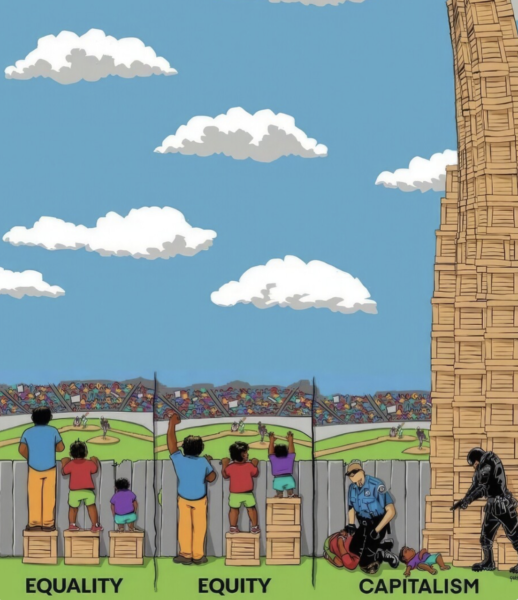
There are 14 Billionaires in NZ + 3118 ultra-high net worth individuals, let’s start with them, then move onto the Banks, then the Property Speculators, the Climate Change polluters and big industry.
You should be angry, NZ Capitalism is a rigged trick for the rich and powerful. The real demarcation line of power in a western democracy is the 1% + their 9% enablers vs the 90% rest of us!
Do not allow their smears of ‘Envy’ dilute the righteous rage you should all be feeling!
There’s no point making workers pay more to rebuild our resilience, tax the rich!
- Sugar Tax
- Inheritance Tax
- Wealth Tax
- Financial Transactions Tax
- New top tax rate on people earning over $300 000 per year.
- Capital Gains Tax
- Windfall profit taxes
- First $20,000 tax free
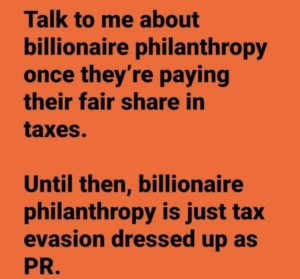
Lift the tax yoke from the workers and the people and place it on the mega wealthy and have them pay their fair share for once!
In 2010, the 388 richest individuals owned more wealth than half of the entire human population on Earth
By 2015, this number was reduced to only 62 individuals
In 2018, it was 42
In 2019, it was down to only 26 individuals who own more wealth than 3.8 billion people.
In 2021, 20 people own more than 50% of the entire planet.
In 2026 000.1% owned 3 times the wealth of the bottom 50%.
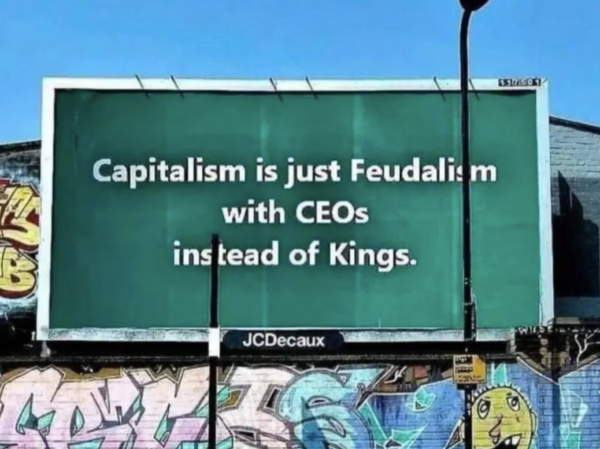
This isn’t democracy, this is a feudal plutocracy on a burning Earth
The Big Tech Tzars have manipulated our collective fear, ego, anger and insecurities through social media in a way that has led to the largest psychological civil war ever launched against one another.
We are but meat bags secreting hormones addicted to dopamine rewards for fat, sugar, salt and sex in a cultural landscape of individualism uber allas where we sing sweet secret lies to ourselves to make sense of a world around us that is frightening and in constant entropy.
Meanwhile, the planet burns and every aspect of our existence is monetarised for big data to sell us more stuff we can’t afford. We are alienated and anesthetized by a consumer culture that keeps us neurotic and disconnected. Our work, our existence, every move we make are all built to suck money to a minority class that sits above us while under neoliberalism, globalization, financialization, and automation, our existence as individuals has only become more disposable.


” I believe we should be tapping our ACC and NZ Super funds to directly invest in NZ alongside bringing in Māori Capitalism ”
Ok. Then why does all this money not trickle down ..( sarc ) to the serfs of Māori capitalism ?
Remember the trickle down effect when taking huge settlements by the Crown and they could inhale the toxification of all this money ? they turned their back on all of their maligned , ill treated , poverty stricken whairoa regardless of tribal affiliation as neoliberalism unregulated capitalism has extorted so many of their pakeha brothers.
While ACC is operating as a rapacious privatized corporate clinical entity it does not empathize with human considerations or has any concept of operating with a social license.
ACC of course is in no way the organization formed in the early seventies to ensure Kiwis were covered for accidents or medical mistakes to prevent them suing and would be fully funded to protect them under the law.
Tapping would require a government elected on the commitment to do just that.
Currently the parties polled show the majority are in their support of the neoliberal approach of continuing the slash and burn economic approach.