

MUST READ: Child poverty in NZ – what is the truth here?

The Government’s media response to the Ministry of Social Development (MSD) Child Poverty Report 2022 proudly claims “Child poverty declines in spite of COVID” .
Sure, material hardship rates for many children improved between 2013-21, thanks to government measures, rising employment rates, improving wages. BUT the MSD report itself is at pains to say that these results do not reflect anything like the full extent of the pandemic period. Let’s not forget too, the huge efforts of the proliferating private charities and foodbanks, which while utterly necessary, remain a disturbing indicator of policy failure.
The government’s media release has a misplaced congratulatory tone.
- Government policy means child poverty measures improve during COVID-19 in contrast to them rising sharply during the GFC.
- There are 145,000 fewer children in hardship in 2021 during the COVID-19 pandemic than when hardship numbers peaked after the GFC in 2011.
- There were 70,000 more jobless households with children during and immediately after the GFC then during COVID-19.
- Rates of hardship for Māori rose to 36% after the GFC, and 47% for Pacific people. These have since dropped to 20% and 24% respectively. This means there are 40,000 fewer Māori children in poverty now than there were after the GFC.
- Around the GFC (2007 to 2011) less than 40% of households with children said they had enough income to cover the basics. This is now 61%. That’s 150,000 more households who can meet their basic needs now.
There are no health warnings in the Government’s media release about how to interpret the data and the limitations of the figures. The data for the latest MSD report was collected during the period July 2020 and June 2021, with reference to the previous 12 months. A family interviewed early in the piece would be reporting income for the 2019/2020 year. So much of the data is prior to the full Covid pandemic, and does not capture anything at all of the severe impact the 2021 lockdown had on low-income families, or the recent devastating cost of living pressures. Remember too, thousands of worst-off children live in emergency accommodation such as motels and garages and are excluded from the survey on which the child poverty report is based because their families have no residential address.
The media release appears tone deaf to the intense pressures that private charities have been constantly reporting in 2022, the thousands of children in damp, cold housing with blighted life trajectories, the crippling rent rises and the entrenchment of the foodbank industry on scale unimaginable to most New Zealanders. The claims on the one hand that child poverty has declined, and the on-the ground reports from those coping with the covid and cost of living fallout on the other suggest the poverty indicators relied on in the Child Poverty Reduction Act are not fit for purpose in times of crisis.
The government would be advised to pay close attention to what the report actually says. Even though families on average appear to do better from 2013, the report shows 120,000 children were still in hardship in the 2021 survey. Of these, around 60,000 children were living in severe hardship (and remember those in motels or other make do accommodation like garages were not in the survey).
Over the past 18 months the resounding evidence from the NGO sector suggests that things have got much worse. There were no special measures in the devastating Auckland 2021 lockdown like a doubled winter energy payments for struggling families. Nor was there any cost-of-living payment recently for them either. Foodbank use has soared. NGO’s themselves are reporting burnout from the high demand And little light at the end of the tunnel.
In April 2022, well overdue inflation adjustments to WFF were woefully inadequate ,while the fixed threshold and high rate of abatement ensured that families were like the rats on a treadmill forced to pay for their own cheese. They see extra income earned over a low fixed threshold disappearing into tax, (17.5-30%) repayment of working for families (27%) loss of accommodation supplement (25%) and student loans (12%). Work it out- nothing to show for extra effort. It is good to see the MSD report say sternly that the claim ‘work is the way out of poverty’ is a nonsense.
The author Bryan Perry is to be congratulated on doing a great job of highlighting the dire living standards of the worst of children and their families. The average hardship measures disguise the full picture. There is a very interesting new feature in the MSD report that the disaggregates Auckland figures into 6 wards. It really matters that in the Southern wards (Manukau and Manurewa-Papakura) the rates of hardship for children at 28%, rates of severe hardship at 13%, and food bank use at 19% are 2-2.5 times higher than for the rest of Auckland. These wards have “24% of Auckland’s under-18 population but 53% of under-18 Aucklanders in material hardship” says the report.
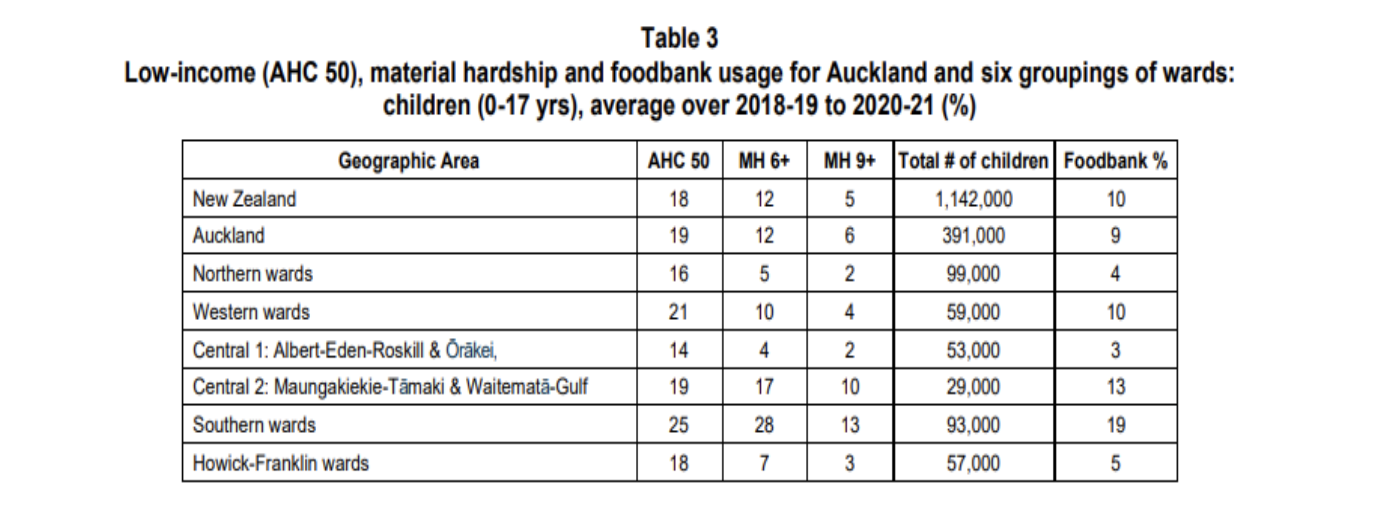
Rather than comparing the child poverty rates of hardship of the global financial crisis of 14 years ago and telling themselves they have done better this time when the full impact of the pandemic has NOT YET been measured, government needs to better understand communities with widespread severe hardship and few resources to draw on.
The incidence of serious disease like rheumatic fever, high suicide rates, mental illness, family violence, transience, youth crime, pupils leaving school too early because their families need them to earn money is having a dramatic scarring effect in poorer communities. New Zealand will pay a very high price in social fallout and be vastly the poorer for the under-investment in these young lives.
Going back to the averages again, material hardship rates, that is going without six or more ‘essential’ items, are much higher for Maori and Pacific children than the rest of the population. Around one in five Pacific children live in material hardship while the rate for Maori is one in three compared to the national average of one in ten. As well two-thirds of children in severe hardship are in a family affected by disability.
David McCormack, a cardiothoracic surgeon employed at Waikato Hospital by Te Whatu Ora (Health New Zealand reports in Ian Powell’s New Zealand’s ‘National Disgrace’: ‘One Of The Worst Places To Bring Up A Child’ | Scoop News :
“ I had never treated rheumatic heart disease before coming to Aotearoa New Zealand. The grievous impact it has on young lives and whanau cannot be overstated.It is a disease divided down racial lines in New Zealand – 93% of cases present in Pasifika and Māori children. Pasifika children are admitted to hospital for rheumatic fever 140 times more often than children of “European or other” ethnicities, while Māori children were admitted 50 times more often. On average 140 people die from rheumatic heart disease each year. Roughly 160 new cases are diagnosed a year but many cases go unreported”
The stock response from the Minister last week was
“ While there is strong evidence in this report that things have been broadly improving for the worst off kids, I know there are still a core group of children in New Zealand that lead very hard lives and there is more work to do to fix that”
More work to do? How long can these children be forced to wait- Labour has had five years. Is there an emergency budget before Christmas? Now it seems that whatever is their next step it is likely to be implemented only if they win the election.
The MSD report identifies that beneficiaries are among the most impoverished people in our society. The rate of material hardship for the children of beneficiaries is around four to five times higher than the rate for children in ‘working’ households. So why does a sole parent, who may be trying to do paid work as well as having the full-time care of 2 or 3 children not qualify for the full Working or Families? Does she really need a work incentive that acts to penalize her for not being off a benefit, regardless of her circumstances or those of the children? Why should her children be denied the poverty relief assistance that would make all the difference?
Why is the Working for Families Review taking so long? The exclusion from the full WFF has had a cumulative effect on the balance sheets of families in low-income communities. Since 2006 when the in work tax credit was introduced (worth at least $72.50 for a family of 1-3 children and more for larger families) the cumulative loss has been around $ 8 billion in today’s dollars.
The MSD report takes the unacceptable living standards of the poorest children very seriously indeed in its 200 pages of detailed analysis
“The analysis shows that for those children in the most materially deprived households (~5 to 8%), life is undeniably very different from that experienced by the vast majority of New Zealand children. This finding is in line with what was found using similar indicators from the 2008 Living Standards Survey. It illustrates what it means in practice to be ‘excluded from the minimum acceptable way of life in one’s own society’, the high-level definition of poverty commonly used for richer countries and adopted in MSD reports.’
The government’s media response just doesn’t cut it.
“Government initiatives like the Families Package, minimum wage increases, benefit increases, and Food in Schools have all contributed to reductions in poverty.”




An AS increase with a rent increase freeze.
Child Poverty rates are used as a shorthand for family poverty. If we have 130,000 children in hardship and one half of those in severe hardship or income poverty it means they live in households that experience deprivation. The household income measure is of course the income of the parents. The MSD report explains.
It’s not especially difficult to vote.
TOP, The Opportunities Party, has just published its programme for the 2023 election. It wants to partner a Government that will make the first $15,000 of income tax-free, and above that have a 20% tax rate up to $80,000 a year, paid for by a 0.75% annual tax on residential land.
More pertinent to Susan St John’s essay, TOP also seeks to:
Remove unfair and unreasonable sanctions on benefits, such as your relationship status determining benefit allowances.
Increase income support for people with disabilities ($400 million).
Make it easier for those with disabilities to access the support they need by streamlining processes and improving their accessibility.
Wipe all Ministry of Social Development debt ($2 billion) to ease the financial burden on low-income communities.
Extend the In-Work Tax Credit (IWTC) to all children of low-income families ($500 million).
It’s time to stop referring to Labour as ‘the Left’. That (leftist) time is long gone. There is an alarming lack of debate, the pushing of agendas without concern for Labour’s erstwhile supporters. The anger of New Zealanders derives (at least in part) from the lack of opportunity for effective citizenship participation. This government has provided us with no information re new policies, or consequences (never mind alternatives). There is a very short straight road from here to fascism.
Is it true that the kids in motels aren’t counted in the stats. If so the stats are worthless
Hear hear
The most disgraceful legacy of this government will be their crippling negligence of all vulnerable children, plus their blithe acceptance of bullying and racism within their own ranks. Small wonder that they oppose freedom of speech. History will judge them, but they don’t care.