

The neoliberal welfare state is refusing to pay the politics of kindness anything other than lip service
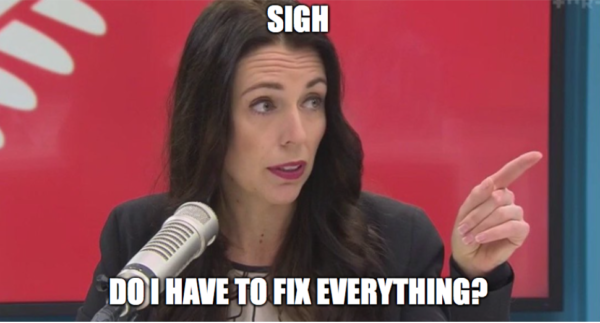
Because this current Government didn’t expect to win, they didn’t have a plan for reform, this has meant there was no plan on how to tackle the neoliberal public service. It’s meant that for all the pleas for a politics of kindness, the neoliberal welfare state is programmed to be a stick to beat the vulnerable with not help beneficiaries.
18 months in and there is very little the new Government can hold up to suggest anything more than lip service to change policy.
Look at the reality.
The homeless are being turned away in Auckland…
Homeless told there’s no emergency accommodation available
Work and Income staff are turning away homeless people in Auckland, telling them there is no emergency housing available, multiple sources say.
…Kiwibuild continues to be an ineffective right wing market solution to a problem caused by free market failure…
Half of all KiwiBuild homes already under construction before being brought into the programme
More than half of the KiwiBuild homes built since the flagship policy started were underway before they were brought into the programme.
…someone with the openly appalling opinions that Cr James Casson has regarding immigrants is allowed to work for Immigration NZ…
Cr James Casson’s job with Immigration NZ untenable: Former minister
The councillor who referred to refugees as “scum” will offer an apology to the Muslim community as calls come for him to be sacked.
Former immigration minister Tuariki Delamere said Hamilton City Councillor James Casson’s position with Immigration New Zealand (INZ) is untenable in the wake of his comments.
“If he’s referred to refugees as scum, then he should be dismissed from Immigration New Zealand immediately,” Delamere said.
…Child Poverty is up…
Number of children living in poor households jumps in 2018 year, latest figures show
The number of children living in poor households had been decreasing since 2015, but rose in the year to June 2018, latest figures from Statistics NZ show.
About 254,000 children were in low-income homes after housing costs were deducted, up 2.4 per cent from the previous year.
While fewer – 183,000 children – lived in low-income homes before housing costs were deducted, this was a 17.3 per cent jump on the previous year.
About 148,000 children were living in material hardship.
…220 children in state care were abused from a supposedly reformed agency who did everything to hide the level of abuse…
We finally know the true extent of abuse in state care. It is shocking
The figures released this month by Oranga Tamariki into the extent of child abuse in state care are shocking.
There’s no way you can look at these statistics – 220 children physically, sexually, and emotionally abused and neglected in a mere six month time period – and not be appalled.
These children are uplifted from their families, from their homes, to a place that’s meant to be safer. In many cases, it is not. In some cases, it is worse.
The fact it has taken so long for the state to finally come clean about how ill-treated some of our tamariki are – and in particular Māori, who are over-represented in both state care placement and abuse statistics – is shameful.
…and of course it’s Māori who are being punished the most…
Oranga Tamariki ‘smacks of racism’ – Dame Tariana Turia
Dame Tariana Turia, the former Minister for Whānau Ora, strongly disagrees, saying “the number of children being abused in care doesn’t warrant a seven” and rating them three out of 10.
She also criticised the organisation for advertising children on Trade Me, saying the practice – which has now been stopped – “smacks of racism”.
Auckland University social work lecturer Dr Ian Hyslop agreed, saying “the abuse of children in care is unacceptable” and the overall the outcomes are “certainly racist”.
…and tragically our suicide rate continues to climb…
New Zealand suicide rate highest since records began
The number of people who have taken their own lives in New Zealand is the highest since records began, with 668 dying by suicide in the past year.
It was the fourth year in a row that number has increased. It was also the highest number of suspected suicide deaths since the coroner’s annual provisional suicide statistics were first recorded in 2007-08.
…the need for a wholesale rebuild of the values of the entire public service and welfare state can only occur if the experiences and genuine well being of those being treated by those agencies are front and centre of the reforms.
The only way to force reform is shaming. The Government must look to the many, many NGOs and Community organisations that are forced to interact with the neoliberal welfare state and fund them to act as service support for beneficiaries and to produce public reports on counter productive policy.
By shaming Government Agencies into action and acting for beneficiaries, these NGOs and Community groups could hold the neoliberal welfare state to account.
The politics of kindness must have more intent behind it if it is to mean anything.




I can’t imagine a more serious cluster fuck than more charities/NGO’s supporting beneficiaries. Charities misalocate capital and waste $$$ in overheads.
Under law the State should be providing a service that is accessible, fair, consistent. It’s easier to do that if you first understand the system as a whole which is thankfully what the current minister has attempted with the WWG.
The minister would have been shocked at the state of affairs the welfare system is in once she read the report a month or so ago mainly because MSD has performed a “yes, minister” type of role, carefully avoiding anything that might threaten their jobs.
I agree that much needs to be done, but it’s going to take time. The coalition has only had just over a year, and they are constrained by the political reality that they have to keep middle NZ on board, and not scare them into National’s arms.
That said they need to ditch the overly cautious budgetary constraints they made with the Greens. Standard and Poor’s said the Government could allow the debt to GDP ratio rise two or three percentage points without reducing its credit rating. They likely can’t do that this term, but they should do so for the next, assuming they win. They need more room to act if they are going to fulfil Jacinda’s claim to be a transformative government.
What I find weird is that the proposed ‘healthy homes’ is implemented in social and state housing last, where you would assume poverty is at the greatest, so really maybe the Grenfell example of what ‘social housing’ is like in modern times aka part of the problem.
Aka you have heaps of bleeding hearts (or professional managers) earning 6 figure salaries and hoovering up money for their charities/social causes which may or may not get to the recipients without a significant chunk of change being extracted by third parties.
… it is pretty easy to set up a very profitable charity and pay zero taxes for example and start collecting government $$$… modern neoliberalism under the ‘kindness’ hat.
I seem to remember a disabled person was getting pretty peeved off at all the disabled conventions being hijacked by bureaucrats who ‘liaised’ with government on the disabled behalf and (in their view) part of the problem when money was going into advocating for the disabled, rather than actually giving the money to the disabled for their living expenses to help them!
Rolling back the neo liberal experiment that became orthodoxy, (aka Rogernomics/Ruthanasia), has to be the priority for activists; if a) they want the coalition to get a serious shot at a second term in office, and b) make some real progress for the 50% of have-nots in this country during that second term.
There are so many things the Govt. could do with the political will…
–make all senior public sector executives reapply for their jobs, and replace most of them with staff from NGOs, Unions and experienced social/health workers.
–Retire WINZ/MSD for good, institute a UBI/GMI, income splitting for couples, free wifi and public transport for the lower paid
–Re-nationalise the Marsden Refinery Consortium, which is developing a green energy division near “Marsden B”, restore power generation and supply to full public ownership, ban the private sector from all state infrastructure, put the bloated admin layers and DHB execs to the sword…etc. etc.
It sounds radical compared to the “business friendly” approach of so many previous governments, but hey, we need our country back!
100% Tiger mountain, bang on I support your vision entirely.
Clearly we all have our pet projects but change needs to happen at a more fundamental level. Government accounts – follow through on the rhetoric from Davos and institute something that really reflects reality. Start with the internationally respected work done by Marilyn Waring. Serious changes to the tax system to make the economy fair for all. New workplace legislation that hands back power and legitimacy to the unions
100% TIGER MOUNTAIN.
All of it.
Jacinda needs to read what her educator Helen Clark had planned in 2007 to combat climate change, as it appears Helen was more ‘active’ than jacinda has been to date.
Particularly when it came to targeting transport by reducing the carbon emissions 40% by 2040.
Today we have increased air travel and increased truck freight 200% since then; – so we are going the wrong way now.
We need all regional rail back again Jacinda.
Thursday, 20 September 2007,
“Govt takes next steps to fight climate change a goal to reduce per capita emissions from the transport sector by half by 2040”
http://www.scoop.co.nz/stories/PA0709/S00339.htm
Govt takes next steps to fight climate change
Thursday, 20 September 2007, 11:34 am
Press Release: New Zealand Government
Rt. Hon Helen Clark
20/09/2007
Government takes next steps to fight climate change
Prime Minister Helen Clark and other ministers today outlined plans for an emissions trading scheme and for new forestry and environmentally friendly land management initiatives.
“There is strong public sentiment for measures to reduce New Zealand’s impact on climate change. The Labour-led Government has carried out extensive consultation with many sectors of the economy. Today we are focusing on the solutions,” Helen Clark said.
“Climate change is one of the most important global issues facing us. It affects us all, and our way of life. Taking action against it is not only the right thing to do; it is also the smart thing to do. Sustainability is a key competitive advantage. To protect our markets and our nation’s reputation, we need to act pre-emptively.
“Our plans have been driven by the need to be fair to all sectors of the economy, while ensuring that our nation as a whole reduces pollution from greenhouse gases.
“An emissions trading scheme is a significant part of our plan. It is important that we put a price on greenhouse gas pollution to encourage businesses and households to become more energy efficient.
“We recognise however, that some sectors and groups in society are less able to adapt quickly. For that reason we are proposing that sectors of the economy are brought into the scheme gradually. It is also our intention to compensate low and modest income earners for the increased cost of electricity, and to encourage all New Zealanders to change their energy use patterns.
The Labour-led Government’s policies to fight climate change include:
· the establishment of an emissions trading scheme to put a price on greenhouse gas pollution
· measures to encourage forestry and more sustainable land use
· a goal to increase renewable electricity generation to ninety per cent of New Zealand’s total electricity generation by 2025
· improving fuel and energy efficiency in buildings, homes and business
· a goal to reduce per capita emissions from the transport sector by half by 2040, and to be one of the first nations to widely introduce electric vehicles
· making the public sector carbon neutral
“Reducing greenhouse gas pollution also offers us the opportunity to have a healthier environment and a more efficient economy.
“Already some businesses, such as those in the tourism and wine sectors, have reduced greenhouse gas pollution and are marketing themselves credibly as carbon neutral and/or sustainable. There are opportunities across the economy for innovation and investment in low-emission, energy efficient products and services.
“The announcements we are making today will protect New Zealand’s clean and green reputation, and support our economy moving further along the path to sustainability,” Helen Clark said.
NOTE:
Copies of the reports – New Zealand’s Climate Change Solutions – an overview, The Framework for a New Zealand Emissions Trading Scheme, Forestry in a New Zealand Emissions Trading Scheme and Sustainable Land Management and Climate Change: Plan of Action, and emissions trading factsheets – can be accessed from the website http://www.climatechange.govt.nz.