

Food for thought as we work to re-set NZ’s trade and investment agenda
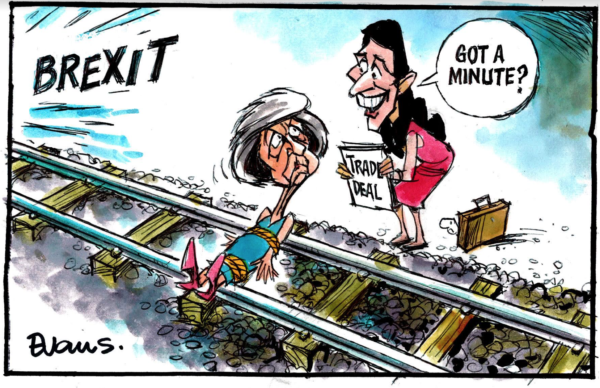
In the past week Prime Minister Jacinda Ardern has been a cheerleader for free trade negotiations with the United Kingdom and European Union, aiming the finish the EU one within the year.
Last Friday at the elite World Economic Forum, New Zealand signed up to a statement of intent by a breakaway group of around 70 countries to launch negotiations on electronic commerce in the World Trade Organization. That’s despite the refusal of the last WTO ministerial conference to mandate those negotiations a year ago.
Last week, trade minister David Parker was in Tokyo for the first meeting of the “CPTPP Commission” – the seven governments who have so far ratified the reborn Trans-Pacific Partnership Agreement, enabling it to come into force on 30 December 2018.
In other words, it’s business as usual for the Labour-led government, and the juggernaut of these mega-agreements keeps rolling on.
So, what’s happened to David Parker’s ‘Trade for All’ initiative to devise a more inclusive and progressive trade strategy for New Zealand? Cabinet approved the establishment of an advisory board back in June 2018. But the board didn’t meet until mid-December, and the low-key announcement of its 23 members came a week later. They will meet again shortly to develop a work plan!
The board has an unenviable task, especially as most of its members have very limited expertise on what free trade and investment agreements actually do and say, especially in areas like intellectual property, financial services, e-commerce, foreign investment or government procurement. It appears to have no independent research capacity, but will be serviced by the Ministry of Foreign Affairs and Trade! MFAT’s own contribution to ‘Trade for All’ to date was a ‘consultation’ where it peddled the same old justifications for what it has done for the past thirty years.
Clearly the impetus for genuine reform can’t be left to the government and self-interested trade bureaucrats, and a board that has limited knowledge and resources and no power.
Last October, a number of unions and NGOs co-convened a conference on “what an alternative and progressive trade strategy should look like”. Some of the sponsors are involved in the trade advisory board process; others are more sceptical. The shared goal was to provide a catalyst for genuine change in how New Zealand approaches the international trade and investment regime. The hui itself was live-streamed and the transcripts, videos and followup are on a new website www.JusTrade.nz
Starting from tomorrow, transcripts of the various inputs will be posted on Daily Blog. Over the next six weeks, you can read contributions from the wide range of speakers across the ten panels: the macro-picture, an internationalised economy, livelihoods, Tiriti-based relationships, a sustainable world, health, knowledge, rights and protections, development responsibilities and reinvigorating the local.
We hope that this steady feed of ideas about the challenges we face and the alternatives we need, coming from many different voices and experiences, will stimulate you to re-engage the debate on where we should be heading as a nation and what you want our international relationships and agreements to do to help us get there. That includes your ideas of how to influence the government to put its current negotiations on ice until there has been a genuinely progressive rethink of our international trade strategy, as Labour promised us at the last election.





The impression from outside is that the established and entrenched players in international trade make it darned hard for newcomers to break in.
That definitely needs to be addressed – in such a way as to reduce harm to brand NZ. We already have enough trouble with players such as Fonterra.
Why do we imagine that short termist politicians with no skin in the game and as much focus as a kid in a toy shop are capable of dealing with this AND climate change? They speak for some: not for all. And the only reason to follow them is out of curiosity, not because they can lead.
They are simply one of many interested players.
Government after government has wrecked the public service and destroyed its quality, its wealth of knowledge. Yes – it definitely needs a tune-up to ensure that the Colonel Blimps can have their say, yet can’t become entrenched. Yet they are professional public servants who carry across the election cycle – and that is what we need.
A wider ‘church’ could be needed so that politicians understand they have a role to play – yet are not ‘owners’. Ever. They are servants and need to behave so. Back from the front line, talking to their own kind.
If not, we’ve utterly failed to learn from the way a person such as Trump can wreck initiatives purely for spite and short term gain.
Reframe the place and purpose of politicians, public servants, established players AND the aspirants/newcomers who are more interested in beneficial sustainable changes. Change the system and expectations.
Otherwise it’s just more of the same – and we really don’t have time for that.
(‘Can’t be done’? Oh yes it can. Look back to the vast and hideous changes wrought by the Fourth Labour Government. A whole nation divided, shaken and set in new lines in three sharp years. It can be done when there’s will and focus driving it. Just – find better leaders than they had.)
I think you had it right in your first statement about entrenched players making it hard for new players. What makes it even more harder is when, say the dairy industry is heavily exposed to foreign investors. Not only do they get huge subsidies as a primary industry but we have to commit billions more tax payer money every time they catch a cold because trade rules dictate we protect (foreign) investments.
And that’s not true. Businesses need to able to go bankrupt so the unproductive land can be made productive again.
‘In other words, it’s business as usual for the Labour-led government, and the juggernaut of these mega-agreements keeps rolling on.’
Chris Martenson, of Peak Prosperity, doesn’t pull any punches and highlights that collapse is already here and is accelerating.
htps://www.peakprosperity.com/blog/114741/collapse-already-here
Sad that Jacinda is being used to peddle the same old Rogernomic ideology now called Neoliberalism… and NZ uses the flawed panels and people who have no expertise (like the Meth levels debacle) apart from getting a nice pay check to keep it all going and 20 years experience promoting the same tired arguments.
When we have the journalist who has recently been prosecuted for rape of an elderly stroke victim, the Russel McVeagh sexual misconduct scandals and investigations, we see the types of people who have ‘blossomed’ with stellar careers over the past 30 years, often in the ‘social sciences’, media, economics or law who have remarkable influence on NZ policy and ideas… no wonder our productivity barely moves with all their ideas and there are record people who are working but need welfare top ups due to our low wages and poor conditions.
The same types of power hungry and dysfunctional people seem to be rewarded in this country who take the money and peddle a very narrow view point and are later showed to be very flawed individuals who should never been in the position of influences they are in.
Yeah, and comprehensive trade rules only work when it can find and compensate those that globalisation leaves behind.
Sadly at present ‘free trade’ record is more about compensating big polluting business for their dinosaur ways, stopping innovation and change, increasing climate change and pollution and stopping smaller players from competing…
It also seeks to reduce freedom of speech, aka in the free trade agreement with China for example, there seems to be delays whenever NZ does something China does not approve of or speaks out on issues, China does not agree with…
Stopping/reducing solar energy to some of the world’ poorest people and to one of the most populated countries…
Profit over the planet: WTO’s lawsuit ruling could be a giant blow to the renewable energy movement
WTO tribunal ruled in a lawsuit initiated by the U.S. that India’s national solar energy program violates trade law
“The U.S. sued India in the WTO tribunal because India’s subsidized solar energy program required that particular parts be made in the country. Washington claims that, because of this program, its solar exports to India have fallen by 90 percent since 2011, when the program started. As the Sierra Club’s Ben Beachy noted, however, India had almost no solar capacity at this time.
In September 2015, the WTO made a similar ruling in regard to India’s solar program.”
“Fossil fuel company TransCanada is already suing the U.S. government, after the Obama administration rejected its proposed Keystone XL Pipeline on environmental grounds. Former NASA environmental scientist and now Columbia University professor James Hansen emphasized that, if the pipeline were built and the vast oil reserves in Alberta, Canada’s tar sands were used, it would mean “game over for the climate,” yet the corporation is demanding $15 billion in compensation from American taxpayers.”
https://www.salon.com/2016/02/24/profit_over_the_planet_wtos_lawsuit_ruling_could_be_a_giant_blow_to_the_renewable_energy_movement/
Well it turns out China is more dangerous than Iv given them credit for. They’re taking back assets because some countries can’t pay and that’s wrong to give some one a loan they can’t pay back in the first place. It’s there / your own dumb fault if you give some one money they can’t pay back. And I mean, FTA’s is been thrown up as away of getting around WTO rules now adays. Some like Africa or pacific nations can just trade with ourselves and wait out the geopolitical trade cyclones.