
36 Arrests At National Aerospace Summit – Organisers Claim ‘Major Victory’ – Peace Action Otautahi
On 08/10/2025, more than 100 peace activists descended on Te Pae Convention Centre to blockade and disrupt the National Aerospace Summit for it’s ties to the United States Military and international weapons companies. The protest, organised publicly online by Peace Action Ōtautahi, was extremely successful in challenging the narrative around what the aerospace industry really is, the group states.
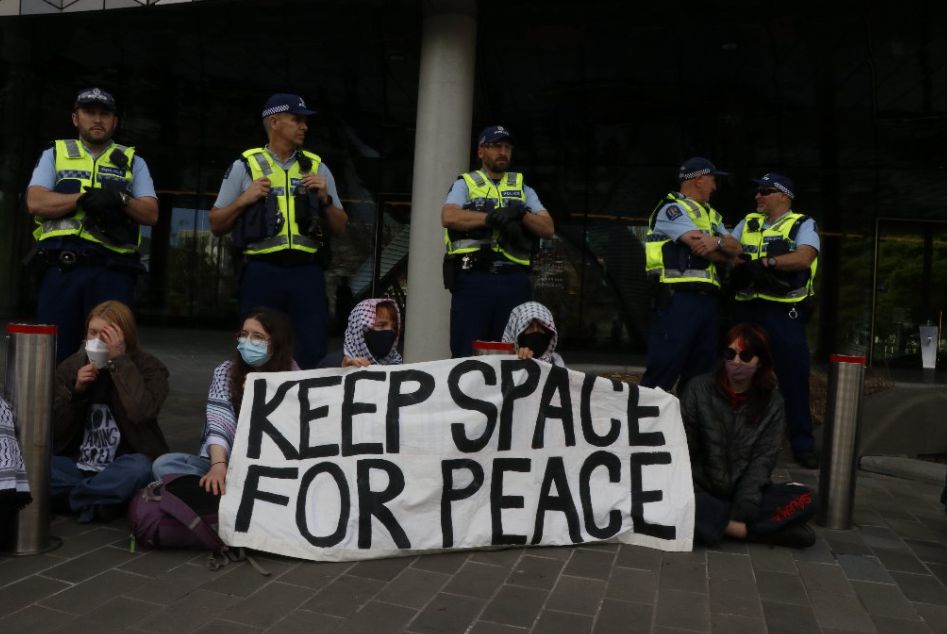
Around 6.30am, groups of activists chained themselves and blockaded various entrances to the building. Of these activists, 22 were arrested, and three minors were detained and released, most at the main entrance. Later in the day, Police arrested 14 more activists for obstructing Police vehicles leaving the summit with previously-arrested activists inside, as well as for wilful trespass, and breach of bail conditions. Three protesters were held overnight, and released around 11.30am on 09/10/25.
Peace Action Ōtautahi celebrates the disruption of the summit and labels the protest as a major victory. “We set out to expose the aerospace industry as what it really is, a front for developing and launching foreign military technology. And we did exactly that” states a spokesperson for the group. “It’s clear from the response that these links aren’t common knowledge, but thanks to these brave activists who were willing to put their bodies on the line, our legitimate concerns have entered the public conversation.”
The group understands that the summit will be held again in Christchurch next year. The spokesperson remarks: “The number of people who are now aware of what aerospace reallymeans, and how New Zealand is complicit in war crimes around the globe, has just been exponentially increased. I’d expect the number of people willing to take direct action against this summit next year to be magnitudes larger.”
Judith Collins, who arrived early at the summit with a large security escort, was utterly unconvincing in dispelling any notion of the industry’s real aims. “The Warmonger from the Waikato,” as she’s been described throughout the protest, knows she is now facing intense public opposition to the sector. Especially to her plans of increasing domestic military technology production, like that of ‘Lethal Drones,’ for which she has budgeted up to $450m NZD. Peace Action Ōtautahi regards Collins’ statement to the protesters to “Follow the rules” ironic given that she herself has recently been referred to the International Criminal Court for enabling a Israel’s genocide of Palestine. A spokesperson remarks “She’s failing in her obligations under Article 1 of the Genocide Convention to ‘Prevent and Punish’ genocide. If she really want’s everybody to follow the rules so desperately, then she might just find herself taking a visit to The Hague.”
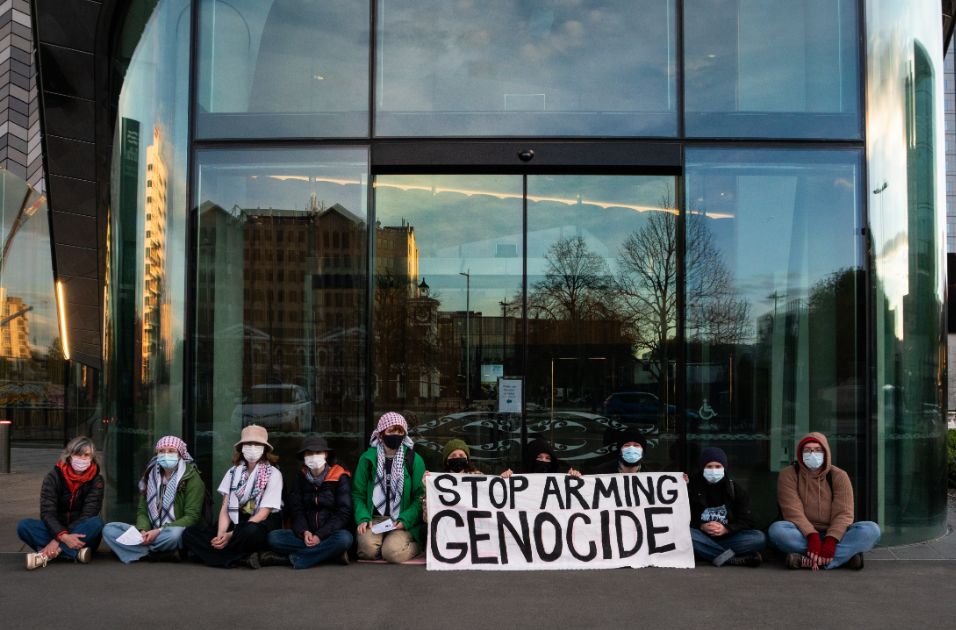
Footage from the protest shows significant physical aggression from the New Zealand Police. Lucy Corlett, one of the activists arrested, said:
“Yesterday I was dragged along the ground by police, then held down and knelt on as they forced my wrists behind my back to be handcuffed. I’ve been left with injuries to my shoulder, elbow, wrist and ribs. However, my treatment pales in comparison to Israel’s genocide of the Palestinian people — a project furthered by Rocket Lab launches from Aotearoa soil. I refuse to stand idly by as a conference of warmongers takes place in our city of ‘peace’. As long as our government keeps our country complicit in the genocide of Palestinians, we will continue to protest.”
A Peace Action Ōtautahi spokesperson, Davien Gray, states: “Seeing police violence against peaceful protesters against war and genocide is harrowing. It’s clear that New Zealand Police are primarily concerned with protecting those profiting from war, regardless of whether or not that requires using excessive force against civilians. Aotearoa New Zealand should protect those standing against apartheid and genocide, not detain and assault them.”
Arrestees were also forced by police to provide DNA samples in custody, behaviour described by human rights lawyer David Small as appearing to be done “to intimidate people engaged in political protest and dissent.” David’s full statement is appended below (Appendix A.), providing insight into the concerning overreach that protesters were subjected to. The three activists detained overnight remained in Police custody for over 23 hours. Peace Action Ōtautahi alleges that those arrested on breach of bail were not charged until much later in the day once the courts had closed, so that they had to remain in custody overnight.
The message from Peace Action Ōtautahi remains clear; so long as our aerospace industry remains dependent on the United States Military and complicit in genocide, there are growing numbers of people willing to stand up and take action.
Appendix A:
Statement From Lawyer and Senior Lecturer at the University of Canterbury, Dr. David Small”
“When the criminal investigations bodily samples act was first passed in 1995 it allowed compulsory samples only from people who were charged with offences with at least seven years jail time as the Maximum.
In 2011 this act was amended to lower the threshold to cover people charged with any imprisonable offence.
At the time there was a lot of opposition to this being allowed by Police without any judicial oversight. The justification for this in the bill is that:
‘we also note that safeguards regarding the rights of individuals in the New Zealand Bill of Rights act and to be included in the police operational guidelines would render judicial oversight prior to the taking of sample unnecessary… The Police operational guidelines being developed by the New Zealand police and the Ministry of justice will guide the Police in the exercise of their new Power by specifying the circumstances in what example is required.’
I’ve read those Police operational guidelines and they contain nothing about Bill of Rights entitlement to protest, freedom of speech, freedom of assembly and so on. This looks like a clear case of Police making use of a power that they have in a way that it was never intended to be used. It looks like they are doing it to intimidate people engaged in political protest and dissent. It should be restricted to its original purpose of investigating and detecting perpetrators of serious crimes. This is a good example of why judicial oversight of DNA sample should be required unless there are exceptional circumstances.”


