

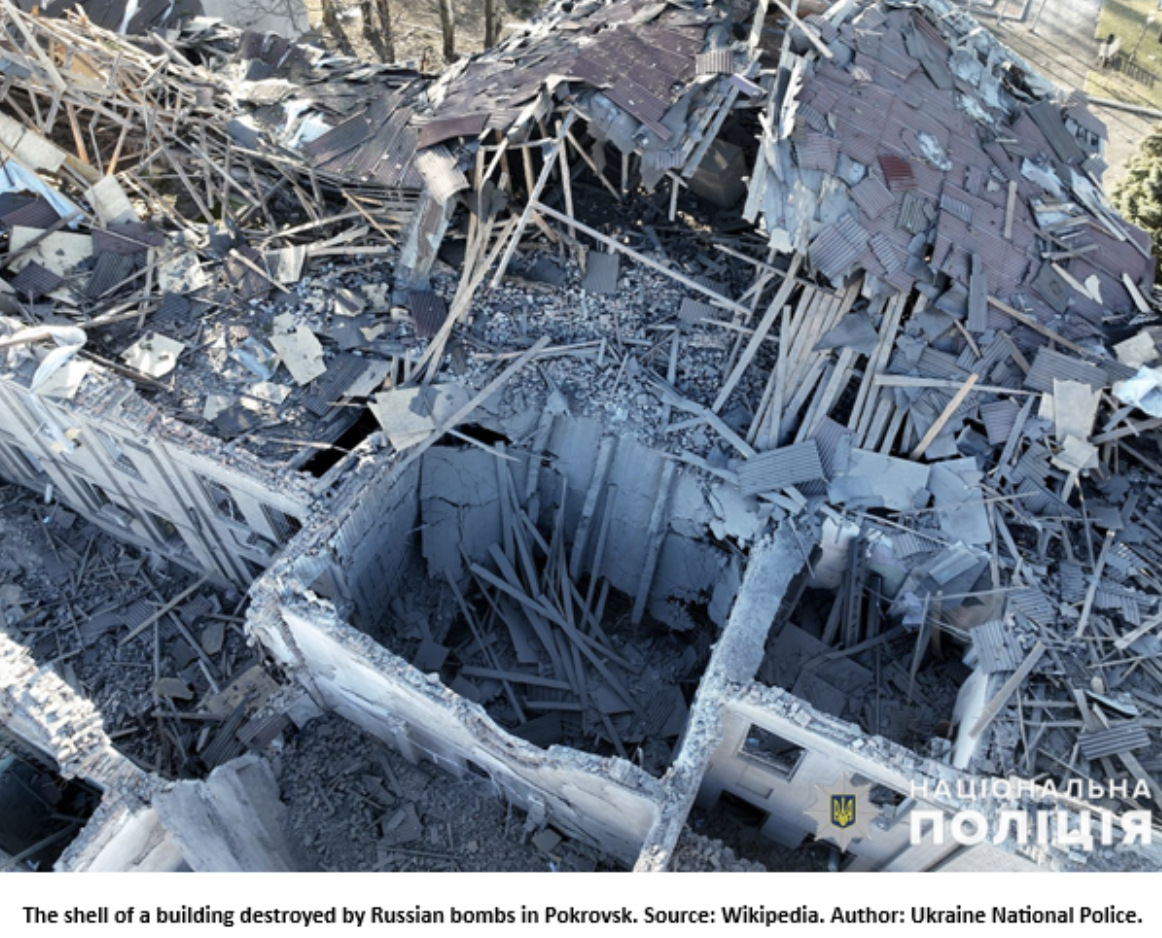
Putin has thrown everything he has at Pokrovsk. Glide bombs, armoured vehicles and hundreds of thousands of infantry soldiers – including some off Russia’s best marine and airborne units. Roughly a third of Russian forces in Ukraine are committed to capturing the town. On 2 December, 2025 Putin prematurely declared victory in Pokrovsk, now six weeks later Ukrainian soldiers are still defending the town.
Putin’s ‘special military operation’ has now lasted longer than the Great Patriotic War and with little return on the huge investment of ‘blood and treasure,’ Pokrovsk is starting to look like a fatal mistake.
The forces the brought Putin to Pokrovsk
Since the failure of Ukraine’s 2023 offensive, Russia’s main effort has coalesced on capturing Donetsk. An oblast annexed by Russia regardless of Ukraine holding 20% of its territory, including the heavily fortified urban areas of Kramatorsk, Sloviansk, Druzhkivka and Kostyantynivka. A series of towns located on a roughly north-south ridge, notable for their Soviet-era buildings, strongly built tower blocks that form the basis for strong defensive works. This area has been progressively fortified since the 2014 Russian invasion and is now known as the ‘Fortress Belt.’ It also blocks a Russian attack from Donetsk into flatter, more open farmland that could be used to advance quickly towards the Dnipro River.
Putin passed laws annexing Crimea, Luhansk, Zaporizhia, Kherson and Donetsk. However, he needs to secure the ‘Fortress Belt, cities to claim Donetsk in anything more than name. Unable to take Chasiv Yar and use it to attack Kostyantynivka Russian forces in Donetsk probed along Ukraine’s frontline in late-2023 and during 2024 looking for a weakness. Swinging south they concentrated for an attack on Pokrovsk in mid-2024. Pokrovsk is a transport hub, and sits on a ridgeline that could be used to attack Kostyantynivka from the south.
Since then, Pokrovsk is the main effort of Russia’s operational-level plan and the ground campaign has focussed on ‘turning movements’ as both sides try to get the other to redirect their forces away from this area. For example, in mid-2024 Ukraine launched an offensive in Russia’s Kursk Oblast. The offensive forced Russia to redeploy soldiers from Donetsk to Kursk changing (or ‘turning’) their direction of effort.
Russia’s advance on Kupyansk is another example of an operation designed to ‘turn’ the opponent’s flank. If Russia can capture Kupyansk it can advance and either threaten Ukraine’s ‘Fortress Belt’ cities from the north, or it can advance west from Luhansk into Kharkiv. A situation that Ukraine would have to respond too, and that would draw Ukrainian forces away from Pokrovsk.
But in recent months, Russia’s ability to try operational-level manoeuvre seems to have diminished and they appear fully committed to Donetsk. Russia committing approx. 140,000-150,000 soldiers or about a third of their force to capturing the town. Russia has two ‘Combined Arms Armies’ (CAA) leading the assault. The 2nd CAA advancing from the south is focussed on Pokrovsk, and the 51st CAA advancing from the north towards Myrnohrad. The Ukrainian formation leading the defence, 7th Rapid Response Corps, has a strength of approx. 30,000. See the map below.
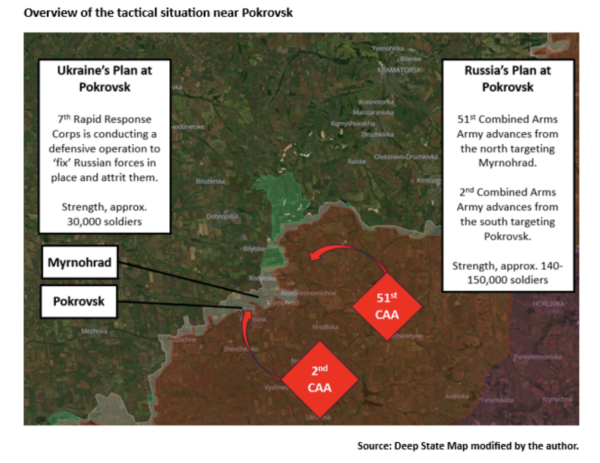
In the mud and snow, the battle for Pokrovsk and nearby Myrnohrad continues. Regardless of Putin’s announcements Ukraine has not given up and both sites are continuously evolving new technology and tactics. Notably, a Ukrainian ground drone, operating by itself, recently defended a position in Kharkiv Oblast for 45 days. Capturing Pokrovsk is getting harder as Russian forces are forced to use open ground to outflank Ukrainian positions, where they are easier to engage with drones. Although, it is likely numbers will prevail Russia’s largest recent gains were made during periods of bad weather and fog. So, the defence may last longer if Ukraine can hold on until better weather arrives.
Why Putin’s investment in Pokrovsk is a mistake
Ukraine’s strategy is clearly articulated and is to wear down and attrit Russia’s military power. In 2024, General Oleksandr Syrskyi took over command of Ukraine’s military he clearly stated that this is his country’s strategy. In December last year in an interview with Sky News he restated this position, saying that “Our strategy is to exhaust the Russian army as much as possible, prevent its advance, hold our territory, while simultaneously striking the enemy in the near rear, the operational depth, and… into Russia itself, with the aim of undermining its defence capability and industrial capacity.”
Ukraine’s objective is to ‘draw in’ and ‘fix’ in place Russian forces then fight defensive battles, on ground of their choosing, and destroy as much enemy combat power as possible. This allows them to trade time and ground for destruction of Russian forces. It is a simple and effective strategy providing Russia commits its forces to attacks on Ukraine’s defensive positions.
In 2024, the war had operational-level manoeuvre and Russia probed at different points on the frontline looking for opportunities. Eventually, in mid-2024 Russia committed to attacking Pokrovsk a decision that has limited their ability to manoeuvre. Pokrovsk has ‘fixed’ about a third of Russian combat power including some of its best infantry, and drone units in one location.
The decision to commit so much to Pokrovsk means that Russia struggles to reinforce Kupyansk, or to open new offensives along the remainder of the frontline. And, this situation creates a dilemma for Putin forcing him to choose between giving up capturing Pokrovsk; or pulling back re-grouping and striking elsewhere. Taking the first option means accepting the sacrifice of more soldiers and equipment. The second option on the other hand, means accepting a significant loss of face, the embarrassment of failure exacerbated by having his claims of victory exposed. After four years of war, it is easy to interpret which would hurt Putin more and why he is unable to consider changing his strategy.
Notably, from a Ukrainian perspective the situation is very different. Pokrovsk has already fulfilled is role by:
- Concentrating a large amount of Russian combat power, on ground of Ukraine’s choosing, where it can be destroyed.
- Stopping Russia concentrating in other areas, and advancing.
- Preventing Russia from reinforcing its operation at Kupyansk so Ukraine was able to re-capture the town.
- Giving Ukraine time to build new more sophisticated defences, that will make any future Russian offensive even harder.
Further, the battle has destroyed the road and rail infra-structure that made Pokrovsk an important logistics hub. The infrastructure can be rebuilt but it will take time and resources. Pokrovsk still sits on useful ground, a ridgeline that provides good observation and an axis of advance on Kostyantynivka. However, the time Russia has and will need to invest capturing the town gives Ukraine an opportunity to mitigate these advantages by building new defences.
I believe Putin has become emotionally engaged in winning Pokrovsk, a weakness because it means he is playing to Ukraine’s script rather than writing his own. Shaun Pinner, from the Centre for European Policy Analysis described this dynamic succinctly, writing that “Pokrovsk represents a place where Russia feels it must win, and where the Ukrainian armed forces are making them pay dearly for trying.” In summary, Ukraine is using Putin’s need for victory to inflict massive casualties and is achieving the objective of any successful general – imposing your plan on the enemy.
Pokrovsk matters because it tells us about how Russian commanders think
Looking at Russia’s operations I am reminded of the term ‘broken-backed war,’ an idea that arose during the Cold War to describe the continuation of military operations after a global nuclear exchange. Essentially, the theory argued that even after such a catastrophe, fighting could continue but that militaries would operate with very limited resources and with a collapsing command and control network. Instead of tanks, armoured vehicles and trucks soldiers would need to walk and use pack animals. Supplies like food, ammunition, fuel and medical supplies would be scarce.
Increasingly, Russia’s army looks like it is functioning in ‘broken-backed war’ mode. Russian soldiers attack in small numbers, their attacks looking increasingly desperate and poorly coordinated. Tanks, armoured vehicles and trucks are rare on the battlefield. Replaced by motorbikes, mules and horses. Russian command and control is also increasingly centralised, and medical support is poor.
Notably, Russian senior leadership continues to underperform and several high-profile generals were recently sacked, or have died in mysterious circumstances. Russian generals being sacked or dying unexpectedly is not new but the fact that this behaviour continues to happen after four years of war indicates the weakness of the military’s command structure. Russia’s frontline soldiers are clearly suffering from both logistics and command issues, while also trying to adjust to a radically evolving battlefield dominated by drones and other new technology.
Generally, sources estimate that Russia takes approx. a thousand casualties a day, or around 25-30,000 young men killed or crippled every month. NATO Secretary General Mark Rutte recently described Russian losses as “unsustainable.”
This raises the following questions:
- How long Russia can continue offensive operations in these circumstances?
- Whether capturing Pokrovsk is worth the losses being inflicted by Ukraine?
Pokrovsk provides insight into the failure of Russian command. Putin is on track to be defeated in this war because he is not ‘appreciating the situation’ in the campaign using military logic. If he was, he would not be relentlessly attacking Pokrovsk, degrading his combat power for limited return. Instead, he would be looking for opportunities to manoeuvre and break free from Ukraine’s plan.
Conclusion
In conclusion, the battle for Pokrovsk is important because even if Russia takes the town, it has already lost the battle. It has degraded its forces and lost the most valuable commodity in war – time. Sacrifice that is not warranted because if Ukraine withdrew tomorrow, the battle has already inflicted hundreds of thousands of casualties on Russia, and destroyed huge amounts of its equipment. Meanwhile, Russia would be faced with re-building the damaged transport network and its ability to attack again, taking more time that Ukraine will use to get stronger and build new lines of defence.
Additionally, the battle for Pokrovsk is not taking place in a vacuum, slowly Russia’s strategic environment is changing. Close allies and partners like Syria, Venezuela and Iran are collapsing or have collapsed, demonstrating Russia’s inability to support or help them. Europe is slowly mobilising, funding Ukraine, closing the Baltic to Russia’s ‘shadow fleet’ of tankers and refusing to be cowed by Putin’s rhetoric. Even the US is showing signs that its leader is tiring of the Putin.
Time is not on Putin’s side and his long and bloody commitment to taking Pokrovsk may prove to be a fatal mistake.
Ben Morgan is a bored Gen Xer, a former Officer in NZDF and TDBs Military Blogger – his work is on substack
