

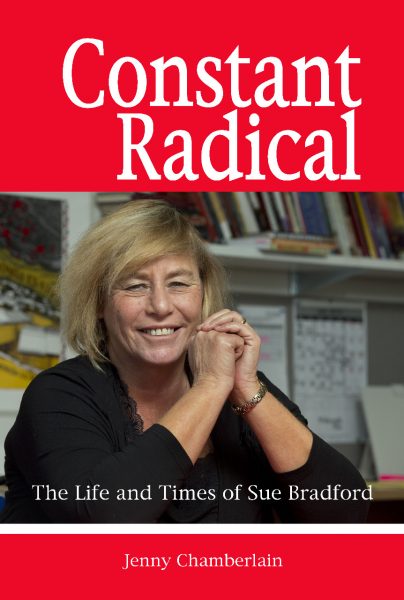
Global politics is in a state of change. Old orthodoxies are breaking down, and new projects are rising to challenge the status quo. These challenges come from both the left and right. While NZ hasn’t felt the same rupture as we have seen with Jeremy Corbyn, Bernie Sanders or Podemos in Spain, the global resurgence of left-wing politics is echoing here as well. Jenny Chamberlain’s biography of Sue Bradford, Constant Radical does not set out to be an intervention into leftist politics. Despite this, those on the left will find it an interesting and valuable read.
Among student, community and union activists, there is an impatient discontent. Many yearn for a political project willing to go beyond the accepted limits and pursue deeper goals than the political establishment deems acceptable. A book about Sue Bradford can’t help but be viewed in this context, and its lessons are valuable.
The book details Sue’s political journey, but the focus is on her personal story. The first 70 pages are dedicated to Sue’s family backstory and childhood. After this introduction there is a rich political experience.
Sue joined radical politics in the late 1960s, part of a generation of activists radicalised by the Vietnam war. The book creates a vivid impression of both the political and cultural rebellion of those times. From that milieu came not just anti-war activists, but the women’s liberation movement, anti-colonial and tino rangatiratanga struggles and a new generation of union militants. Any new radicals would do well to learn from the confident creativity of the fire last time.
The spirit of the 60s is covered in many books, and the strength of this book is not found in any unique insights into the period. Sue’s politics go deeper. While many others made peace with society and started safe careers, Sue remained a ‘constant radical’. What sets her apart, however, isn’t just maintaining the old orthodoxies. There are plenty of old souls who still make it to all the protests. Constant Radical’s real value for politicos is the way it can be used as a guidebook for navigating the difficult path of translating radical politics into concrete organisation.
Constant Radical outlines the work Sue undertook, alongside many others, to build fighting organisations of the poor and oppressed. Unemployed centers, bookshops, political parties, think tanks, newspapers for the unemployed, hikoi, coalitions for protests, a residential education center – the list goes on. It’s a history of political organisation building that is invaluable to radicals today. A radical politics must have at its core the drive to go beyond radical ideas and into radical action. If analysis can’t be translated into activity, it is of limited value.
The book inadvertently makes a telling comparison. It mentions both Sue Bradford and Tim Shadbolt at Auckland University in the early 1970s. Sue at the time was quiet and shy, but purposeful and committed. Tim Shadbolt, by contrast, wore a cape around campus and was the flamboyant face of the protest movement. Sue’s radicalism has passed the test of time, whereas Shadbolt quickly abandoned it when the counter-cultural wave ebbed. He kept the joker persona but that’s about it, and in time became the very establishment Mayor of Invercargill. The book is never strident or condemnatory, lecturing people isn’t Sue’s style. But through her own actions and the mana she has rightly earned from them, a strong argument is built for serious, long-term engagement in radical politics. The posturing “Bullshit and Jellybeans” approach goes nowhere.
This book will also be useful for those new to the radical left as a way to explain the background and context of radical politics in New Zealand/Aotearoa. Sometimes becoming involved in militant politics can be like going to a party with a new group of friends. It’s difficult to engage when you don’t know the backgrounds, histories and traditions of those involved. This will be especially the case when read alongside other books looking at recent decades from a left perspective, such as Cathy Casey’s Matt McCarten – Rebel in the Ranks and Cybele Locke’s fantastic Workers in the Margins.
It is also worth noting that while this is a personal biography of Sue, there is an amazing number of other people named along the way. Sue’s personal and political journey was accompanied by many friends, comrades and close collaborators. Biography is by nature individual, but reading this book you can’t help but appreciate the collective of activists who helped keep the fight for a new left alive. Many of them remain active today.
As a final point, for those who know Sue, it can be at times awkward reading. It’s easy to get into the juicy details of a biography about a historical figure, or someone you never meet, but it felt a little bit intrusive to be reading intimate details of the life of someone you’ve shared a beer with. Ultimately, this has left me with a greater appreciation of Sue’s personal strength and warmth. Whether you agree with her or not, no one can deny the many contributions she has made to New Zealand history and the deep, principled set of convictions that drove her through this long and often arduous work.
For those of us trying to follow in her footsteps, Constant Radical is a must read.
Ben Peterson is a Union Organiser for Unite
Comments are closed.