
LONG-FORM REPORT: Creating the citizen economy
How to stop ‘the normal principles of taxation’ destroying our economy and begin changes to create a citizen economy (Part A)
EDITOR’S NOTE: Taxation is the mechanism for redistribution of wealth to combat inequality and for redirecting resources to build a society. But our current tax principles though largely hidden or not understood by ordinary people, lie at the root of all our current inequality and struggling economy. Struggling at least for ordinary people. This article shows our current tax principles are central to our economic problems. Understand and fix tax and we are on a path to greater economic security and wealth for all, a ‘citizens economy’.
Special Analysis by Stephen Minto.

In my article ‘Housing – We can’t build our way out of this housing affordability crisis.’ on 23 August 2021 I looked at the economic structure driving housing affordability and how to solve it. I identified ‘the normal principles of taxation’ as a major factor driving excessive investor demand.
Those normal principles are helping create three of the main problems we are facing in our society:
- tax avoidance,
- inequality, generating poverty (including the housing affordability crisis),
- environmental damage, and the resulting multiple related crisis’s. (e.g climate).
These three problems show the current ‘normal principles of taxation’ are sending the wrong economic signals to the economy and distorting it away from its primary purpose, the supply of goods and services to meet our society’s wants and needs. But there is a simple reset of the principles that removes the structural drivers currently creating these problems. And a reset is essential to fix these problems as new taxes or laws will just be lipstick on a pig if we don’t fix the underlying structural drivers.
This relatively easy reset does not require any international agreement or loss of autonomy for New Zealand.
NOTE: For your convenience, we have structured this long-form report into five sections:
- In Part A we look at six ways the existing normal principles of taxation are damaging the long term economy and subsequently our society. They show the basic principles of economics are being undermined by the normal principles of taxation. I then identify the two main actions of a reset that will fix this damage.
- Part B in this series details the full range of required tax reset ideas (e.g. get rid of damaging GST) and goes through the impacts from the full reset and how many of those challenges actually put the economy on a more sustainable and stronger growth base, with more competition.
- Part C in this series covers aspects of the Pandora Papers and how it is the ownership structures of companies and trusts that are creating moral and economic problems just like the normal principles of taxation do. I raise some basic questions about how we should/could change the powers of, or scope, in which these entities are formed and operated. It is only in the structural permission about how they work that we can stop the economic problems we currently have.
- Part D in this series examines beneficial impacts and reasons why the capital revenue distinction must go. Including how it will operate and impact business.
- Part E in this series details impacts on various sectors of the New Zealand economy.
- PDF – Or you can download and print the pdf of this long-form report.
What are ‘the normal principles of taxation’?
At a very high level, income is identified by having three features:
- It comes in
- It is periodic (not one-offs)
- It has the character of income in the hand of the person who receives it.
From these base features principles arose. They have been adapted and interpreted through case law of a capital/revenue distinction. That can be defined as:
- Capital is not taxed but revenue is, so some businesses try to label items as capital to reduce their tax bill. A lot of the Pandora Papers covers this type of ‘legal’ activity.
- A sale of a farm, as a one off, is generally capital and not subject to tax. You would expect that to be reinvested somewhere rather than used to live off. But the sale of produce from the farm (periodic – used to live off) is taxable.
- Expenditure incurred to gain that ‘income’ should be deducted before tax is paid. Money spent to gain income is not really income that can be taxed.
- So you get gross income and net income.
- Expenditure incurred can’t be questioned.
- Costs to run a business can’t be questioned for taxation because it is up to the owners how to run the business regardless of the consequences or how sensible they are.
These are enough principles for my purposes; but inherent and inseparable in these principles are some values:
- tax is a cost, and
- it is legitimate and necessary for efficiency to minimise that cost. Like you would with any other cost.
But there is the catch in this, tax is not a normal cost.
Why are these ‘normal principles of taxation’ a problem?
Here are six points that explain why the principles send the wrong economic signals to the whole economy and undermine economic growth.
1. They undermine comparative advantage and encourage monopoly
(Small businesses with lower costs should have an advantage in price over big firms. But larger firms use costs to reduce their tax to give them an advantage.)
- Business is supposed to be efficient and reduce costs, to be competitive. The theory goes, by driving down costs you drive down price which is better for satisfying consumers wants and needs. This is more efficient and only business can do this as government is wasteful and costly.
- But this same efficiency driver on a micro business level sees tax as a cost that a business gets nothing for on a balance sheet. So to avoid tax, a dead cost, the ‘normal principles of taxation’ allow them to grow other costs to not only prevent having to pay tax, but also to do things that drive up the price of their goods and services so they gain more profit.
- We all know and experience the marketing techniques that large business use to keep their profits high, or how they run anti-competitive practises to undermine competitors. e.g. run an airline along the routes of a competitor so they don’t grow and move into their high cost routes. And these techniques cost a lot. They rely on big data from loyalty cards, slick advertising, changing superficial designs with new releases, glamorous shops, etc. And they rely on access to debit financing. These are just ‘normal’ large business practises based on behavioural/marketing psychology and finance.
- So large businesses don’t mind incurring these costs because they will reduce the ‘dead cost’ taxation they have to pay. And it is a big saving, 28% on every dollar spent. So consumers/taxpayers in having a reduced tax are actually helping large companies pay for techniques to make us pay more money for their goods or services. So we pay twice for their supplied good or service – once on the high/‘discounted’ price and second through the tax subsidy.
- Small businesses simply can’t afford to run the same techniques or access debt finance in the way a large firm can. Their whole pricing structure is done differently; they reduce their costs and run a tight ship. These economic rules simply don’t apply to large business because the normal principles of taxation turn costs into an asset for them – a tool to drive out smaller competitors while driving up price. Small firms can’t compete against these large firms no matter how good the quality or price they charge for their good or service.
- Another perverse result is large businesses become less concerned about quality and service in part because like any large bureaucracy they have to wear a few problems. But also in part because large businesses not only compete on price and quality, but compete through ‘cost accrual competition’. The ability to accumulate costs that work to their advantage over smaller competitors. And it is profitable and relatively easy and ‘legal’, but it shifts a large business’ focus away from innovation and building quality or low price, and into a focus on gimmicks and primal manipulations to trick us to buy. And it reduces competition as smaller firms can only compete by reducing costs and there is a limit to that.
- We can see this most easily in fast food and retail where there has been a slide into franchise. The Chemist Warehouse is one of the most recent. Costs on the floor are tight but the marketing, site location rental, management fees, executive salaries, advertising, debt financing are all high cost. In a generation the smaller owner run businesses taking pride in their business are largely gone from New Zealand. So many small businesses struggle and fail because it’s hard to find niches to escape the larger firms relying on costs and turnover to drive their pricing. Cost efficiency is no longer a key economic driver for a large business; ‘cost accrual competition’ through saving tax is the easiest way to wealth.
- In addition larger businesses are more likely to spend on vanity expenses because it still reduces their tax bill so it gives them an advantages over smaller competitors. e.g. take a lease on property in prestigious locations, purchase on finance or lease luxury cars, still get a 50% deduction for business ‘entertainment’ expenses – meals and lunches, tickets and who knows what else.
- ‘The normal principles of taxation’ remove the natural competitive advantage of a low cost business supplying the same goods and services. These smaller business are normally New Zealand owned and operated. And to catch that advantage all businesses have to follow that high cost model, and treat tax as a cost to be minimised, leading to larger and larger businesses leading to monopoly capitalism. Cost accrual competition is a powerful economic tool and we the taxpayer are subsiding it to only some people’s advantage.
2. They undermine redistribution of wealth (tax) and the resulting economic stimulus
- Almost all businesses do not create wealth, they simply accumulate wealth. And to accumulate they rely on the education and health systems to support access to employees and customers. They also rely on infrastructure, courts, police etc in which to do business. Tax minimisation, avoidance and evasion, undercuts the process of redistribution of wealth which pays for the supply of these services and therefore it undercuts the provision of the services the business needs to function with.
- Redistribution by taxation also supports demand across the economy which in turn supports business accumulation of wealth. The ‘tax is a cost to be minimised’ attitude comes from the normal principles of taxation, but tax helps promote the multiplier effect which benefits the entire economy. The principles need to change so that no business has an incentive, and mechanism provided by the principles, to minimise tax, as it works against the long term supply of goods and services, within the economy.
- Tax is like no other cost as it is not fixed. The principles calculate it as a relative cost based on what income is left over after costs. So on a micro economic level a business see’s an advantage to run up costs to minimise payment of tax. But on a macro economic level that minimisation is damaging the economy in which it functions. Tax minimisation is actually an act of self harm by a business in the long term. The normal principles of taxation are creating the problem.
3. They subsidise risk taking and provide no choice for taxpayers on doing that.
- By allowing business to deduct expenses to reduce their income that is liable for tax; it makes the New Zealand taxpayer subsidise the provision of that good or service through sacrificing tax collected. And as said before the saving is not always passed on, prices are held high and profit maximised so consumers are not getting the benefit of the subsidy. The normal principles of taxation allow no choice for society on making this subsidy. e.g. huge amounts of investment resources can be used to subsidise the business of taking rich people on tourism flights to space. Would people vote for that choice, over lifting more children out of poverty? But there is no vote, we have no choice, and it is tax revenue we could have.
- The entrepreneur who has the knowledge to make these choices about what costs to incur should take the risk for those choices. Choices and risks should not be subsidised by taxpayers or government as that is not their role.
- If the people or the elected representatives decide to subsidise an activity that is okay. And that is very different from a blanket subsidy as happens currently under ‘the normal principles of taxation’.
4. They punish innovation or the efficient use of resources
If two businesses supply the same good or service but one does it at a higher cost than the other, why should the lower cost company pay more tax? This is not good economic policy.
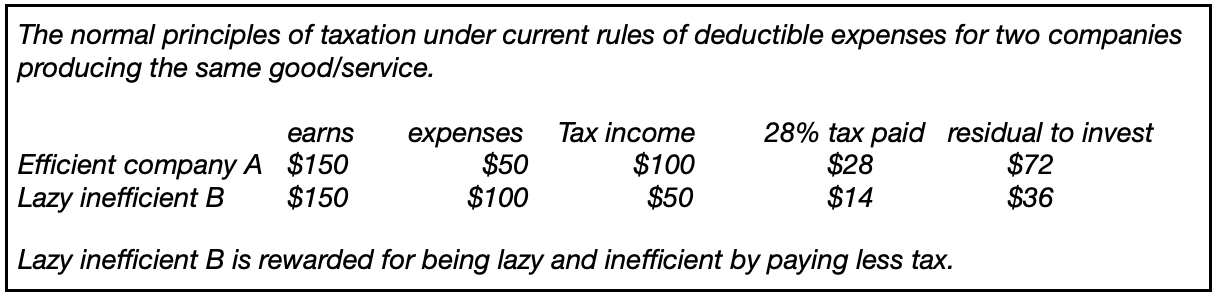
- The Lazy Inefficient company B has more expenses ($100) so only pays $14 in tax but the efficient/innovative company A ($50 in expenses) pays $14 more tax at $28.
- The normal principles of taxation are sheltering poorly performing companies, and punishing well performing companies. And the taxpayers through having less tax collected are subsidising the inefficient poorly performing company.
- And the principles allow more investment income to be made available to this poorly performing company. i.e. wasting scare investment capital. (If B did not get the tax subsidy and had to also pay $28 in tax like efficient company A, then Lazy inefficient B would only get $8 to reinvest).
- To those who say the high cost of B could be due to the quality service they provide. Yes, and that will mark them out from their competitors, and that quality should sell them. But there is no way for the blunt instrument of taxation to tell the difference of quality to wasteful spending; so it shouldn’t. If customers don’t want that business’s ‘quality’ then that is a market signal. There is no reason for the taxpayers to subsidise a business’s choices on quality as the entrepreneur might be right or wrong and there is no way to tell, except by the customer.
- More can be said on this example but it does not change the fundamental point that the wrong economic signals are being sent. e.g. Company A could have less customers and be price matching to Company B to maximise their profit rather than passing on the savings from innovation to their customers. Company B becomes a tool to make customers pay more as its existence takes up some demand, which slows the introduction of potential new competitors. This is another reason to have B out. This shows tax is only part of fixing the economy but a very very important part.
5. They subsidise environmental damage or resource waste by creating an externality
- Of course not all companies have high cost structures because they run anti-competitive practise, or have vanity expenses, or they are just seeking tax minimisation. Some businesses, are just very costly to undertake and there is nothing inefficient about that, e.g. mining.
- But should the costs to run those enterprises be subsidised by the taxpayers taking a reduced tax collection? The high costs of those business choices should be borne by the risk taking entrepreneur with the knowledge to take those risks.
- For example, if you do the Hump Ridge track you see some great wooden viaducts used to bring out the timber from a milling operation. The devastation of the local forest was complete but the business as reported never made a profit as its costs were so high and the sales income never fully came in. New Zealand got nothing of substance out of this destructive exploitation. Yes workers got wages and scrimped a life of remote hardship. The directors would have got income along the way. Yes there is now some tourism value but it’s probably not much more than if it was left. Overall, the value of the forest asset was wasted without profit. The ecological and cultural value lost can’t be quantified.
- The same destruction and waste occurred in the areas around the ‘Bridge to Nowhere’ in the inner Whanganui. All over New Zealand subsistence businesses were supported by ‘the normal principles of taxation’ for people to eke out an existence to the detriment of traditional Maori life and culture, the environment, and their own lives. The ‘normal principles of taxation’ were one of the systems within colonial exploitation that allowed profits to be stripped back overseas without as much redistributive effect from an effective taxation. The principles were a tool to strip value out of the new nation as the costs of exploitation were offset to the income. It is a tool in a class system that strips income away from the redistribution/taxation process.
Colonial legacy justification and creation of an externality
- Yes, you can argue that this sort of tax subsidy for business was necessary to enable economic activity in new lands. And that is the colonial argument. From where we stand today we can see the waste and destruction of that legacy and thinking. Our climate and environment is imperilled because of it. But it’s still happening, that structure is still in existence within the normal principles of taxation, and it is helping drive environmental damage and climate change. The rules were made through judge law to favour the wealthy to help drive their, or their class’s, wealth. This reset will at least make the full cost fall on the risk takers and they will at least be more careful in future because the cost will fall on them fully.
Ongoing impact
- If income from a business activity almost matches the cost of the activity, then very little tax is paid. So when the good is being sold the price does not reflect the cost of society’s human and physical infrastructure that was required to support that activity. Because tax was reduced this cost is not calculated into that sale price. i.e. a seller will work for the highest price but if the cost of production is subsidised, the threshold for the sale price is being subsidised and the true cost is not reflected in the price resulting in false economic signals being sent to producers. The normal principles of taxation are creating an externality of the cost of society.
- A business must fully contribute from its income back to society through paying tax or there is no point in society letting the business be in existence. Like the purchase of the viaducts, or the mill boilers, tax is just a cost that should be factored in and you can’t avoid it.
- Each business or activity needs to be viable in its own right so it has a cost that reflects if it is a high cost activity. Current loss offsetting hides a costly activity and dissuades companies funding research or looking for alternatives to get around high costs. Subsidising by tax undermines that drive for innovation.
- Environmentally damaging activities like mining are one such activity where if the cost of tax was not able to be avoided, a higher price would generate more focus on recycling, or innovation to find alternatives. See more comment under heading ‘Different sectors have different impacts’
- It is no longer appropriate for our business community to be molly coddled and subsidised by socialising their costs onto the New Zealand taxpayer, the government, and the environment.
6. The ‘normal principles of taxation’ are helping cause an international destabilisation problem.
- President Xi in China is crushing democracy in Hong Kong as he see’s it as a vehicle to undermine China. But he is fighting the wrong enemy. As a former colony of Great Britain Hong Kong follows the basic outline of ‘the normal principles of taxation’. And most of the tax principles were set through english case law by judges who arguably have acted in their own or their class’s economic interest when making decisions that set precedent. As a colony these tax principles facilitated economic value being stripped away from the colony and the lands near it to the benefit of the ‘mother country’. In the post colonial world we still see these tax principles being used to strip value out of countries with little tax paid, and then into tax havens for the use of the billionaire owners of Google, Amazon, Microsoft and others.
- China has become the factory of the world as large multinational companies moved manufacturing there for cheap resources and low regulation. President Xi wants the work and business to stay so it will give stability and economic strength to China. He was recently reported on CNN Aug 18, 2021 by Laura He as pushing on China’s rich to redistribute wealth. So he can see problems in his nation but he is asking business people bound by a tax system to act outside that system. His quest for security by taking on democracy and the Uyghur people means he is no longer walking with his people as a leader, using the wisdom of the crowd to guide his nation but is leaning into an inherently unstable autocratic leadership model. And he is adding fuel to the cold war that leaders in the US, UK and Australia, seem willing to hype up in a new alliance. He has chosen the wrong enemy; it is the colonial based tax structure that is undermining China’s security, e.g Transfer Pricing and Thin Capitalisation are able to undermine revenue and the ability to grow domestic based businesses in a way that spreads wealth. That has to be dealt with by simple consistent rules as suggested here that do not favour multinationals, as the current normal principles of taxation do. Democracy needs to be decoupled from exploitive capitalism and a tax reset will help do that.
- And the ‘west’ is also struggling with conflict and polarisation in society, driven through culture war issues like immigration, climate change, vaccines, and abortion rights. In the ‘west’ the culture wars are facilitated through a dysfunctional 4th estate and poor quality democratic processes. These culture wars have some urgency for ordinary people, ‘taking our jobs, taking our opportunities’, but theses are just the scapegoats for the very real economic struggle many are experiencing. It’s about the economy getting polarised. Ultimately the western nations have the same enemy as China in the poor functioning of the tax system. The tax system is helping build monopolies, facilitating tax avoidance, and undermining local businesses. We are all poorer.
- The normal principles of taxation are well overdue for a complete overhaul so they build each nation’s economy and redistribute wealth, and that is the purpose of taxation, not to concentrate wealth and build tax havens.
- Note: The need for international trade by New Zealand will not be impacted by these changes but it may, or may not, modify it. And with the supply chain disruption brought by the Covid-19 Pandemic, it makes it an excellent time to bring in changes that will ameliorate the disruption we are already experiencing. It will help our nations build back on to a more sustainable path.
How shall we reset ‘the normal principles of taxation’?
- In the media and policy world the strongest reset theme for taxation is greater transparency and sharing of information from other jurisdictions (especially tax havens) so tax can be claimed. This is all essential work that needs to be done but transparency and sharing information does not remove the structural problems created by the principles. And the current principles have created a complex set of rules that are an administrative burden.
- And the creation of new taxes like wealth taxes will not deal with the structural drivers of wealth concentration. As the Pandora papers show the normal principles of taxation are a major driver of wealth concentration and tax avoidance.
- I propose a structural reset that uses existing economic understandings which therefore won’t destabilise the economy, and it works alongside the existing market forces, sending appropriate signals to the economy.
The two main reset actions are:
- Remove deductibility for all expenses except for domestic salary and wage payments.
2. No capital revenue distinction for non-individuals.
This is supported by:
- A very broad legislative definition of ‘income’ to ensure everything that comes in is taxed regardless of traditional capital revenue distinctions. Even to include related party loans (with an exception for 3rd party loans – perhaps a strict list of who can be a 3rd party). The Pandora papers show this is essential regardless of even this reset. Because the current normal principles of taxation allow a company to make income but then through a series of entities turn it into a loan to be made back to the company or another related party and a ‘loan’ is not taxable. Part C, in this series, gives an example.
- No grouping of companies for tax purposes. Companies are separate legal entities and will be treated that way for tax.
- The original intention of grouping was to prevent tax avoidance but it has now been twisted to be a major tax minimisation technique. i.e. Company tax rates in the past had a progressive structure. To avoid paying the higher rates a company created lots of sub companies and spread the income out so each paid an amount just below the high tax rate. This was then stopped by the requirement to group the companies so they did pay the higher rates of tax. But then for anti-competitive purposes parent companies began to run subsidiary companies – not to make a profit but to make a loss (the exact opposite of what companies should be set up for in an economy). Using ‘cost accrual techniques’ and low income. e.g. run a small airline at a loss to compete with a budget airline to preserve their other profitable routes. Grouping then allowed their losses to be offset against the income of their profitable routes so less tax was paid. If a situation arose where the loss company was no longer needed the losses could be retained but limited liability remained as a protection for the parent company. A long time ago the progressive tax rates on companies were removed and company tax was made a flat tax rate but nobody got rid of this ability to group companies. The companies wanted it kept. It is overdue to get rid of grouping.
- Without a capital revenue distinction and strict application of entity status, shifting assets between separate legal entities will generate taxable income because their status as a separate legal entity now becomes important for tax purposes. With less advantage in having separate legal entities, companies will become bigger which will improve transparency and reduce the ability to avoid tax or scrutiny. This reset will work with international trends to improve transparency. With more potential exposure to risk, behaviour and focus will change.
- A company to trade in New Zealand must be required to have a company registered and based in New Zealand through which all its activities are subject to tax that are ‘sourced’ from New Zealand. And they must have a New Zealand bank account. An asset in New Zealand can’t be owned by a foreign based organisation in a tax haven as the risk of tax avoidance is too high. If there is not a base in New Zealand, e.g internet sales, then work must be done with banks on how sales can be caught for tax or punishments if not. This is already a tax issue and not created by this reset.
- In ‘Part D (of this series) – Beneficial impacts for all with no capital/revenue distinction and less tax minimisation’ I go through more discussion of these points. In particular how taxing disposals of cash accumulations is not double tax but sends a beneficial push into quality and price for goods and services.
Economic policy and tax principles alignment
This reset does four main actions:
1. It removes the structural drivers for all the six economic problems listed above. Obviously other actions need to be taken in addition to tax for issues like international relations. This reset does not restrict actions but better supports them.
2. It stops almost all tax avoidance techniques based on currently ‘legal’ processes. Nobody is telling business how to run their business or control what they do. The choices are all still with the business, it is just the consequences and risks that will be fully carried by the chooser.
3. It removes any incentive to waste or damage the environment, or any assets, as all costs will be fully carried by the producer. Because things will cost more, the throw away culture will not be structurally supported by the tax system. Note – things are costing more now but with no quality improvement. Quality has the chance to come back.
4. It redirects investment capital to producing goods and services to meet the needs of society. With interest no longer deductible for tax there will less demand to debt finance. Finance will therefore be freed up for investment in actually producing goods and services. Yes some capital will be taken up to hold assets like land but that is a good investment at the moment. The purpose of debt financing is largely cost accrual competition. Part B of this series has more on the potential positive changes in how investment may occur.
But is this economically viable? We must look at the numbers.
Financial impact of reset
From the Statistics New Zealand website we have the ‘Annual enterprise survey: 2017 financial year (provisional)’.
It states for businesses/enterprises the:
- total income for New Zealand is $644.2b (billion) and total expenditure is $560.7b.
- Surplus potentially subject to tax = $83.5b (If the current tax of 28% was applied, this = $23.38b)
- 2017 Inland Revenue Annual report, says corporates actually paid $14.2b.
For contrast from the Inland Revenue website 2017 annual report –
- Total tax in 2017 was $69.2b and Individuals paid 48% ($33.2b) plus GST 26% ($17.9b) = 74% of total tax was paid by you and me.
Taxation under a reset calculation – A soft transition calculation
The existing tax rate of 28% could be used or a lower rate of 15%. But if we aim to increase taxation because it is sorely needed for social purposes, and to pay down debt, and we don’t want to cause too much business disruption, then the following is an option.
- Businesses claimed they had $83.5b income over expenses for the 2017 year.
- If we initially taxed all companies at 10% of total income, no deductions for costs (except domestic salary and wages). And indexed to go up in future years. This will give a massive boost to small business.
-
- $644.2b x 10% = $64.42b tax.
- As business had $83.5b over costs it means there is income available to pay the $64.42b tax. They would have to shift profit expectations and likely no dividends. Impacts will depend on the individual business. If we add in the Individuals tax, and ‘other’ ($37.1b) tax paid that year (I leave out GST as it must be dropped – as it damages the economy) we would have: a total tax for 2017 of $101.2b
- The amount of 10% should be indexed to go up 1% every one, or two or so years, until it reaches 15% or 20% or whatever the government of the time decides. The 10% rate is too low for the urgent needs of climate change and human need. (The cost is higher now because actions were not taken earlier, and business in aggregate has not supported taking action sooner, in fact they hindered action).
Other taxes?
- This increase in tax collected is without any new wealth tax or capital gains tax, and with a reduction of the headline tax rate. But there may be other reasons to do new taxes. In times of war. Or environmental crisis. Or a housing crisis. Tax is so low at the moment and the social needs so pressing, plus the debt must be paid down, that the amount of tax to be paid must go up.
Easier compliance
- Another reset benefit is it could be possible/investigated to require all money deposits to a non-individual to go through one bank account with an instant deduction for 10% tax. A credit can come back once a salary or wage payment is made in the Inland Revenue employer account. This means no provisional tax or due dates to worry about. A great compliance saver for small business. Obviously all bank accounts would have to be linked to an IR number to prevent avoidance but if all non-individuals bank accounts were automatically subject to tax, then that removes some temptation to avoid tax liability.
The economy context
- This reset is still only income that is being taxed; something that has ‘come in’. So money is there. Any realised capital gains would also be taxed because they would have ‘come in’. But as there are avoidance techniques for companies to delay gains coming in I am not expecting much to be collected under this category, initially. But a rising tax rate might persuade them to come forward earlier. But we could use the ‘risk free rate of return method’ to calculate this ‘income’. But that would be at least 15%. Other options to capture unrealised gains are being discussed in the wider media.
- If large businesses say they will go out of business, then that shows just how dependent they are on the tax subsidy. So are they truly viable? The slow introduction of a lower but more effective rate would give them time to adapt to moving away from debt financing, and high cost structures. But there are many more effective ways to achieve this change. I don’t expect them to move away from their marketing techniques but they would pay that cost without being subsidised by taxpayers. Issues with marketing and consumer protection can be dealt with separately but those actions will be undermined by the current tax system. Actions will be more effective with a tax reset.
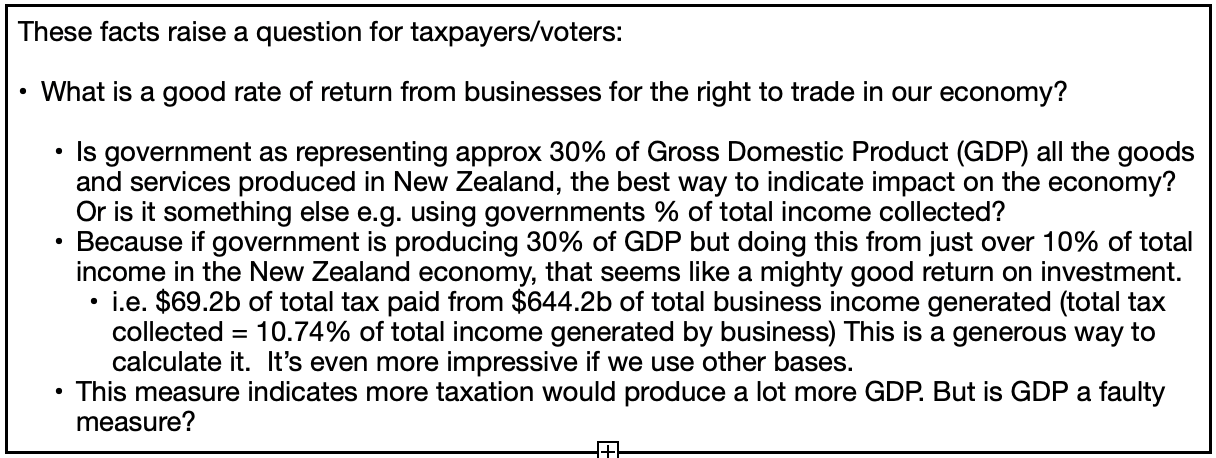
- To stick to the concept of government spending being less than 30% of GDP reduces our ability to create wealth through the multiplier effect. A demand driven economy will bring better economic growth that actually satisfies people’s needs. The only risk to a demand driven economy is how to control pricing and inflation, (I propose an article on this at a later time). We tried supply side economics and we have poverty, housing shortages, housing inflation, a struggling health sector, and an education system beholden to overseas students.
Perfect timing
- The recent talk about inflation and stagflation in part due to supply chain disruption make it the perfect time for the reset to happen as it will reduce business sector demand. All large businesses will be strongly focused on reducing their high cost business structure which will reduce demand and take pressure off inflation. Recall that a lot of business sector demand is micro business churn to drive price and demand up for their product or service. It is not growing the economy except in an incidental sense. Innovation, exports or savings are not being driven in the macro sense by that spending. By contrast small businesses with the lower tax rate will be opening up, increasing competition. I talk about inflation in Part B of this series but will require a further analysis.
Summary – we must reset ‘the normal principles of taxation’
- This reset is not about political sides or ideas. It is about making the economy work as it is supposed to, meeting people’s wants and needs.
- If we believe in markets with businesses competing on price and quality then this tax reset must be done because the current tax system undermines that, or
- If we see the economic system is failing and people are falling through the cracks then this tells us one of the main reasons why and how to fix it.
The current tax system is breaking the economy and society. We are a frog in a pot that’s been on the stove for a while.
- Further evidence the tax system is broken is seen in the US which has the same basic principles of our system and many of their largest companies aren’t paying much tax, e.g. Amazon, Honeywell, Halliburton, IBM, Fedex, Nike, US steel, Chevron, Delta. These companies are even managing through globalisation to avoid capital gain taxes. So we can’t just rely on new taxes to solve the existing problems. The foundation, ’Income tax’ must be fixed and this reset is how to do it so the big companies pay their fair share.
- Minimising tax is big business for every large firm. For the cost of a small team of accountants they can structure finances to avoid billions or hundreds of millions of dollars in tax. The purpose of tax is to redistribute wealth but ‘the normal principles of taxation’ are discouraging redistribution so economies and societies are struggling, with small businesses disadvantaged and people’s wants and needs not being met.
- The reset here retains largely the same tax system with all business treated the same. But the reset strips the rules down so there is nowhere to hide or shift the money. Because it is in the rules where the loopholes are found. And the rules/legislation are written with the normal principles of taxation firmly in mind, and with considerable input from those accountants who are deeply embedded in tax orthodoxy. The business sector has had a significant input into developing tax law and the business sector likes lots of red tape rules as it offers lots of loopholes.
- In this reset you can’t shift money between income (subject to tax) to capital (not subject to tax). A person can’t reduce their tax by claiming expenses real or imagined. There are no losses or capital losses. I suspect the reason why we don’t have a capital gains tax in New Zealand is the fear of capital losses undermining future government revenue along with complexity of the law – but this reset shuts down those fears.
- With this reset the tax system becomes much simpler and more transparent. This is why stripping the rules back, as is proposed in this reset, is actually the only way to get a truly broad based low rate income tax system.
Note: Even if the government only takes the tiniest initial step along this path by removing the deductibility of interest. This will slow the incentive to debt finance, which will undercut many of the negative tax practises. And with lower demand for loans it will help redirect investment to new projects or innovation. We will start the journey to a more efficient tax system that builds the entire economy and society.
It is overdue to change ‘the normal principles of taxation’. Write to your MP’s and tell them so over and over again. Because some self-interested businesses do the opposite, a lot. They forever talk about black hole expenditure and of this situation or that. Just recently the government allowed deductions for feasibility expenditure – that is normally capital expenditure and not a deduction. So the rules are going one way all the time to allow more and more costs. This reset removes most of that and simply moves the dial back the other way. This reset is not breaking the tax system anymore than it can be said the feasibility changes are. We all know from the Pandora papers the income tax system is stuffed but surprisingly it’s not impossible to fix.
———————
In Part B of the article ‘Creating the citizen economy’ I expand what is involved with a comprehensive reset and outline the key impacts.
- In Part A I outlined the problems the current principles are creating and I outlined the two main changes.
PART B – The six reset actions in New Zealand – for the normal principles of taxation
The six actions are:
1. Remove deductibility for all expenses except for domestic salary and wage payments.
2. No capital revenue distinction for non-individuals (variation for a private home in a trust or other entity).
3. Imputation and other related memorandum accounts should be ceased.
4. Introduce some restrictions on charitable status, and donations.
5. Remove GST as a tax (alternative taxes could be considered to replace if needed).
6. Tax evasion (tax avoidance is dealt with by the above proposals) become fully engaged by the New Zealand Police – financial intelligence unit.
1. Remove deductibility for all expenses except for domestic salary and wage payments.
- A deduction for domestic employment gives encouragement to employ people, and to reward them well is not a drag on the business (e.g. no claim for wages if you set up a call centre in another country). Easy to audit the claims as domestic salary and wage records are kept within the NZ tax system.
- This removes cost accrual competition and reduces the opportunity to avoid tax. It would structurally set the idea that tax is just a cost that business must pay.
- This action gives comparative advantage to low cost locally based businesses. This will encourage small start ups. Small businesses allow more opportunity for ideas and innovation to be pursued. It encourages peoples enthusiasm to pursue their ideas. More people are employed in small businesses.
- This action simply aligns costs that set up the business (capital and not deductible) with costs to run the business as (revenue and deductible) so neither expense is deductible for tax (Just like employee’s aren’t allowed any deductions). Currently larger companies find it easier to set up intervening companies which will incur the capital costs but then on-charge the capital costs through the intervening company so they look like revenue costs. This sort of tax minimisation ceases. Smaller companies benefit.
- It will promote fair competition, and economic efficiency by recognising the above comparative advantage of a business with a lower cost structure, leading to less waste of resources while encouraging New Zealand based business which could lead to a lower carbon footprint.
- The tax system would be easier and less costly to comply with and administer. It would also make the introduction of the second reset action much simpler and less complicated.
- There are several significant impacts which will change the way business is likely to be organised (see below for a discussion of impacts). Just as the existing ‘normal principles of taxation’ are encouraging negative behaviour, the reset will encourage positive behaviour.
- Drawings would have to be paid through the IR employer system to be credited for deduction so taxed when received and included in social policy calculations. Or there is no deduction and it would still be required to be declared as income.
2. No capital revenue distinction for non-individuals (variation for a private home in a trust or other entity). [This means all money coming into the business is subject to tax unless expressly exempt. Currently if something is called capital you don’t need to pay tax on it. But with the reset all disposals of an asset are income, unless expressly exempt.]
- The objective is to simplify taxation and remove the opportunity to re-characterise something that is income into something that is capital to avoid tax. Currently capital ‘income’ (a one off) or ‘gain’ is not taxable because it is not considered income. The reality is this is an accounting fiction for a non-individual. All actions by a non-individual advance the financial interest of that entity so its essence is one of generating income. Like a trader who buys and sells things that are capital items but if you sell with an intention of profit that is taxable. A non-individual often acts as part of a network of entities, or in a scheme of actions, so all actions have the character of income for a non-individual.
- Variation is just to allow a person living in a home but under a trust ownership, (somebody might need to protect the home so it is not lost in a business failure or loan situation) to continue to do so. One house only. It would probably need to be a public list to ensure compliance is not an issue. But perhaps there are other ways.
- A reset would require a legislative definition of ‘income’ for non-individuals. It would be simple like the feature ‘it must come in’. This would mean realised gains are taxed because liquidity of some sort is available to be taxed. The complexity to track gains drops away if we are just tracking the gains without considering expenses (although using the ‘Risk free rate of return’ method could be done and may be easier). Public companies must publish their financial accounts and they use this to promote their companies so I think the hiding of gains would not be easy. Some work would need to be done to ensure ‘off balance sheet’ gains are included. With a wide ‘income’ definition some specific items could be removed by an exemption (e.g. loans from 3rd parties). In Part C I give a situation where income is converted to a loan so it is not taxed. To stop this requires a very wide definition to be applied.
- There would be no losses because it is just gains – ‘it comes in’. There are no expenses to create losses. There would be no allowance of historical loses to roll forward. The risk of the loss remains with the entrepreneur, who has the knowledge to take the risk. Rather than the current situation where losses are socialised through the tax system by a reduced tax take.
- This is not a capital gains tax but a definition of ‘income’ issue. Much like the government of the time with the introduction of the ‘Bright line test’ for property ‘rightly’ saying it was not a capital gains tax. And even if some do make the argument it is a capital gains tax this would still be false for individuals, and the fact that you can turn income into loans under current rules shows it is just an income definition issue.
- There are some big challenges and changes to how business would think and act for: exports, speculative business, high turnover business, (see below for a discussion of impacts).
- Because all disposals of an entity’s assets (capital) become income this changes how some items are viewed. A cash accumulation is an asset. So to send this back to the parent company will mean it is taxed. This has a positive impact on reinvestment in the company. For example, an aged care facility makes profits from caring for elderly residents. Profits can be reinvested to improve services or bring down prices. This is the purpose of the market mechanism. But it is hard to enter the market for aged care business to create a bit of competition (if we want that), meaning the market mechanism doesn’t work that well. So taxation on disposal of profit to an entity outside the company will have the effect of encouraging funds to stay in the company to improve services and pricing, and grow the business through quality and price. In the current tax framework there is too much focus on profit extraction to the detriment of service and quality. However we can predict that the reaction will be to make companies bigger so money is just transferred between units or sites. But still for assets to leave the company it will be taxed. Companies will have to be more careful about structures to ensure they only pay tax once when it leaves the company.
- More positive impacts are given in ‘Part D – Beneficial impacts for all with no capital/revenue distinction, and less tax minimisation.’ which will build better more responsible companies with less tax minimisation.
3. Imputation and other related memorandum accounts should be ceased.
- It was said to prevent ‘double taxation’. i.e. A person with a 33% personal liability for tax gets a credit for the 28% tax already paid by the company when the company pays the person a dividend. The person then just pays 5% extra or whatever rather than 33% or 38% on the dividend. Removal of the credit would function like a sort of wealth tax so they do pay the 33%, or 38%.
- Currently imputation encourages the payment of dividends to shareholders which strips investment capital out of companies. The prospect of taxation would encourage capital to remain in the company for growth, which is good for our economy.
- Easy to administer and collect as with payment of a dividend there is clearly income available, and it can be taxed at source. As income it avoids complaints about disposal of assets to pay a tax, which a wealth tax raises. (I’m not against wealth taxes, it’s just it still leaves in place the distorting income tax foundations, ‘the normal principles of taxation’, that lead to monopoly capitalism which necessitates the wealth tax).
- The traditional avoidance mechanism of bonus share issues would need to be prevented or declared taxable for an individual (with simple rules not complex ones). For a non-individual the receipt of a bonus share would now be taxable with no distinction of capital – revenue.
- Because of imputation, tax rates on wealthy people in New Zealand are low and they are the main benefactors of dividends.
4. Introduce some restrictions on charitable status, and donations.
Amend advancement of religion exemption
- A church/religion doesn’t pay tax on a business if they are approved as advancing religion. In a tolerant society your choice of religion should be your own and that personal choice should not reduce a citizen’s wider commitment to society by paying tax.
- It is harder in the modern world to see how the advancement of religion is a positive to society, e.g attitudes to vaccines, women etc. Perhaps this exemption should only apply to that income used solely for the relief of poverty, the sick, or those in prison.
- The tax exemption means all taxpayers are in effect subsidising a person who might knock on your, or your neighbour’s, door to talk about their choice of religion.
Amend advancement of education
- The advancement of education should only apply where it is for the relief of poverty. A business is subject to tax and education is a business for some.
- This exemption might have been okay in an age when government did not provide free education to all. Now the exemption is sometimes to support people who want to make a choice about controlling their child’s education. That choice is their own and should not remove an obligation to contribute tax to the wider community.
Remove the donations rebate
- Donations should no longer generate a tax rebate. It is an administrative burden and has been subject to abuse. What you donate is your choice but once you can reduce your tax bill through a tax rebate/refund, it makes everyone a contributor to your personal choice. Let’s just keep it a personal choice.
- Previously there were arguments that services were not provided by government and this allows the gaps to be filled. In theory private enterprise can now fill those gaps and be self supporting. Government can assess the need and whether to fund that service or perhaps there are lower administration costs if government does it and that is an option.
- The current rules, the ‘Peter Dunne changes’, have allowed wealthy people to not pay any tax to government, but pay it all to their preferred charity. This creates a situation of winners and losers in funding rather than a spread of services to fulfil needs, and this is inefficient for the wider society. This is actually not charity or philanthropy but an undermining of community. If tax stays with the government we have better public accountability.
- And the experience with philanthropy is not great. The excess of charity to some, what a particular philanthropist thinks is the deserving charity means some charities become vehicles for the fantasies of the wealthy. A well reported example was Bill Gates’ misguided support for small schools in the US which arose from his misunderstanding of statistics. He thought small schools gave better academic achievements but the statistics did not say this. Huge waste and disruption followed his charity work.
The current rules on charities are undermining tax collection and our collective wealth. A rebate is undermining a citizen’s contribution to the wider society.
5. Remove GST as a tax (alternative taxes could be considered to replace if needed).
- GST is a regressive tax and is therefore completely unsuitable for a civilised society.
- The lie that the cost of GST equaled the lowering of income tax rates means nothing as time goes on and there is any negative disparity of salary and wage rises/changes and inflation. And this is what has happened, wages have not risen with inflation so it is not equal.
- GST undermines New Zealand businesses when competing with online overseas firms, for New Zealand purchasers. This especially impacts small New Zealand businesses. Overseas companies may or may not comply with our GST tax rules, and audit of overseas companies is a huge burden (it is questionable whether we even do it).
- GST runs counter to Keynesian economics as it suppresses demand from the poorest groups who spend all their money in the domestic economy and stimulate it. Taxation should be directed to the wealthiest people in society as the purpose of tax is redistribution. Recent history of stimulus payments (Japan to halt deflation, the US 2008 bank bailouts, and the US Trump budgets cuts) all gave stimulus to large businesses which tended to save the money or push it into their own stock prices, which did not stimulate the economy or make the lives of its citizens less harsh. These are repeated demonstrations of the ineffectiveness of pushing money into the supply side of the economy. Wants and needs are not being met but share prices have been sustained. We have witnessed the misapplication of Keynesian policies to deliver corporate welfare. The large business community is simply not that strong and effective at supplying wants and needs. We can all see this in our communities.
- GST has a lot of complexity in making time-consuming and finicky adjustments for private use of assets and on disposal of assets when the business is ceasing. It is easy to make mistakes and misunderstand what is required. By comparison an income tax on what has ‘come in’ without adjusting for capital/revenue or expenses is much easier. With this reset and no GST business people/owners particularly small owners would be primarily focused on running their business.
- The concept of taxation on consumer consumption may appeal to some people who want a less wasteful world, but GST does nothing to determine what is or isn’t consumed or the efficiency of its production.
- GST is misnamed. It is actually a tax on salary and wage income collected through the mechanism of people’s purchases. Unfairness arises as some wealthy people get their business or company to own all their assets. So a person can rent their house, their car, all their costs to run the house etc so that these can become costs for the business and GST is collected back through the business. Particularly if owned through a sequence of companies that link back to overseas companies possibly in a tax haven. And their own rent is in effect paid back to them as the beneficial owner. So all the GST from running the ‘business’ is ultimately recoverable to the beneficial individual.
- GST is a fundamentally unfair tax as it is primarily paid by salary and wage earners when it is supposed to be paid by all final consumers.
- GST is structured by zero rating to subsidise products for overseas consumers. This is damaging. See item D in ‘What are the main impacts from this reset?’ below.
- GST is conceptually flawed and failing for all the above reason.
6. Tax evasion (tax avoidance is in part dealt with by the above proposals) becomes fully supported by the New Zealand Police – financial intelligence unit.
- Tax evasion is one of the most serious threats to the health of our society and therefore to our democracy.
- The current growth of populist leaders is linked to the instability created by inequality which is in part driven by tax avoidance and evasion. Tax evasion must be taken very seriously and aggressively pursued, and any tax investigation work should be at least fully engaged with the New Zealand Police – financial intelligence unit. A threat of surveillance and criminality will be very sobering to the tax behaviour of the business community.
Summary of the six points
All these proposals are within the existing economic and tax structure and mostly only require simple changes to the existing rules. They are low cost to administer as there are fewer exceptions so fewer rules. Accounting rules would remain as they are. It is just tax rules that would change to focus on income only.
Transparency on the amount of tax paid
To support these changes private companies should be required to make public the income aspects of their accounts so a competitor who might be aware of what work is being done by that firm, could then assist or tipoff Inland Revenue if there is not compliance.
A non-individual’s contributions via tax to society should be celebrated and perhaps this should be available to the public. The purpose of entities within an economy is to create supply to meet demands for wants and needs and the supply of tax is part of that process so why should it be hidden, which was the previous assumption. Lack of transparency has not been helpful for combating tax evasion.
The seven principles guiding my reset changes above are:
- Tax will be seen as just a cost of business, like any other cost that can’t be evaded.
- These proposals do not completely erase tax avoidance but they go a very long way to doing that. Avoidance in future would primarily be about saying things aren’t income or the value of the income is not as much. There are other avoidance techniques like hiding ownership to pay a lower rate of tax. This is discussed a little more in Part C of this series.
- A level playing field for small and large businesses with a clearer focus on what they should be doing i.e. – providing goods and services (Including innovation and exports) not cost accrual competition.
- Better economic outcomes for consumers and local businesses.
- Simpler voluntary compliance.
- Low administration cost.
- Lower environmental costs.
What are the main impacts from this reset?
A. Businesses with a high cost structure would have to reflect these in the prices they charge to consumers and/or amend their expectations on a return from capital.
B. Businesses with a low cost structure would become very competitive in the provision of goods and services (competition would help temper the above price increases).
C. There would be an initial burst of inflation.
- We had to deal with the same situation on the introduction of GST. We currently have to deal with inflation for building materials and housing – it is a problem that exists regardless of the tax situation and it should not make us afraid of a necessary tax reset. But to deal with inflation –
- The removal of GST would assist at keeping inflation lower for consumers.
- Tax on gross income gives more income to the government to support beneficiaries/people in need, to counter negative impacts from inflation.
- Tax on gross income could allow a government to consider lower tax rates for individuals. But tax is already so low it is damaging society. A new consensus needs to emerge, that the collection of tax helps the economy and is an asset for business.
- A risk of runaway inflation needs to countered, i.e. some firms might ramp up prices to take short term economic revenge to try and return the status quo.
The government could partnership with a New Zealand company, or preferably go it alone, to have a supermarket facility to stock essentials or a range of goods. The government would fund the basic wholesale price using economy of scale purchases and then that preferred retailer or their own organisation would sell with only a 1% or 2% commission on those goods, and the government gets its money back on the wholesale sales (less some sale costs). Or
a percentage of expenses is able to be deducted. Like with property and interest deductibility. Only 75% allowed to deduct this year; then 50%; then 25%. This is not a good option as there is likely to be a rush to buy which might push up inflation.
- But inflation may not be as high as feared as some expenses are not hard cash costs, e.g depreciation, so there would not actually be a dollar for dollar rise in prices.
- Also large high cost structure businesses would have to drive down their spending plans and shift their business model to a low cost one. Business demand would drop off. This should keep inflation down. With the supply chain problem at the moment, that drop in business demand could push inflation down or steady it. It is the perfect time for a reset to occur.
- Also see point F below. If there are less steps between producer and consumer then there is less chance for inflation.
D. Our exports would cost more.
- This would create the correct incentive for New Zealand to add value to its products before export; creating jobs and innovation opportunities (e.g. in science, medicine, engineering) in New Zealand.
- For example, milk powder auctions. In the reset, production costs are now fully carried by the producer and not socialised to the taxpayer. To try and increase their revenue they are more likely to innovate to increase the return on their product, or go into vertical integration to access parts of the value add chain.
- Products sold by contract, for example, logs to China – our logs would cost more and they may – pay the high price, buy less, or not buy. If they don’t buy then we simply do not have a product that is worth selling. We would have to change that log/product using innovation, science and/or manufacturing, into something people did want to buy. Or move into something else.
- And there are Research and Development tax credits available to support innovation and they would continue to be available. (But I suspect a perverse situation will arise of getting R&D credits whatever the research. Perhaps the money for R&D is better spent by directly allocating more money to places like Crown Research institutes or tertiary institutions).
- In a sale negotiation a producer is aware of what a ‘profit’ will mean for them. Removing deductibility of expenses simply changes the base line for what that profit is. This happens now for any increase in cost.
- With the current tax system allowing costs to be socialised, it makes New Zealand taxpayers subsidise products for the benefit of overseas purchasers. It is creating an externality of some of the cost of production which sends the wrong signal about the use of resources and this is bad for the environment and economy.
- This creation of an externality is exacerbated by GST zero rating for exports (This is done so our goods remain more price competitive! The principle is the goods are not consumed in New Zealand so there is no GST but all the costs of production are deductible for GST). So all the services that went into supporting that export; education of people/employees, health services to look after people in the business, the courts that enforce laws that make doing business possible within New Zealand – al those costs of running a society are excluded from the cost price by the exclusion of GST to help fund them. Again the New Zealand taxpayer is being asked to subsidise the cost of goods and services supplied to overseas purchasers by having a reduced tax take. Yes the seller will return income from the sale and pay income tax (maybe) but those taxes are now too low. Using current tax system terminology; it is not income to the nation without taking account of the cost of production. This is just another reason GST is a terrible tax and should be dumped.
- Producers when negotiating a sale must have all the costs that contributed to that good or service in that cost price so the negotiation is real. Removing the impact of taxation and the services it supports is subsidising the sale.
- These reasons show that every country in the world would be doing the environment and their taxpayers/people a favour by moving to the reset changes here.
E. Speculative investments would become more risky.
- A traditional corporate raider might buy a company but as the cost to purchase is not deductible, each gross sale of the assets they strip off would be fully taxable. Tax on the sale of each asset could be more than the collective net profit.
- This is an important shift in the economy away from rewarding lazy asset stripping practises to businesses having to actually work and produce something to make their money.
- It would also take the pressure off prudent boards of directors who want to be cautious and careful and hold assets for a rainy day. These values/skills need to be protected as well as the push for innovation and value add, but not just asset stripping.
- If a company decided to buy another company but shortly after they changed their mind. That is a risk they had to calculate before they made the purchase as the sale will be taxable with no expense offset of the purchase price. This fact could pull down the number of potential purchasers which in turn could pull down the purchase price of businesses. And that may not be a bad thing because so many owners sell up for the capital gain and an easy life. Sales are often to overseas investors – who then turn the purchase price into effectively a loan to the business with the interest being tax deductible (subject to Thin Cap rules) and the loan repayments capital. So the choice to sell up would not be incentivised or rewarded with no tax as what happens now.
F. Middle men get squeezed
- The more sale and purchases between production and the final consumer the more the product will cost and the greater the amount of tax paid. This creates an incentive to have as few steps as possible between producer and consumer. Currently these middle steps layer in cost for the consumer as each step must make a profit for the function they fulfil. With the new rules the fewer the steps the greater your competitive advantage and the incentive to provide a cheaper product to the customer.
- Under this reset a local producer would correctly have the natural advantage of dealing directly with the local consumer. Somebody coming from elsewhere must have a special advantage (a quality or price) to undercut the local. A natural ‘green economic’ advantage will apply of supporting local production. Farmers markets would become even stronger by being price competitive.
- Existing business can adapt and achieve fewer steps by:
- Vertical integration – through different divisions of a large company instead of selling through separate companies or by using wholesalers. Perhaps supermarkets are close to this already?
- Producers being more online and visible online to skip any wholesale or retail outlet steps.
- Producers cooperating more and forming into physical or online markets, geographic online markets for easy delivery. The delivery person may be in partnership with producers? It will be clear business people will be avoiding intermediate sales (to reduce tax impact on the final consumer) by co-operating rather than sale transactions. Charging for service but not buying the product themselves.
- It is possible that dairies or private stores could become collection or distribution points for goods purchased?
- Being physically closer to their market.
- Supermarkets may have to reimagine themselves if producers band together to create virtual supermarkets. I can only speculate how these powerful supermarkets will react but they will be threatened by change as they have a high cost structure based on palaces in which to sell goods; unlike the less glamorous stores they once were.
G. Investment opportunities
- Investment opportunities (to start small businesses) would open up across the New Zealand economy especially in retail and hospitality because the big boys with high cost structures would not have the competitive advantages they currently get from ‘the normal principles of taxation’.
- Opportunities are likely to be with New Zealand based business who own their own premises or who can work from home, so are more community based. Many are potentially more artisan, e.g. artisan bread would be more price competitive with supermarket bakeries. Or small New Zealand clothing designers will become more competitive as they don’t have the high cost structure of central city retail stores (clothes produced overseas may still have cheaper costs but now the freight and retail costs will be fully reflected in the retail price allowing a New Zealand manufacturer to be more competitive).
- Further support of domestic production would be needed such as requiring certifications that goods imported are:
- recyclable, and there is a system in place to do it,
- made in a factory with people receiving a living wage in their nation,
- made in a way that is minimising damage to the environment or at least meeting any New Zealand standards.
- Certifications are likely to be open and anybody can challenge one. So info on where and when a good is produced is on the certification. An NGO or competitor could check the certificate and a fine made or withdrawal of goods made with a tax penalty? Options can be looked at. If critical goods are not able to meet these standards, then imports could continue but an active search for alternatives should be started in New Zealand.
- If we did not require imported goods to meet certain standards then we are undermining our domestic production, our environment, and the lives of citizens elsewhere. We are also perpetuating the exploitive process and systems (like the normal principles of taxation) overseas that damage people and the environment.
H. Increased visibility of criminal activity?
- The proceeds of crime need to be laundered and often this is about pushing transactions through several entities to hide it. But if sale and purchase agreements go through here in New Zealand entities, then they will be subject to tax. Almost all other legitimate businesses will be trying to minimise transactions.
- I’m sure they will find ways to be criminals but in theory it could be easier to find criminality or more easily get tax if found.
- As the Pandora papers show, more work needs to be done and this reset is the simplest and most effective way to help.
I. High turnover low margin activities would have to change their model
- Another challenge is businesses that rely on quick buying and selling for turnover. This applies to most retail chains in New Zealand and they will need to adapt to the new competition that would come as their prices will rise.
- The sharemarket may need some form of exemption but it seems like an institution that is not performing its function of raising capital that well. An investigation of how well it works for the economy is overdue. It tends to value speed over thought and financial bubbles tend to rise and pop as if it’s a boiling pool more than a secure investment tool to support investment across the economy.
- If an exemption was to be given then there would have to be trade limitations or money would pour in to try and make capital gains without the hard work of building infrastructure and having investment ideas. I think an exemption is not a positive or constructive step for the economy as it would enhance the distortion of investing for wealth rather than producing something for wealth. Money is just following money to puff up the sharemarket.
- If there was no exemption then the volumes of trades would significantly reduce. The risk is investment could not move into new enterprises without a fear of taxation. Options need to be explored. e.g a short period of time on a regular basis (yearly, monthly?) when trades could be done with perhaps a transparent register of planned trades for that date. The register could close off two weeks before the period. But large trades have to be registered a month or more before the close off. This gives greater security to the sharemarket and less chance of panics or too many people rushing on to one stock. These are just some basic ideas. Many people love the speed and urgency of the market but investors being able to see clearly and in time who is intending to buy and sell a certain stock will create a more reflective and balanced analysis and commentary on what is happening and steps can be taken to fix problems. The urgency back in the 2008 sharemarket crash shows the current system is too vulnerable to collapse.
- It should also be explored and options developed on how else the ‘purpose’ of the sharemarket can be delivered or organised. It seems a very fragile framework to conduct investment in. For example, there could be development funds set up for sectors of the economy – health, housing, education, roading etc. And people could invest into the fund or a project being run through the fund. Businesses could suggest projects or investments to be supported by each fund. The project or options would be assessed as to how well it would deliver the need that the fund is trying to support – investors could then chose where they wished to put their money. Businesses would compete for funding of their project. There is a lot of process to establish, but this would be a better way to marshal the investment strength of the state rather than the current sharemarket approach of ‘give us your money as we are big and doing well and we will find ways to invest your money’. This is just one option idea and needs more work. It just shows there are other ways of doing investment.
- With these development funds it is possible or likely that the sharemarket will just fade away into irrelevance, but if it works it will stay.
- The sharemarket is very much about the better known get the most investment as they are seen as more secure. Borrowing is often possible because of the share price, and debit financing is heavily driven by the tax advantages. This framework is a very blunt tool to stimulate production/supply of goods and services to meet wants and needs in the economy. The reset disrupts these assumptions because it removes the tax subsidy. A company still has the complete right borrow and nothing is stopping them from doing it, excepts the risks involved. This raises the prospects of evolving new ways finance can be raised. So alternatives are about funds or companies projects that people or funds could invest in are one possible way to go. There could be a small business fund for start ups. Investment markets or ‘exhibitions’ could be a bigger feature where investors meet producers to pitch ideas and have demonstrations of product etc.
- Ultimately capital regardless of anything I suggest or speculate here, will find a way to make money in the way they wish. Nothing is done here to stop that. It is just tax will not be available to subsidise it.
J. Large capital infrastructure projects
- Like they do now, they will struggle. There aren’t any oil refineries, aluminium smelters, or steel works lining up to move to New Zealand. Currently all large infrastructure work rely on significant government support to make them happen so we lose nothing by making expenses non deductible.
- The film industry is a political decision to support or not, like the America’s Cup. That situation just continues according to political choices like it always has. Remember by allowing expenses to be offset to income we reduce the tax collected so we the people in effect help pay for it. So it would be a more transparent process if it is clearly brought into the political sphere. There are far more benefits for stopping the allowance of expenses than leaving it as it is.
K. Accounting Reactions
- There would be moves by accountants/businesses to have ‘gains’ moved out of entities and to individuals, and called a capital gain to the individual and not subject to tax. Rules would be needed so assets and gains stay within the businesses or are taxed to the individual, rather than just being ‘loaned’ to the business. There are many great simple ideas but here is not the space to discuss them it is just an area of work to fix a small potential tax loophole that some will try and stretch open.
- Valuations of items sold will be an issue. Perhaps items will be under valued to reduce the tax payable. So independent valuation if there was a dispute, or if a sale was between related parties.
L. Different sectors have different impacts
- Using the table in ‘Part E – Impact on various sectors in New Zealand from making a Reset’
- The table shows approximate impacts. It is impossible to tell how much each business could preserve/increase profit by cutting back expenditure. But the table indicates areas where inflation is more likely to be high as costs are so high. And as said before this is an appropriate price signal.
- The following are just some examples of how impacts would play out across some sectors of the economy. Statistics New Zealand ‘Annual enterprise survey: 2017 financial year (provisional)’.
My purpose here is just to be indicative of impacts. It is not required information or essential to my central points of the economic impacts. I’m using it to reinforce two points:
- Firstly – the argument that non-deductible expenditure would have very different impacts in different industries, ergo it may not work equally. My central point is – that there is different impact is true, but that is not bad. Every sector and business in a sector must pay its way under the reset. Under current rules one sector or business can be in loss to subsidise another sector or business which ultimately favours large firms. For example:
- Mining. For all the cost involved to undertake the enterprise there appears very little reward. Only a 4.6% return over the costs. Is this a good use of investment capital in New Zealand? Is that a better investment than elsewhere? The reset (no deductibility of expenses) forces the business to ask this essential question within new parameters, and by that process it means the state is asking the same question because the state will have its tax. The calculation is different to the current ‘normal principles of taxation’ which allow high costs to be a tool to bring down profit that makes the basic product seem lower cost. e.g. In a vertically integrated company to use the costs to make the mining output a low cost input to their business where value is added later. In effect it encourages the exploitation of the resource rather than the recycling of it. Mining is expensive, and taxing the gross income will ensure it is seen as such. A logical consequence is that the recycling of resources already mined will become more attractive and built into the life cycle of the product e.g. a better collection process for products at the end of life. Royalties can stay as they are or be adapted and work can be done on this.
- Wholesale trade. 4.2% return over costs. I have already explained under the heading ‘The middle men get squeezed’ that this sector will probably have to be specialist to survive or focus on imports. They will have to adapt as the shorter the gap from producer to consumer the lower the cost. This will encourage domestic production to keep that gap short. Exports will be more focused on higher value or value add products. So a high cost forces the wholesaler to more intensively ask ‘is this a good use of investment capital’. If there are shortages the price of a good goes up then the answer is yes. If there are no domestic competitors then the same answer. But if there are domestic competitors, that part of the trade may not be as profitable.
- Financial services. 56.9% income over costs. They can pay the tax on gross income. How they fund that is covered under the discussion on inflation. There should be a reduction in debt financing demand (‘interest’ on loans no longer being deductible) so for their services they may not be able to put up their costs hugely.
- Secondly – The argument that higher costs is not proof of being inefficient.
- Again true and I have dealt with this under the heading ‘They punish innovation or the efficient use of resources’. ‘The normal principles of taxation’ in the tax system currently can’t identify efficiency therefore it allows inefficiency to hide and be subsidised. The reset by contrast exposes the inefficient to the risk taker, the business entrepreneur. This must be a good thing to the economy because the person concerned is now accountable for the inefficiency.
- If the good or service is efficient then the higher price needs to be paid. A high price could encourage innovation to find a way to avoid the high price.
M. Miscellaneous points
-
- Another possible avoidance technique is pricing. e.g. Papua New Guinea with its mines could collect a lot more revenue if tax is based on gross income but it would still face the issue of whether the ore being mined is properly priced before it is on-sold for refining. Does New Zealand face this issue in any trades or products? Transfer pricing is a world wide problem and the removal of expense deductibility will go some way to fixing but not so in some industries where there is strong vertical integration.
- Drawings must become taxable to the receiver when received. And they would have to go through the IR payroll systems in order to get a deduction recorded. The argument that income goes up and down for new business is based on a truism but is a red herring. If you can take the money for a drawing it was there. Just take it as salary/wage. There are no tax losses now so there is no reason to have drawings in case the business is in loss. If the business is in accounting loss well if you took money you must pay tax on it as it is coming out of the business. The business must pay its way.
Planning for change.
- In all cases prices would need to be looked at, costs and expectations of the return on capital reviewed, business viability, just like it is done currently for any good or service that is provided when costs rise.
- As stated before there will be a spike in inflation and there are actions that can be taken. If inflation was excessive then that will allow competitors to come in and bring prices down. We have had this before with tax changes like the introduction of GST. The government should be on the look out to take action to protect the economy and have a plan A and B etc. There are many ideas about how to control this, or a transition to change. More work needs to done on the very difficult issues of price setting and inflation and I hope to write on it.
A positive change for good business and fair competition
- Businesses need to see these six changes not as an existential crisis but as a strategic shift in the economy back to them being focused on delivering quality goods and services to customers in the most efficient way possible. Rather than in many cases having a profit (turnover) focus foremost. Quality and service should be the path to profit.
Further benefits of a reset of the normal principles of taxation
A greener economic system and society?
- Without the ability to deduct costs, all costs become a dead cost in the financial accounts. A business will become even more cost adverse leading to a less wasteful approach to resources. Then a greener society has more chance of organically arising. (No longer will there be an effective 28% reduction in price through tax being claimable).
- With a shift in competitiveness the current business slide into overseas franchises (with all the risks of profits and investment capital going to overseas owners) may be slowed or halted . If smaller New Zealand businesses pick up there may be less need to carry product around the world to satisfy demand here.
- If goods cost more, there is an incentive to buy quality so they last longer and lead to less waste and needless turnover.
- More indigenous production can lead to lower cost production. More chance of a business looking for recyclable materials here or low cost local inputs. The idea of just import to fill a need or gap would reduce because price is the natural inhibitor to that.
- More smaller businesses would mean more looking for local opportunities to develop and expand. Our local economy could be more dynamic.
- But a greener more environmentally sustainable economy needs more than this hope to make it actually happen. The reset advocated here gives a foundation for sustainability that can be more easily built on than our current tax economic foundation.
- I do not intend to glamorise small business. It still needs to be held accountable for health and safety, for employee rights. It can be less skilled and therefore less professional, less able to stay up to date. They would need support, training e.g. co-operatives with courses or conferences to keep skills levels up. Maybe circulating staff between different shops to learn and gain experience to bring back. There are options needed that are more than just changing the tax system.
Urban housing impacts
- There would be an initial move away by businesses from high cost areas, (central cities and malls) to a more diffuse locating of services closer to communities where services are needed but costs are lower. The existing businesses (the high cost structure ones) reaction to counter this is likely to be by bringing the people to the centres or the malls so the people are co-located with their goods and services. So we could see very large high rises beside or over the existing sites of malls or central cities. The people come down their lifts and into large shopping areas or malls. Again this would reduce transport needs, pollution and the endless road building focus. It would allow people to live within the central city or hubs, rather than the current endless urban sprawl (with costly infrastructure spends) that destroys quality farm land and necessitates lots of commuting with hours of wasted life in traffic.
- If the private sector did not react in this way, then these mall or central city sites would be available for government to lead development of urban housing intensification. Intensification I perceive is a government objective and more desirable for people.
- If this hub and centre model is properly urban planned and built with a focus on quality, not primarily profit, this would allow preservation of character features of New Zealand cities (gardens, trees, historic houses, other features like parks and greenbelts). If you just intensify based on a private enterprise ownership model alone you will get the endless concrete urban sprawl seen in every third world city where without regulation private enterprise rules.
Tax Administration
- The accounting and tax compliance burdens on small business would be significantly reduced as they would only need to think about what their income was and the tax % that would apply. Good business practice would still require proper accounts to be kept. Arrangements could be made with banks to collect the tax money from deposits into bank accounts of non-individuals? (Bank transfers between fully related entities would be taxable unless expressly exempt. Each separate legal entity will be treated as independent. Transfers between different parts of the same one legal company, that is registered and based in New Zealand would not be taxable. But perhaps work needs to be done to make sure there is no twisting of status to bring advantage. A rule could be that if limited liability exists for a separate ‘unit’ there it is separate and tax applies. This is a precaution idea to stop avoidance).
Future possibilities
- And if there is no reduction in overseas franchises and a green society does not arise? These six changes still mean New Zealand will collect more tax from businesses to grow our society. It will be harder for overseas parent firms to shift profit out of New Zealand without paying tax on it. Yes, evasion will shift to what is income but a wide definition will be harder to avoid. And over time if tax rates rise so will the level of tax collected, so the costs of these businesses will rise. Eventually a tipping point may be reached and local production will be competitive.
Summary
The New Zealand economy is being given the wrong economic signals by ‘the normal principles of taxation’.
- They undermine the comparative advantage of low cost firms and favour large firms which reduces competition and leads to monopoly capitalism.
- They undermine taxation which means support services for the business to function within are not as effectual because they are underfunded. They make redistribution of income less effective which means domestic demand for goods and services from businesses is lower than it should be, which inhibits wealth creation in the economy.
- They socialise risk taking onto the ordinary taxpayers and government with no choice in the risk.
- They punish efficient low cost businesses making the same good or service as another company, by making the efficient pay more tax.
- They create an externality through forcing all taxpayers to subsidise environmentally damaging practises or activities. And sometimes without any reward for that subsidy.
Because of these signals we have watched for years our domestic economy slowly and surely slip away from smaller New Zealand businesses and slide into franchise. Yes, the failed neo liberal experiment has exacerbated the problems but ‘the normal principles of taxation’ have been a problem for a very long time and they have fuelled the growth of tax havens. Defenders of the principles argue their fairness and coherence is in treating all business the same without favour. But that is simply not true, they ignore the field (the principles) that is heavily sloped to one side. One side, the small business side, can’t access the advantages like the other. High cost business structures are able to be sustained by large capital accumulations which means ‘the normal principles of taxation’ roll the economy to monopoly capitalism and squeeze everyone else out.
The reset here will make the New Zealand private sector both more adaptive and responsive to domestic demand, and more serious about innovating and exporting for wealth gain. These changes reinforce the need for government to have a strong influence and role in meeting the demands of society. And a key part in that is for businesses to pay tax for wealth redistribution so money is circulated to sustain demand and economic activity within a society to meet the needs of the people.
Without wealth spread across lots of people and ultimately into smaller businesses that ultimately can grow into larger ones, the ability of New Zealand to grow wealth will be undermined. People will just be the manager of the overseas franchise, or the employee in the low wage job of a large corporation.
———————
In this Part C of the article ‘Creating the citizen economy’ I look at things we need to consider to change the scope and powers we allow to non-individuals when we let them be set up. The current structures are facilitating tax avoidance.
- In Part A I outlined six reasons why ‘the normal principles of taxation’ are distorting the economy to monopoly capitalism and how we can take two steps of a reset to fix these distortions and how this would be very beneficial to the economy. In Part B I expanded what is needed in a full reset and I explored the economic impacts of a reset.
PART C – Creating the citizen economy
The Pandora papers repeatedly show a wealthy person hiding their ownership of assets, because ownership is important for taxation. Why?
- There are two types of rules to establish whether an activity should be taxed in New Zealand or not.
- The source rules – income is earned in some way in New Zealand so it is taxed here. E.g. a resident of another country like, the United Sates, might visit and work here for two weeks and that two weeks of income is taxed in here. But if they also got rental income or something back in the United States, that is not sourced here so it is not taxed here. And the person has not become a New Zealand resident.
- The residency rules – a tax resident of New Zealand is taxed on all their income from around the world.
- So if a company/legal entity is registered overseas and holds assets overseas the source rules and the residency rules do not apply. However through a string of companies/legal entities that ownership may be traced back to a beneficial owner who is resident in New Zealand and therefore under both the residency and source rules the income from those assets should be taxed in New Zealand.
- For example, a New Zealand resident owns a property overseas and they rent it out – it is taxable in New Zealand under the residency rules. But if a company or trust owns the property and then it links to a series of shell companies and trusts set up in tax havens, the beneficial owner is hidden and technically the New Zealand person can claim they don’t own the property. The rental income is therefore not returned as taxable in New Zealand [Or if the rental property is in New Zealand then it is caught by the source rules and taxed here and this is where cost accrual competition is used to minimise tax].
-
- But wait there’s more, if that tax haven company holding the overseas rental property sets up a loan agreement between it and another one of those related tax haven entities, and they then turn that rental income into a loan that they make back to the New Zealand resident, the ‘beneficial owner’. That resident can then receive the money as capital which is not subject to tax. And of course back in the tax haven there will be some provision that the loan will be written off in some circumstance, like a sale. And ‘interest’ on that ‘fake’ loan is deductible here in New Zealand if that loan is said to be for a business trading in New Zealand, or for the trading of shares in New Zealand. So less tax is collected in New Zealand from income generated here.
- We think of borrowing being about providing a company with resources to grow a business to create opportunities and grow the economy. We are all wealthier from this economic growth. But these assumptions no longer apply.
- Debit financing is an epidemic in New Zealand that is built on the foundation of the ‘normal principles of taxation’ giving the ability to deduct interest on loans, and reducing tax that could be paid in New Zealand. Debt often reflects a choice by the entrepreneur to structure an arrangement to minimise tax. The positive micro economic effect for the business (less tax paid) is outweighed by the negative macro effect on the economy and our society (less redistribution and stimulus to the economy). Interest deductibility has become a poison to the economy inhibiting growth by reducing tax redistribution.
- This reset by removing the ability to deduct costs which includes interest on a loan will at least stop that aspect of tax avoidance. And for the claim that removing interest deductibility is to impede the honest majority because of a few dishonest, is simply not true. The normal principles of taxation allow the dishonest to mimic the honest. And because dishonesty is allowed under the rules, the honest do not see it as dishonest. They have these practices modelled to them successfully and to compete, to maximise profit, you must follow the ‘best practices’. And the result is the six problems I outlined in Part A that show the principles are distorting the economy and damaging it.
No capital revenue distinction for a non-individual (capital is not taxed but revenue is)
- But the reset holds out further prospects to limit avoidance through the removal of a capital revenue distinction:
- A reset can include a fake loan as an amount that ‘comes into’ the New Zealand company and therefore can be taxed as income. (But if the loan comes back to a ‘natural person’ the capital revenue distinction still applies). The reset means the definition of income can be used to shape the flow of capital in a positive way. e.g. to identify loans that are not income by – listing reputable entities that do not deal with tax havens, or specify that only approved New Zealand entities/banks can make loans. A reset can therefore lift the context in which honest business can safely and profitably operate, without a descent to a lowest common denominator of tax avoidance. Honest business practice would have a competitive advantage through taxation rather than vice versa. These are possibilities.
- A reset doesn’t stop all tax avoidance.
- For example, a company based in a tax haven overseas may own a property in New Zealand.
- A sale of that property by a non-individual should be subject to tax (not for a family home the beneficial owner lives in). Tax could be collected before a transfer of land title.
- But if the company in the overseas tax haven that holds the property is sold to another company in the tax haven, the name of the registered owner in New Zealand does not change. There is no trigger for New Zealand to collect tax. (It is possible the two beneficial owners, the seller and the purchaser are both New Zealand residents but this is hidden in the tax haven).
- For example, a company based in a tax haven overseas may own a property in New Zealand.
- This shows it is difficult to collect this sort of income, or what some would call capital gain. If we just look at taxation there are two main ways to check people are complying and/or to collect tax.
- Search for the beneficial owner information. ie. wait for secrecy to be lifted so that one day we might be able to dig through mountains of overseas information to find out who the beneficial owners are and then argue with them for years over how much tax should be paid. Clear simple and defined rules and exclusions would be easier and less costly to administer.
- Use rewards and fear to undermine tax avoidance. A person who informs on another person over tax avoidance may get a percentage of any penalties. e.g. A beneficial owner in NZ has a series of companies and trusts in a tax haven that owns some properties in New Zealand. If they sell to anybody and try to avoid tax the purchaser is encouraged to inform New Zealand authorities. This makes tax avoidance a constant insecurity of looking over your shoulder. Any risk to business relationships become a financial risk.
- But there are more ways to deal with tax avoidance than just changing tax rules.
- The overseas press in response to the Pandora papers reports talk of going after the enablers of tax avoidance. This can be done but it won’t get to the root cause, the structural processes, like the normal principles of taxation. A focus on enablers will not stop the profitability of tax avoidance so new enablers will continually arise like weeds, or like criminals willing to fight a war on drugs.
-
- We need to look at the structure of companies/trusts and the legal powers we grant to them. The scope they can operate in and the functions they can fulfil are very broad. The context of the development of companies is in the age of piracy and colonial exploitation where there was a lack of concern for other peoples. Companies were designed to protect the wealth of people in the mother nation because some of the early crashes, like the South Sea Bubble, ruined a lot of wealthy people. Also the East India Company was trying to work out how to organise itself to make as much money as possible with as little risk as possible.
-
- As a consequence there are not many legal restraints or boundaries within the structures of companies. They allow semi-anonymous behaviour, and like in social media, people can get very harsh and self focused when they feel anonymous. The authority given to a company to allow shareholders to avoid debt responsibilities is too wide. Reckless behaviour is advantaged and protected in a company with limited liability. Companies allow some individuals, the shareholders, to possess more rights than natural individuals, because companies are designed that way, and perhaps that is no longer good, if it ever was. Restructuring the rights, scope and functions of a company is a more relevant and productive area to find fixes for tax avoidance than a focus on those who seek to use the existing structures to make money in.
- For example, some ideas to investigate how to put constraints on companies:
- how many layers of companies or trusts can exist before a beneficial owner is identified. For a non-public company (private) perhaps it is one? Only the names of the natural person beneficial owners may be listed.
- all ownership should be public.
- Details of an owners asset wealth is required to be declared and published.
- What is a better limit to limited liability. Perhaps more must be at stake for an entrepreneur than the current bankruptcy rules allow? Perhaps the restriction on limited liability is ‘limited to a dollar figure? And all assets declared on beginning of an undertaking? Perhaps access to assets is removed?
- The nature of the company must be declared. It’s trade, or a shell.
- Tax paid
- Assets required to be publicly listed.
- These are just some ideas that can be explored as a way to set up boundaries of behaviour through transparency which will build better economic growth across our economy, and build a better society.
- The Netflix series ‘Squid Game’ follows an allegory of capitalism about what people will do, not by force and command, but by the context and options you place before them. The context we place our entrepreneurs in – with a series of tools (companies/trusts) without almost any boundaries, tax principles that encourage waste and minimisation of tax, and the provided goals of profit maximisation for personal gain; is not conducive to community (or the provisions of goods and services to satisfy wants and needs). Proof this is a true statement is the current housing affordability crisis; where is affordable supply? But back to community, at our heart, as Aristotle said , ‘man is by nature a social animal’. Our current tax system appears to be working against our best nature.
———————
In this Part D of the article ‘Creating the citizen economy’. I outline some considerations and justifications for having no capital/revenue distinction.
- In Part A I outlined six reasons why ‘the normal principles of taxation’ are distorting the economy to monopoly capitalism and how we can take two steps of a reset to fix these distortions and how this would be very beneficial to the economy. In Part B I expanded what is needed in a full reset and I explored the economic impacts of a reset. In Part C I look at things we need to consider to change the scope and powers we allow to non-individuals when we let them be set up.
Part D – Beneficial impacts for all with no capital/revenue distinction and less tax minimisation.
- The objective of reset feature number 2, is to simplify taxation and so reduce the opportunity of tax avoidance through recharacterising something that is income into something that is capital and not taxed. Recharacterising for tax avoidance is gone with this Reset.
- Some operational questions arise in not having a capital/revenue distinction.
- A purchase by a company of inputs to produce something could be said to be ‘coming in’ as an asset or gain even though no money has come in, but only gone out. But in case some argue the assets ‘came in’ and they are therefore income and subject to tax, it needs to be clarified that it is not income. Purchase of physical production inputs are exempt, but of course any monies or value from disposals of them are taxable as income.
- If a company purchases a valuable work of art, it has ‘come in’ but is that taxable as income or a gain? I say no. It could be the employer wanted a nice picture on the wall. But it is generally not a production asset. So if it was obtained or traded in exchange for some products/widgets the company normally sells then it clearly has a sense of being income and its value would be taxable. So a definition of income would have to say there must be some sort of reciprocity before what comes back in is taxable. Guidance on this from existing rules would be best and then strongly tightened to prevent avoidance activities. Of course any disposal of that art would be taxable income to the company because the art is owned by the company.
- If a Risk Free rate of return method was used to assess gains then distinctions would have to be made for things traditionally seen as capital/revenue. There are examples to follow on how to do this.
- Without a capital revenue distinction all disposals are income. It could be argued money is disposed of to purchase production inputs so that disposal is subject to tax. Of course it should not be, it’s just the converse of the situation above of production inputs but in relation to money. An exemption needs to be made for this specific situation.
- If the company loans its parent company, its cash accumulation; that is a disposal of an asset and taxable. But what does it get back for the ‘sale’! Nothing! There is no good or service sold and no consideration to pay tax on. Incorrect – It gets the initial investment into the company. It is paying for that investment by making a distribution. Rather than taxing the investment we tax the amount on distribution. We are taxing the purpose of a making a distribution. A specifically permitted registered bank or exempted financial institution making a loan would be exempt as long as it is arms length, or to a 3rd party.
- Two issues are raised by this: taxing twice, and it’s a loan to another entity!
- Point One – taxing income twice. i.e. once when goods and services are provided by the company and payments for them are taxed as income, but also when the accumulated capital is taken/loaned to another entity and taxed as a disposal.
- It is not actually taxing twice because it is being taxed for a different purpose. In this case the purpose of taxing the disposal is to discourage capital extraction from a profitable company. This is about the primary purpose of a company/non-individual, being to supply goods and services within the economy to meet wants and needs. Taxing the disposal occurs because company investment assets are being diverted to a secondary purpose, i.e. to be used as income for a narrow group of people, shareholders.
- Another way to express the ‘purpose’ argument is that each legal entity is separate and has its own profit motive. A company’s purpose to supply a good or service, and when it delivers it, that is how it meets its profit motive. The company purpose is not as is often stated to earn a profit for its shareholders. This idea comes about due to a lack of intellectual separation between the profit motive of the company and the shareholders profit motive. Some shareholder will say we own the company and it will do as we say. But that position fails when we consider other separate legal entities, like employees, they have rights. e.g. an 8 hour day, sick leave. There is an understanding with natural persons and legal entities that they have an existence and purpose beyond ownership. If you want separate legal entities to run things then the reset tax outcome is that it holds the purpose separately to any shareholder purpose. Because of the over emphasis on the secondary purpose, think of example of the aged care home where money is pulled out for shareholders when it could be used to improve services and prices for users. We have to tax that secondary purpose in order to give a value to or push towards the first purpose. Which is the purpose that society primarily needs from that company. If the company doesn’t make a profit then it fails, but the reward for investors must follow the profit and primary purpose.
- Also this has to be done because tax avoidance is out of control. Most disposals from a company are to other non-individuals rather than direct to natural person’s. If the disposal is not taxed, then this is still a huge benefit over a distribution that goes to a natural person where higher tax rates apply.
- Taxation on disposal will also discourage shuffling money though multiple legal entities to hide ownership. Each step is taxed. Tax avoidance/minimisation is linked to these practises.
- Tax on disposal of an asset, a capital accumulation, will act like a progressive tax rate but only activated on disposal. It is simple to avoid if there is no disposal. This disposal tax rate could be set at a higher level than the rate when income is received.
- Even if the loan to the parent company or another company is to fund another business activity and therefore to meet another want or need, it is still money being taken from a successful business that could be improving services or dropping prices. Therefore loans as profit extraction must be taxed. The government must take a further share of that investment success to stimulate the wider economy in which that new venture will be undertaken.
- As noted before, investment capital is often diverted to activities that protect the company rather than work for the benefit of the wider economy. Tax should discourage cost accrual competition. And the inclusion of loans will assist in stopping inefficient spending on cost accrual competition.
- To argue against this reset idea is to encourage inefficiency in the market. Or perhaps it is to make the case the market mechanism should not belong in some services or industries? i.e. you don’t want goods and services improved.
- Point Two. ‘It’s a loan to another related entity and loans are not income and not taxable!’
- And that is what makes them a tax avoidance risk. To prevent tax avoidance and for equality of treatment with any other disposal of a company asset. The value of the loan to another entity has to be taxable and not just the interest coming in. See Part C where income can be turned into a loan to avoid tax. To not include a loan as a disposal and taxable would undermine the intent of creating a structure in which a business is encouraged to be more focused on delivery of quality goods and services.
- Of course in a practical sense there will be little double taxation, if you call it that. This is because behaviour and structure will change. The current business fragmentation into multiple entities will revert back to activities being business units in one company, so money is not moving between separate legal entities so there is no double tax. But this behaviour change will bring the huge benefit of greater transparency of ownership and control in the economy. And that will help bring more accountability through potential liability. See Part C for a little more discussion on hiding ownership to create tax avoidance opportunities, and money laundering. Of course there will be at least one taxing point on disposal when money leaves that bigger company.
- With less companies, limited liability becomes more about contract negotiation rather than a hard reliance on legislative law, which currently allows the risk takers to avoid responsibility. e.g. Bankruptcy rules are a mockery of accountability. Better business practises should arise with more accountability because there is more risk of liability.
- This reset and structure change creates a risk the parent company based overseas will claim they just have a business unit in New Zealand and therefore any profit extraction is just moving money inside the overseas company. Therefore, an overseas parent company must be required to register a company in New Zealand to do their trading in New Zealand and all income must go through that New Zealand company and none of it direct to the parent. Assets must be held in a New Zealand entity. More work needs to be done on internet sales which is currently a problem anyway.
- The payment of a dividend is also the disposal of a capital asset, the capital accumulation. The tax on disposal at 10% could be treated differently. When a dividend is paid to:
- a natural person, based in New Zealand, this tax could be recorded as a 10% withholding tax that they can claim as a credit on their personal tax return when establishing their personal tax liability. Overseas people raises issue with DTA’s that need to be looked at.
- for a non-individual whether they are registered in New Zealand or overseas there is no withholding tax credit recorded. The tax is a final amount paid by the company paying the dividend.
- This framework allows choice for a person on how to structure their finances. A New Zealand resident can choose to have an overseas company registered as the owner of the shares in the New Zealand company that is paying the dividend. So it is fully taxed when paid out and there is no withholding tax credit. But when that overseas company sends income back to New Zealand that is taxed in full when it arrives. Because it is caught by the wider definition of income and it came in, so each step is being taxed. This will help give some equity in how income is taxed when using different structures.
- If money stays in the non-individual entity it could be an encouragement for the business to pay its staff more because that expense is deductible. And this would improve transparency of financial reward for CEO’s etc. Shareholders would become more long term investors. Dividends paid would be taxed at a higher rate and as shareholders are primarily the very wealthy that is appropriate. Even if the funds are KiwiSaver and linked to salary and wage earners the potential for demand driven growth in the economy is enhanced by the greater tax increase.
- Point One – taxing income twice. i.e. once when goods and services are provided by the company and payments for them are taxed as income, but also when the accumulated capital is taken/loaned to another entity and taxed as a disposal.
———————
In Part E of the article ‘Creating the citizen economy’ destroying our economy and society as shown in the Pandora papers’. I take some basic data and look at the impact on various sectors of the economy.
- In Part A I outlined the problems the current principles are creating and I outlined the two main changes.
- In Part A I outlined six reasons why ‘the normal principles of taxation’ are distorting the economy to monopoly capitalism and how we can take two steps of a reset to fix these distortions and how this would be very beneficial to the economy. In Part B I expanded what is needed in a full reset and I explored the economic impacts of a reset. In Part C I look at things we need to consider to change the scope and powers we allow to non-individuals when we let them be set up.
Part E – Impact on various sectors in New Zealand from making a Reset
Data is from the Statistics New Zealand website and the ‘Annual enterprise survey: 2017 financial year (provisional)’.
|
Sector |
Total Income |
Total Expenditure |
% surplus Income to expenditure |
10% gross tax payable |
|
Agriculture, Forestry and Fishing |
40336 |
34128 |
19.6 |
profitable |
|
Arts, Recreation and Other Services |
18747 |
16613 |
13.0 |
profitable |
|
Construction |
56424 |
53148 |
8.2 |
short |
|
Education and Training |
4391 |
3932 |
11.7 |
profitable |
|
Electricity, Gas, Water and Waste Services |
19123 |
15168 |
25.9 |
profitable |
|
Financial and Insurance Services |
71345 |
45493 |
56.9 |
profitable |
|
Health Care and Social Assistance |
16547 |
14466 |
14.4 |
profitable |
|
Information Media and Telecommunications |
14126 |
12812 |
10.4 |
short |
|
Manufacturing |
104622 |
98214 |
7.3 |
short |
|
Mining |
5511 |
5224 |
4.6 |
short |
|
Professional, Scientific, Technical, Administrative and Support Services |
51057 |
41219 |
24.2 |
profitable |
|
Public Order, Safety and Regulatory Services |
1350 |
1265 |
7.3 |
short |
|
Rental, Hiring and Real Estate Services |
32111 |
20538 |
55.9 |
profitable |
|
Retail Trade and Accommodation |
84926 |
81244 |
5.2 |
short |
|
Transport, Postal and Warehousing |
24450 |
21496 |
13.9 |
profitable |
|
Wholesale Trade |
99094 |
95705 |
4.2 |
short |
|
All industries |
approx $644.7Billion |
approx $560.7Billion |
- A transport company if it earned $2.5M total income x 15% tax rate = $375,000. Under the old rules $2.5M less costs $2.1M = $400,000 x 28% = $112,000. So an extra tax bill of $263,000 a year, or $21,916 a month, or $720 a day. Prices would rise to cover the cost.
- A mining company $5.5M x 15% = $825,000 . Under the old rules – $5.5M less cost of $5.1M = $400,000 x 28% = $112,000 tax to pay. So an extra tax bill of $713,000 to pay a year, or $59,416 a month, or $1,953.42 a day. And this is appropriate for a high cost activity. Their costs should go up so it signals accurately to the economy the cost of this activity which sends a signal to find alternatives or to innovate to get round the cost. Not use the tax system to get round the high cost.
- A warehousing company with a low margin model will struggle. Any industry with this model will struggle. As set out before, these businesses are often interposing between producers and consumers. The less steps between these two the lower the cost of the good or service. That is an appropriate signal for the economy.
- The sectors that are short will have to raise prices if they can’t bring down their cost. If industries can bring down their cost they will increase their profit margins. They are then competing on a more level playing field with small businesses. Even the sectors not short will have to consider price rises. GST is neutral for business as they don’t pay it, they just collect it for the government. But GST is not neutral for the final consumer so removal of GST will help consumers fund some small cost increases.
EDITOR’S NOTE: You can download supplementary material that supports this analysis. Please download this PDF that includes: Part A, Part B, Part C, Part D, Part E.
- This long-form analysis/report was first published on EveningReport.nz.


Will have a proper look at Stephen Minto’s Report next week when my attention span for reading grows with less time online. After a quick scan, it looks full of interesting ideas, as did the WEAG Report on Welfare…
With almost any alternate take from Social Credit to Sustainable agriculture, it takes political will and political grunt and support from a critical mass of people to make happen.
Cool. These ideas are hard to convey as it is hard to gauge how familiar people are with the ideas.
Tax redistribution is essential for society but as importantly, here I show the economic signals from the current tax principles are very negative and lead to monopoly capitalism. This reset will remove that negative anticompetitive trend. And send consistently positive signals to the entire economy.
Most of this enormous read leaves me with an uncomprehending headache. I still think that simply taxing the unimproved value of all land, Henry-George style, is likely to be the simplest and most effective extension of tax beyond taxing work to taxing wealth. It seems to me that tax has two purposes: 1, to redistribute buying power from rich to poor, and 2, to subdue inflation.
I do, however, clearly understand and agree that the definition of ‘charity’ for tax exemption should be restricted to the alleviation of poverty, and should exclude the advancement of religion, culture, education, or any other purpose.
And I entirely agree that GST is regressive, hurts the poor, and should be scrapped.
Sadly, the Ardern-Robertson government, now into its fifth year, is proving itself just another instrument to preserve the rule of the rich. It is deaf and blind. Nothing will change.
Sorry about the headache John. There is little point in extending to wealth taxes when income tax is so completely undermined that massive companies around the world are not paying tax. And income tax rules are used to undermine CGT taxes.
This reset is the most effective to bring about the possibility of change. Not only does it collect tax more fairly, it changes tax economic signals away from encouraging mega monopolies and wasting economic resources. This resets’ main strength is in the economic changes it builds.
Kudos for size. To do it justice, this is what I call, prime holiday reading/contemplation/learning….
Thank you.
Thank you.
gerrit sounds like thought avoidance or at least a limited path for ideas. But interesting you say that state servants don’t pay ([income] tax. I wonder at that?
State servants show tax payed shown in their payslips. However if we imagine a state servant on say 60K, the payslip will show a tax deductible of say 20K (just using round figures). Their actual income is 40K and that is all the money the state has to find in the tradable sector.
Meaning the state does not take 60K from the tradable sector and pay it to the state servant and then claw back 20K. Effectively the state has an expenditure of 40K even though the state servant payslip shows 60K. Simply really. A state servant is an expenditure item, not an income item.
“gerrit sounds like thought avoidance or at least a limited path for ideas.” You might need to explain that statement in more detail. Way over my level of comprehension and payscale. If you see alternative views not to your liking discuss them, don’t hide behind pithy non sense.
You are bound to be challenged gerrit. I notice that you tend to be negative a lot, and backing is needed for such ideas, the thinking often seems to be set on criticism. Could you remind again of how we can get on a better footing for everyone for the future?
We can get on a better footing by asking questions of suggestions to change any regime. If you think that is negative, your problem. However how about addressing the three issue I raised?
How does one enable depreciation of plant and equipment in a wealth tax situation?
How do you address the inequality in taxation depending upon the charitable trust status of the business owner?
How does the state get a revenue stream for state servants?
The overriding problem that the state has in addressing inequalities in the tax system is that it needs a vibrant tradable sector to generate income to pay taxes on for redistribution. Do you think we have a vibrant tradable sector currently?
I guess you would be in favour of
“A person who informs on another person over tax avoidance may get a percentage of any penalties. e.g. A beneficial owner in NZ has a series of companies and trusts in a tax haven that owns some properties in New Zealand. If they sell to anybody and try to avoid tax the purchaser is encouraged to inform New Zealand authorities. “
I believe I answer your 3 questions above. Eg in this reset there is no depreciation for tax. But there would be for accounting, if it is done. Just like normal accounting. There is no need to enable depreciation, and this reset is not a wealth tax. It is a reset of ‘income tax’ to fix the negative economic signals being sent to the entire economy.
Governments have been chasing a vibrant traceable sector for ages but the tax system as I show here is favouring the big and inefficient business.
This reset will help deliver a more efficient and vibrant trading sector.
The informing on others is just like informing on any criminal activity and rewards are often offered for information. It could also be seen like informing on beneficiaries which many people seem comfortable with. I don’t know where you sit in that but it is currently a fact of life.
Income is, essentially, the value created from economic activity. You seem to be assuming that the activities of civil servants create no value.
My point in a nutshell. State servants dont pay income tax no matter how much value they create (they do on paper but the state does not receive any revenue from them, it simply does not give the state servants extra money and then claw it back in tax). So the state has this problem; to many state servants and the burden on the tax paying tradable sector can become too large.
Now you could argue that the state derives some form of benefit from state servants. How is that quantified (money in the coffers), how is that benefit distributed?
Except for GST, the state derives no distributeable income from the expense of employing their servants.
Now if that state servant is employed by a crown owned business entity, you could argue that the crown entity pays a dividend back to the state and that crown entities servants do pay income tax as the income for the crown entity is commercially gained from the tradable sector.
So any state servant whose income is not derived from their employers operations in the tradable sector, does not pay income tax.
To further compound the state servant issue is that the state operates without having to report a bottom line (unlike crown owned business entities where income minus expesses equals a bottom line). Meaning operational and employee efficiencies are never measured. State servants are an expense item on the state books, not an income generating force.
Should we do away with state servants? No. Should we hold ministers and senior adminastrtors to account? Absolutely. How else can we prevent a $50M expense on a cycle bridge proposal if no one is held to account?
I guess the question is how we can hold the state to account to be as miserly with the expenditure to administrate their activity. That would leave a lot of tradable sector tax money the help inequality.
I’m pretty sure that civil servants’ gross incomes are included in national income statistics, not their nett incomes. This differs from beneficiaries, whose incomes would not be included at all. The receipts of civil servants and beneficiaries are treated as income so that the amounts can be added to any other income, that they may have earned, for the purposes of calculating their tax liabilities.
It is assumed, rightly or wrongly, that civil servants create value, and that the salaries they receive are a measure of that value.
Such a simple concept that as the state pays a state servant they do not account for their tax. Why give a state servant $60K from the state coffers and than claw back $20K in tax. The state has not made $20K in tax. It is a zero sum game.The state has only to account for $40K in expenses .
Sure the state servant’s work adds value and their salaries reflect that. But the tax amount shown on their payslips does not add a single dolar to the state coffers.
However, the civil servant’s income is still $60K because that is the measure of the value assumed to have been created from his efforts.
Through tax the government gets approx 10% of the income generated in the NZ economy. But it delivers 30% of the NZ gross domestic product. That is more productive than the private sector.
Therefore if govt collects more tax; more education, hospitals and infrastructure could be produced/supplied that would make it easier for the tradeable sector to function within. Public servants deliver the society in which the tradeable sector functions safely and securely. State salary is spent in the domestic economy to the benefit of the tradeable sector.
Many societies around the world have low quality state employees and their tradeable sectors struggle with corruption, slow courts, and poor quality infrastructure like roads.
“Through tax the government gets approx 10% of the income generated in the NZ economy. But it delivers 30% of the NZ gross domestic product. That is more productive than the private sector.”
Even if that’s true it really has no relevance. what the government needs to recover, from the community, the costs of producing that 30%, the the actual 30%.
Sorry. Last clause should be “NOT the 30%.”
Great comment.
In the government books there is an accounting cost of the gross amount. Just like in ordinary accounts. The same rules apply. But this is just a diversion and has no bearing on my article. You later put out a string of logic and I see the point you are making. But anyway it’s not accounting practice.
You are right to question this.
One of the characteristics of “income” that you have omitted is that its source is the value created by economic activity. Most economists and statisticians make a distinction between ” income”, and what the call “transfer payments”. Typical of the latter would be welfare payments which merely transfer income from a taxpayer to a beneficiary; but the term should should also include rent and interest since they create no new value but are simply a means of exploiting existing assets. They should not be tax deductible.
Your treatment of tax “padding” is also somewhat deficient, since padding simply transfers the tax liability from the padder to the recipient. and therefore does not represent a loss of revenue by the government. The only time this is a problem is when private expenses are passed off as business expenses. This, however, is tax evasion which is a crime. The problem in this case, therefore, is not with the tax system but with our crime detection methods. Padding of course can create inefficiency, but that is not necessarily a problem.
I don’t think much of your proposal for a 10% revenue tax since this would lead to duplication of tax. If company A sells $100 dollars worth of goods to company B it pays $10 tax on that sale. But company B must recover that $100 as part of of its own revenue if it wishes to avoid a loss; and in doing so will end up paying another $10 dollars tax on that particular expense. One could see this process being repeated many times, resulting in a very large amount of tax being paid on that one item.
ps: “Tax padding” at he start of the second paragraph is a typo. I meant to say “expense padding”.
A distinction of ‘income’ and ‘transfer payments’ is not necessary for this reset.
Your comments on ‘Expense padding’ are only looking at tax. My central point is the negative incentives that are being sent to the overall economy. Micro economic behaviour of padding is undermining economic efficiency and the macro economic system in which business functions. Etc
I make comments about tax duplication and how it would be minimised and how those effects are good for the economy. Current rules are shaping behaviour negatively. This reset reshapes them positively. Disposals are taxed because profit is being used for a purpose other than supply of a good or service and the quality of that supply. Or the driving down of the price which is supposed to be a function of competition.
“A distinction of ‘income’ and ‘transfer payments’ is not necessary for this reset”
The distinction is not necessary under current tax rules, only for statistical purposes. However, current rules could be changed to make transfer payments not subject to income tax. It may be desirable to charge rentier income at any rate under different rules.
“Your comments on ‘Expense padding’ are only looking at tax.”
The tax implications should not be overlooked as they are the major problem with your proposals. Your system makes the expense padding problem worse since it can also duplicate the tax on the padded expenses. I acknowledge, however, that padding leads to inefficiency.
“I make comments about tax duplication and how it would be minimised and how those effects are good for the economy.”
The point is to eliminate duplication altogether. The current system achieves that. Taxing revenue instead of income never can.
“Current rules are shaping behaviour negatively.”
The purpose of taxation is to divert a portion of gross domestic product to use by the state. (Subsidiary purposes such as inflation control and income distribution merely influence the rates of tax, and are not the main purpose, as some claim.) The current system ensures that each taxpayer pays an exact proportion of his income to the state for that purpose and that the state receives the exact amount it needs. Paying an exact proportion of his revenue does not achieve these ends.
Income = revenue less expenses. That is what the taxpayer takes home at the completion of his economic activities, and that is what he should be taxed on, not his revenue as you are proposing. There are no ways to satisfactorily mitigate this.
My article points out the economic problems with only taxing income after expenses. And Billionaires and many others aren’t paying tax because of the current principles you set out. Tax should be like any other cost and comes off gross income. The economic benefits outweigh any potential negatives.
I appreciate the tremendous effort made and time taken with this article. It was interesting to read.
The reduction in GST would serve to make a fairer tax system, although GST is a major tax earner for the New Zealand government, and other countries have comparable or higher rates of GST.
Tackling the issue of the missing billions in corporate tax in New Zealand; the method of companies creating, in essence, subsidiaries which they effectively control and loan money back to the parent company; and the tax avoidance by giant US companies of capital gains tax: all extremely good points.
There’s so many alternative methods of bringing in tax revenue that simply haven’t been explored as thoroughly as possible. I view it as an ongoing duty for successive governments to establish Think Tank like Groups to determine how best to implement the better of these taxation policies; rather, though, we are lumbered with more of the same. A change from right to left means very little change to our taxation system and we’ve seen nothing implemented on a grand scale in that area for nigh on half a century.
In New York City, there is a Mansion Tax applicable to the purchase of luxury residential property of two percent to the dollar for every dollar in excess of $1million. If we’d had that tax implemented in New Zealand prior to the 2010/2011 earthquakes, which would have been appropriate as there were more and more mansions being sold in the $3million to $4million range every year, then poverty would not have increased so much after the earthquakes, provided that the tax revenue was redistributed to the working and beneficiary classes.
I’ve mooted the point on other political blogs that workers be able to claim depression on the main vehicle they use. Their employers are able to claim depreciation, rego, WoF, fuel costs, and service costs, on all cars, vans, tractors, trailers, and trucks that they own, yet often these vehicles are only used for a fraction of the time as private vehicles.
There’s so much more to be said, so much more work to be done in this area, and so much more hearty debate. Thank you.
Thank you. My article is not just about a more effective fairer way to collect tax for redistribution. But also about sending the correct signals on economic behaviour and growth.
Tax orthodoxy and vested interests are the problem with think tanks.
Three issues not covered but need thinking about.
1- Depreciation for capital plant and equipment. Where does that sit in terms of wealth?
2- Maori trusts. Are they lumped in with your religious trusts? Should Maori business owned by trusts pay the same rate as non Maori businesses? (Maori Authorities running a business pay 17.5% taxation.)
3- Except for GST, state servants dont pay tax. With the increase in number of state servants, the tradeable sector has to work much harder to pay for the state servants. Would it not be better to drop taxation rates for the tradable sector and increase GST to say 30% so that state servants pay their fair share? Consumption taxation rather then income taxation? You rally against the concept but as state servant levels increase there must be a way to tax them equally to tradable sector workers and their employers.
Without a functioning tradable sector you don’ have a state or state servants.
This is after a quick read, going to spend a bit more time on it.
Unfortunately all your proposals are taxation to increase state income. Would like to see a similar precis regarding state expenditure alternatives to reduce the taxation burden on the tradable sector.
You would get more equitable wealth distribution if the state expenditure was better managed. You will find many many example of late.
Should Maori business owned by trusts pay the same rate as non Maori businesses? (Maori Authorities running a business pay 17.5% taxation.)
DEFINITELY I am fed up with the whole Trust culture. Imagine you have a very successful business ‘Sanitarium’ and you are a trust.
The whole Trust model needs seriously reviewing. Much of it is a crock.
Maori are the most disadvantaged ethnic group in NZ. It is fully appropriate that the tax rate for Maori trusts is low as their beneficiaries are low income.
Depreciation as an expense would not be tax deductible. It would be done as a matter of course by the business to fund future replacement or repairs. It remains the same except no tax subsidy.
Māori trusts tax rates are set by govt. As approx 90% of Maori have low income and as beneficiaries of trusts a low tax rate is absolutely appropriate. Perhaps one day when wealth accumulates for Maori the rates would change?
State servants do pay personal tax. Government books are done from gross income as a liability.
This reset will send the correct economic signals about efficiently using economic resources and not wasting them. It removes the economic favouring of large enterprises through tax advantages.
What about the foreign residents with property and voting rights? *crickets chirping*
Apologies for reply delays. I’m on holiday and typing on a phone. Briefly- source and residency rules for tax need to be applied so tax is paid. At least on NZ income. This can be a challenge currently and it still has challenges but my reset makes this easier. See Part B for more
I slightly misunderstood your point in my earlier reply. Foreign residents with property and voting rights is largely a red herring. The trend now is that actual individual people don’t own anything because a/several non-individual entities that they control, own their possessions. So there is nothing to tax to their name. This means they avoid high individual tax rates, etc. People puzzle over how to tax them but this citizens economy solution gets round this problem by following the money not the category of person.
So Peter Theil, or any millionaire/billionaire, will have a massive shareholding in their company. But it will be held in the name of a trust or a company. So if that they sell a parcel of shares it will be taxed as income to that company or trust. If they change the shares from that entity to their personal name it will be taxed at that point as a disposal (no capital revenue distinction). So at least it will be taxed once.
But once shares are in their name any dividends paid will be liable to tax at the high individual rates. However there is still the issue that they will still skate around the world avoiding tax as they will ensure they do become subject to the source and residency rules. This is where international tax agreements can play a part with sharing information. For example, an international agreement could be that a person with multiple passports will pay tax on their world income for a year based on the time they are in the passport country. You spend 3 months a year in NZ and you have a NZ passport, then they submit 3 months of their world income for that tax year here (on the assumption they have transferred assets into their private name). But even without an international agreement NZ could make these people subject to tax on this basis. It is a rule that may only apply to the super elites eg, millionaires or multimillionaires. That way we don’t have to track everybody. Yes, Mr Thiel might give up his NZ passport. If he does, then his entities that earn income in NZ from their taxable activities would be subject to the rules I have already outlined in my article. He would now pay tax.