

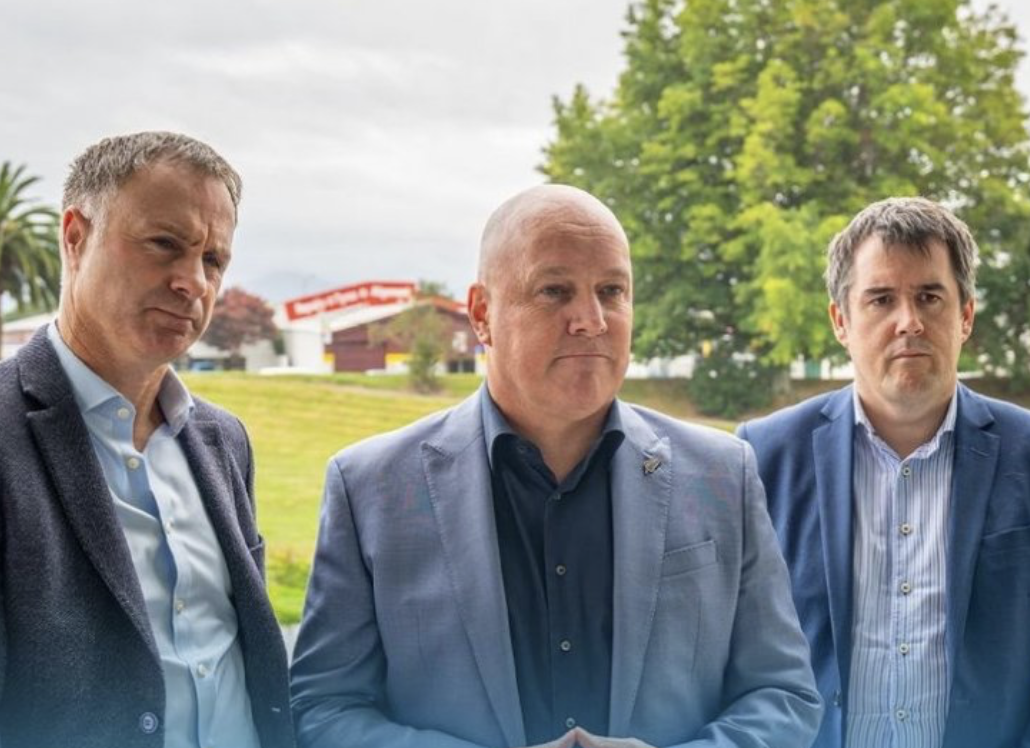
Let’s be very clear as to what this Regional Council shake up is actually about.
It is a gerrymander to rig local elections the same way National are rigging the special votes provisions of the national elections.
It is a sick power grab to privatise local council assets and allow National’s donors to commit whatever environmental vandalism they like to turn a buck.
The real crux of the change is in the voting process that National intend to gerrymander.
There are two voting models being explored.
The first is 5 votes for each new council based on simple majority.
That would be 1 Urban vote, 1 Town vote and 3 Rural votes. If the 3 Rural votes all vote together, they will always win all decisions.
The second voting method is proportional so Urban would have 70%, Town would have 15% and the 3 Rural appointees would have 5% each. In that system, Urban always wins and there is no way National will allow that!
Remember, regardless of which voting system they establish, the Government will still have the power to overturn those decisions anyway.
It is a naked power grab which National will do everything to ensure their rural mates get to rig.
Some will argue I am being unfair on National and that the decision on which voting system will be used hasn’t even been decided yet, but I would point to the way National have gerrymandered special voting for the next election and argue they are rigging the process because they realise they can’t stop the demographic realities of democracy to keep propping up their minority interests any longer and are just naked about their venal self interest now.
National will rig this to ensure their Rural mates always win.
The NZ Left keep underestimating how far this Right Wing Government will go to entrench their privilege.

Increasingly having independent opinion in a mainstream media environment which mostly echo one another has become more important than ever, so if you value having an independent voice – please donate here.
I think that they are doing it the wrong way round.
Abolish district councils and run the regions by Regional councils.
The NZ Left keep underestimating how far this Right Wing Government will go to entrench their privilege.
I think this is right. Your mind can never expand enough to match AI ….. But listen for 33.54 and you will get an idea of how things are. And you can always listen again in a couple of days time, having had time to recover.
Labour has not dared to think too much since ushering in neoliberalism to NZ. That may be too much of a spoonful of medicine to recover from. Just place a bandaid on and hope that it will heal over unseen.
So – regenerative AI acerola style. And think beyond the idealogues in Labour, which has advanced to being represented more by legals than by manual workers, and solicitors and their ilk specialise in the law, which is theoretical and based on mindset. Just as Kiwi mindset has changed, so is the law more fluid than before and what is its moral suasion now or has it any? What effect will AI have on governments – learn more from this acerola link.
https://www.reddit.com/r/antiai/comments/1parr2y/what_does_it_mean_to_be_ai_generated_by_acerola/
(This is long on rates and council services, seemed good stuff that would be helpful. )
Some rational comment from responsible knowledgable New Zealanders or with experience in the wider world. On Councils, Rates, Caps, and Practices, the Future.
https://wellington.scoop.co.nz/?p=176139
Centralism v Localism
December 2, 2025 6 comments
Wellington.Scoop
There’ve been some challenges to the government’s plan to sack regional councillors and replace them with boards of mayors whose task will then be to abolish the regional councils and create “Combined Territories Boards” to replace them.
The most prominent critic is Dame Anne Salmond who sees a threat to local democracy. She writes in Newsroom:
If New Zealand is over-governed, it’s at the level of central government. We could cut the number of ministers and ministries in half, and still be more top-heavy than other countries [of similar size.]…
Other small, successful democracies have far fewer ministries and ministers in central government than in New Zealand, with far more power and resource retained by local communities. Governance is close to the grassroots, and the principles of localism and subsidiarity allow for a high degree of local decision-making……
Scoop’s Gordon Campbell has similar concerns:
This looks like the sort of exercise of centralised state power that we used to regard with horror if we read about it happening in say, Africa or South America. Ironically, the amalgamations being pursued via this blueprint are being promoted by the same political parties that – less than three years ago – were railing against the erosion of local democracy, and the extinction of community voices via the Three Waters reforms. Well, this plan is Three Waters, on steroids…
… This new plan goes far further, in that it aims to centralise power, restrict the role of elected councillors and reduce local community inputs with respect to the entire range of public services.
You may have to sacrifice your holidays (again) if you aim to try and stop it. As happened last year with the Treaty Principles Bill, the period for public submissions on this contentious legislation will straddle the Christmas/New Year holiday period, with the final deadline for public submissions being February 20.
The comments below don’t seem to be able to grapple with the idea much if at all. And giving more power to Mayors so that they are kingmakers in their local communities is not the panacea that the commenters claim. They often are more political than practical and citizen-oriented.
While we can’t do more ourselves as we go into retirement which can last for a third of people’s lives, helped by generous health systems for people virtually whiling their life away at the country’s expense; a point that few discuss is another view from the prism. At present the trend is to stop people doing things voluntarily, Councils wish to be in control by appointing contractors. Contracting out council work and seeming to do less actual work themselves, I don’t know how new ideas fit with that, which I don’t like. Yet they charge higher rates, based on land value, that is being inflated by an unnatural demand excited by central government tax and revenue gaining policies!
That ratepayers also have to pay 15% GST on rates is a questionable matter. We pay taxes to the government and from them services are or were supplied. Rates are just local taxes surely. Central government has introduced a very complicated monetary system that lacks clarity and rationale I think
Local matters aren’t simple and race-based arguments can be divisive, and even ugly.
This is a well reported discussion from New Plymouth from August 2025.
https://www.1news.co.nz/2025/08/14/councillor-kicked-out-of-meeting-after-labelling-policy-racist/
How central government doesn’t want to work with Taranaki region for homeless outdoor sleepers:
https://www.rnz.co.nz/news/national/540778/growing-tension-between-new-plymouth-mayor-and-msd-boss-over-rough-sleepers-revealed
This is an interesting article quoting informed people.
Dec 3/25 https://www.thepost.co.nz/nz-news/360831159/
rates-rises-rubbish-deal-or-necessary-evil
by Julie Jacobson September 26, 2025
(additional reporting by Sinead Gill, Sapeer Mayron)
Some illuminating words and thoughts first from previous New Plymouth mayor Neil Holdom, from experience. Then Craig Renney an economist looked to use the discipline to produce practical outcomes.
The one thing people like less than rate increases is cuts to their local services. We want European-standard services on an American-taxation model.”He notes other OECD countries transfer significantly higher proportions of central taxes to local governments than New Zealand does.
Instead of blunt rate caps, a smarter solution Holdom says, includes benchmarking councils to assess efficiency, and sharing a portion of the GST on new developments to help fund infrastructure.“Without fairer funding, we risk passing on broken pipes, failing roads, and unaffordable debt to our children and grandchildren.”
Craig Renney, an economist at the CTU, points out New Zealand’s rating model works on property, not population. Population (and population need) has risen rapidly over the past decade – yet rateable property hasn’t grown at the same pace.
In faster-growing areas, local authorities face real challenges in delivering services with an inadequate taxation base. Compounding that problem has been years of underinvestment – meaning that many areas are being forced to play catch-up.
Another fly in the ointment has been the increase in debt-servicing costs in line with Reserve Bank interest rates hikes….
…In 2024, councils across the country were responsible for $217 billion worth of assets and employed 39,400 staff. In 2022/2023, they had a collective spending power of $20 billion….
Getting serious about rates means getting serious about the cost pressures that councils are facing. Rather than changing the legislation to narrow councils’ purpose and capping rates, councils need assistance in delivering basic infrastructure.”
Local Government Minister Simon Watts has made it clear the Government will not be supporting new taxes and revenue tools for local authorities until they start delivering real “value for money New Zealanders receive in return for their rates”.
And then there’s Treasury. It suggests underspending by councils over the past three decades as pressure goes on to keep rates low means rates are far lower than they need to be to be considered sustainable.
Both sides, it seems, want reform. What that looks like ‒ and apart from capping suggestions include amalgamation and alternative funding sources such as bed taxes or congestion charging ‒ may well be decided by voters’ ticks come October 11.
A listing on google with surprising wording.
Race briefing: New mayor, new chapter for New Plymouth
The Spinoff https://thespinoff.co.nz › politics › 25-09-2025 › race-b…
25 Sept 2025 — Sadly, the New Plymouth District Council is no longer using poo to encourage people to vote – but a healthy field of nine mayoral candidates …