

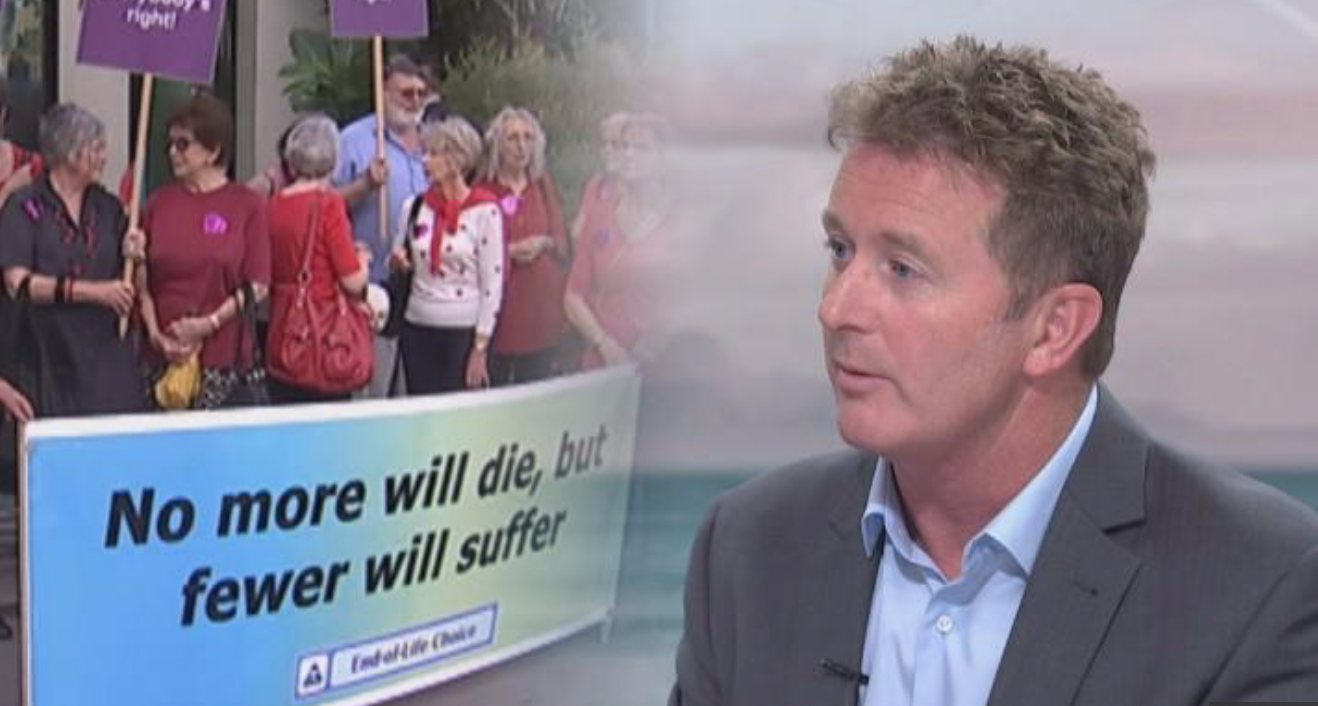
Lawyers have pointed out critical flaws in the amendments proposed by David Seymour to the End of Life Choice Bill he sponsors and have called foul on a number of claims he has made publicly.
Dangerous amendment to Crimes Act (1961)
Amongst the problems with Mr Seymour’s proposed amendments identified by Lawyers for Vulnerable New Zealanders (LVNZ) are the proposal in his Sponsor’s Report to amend the offence of Aiding and Abetting Suicide under s 179 of the Crimes Act (1961) by granting full immunity from criminal prosecution to those who use the Act to aid and abet the assisted suicide or euthanasia of their family members or friends.
“This would afford a viable defence to the very people likely to abusively coerce or pressure their family members into requesting euthanasia or assisted suicide,” says Richard McLeod a spokesperson for LVNZ.
“In order to enable the well-intentioned to assist the capable to easily end their lives, this amendment removes a safeguard that prevents the ill-intentioned from harming the vulnerable.
“It is one thing to give information to a confident person at their request. It’s quite another to leave pamphlets about euthanasia or assisted suicide with a depressed person and say: ‘It’s clear you’re unhappy, but this is not easy for any of us. I brought you another one of these brochures on assisted dying. Like I said, it’s worth thinking about. I’ll help if you like.’ This proposed amendment does not make that distinction. It’s a late, hasty and ill-considered attempt to fix a botched piece of legislation,” says McLeod.
“The ‘Sponsor’s Report’ only exposes more vulnerable terminally ill Kiwis to abuse and coercion, and then goes and grants full criminal immunity to their abusers”, says LVNZ co-spokesperson, Dr Huhana Hickey. “These eleventh-hour, half-baked attempts to fix this Bill only make an already flawed piece of legislation even more dangerous. It’s a Bill for the few that poses grave risks to the many.”
Calling foul on inaccurate claims
In a report published on its website the lawyer’s group, which now numbers over 100 signatories, has challenged many of Mr Seymour’s recent statements. These include his claims about the Bill’s coercion clauses and claims that depressed people won’t meet its competency criteria, that the Supreme Court of Canada has ruled the Bill is “safe”, that overseas assisted dying laws aren’t impacting vulnerable people, and that New Zealand children will not be able to access euthanasia under the Bill.
“Many of these claims are inaccurate or misleading in their effect,” says McLeod. “The Bill’s sponsor may not have intended to mislead, but it’s the effect that matters, not the intention. And that is the same standard we apply to this Bill. The intention may be honourable, but the effect is dangerous.”
Mr Seymour’s Claim:
“[I]f you’re so depressed that you feel that your life is hopeless you’re not going to meet the criteria of being somebody capable of making the decision.”
TVNZ Q+A debate, 1 April
LVNZ Response:*
The Bill only requires that a requesting patient “has the ability to understand the nature of assisted dying and the consequences for them of assisted dying” (section 4(f)).
Mr Seymour’s Claim:
“The Supreme Court of Canada, the Western Australian parliament, the Quebec Select Committee and the Attorney General have all said that the safeguards are adequate and this Bill is consistent with human rights.”
TVNZ Q+A debate, 1 April
LVNZ Response:*
We are not aware of any of these overseas bodies commenting on the End of Life Choice Bill. The following courts and legislatures have analysed euthanasia and assisted suicide regimes and have observed that safeguards are not adequate in protecting vulnerable citizens against the risk of abuse:
• The Courts of the UK including the Supreme Court
• The Courts of Ireland including the Supreme Court
• The European Court of Human Rights
• The United Kingdom Parliament
• The Scottish Parliament
• The National Assembly for Wales
• The Guernsey Parliament
• The Portugese Parliament
• Parliaments of Australian states and territories
• Legislatures of 39 states of the United States
Mr Seymour’s Claim:
Two doctors are required to detect coercion in a patient: “…actually it’s not one doctor, it’s two doctors”.
TVNZ Breakfast, 7 April
LVNZ Response:*
Under the Bill only the first doctor is required to assess whether a patient is being coerced (section 8). The second doctor is not so required (section 11).
Mr Seymour’s Claim:
“There is no evidence after extensive research in all those countries which has found that coercion is an issue.”
TVNZ Breakfast, 7 April
LVNZ Response:*
There is a considerable body of evidence that coercion and abuses have occurred in the few jurisdictions that have legalised assisted dying.
—
“We do not claim that Mr Seymour has deliberately attempted to mislead the public,” says McLeod. “However, many of the statements he has made are simply not accurate or, at best, questionable. On behalf of vulnerable New Zealanders, we think it’s important to set the record straight.”
* The full response to public statements made by the End of Life Choice Bill’s sponsor can be viewed at lvnz.org
The files are also available for download here